The house is quiet, the lights are off, and that’s exactly when your mind decides to get loud. Your heart beats a little too fast, the to-do list starts scrolling, and the clock keeps moving. Anxiety at night can turn bed into the most stressful place in your home, and this guide gives you a full evening-to-morning plan to calm it and sleep better, from the hours before bed to the moment you wake.
✨ Key takeaways
Hold a short worry slot in the early evening, so your thoughts have somewhere to go before bedtime.
Stop tea, coffee and alcohol at least six hours before bed, as the NHS advises for insomnia.
Wind down for at least one hour with low light and calm activities instead of scrolling.
Go to bed only when you feel sleepy, not just because the clock says it’s time.
Keep the same wake-up time after a bad night rather than sleeping in, so your body clock stays steady.
See a doctor if trouble sleeping lasts for months or self-help changes haven’t helped.
Why Anxiety at Night Feels Louder Than in the Day
Anxiety at night feels stronger mainly because the distractions disappear. During the day, work, chores and people take up your attention. Lie down in the dark, and worries finally have the stage to themselves.
At a glance: your evening-to-morning plan
| Time | What usually happens | What to do instead |
|---|---|---|
| Early evening | Worries pile up unsorted | 10-15 minute worry slot at a table |
| 6+ hours before bed | Late coffee or an evening drink | Switch to water or caffeine-free drinks |
| Last hour | Scrolling, work emails, bright screens | Dim lights, bath, book, gentle stretch |
| In bed | Racing thoughts, tight chest | Box breathing, muscle release, a calm image |
| Awake too long | Clock-watching and frustration | Get up briefly, do something calm in low light |
| Next morning | Sleeping in to catch up | Same wake time, daylight, no nap |
The Sleep Foundation notes that people who struggle with worry often ruminate about their concerns in bed. Rumination means going over the same thoughts again and again without reaching an answer. It’s the brain’s way of trying to solve problems, but it picks the worst possible time.
The body side of the problem
Your body joins in, too. When you feel anxious, your heart rate and breathing can speed up, and your muscles tighten. That’s the opposite of what sleep needs, so falling asleep gets harder, and lying awake then makes you more anxious.
This turns into a loop. The Sleep Foundation reports strong evidence that sleep deprivation can trigger or worsen anxiety. A rough night leaves you more on edge the next day, which sets up another anxious evening.
Bed can become a cue for worry
After enough restless nights, your brain starts linking bed with being awake and worried. You might feel sleepy on the sofa, then wide awake as soon as your head hits the pillow. Breaking that link is a big part of easing anxiety at night, and several steps below help with it.
Everyday triggers that turn up the volume
A few common habits make anxiety at night more likely. Check which ones fit your evenings:
- A packed day with no pause. Thoughts you didn’t have time for during the day queue up for bedtime.
- Late caffeine or alcohol. Both can disturb sleep and leave your body on edge.
- Work or news right before bed. One tense email or headline gives your mind something new to chew on.
- An irregular schedule. Going to bed and waking at different times confuses your body clock.
10-15 min
A short daily worry time, often before bed, helps calm racing thoughts.
📝 Note
Night-time worry is common and doesn’t mean something is seriously wrong. If you also wake at 3 a.m. with a racing mind, the guide to waking up at 3am with anxiety covers that pattern in detail.
Early Evening: Give Your Worries an Appointment
The best time to deal with anxiety at night is a few hours before bed. If you sort your worries in the early evening, there’s less left to surface when the lights go out.
The 15-minute worry slot
The NHS suggests a short period, say 10 or 15 minutes, every day or so, to write worries down and look for solutions. It notes that a regular worry time can help calm racing thoughts at bedtime.
Sit at a table, not in bed. Write each worry on its own line. Ask, “Can I do anything about this?” If yes, write the next step and when you’ll do it. If no, write “noted.” When the timer rings, close the notebook.
Short on time? The two-minute version
Busy evenings happen. If you can’t spare 15 minutes, take two. Write the three worries that feel loudest, add one next step to any you can act on, and close the notebook. Even a tiny slot tells your brain that anxiety at night isn’t the only place these thoughts get heard.
Close the day on paper
After your worry slot, jot down tomorrow’s first three tasks. Your brain relaxes when it knows nothing will be forgotten. Then put the notebook somewhere out of the bedroom.
💡 Tip
If money is the worry that keeps showing up after dark, the article on financial anxiety at night gives you a money-specific version of this routine.
Your early-evening handoff
Set a timer for 15 minutes
Sit at a table with a notebook, away from your bed.
Write every worry
One line each, no editing, no judging.
Sort them
Mark “act” or “noted” next to each line.
Plan the “act” list
Write the next step and a time for each one.
Write tomorrow’s top three
Then close the book and leave it outside the bedroom.
Your worries deserve attention, just not at midnight. Give them an appointment, and your bed can go back to being a bed.
beawareofme
The Last Hour: A Wind-Down That Calms Anxiety at Night
The final hour before bed is where you teach your body that the day is over. The NHS advises relaxing for at least one hour before bed, for example with a bath or a book.
Dim the lights, lower the stakes
Turn off big overhead lights and use lamps instead. Choose calm, low-effort activities: reading something light, a warm shower, gentle stretching, folding laundry or listening to quiet music. Skip anything that asks for decisions or stirs strong feelings.
Food and drink in the evening
A heavy meal late in the evening can leave you uncomfortable in bed, while going to bed hungry can keep you awake too. Aim for your main meal a few hours before bed, with a light snack later if you need one. Switch to water or caffeine-free drinks from the afternoon.
The phone question
Screens keep your mind busy with messages, news and endless scrolling. Each one can bring a fresh worry right before bed. Try putting your phone on charge outside the bedroom an hour before sleep.
If that feels too big, start with 20 minutes and build up. The guide on digital curfews has ideas for making the switch stick. And if you find yourself staying up late just to get some me-time, read about revenge bedtime procrastination.
🧭 Try this tonight: your calm last hour
☐Phone on charge outside the bedroom.
☐Overhead lights off, lamps on.
☐Warm shower or bath.
☐Ten minutes of a light book or gentle stretching.
☐Set out tomorrow’s clothes and breakfast.
☐Bed only when your eyes feel heavy.
✨ Quick win
Pick one fixed “lights low” time, like 9:30 p.m., and set a gentle reminder. Doing the same thing at the same time each night helps your body expect sleep.
In Bed: 4 Calming Techniques When Your Mind Starts Racing
Even with a good evening routine, anxiety at night sometimes shows up in bed. When it does, focus on calming your body first, since a relaxed body gives racing thoughts less fuel.
1. Box breathing
The Sleep Foundation describes box breathing as breathing in for four counts, holding for four, breathing out for four and holding for four. Slow, controlled breathing can calm your nervous system. Repeat for two to three minutes.
2. Progressive muscle relaxation
Tense one muscle group for about five seconds, then release it and notice the difference. Start with your toes and work up to your face. The Sleep Foundation notes that tensing and releasing each muscle group in turn can ease physical tension caused by anxiety.
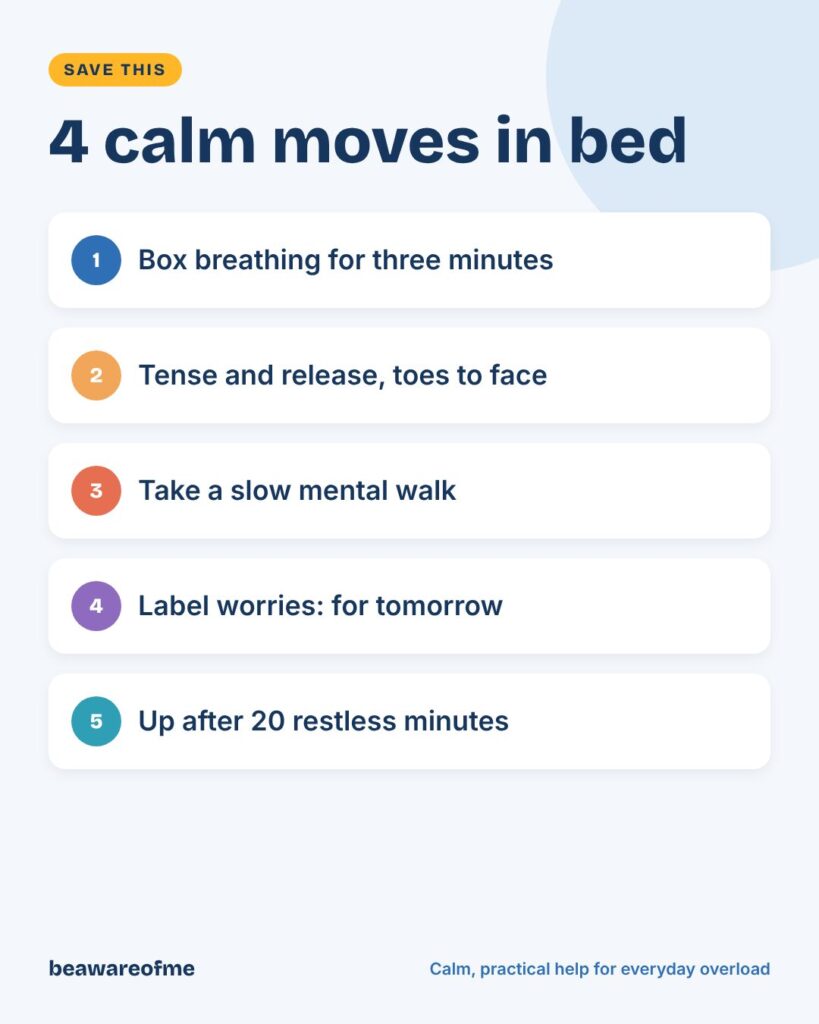
3. A boring mental walk
Picture a familiar, calm route in slow detail, like walking from your front door to a local shop. Notice each step, each door, each tree. The aim is to give your mind something gentle and dull to hold, instead of a worry.
4. The “later” label
When a worry arrives, say silently, “Thank you, that’s for tomorrow’s slot.” You’re not ignoring it. You’re reminding your brain it has a time and place. Then return to your breathing.
For a longer list of bedtime tools, see these ways to calm anxiety at night and relax before bed.
⚠️ Watch out
If you notice chest pain, trouble breathing or a racing heart that feels unusual for you, don’t assume it’s only anxiety. Seek medical help, especially if it’s new.
Still Awake? What to Do After 20 Minutes
Lying in bed fighting sleep usually makes anxiety at night worse. If you’ve been awake for what feels like about 20 minutes, a short break often works better than trying harder.
Get up, keep it dull
Go to another room with low light. Do something calm and a little boring: read a few pages of a paper book, fold towels or sit with a warm caffeine-free drink. Avoid your phone, bright screens and anything that wakes your mind up.
Go back to bed only when you feel sleepy again. The NHS recommends going to bed only when you’re sleepy. Over time, this helps your brain link bed with sleep instead of worry.
Stop watching the clock
Checking the time adds pressure. You start counting how many hours are left and how tired you’ll be. Turn the clock to face the wall, or put your phone out of reach. Not knowing the exact time often makes it easier to drift off.
A two-line script for the middle of the night
When you wake up worried, frustration often does more harm than the worry itself. Keep a short script ready and say it slowly in your head: “This is anxiety at night, and it always passes. My only job right now is to rest my body.”
Rest still counts, even when sleep doesn’t come straight away. Lying quietly with slow breathing is far kinder to your body than an hour of tossing, turning and checking the time. Let that be enough for now.
Lying awake: what helps and what backfires
| If you notice… | Try this | Avoid this |
|---|---|---|
| Racing thoughts | Write one line, say “later,” breathe slowly | Solving the problem in bed |
| Tight chest or shoulders | Progressive muscle relaxation | Tossing and turning for an hour |
| Frustration about not sleeping | Get up for a short calm break | Checking the clock again and again |
| Wide awake after a long break | Read in low light until sleepy | Scrolling your phone |
The Next Morning: Protect Tonight’s Sleep
How you handle the morning after a rough night shapes the next evening. A few simple choices stop one bad night from turning into a pattern of anxiety at night.
Keep the same wake-up time
It’s tempting to sleep in, but the NHS advises against it: stick to your regular sleeping hours instead. Waking at the same time every day keeps your body clock steady, so you feel sleepy at the right time tonight.
Skip the nap, find the light
The NHS also advises not napping during the day when you’re dealing with insomnia. Instead, get outside in daylight, move your body and eat regular meals. If mornings feel heavy with dread, the guide to morning anxiety gives you a calm first-hour plan.
Want to plan a bedtime that fits your wake-up time? The free bedtime calculator helps you work it out. And if your loops run all day, not just at night, see how to quiet overthinking anxiety.
Track one week of nights
Patterns are easier to change when you can see them. For seven days, jot down four things each morning: when you went to bed, roughly how long it took to fall asleep, whether anxiety at night showed up, and what you did in the last hour.
By the end of the week, you’ll often spot a link, such as late scrolling on the worst nights or calmer sleep after a worry slot. Bring this record to your doctor if you decide to get support, since it makes the conversation much easier.
When Night-Time Worry Needs More Than Self-Help
Self-help steps work for many people, but sometimes anxiety at night needs extra support. Knowing when to ask for help is part of looking after yourself.
Signs it’s time to talk to someone
The Sleep Foundation lists struggling to fall or stay asleep at least three nights per week as a warning sign. The NHS suggests seeing a GP if changing your sleep habits hasn’t helped or you’ve had trouble sleeping for months.
- Worry keeps you awake most nights for weeks.
- You feel exhausted or unable to function during the day.
- Anxiety shows up in the day too, not just at night.
- You notice low mood, panic attacks or physical symptoms that worry you.
What support can look like
The Sleep Foundation notes that cognitive behavioural therapy (CBT), a structured talking therapy, can often reduce anxiety even in people who have insomnia. A doctor can also check for other causes of poor sleep. You’ll find more practical guides in the anxiety section of this site.
📝 Note
If your thoughts at night ever turn to harming yourself, please reach out right now. In the US call or text 988, in the UK and Ireland call Samaritans on 116 123, or find a local line at findahelpline.com.
5 Common Mistakes That Keep Anxiety at Night Going
Some habits that feel soothing in the moment actually keep the cycle running. Watch for these five and try the better swap.
1. Using alcohol to wind down
A drink can feel relaxing at first, yet the NHS advises avoiding alcohol at least six hours before bed when you have insomnia. Swap the evening drink for a warm caffeine-free one and a bath.
2. Going to bed early to “catch up”
After a bad night, an early bedtime seems logical. But lying in bed when you’re not sleepy gives worries more time to start. Go to bed only when sleepy, and keep your usual wake-up time.
3. Solving problems in bed
Planning tomorrow while lying down feels productive. In reality, it teaches your brain that bed is a place for thinking. Do your planning at the table in your worry slot, and keep bed for sleep.
4. Scrolling until you feel tired
Many people use their phone to distract themselves until sleep comes. The trouble is that news, messages and bright screens often bring fresh worries. Choose a paper book or calm audio instead.
5. Treating one bad night as a disaster
Telling yourself “tomorrow is ruined” adds a second layer of worry on top of the first. Most people get through a rough day after a poor night better than they expect. Keep your routine steady and let the next night take care of itself.
Anxiety at Night FAQ: Straight Answers for Restless Nights
Why does my anxiety get worse at night?
At night, the distractions of the day fall away, so worries you pushed aside have space to surface. Tiredness can also make emotions feel bigger and harder to manage. A tense body makes sleep harder, and lying awake then adds more worry. An early-evening worry slot and a calm wind-down hour help many people break this pattern.
How can I calm anxiety in bed quickly?
Start with your body. Try box breathing: in for four counts, hold for four, out for four, hold for four, for two to three minutes. Then tense and release each muscle group from your toes to your face. If a worry pops up, label it “for tomorrow” and return to your breathing. Keep your phone out of reach.
Should I get out of bed if I can’t sleep?
If you’ve been lying awake for what feels like about 20 minutes and you’re getting frustrated, a short break often helps. Go to another room with low light and do something calm, like reading a paper book. Return to bed when you feel sleepy. This helps your brain link bed with sleep rather than worry.
Does caffeine affect anxiety at night?
It can. Caffeine can keep your body alert and make it harder to fall asleep, and a racing heart from coffee can feel like anxiety. The NHS advises avoiding tea, coffee and alcohol at least six hours before bed if you have trouble sleeping. Try switching to water or caffeine-free drinks from the afternoon and notice the difference.
How much sleep do adults need?
The NHS says most adults need between 7 and 9 hours of sleep a night. Needs vary from person to person, so how you feel during the day matters more than an exact number. If you regularly feel exhausted despite spending enough time in bed, or you struggle to sleep for months, talk to your doctor about it.
When should I see a doctor about night-time anxiety?
See a doctor if you’ve had trouble sleeping for months, if changing your habits hasn’t helped, or if you struggle to fall or stay asleep at least three nights a week. Also seek help if worry affects your days, your mood or your health. Cognitive behavioural therapy and other support can help with both anxiety and sleep.
Anxiety at night is loud, but it follows a pattern, and patterns can change. Give your worries an early appointment, protect your last hour, and treat bed as a place for rest, and over time your nights can turn quieter and your sleep deeper.
🛟 Please read
Educational content, not a substitute for professional care. If you are struggling, talk to a doctor or a qualified professional. If you are thinking about harming yourself, contact local emergency services or a crisis line now (US 988, UK and Ireland Samaritans 116 123, or findahelpline.com).