Your chest is tight, your mind is running ten tabs, and someone told you to “just write it down.” Fair enough, but write what, exactly? Journaling for anxiety works best when you use a method built for worry, not a blank diary page. This guide gives you six anxiety-specific methods, copy-ready templates, and a seven-day plan to start tonight.
🌱 Key takeaways
Why Journaling for Anxiety Is Not the Same as Keeping a Diary
A diary records what happened, while journaling for anxiety gives worry a container, a shape and an exit. That difference matters, because free writing about fear can turn into rehearsing fear. Anxious minds tend to loop, and an open page lets the loop run on paper too.

Here is the whole guide in one table. Find the row that sounds like you and jump straight to that method.
| If your anxiety looks like… | Try this method | Time needed |
|---|---|---|
| Worries popping up all day | The 15-minute worry window | 10-15 min, once a day |
| One fear that feels huge | The thought record | 10 min |
| Catastrophic what-if chains | Worst, best, most likely | 5 min |
| Problems you could actually fix | The worry tree | 10 min |
| Racing heart, tight stomach | Trigger and sensation log | 3 min |
| A mind that only sees threats | The positive affect page | 15 min, 3 times a week |
What Structure Does That a Blank Page Can’t
Structure gives your brain a job. Instead of “how do I feel?”, you answer narrow questions like “what is the evidence?” or “can I act on this today?” Narrow questions slow the spiral down. They also leave you with something useful at the end, such as a plan, a calmer thought, or a pattern you can spot.
The University of Rochester Medical Center notes in its guide to journaling for emotional wellness that writing can help you prioritise problems and track symptoms day to day, so you can recognise triggers. That is exactly what anxiety-specific templates do. They turn vague dread into data.
💡 Good to know: You do not need a special notebook. A notes app, index cards or the back of an envelope all work. The template matters far more than the paper.
Match Your Anxiety to a Method in 30 Seconds
The fastest way to make journaling for anxiety work is to pick a method that fits how your worry actually behaves. Most people grab generic prompts, then feel worse when nothing changes. Instead, notice your pattern for two days first, then choose your journaling for anxiety method.
The Three Anxiety Patterns Most People Recognise
- The drip: small worries arrive all day, about emails, health, money or what someone meant. Use the worry window.
- The flood: one fear takes over and feels completely true. Use the thought record or the worst, best, most likely page.
- The body alarm: you feel it before you think it, through a racing heart, shallow breath or a knotted stomach. Use the sensation log.
Many people have all three on different days. That’s fine, and journaling for anxiety can flex with you. Keep the six templates on one page and choose based on what is loudest right now. If you are not sure which kind of worrier you are, the free what kind of worrier are you self-check can help you name it.
When Journaling Is Not the Right Tool Right Now
Writing is a thinking tool, so it works poorly at the peak of panic. If your heart is pounding and your thoughts are scattered, calm your body first. Slow breathing or one of these grounding techniques for anxiety will bring you down enough to hold a pen.
⚠️ Watch out: If writing about a topic makes you feel steadily worse after several sessions, stop and switch methods. Journaling for anxiety should leave you a little lighter, not more shaken.
Method 1: The 15-Minute Worry Window
A worry window is a short, fixed time each day when you write down worries on purpose, so they stop interrupting the rest of your day. The NHS describes this approach in its Every Mind Matters guide to tackling worries, suggesting a period of “say 10 or 15 minutes” to write worries down and look for solutions.
How the Worry Window Works Day to Day
During the day, a worry shows up. You jot two or three words on a list, then tell yourself, “Not now, at 6:30.” Later, you sit down for your window and work through the list. Many worries look smaller by then. Some have already sorted themselves out. This is journaling for anxiety at its simplest.
Pick a time that is not right before sleep for you, if bedtime tends to be when your mind races. Early evening suits many people. Set a timer and stop when it rings, even mid-sentence.
☀️ Try this today: your worry window template
☐ Time and place of my window: ______ (same every day)
☐ Worries I parked today: list them in a few words each
☐ For each one: is this a real problem now, or a what-if?
☐ One thing I can do about it, and when
☐ Closing line: “Window closed. I can come back tomorrow.”
If a Worry Will Not Wait
Some worries feel urgent. Ask, “Can I act on this in the next hour?” If yes, act. If not, it goes on the list. Postponing is a skill, and it gets easier after a week of practice.
✨ Small step: Keep your parked-worries list on your phone lock screen or a sticky note. The act of writing two words is often enough to loosen a worry’s grip.
Method 2: The Thought Record That Talks Back to Fear
A thought record is a simple table that lets you catch an anxious thought, check it against the facts, and write a more balanced version. It comes from cognitive behavioural therapy, or CBT, which is a talking therapy that looks at how thoughts, feelings and actions connect. You can use the basic format on your own as part of journaling for anxiety.
The Five Columns, Filled In
Here is a worked example so you can see how the columns fit together. Copy the layout into your notebook and fill it in the next time one worry takes over.
| Column | What you write | Example |
|---|---|---|
| Situation | Where, when, who | Boss sent “Can we talk tomorrow?” at 5pm |
| Anxious thought | The exact sentence in your head | “I’m in trouble. I might lose my job.” |
| Feeling (0-100) | Name it and rate it | Dread, 85 |
| Evidence for and against | Facts only, both sides | For: short message. Against: good review last month, she often books chats this way |
| Balanced thought (re-rate) | A fairer sentence | “I don’t know what it’s about. Most of her chats are routine.” Dread, 40 |
Questions That Help When You Get Stuck
- What would I say to a friend who wrote this thought?
- Have I been in a similar spot before, and how did it actually go?
- Am I treating a feeling as a fact?
- What is one other way to explain this?
The goal is not to force a happy thought. It is to find a sentence that is more accurate. A drop from 85 to 40 is a real win, even if some worry stays. That is how journaling for anxiety builds trust over time.
Method 3: Worst, Best and Most Likely on One Page
This five-minute page interrupts catastrophic thinking, which is the habit of jumping straight to the worst possible outcome. You write three short versions of the future, then a plan for the most realistic one. It is the quickest page in this journaling for anxiety toolkit.
Write the disaster your mind keeps showing you, in one or two lines.
Write the best realistic outcome, even if it feels unlikely right now.
Write what would probably happen, based on past experience.
List two things you would do to cope and one person you could call.
Choose one small action that prepares you for the most likely outcome.
People are often surprised by step four. Writing a coping plan for the worst case can make it feel less frightening, because you can see that you would still have options. If you tend to replay these chains at night, our guide to stopping overthinking for anxiety relief pairs well with this page.
Anxiety asks “what if?” A good page answers “then what, and what would I do?”
— beawareofme
Method 4: Draw the Worry Tree and Sort Every Worry
A worry tree is a short decision path that sorts each worry into “I can act on this” or “I can’t control this,” and tells you what to do next. The NHS page on tackling worries uses this tool to help people separate practical problems from hypothetical ones.
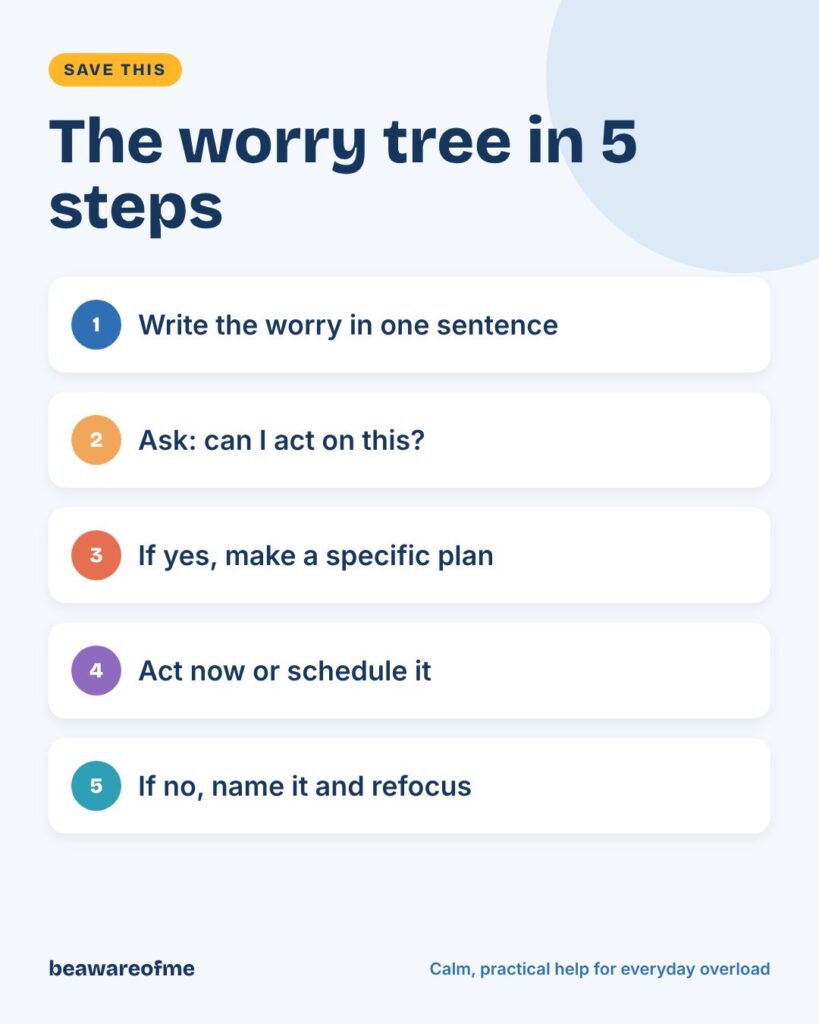
The Questions on Each Branch
Write it as one clear sentence.
If no, go to step 5. If yes, keep going.
What, how and when. Be specific.
Do it today, or put it in your calendar.
Name it as a what-if, then turn your attention to something in front of you.
Practical Worry or Hypothetical Worry?
A practical worry has a next step, such as “I haven’t paid the electricity bill.” A hypothetical worry has none, like “What if something terrible happens to my family one day?” Both feel equally loud. Only one of them deserves a plan, and journaling for anxiety helps you tell them apart.
For hypothetical worries, the NHS suggests accepting that you can’t act on them and moving your focus elsewhere, through distraction, relaxation or clearing your mind. That last step is where a short walk, a chore or a breathing exercise helps.
📝 Note: Money worries often feel hypothetical but contain a practical branch, like checking one balance or calling one provider. If late-night money thoughts are your pattern, see our guide to financial anxiety at night.
Method 5: The Trigger and Sensation Log for Body Anxiety
A sensation log tracks what your body did, what happened just before, and what helped, so you can spot patterns over a week or two. It suits people whose anxiety shows up physically first. It takes about three minutes per entry.
Your Three-Minute Log Template
| Field | What to note | Example |
|---|---|---|
| Time | When it started | Tue, 10:40am |
| Body | Where and how strong (0-10) | Tight chest, 6 |
| Before it | Place, task, food, caffeine, sleep | Second coffee, big meeting at 11 |
| Thought | Any sentence in your head | “I’ll freeze when it’s my turn” |
| What helped | Anything that eased it | Walked to the kitchen, slow breathing |
What to Look for After Seven Days
Read your log on day seven. Circle anything that repeats. Common patterns include short sleep, a second or third coffee, skipped meals, a particular meeting or person, and late-night phone use. You may also notice what reliably helps. Few forms of journaling for anxiety give you such concrete clues.
Patterns give you choices. If every high-rated entry follows less than six hours of sleep, sleep becomes your first target. Our guide to anxiety at night and sleeping better explains why that link is so strong.
⚠️ Watch out: Physical symptoms such as chest pain, breathlessness or dizziness deserve a check with a doctor, especially if they are new or severe. A log is a great thing to bring to that appointment.
Method 6: The Positive Affect Page, Backed by a Trial
Positive affect journaling means writing about things that went well, things you are grateful for, or strengths you used, in a structured way. It does not deny anxiety. It widens the lens so threats are not the only thing your mind records. Think of it as the balancing page in journaling for anxiety.
15 min
Length of each positive affect journaling session in a randomised trial of 70 adults.
JMIR Mental Health, via PMC
3 days
Sessions per week across a 12-week program.
JMIR Mental Health, via PMC
1 month
Point at which journaling was linked with less anxiety than usual care.
JMIR Mental Health, via PMC
In that randomised trial published in JMIR Mental Health, adults with medical conditions and raised anxiety used web-based positive affect journaling. The program was linked with less anxiety after one month compared with usual care, plus less mental distress than at baseline. It was a small study, so treat it as encouraging, not as proof.
Five Prompts for Your Positive Page
- Something small that went better than I expected today was…
- A moment I felt even slightly calm or safe was…
- A strength I used today, even if nobody noticed, was…
- Someone who made my day easier, and how…
- One thing I’m looking forward to this week is…
💡 Good to know: Specific beats grand. “The bus came on time and I got a window seat” works better than “I’m grateful for my life,” because your brain can actually picture it.
Your 7-Day Journaling for Anxiety Starter Plan
This one-week plan lets you test journaling for anxiety without overthinking which method to choose. Each day takes 15 minutes or less, and you finish the week knowing which tools suit you.
Park worries all day, then spend 10 minutes on the list in the evening.
Pick the loudest worry and fill in all five columns.
Run three worries through the branches and schedule one action.
Log every body alarm today, even small ones.
Use it on something coming up this week.
Answer three of the five prompts in detail.
Reread the week. Circle which method helped most and keep that one.
How to Make the Habit Stick
Attach your session to something you already do, like after dinner or with your first tea. Keep the notebook where you will see it. If you miss a day, simply pick up the next one, because consistency over weeks matters more than a perfect streak.
Prefer more open-ended writing once the week is done? Our broader guide to journaling for mental health covers general prompts, while these journaling prompts for high-functioning anxiety suit people who look calm on the outside but race on the inside.
✨ Small step: Finish every entry with the same line: “One thing I can do next is…” That habit alone turns journaling for anxiety from venting into progress.
5 Common Mistakes That Make Anxiety Journaling Backfire
Most journaling mistakes come from writing too long, too vaguely, or at the wrong moment. Each one is easy to fix once you can see it, and fixing them makes journaling for anxiety far more useful.
1. Writing Until You Feel Better
Open-ended sessions can turn into an hour of rehearsing every fear. That is rumination with a pen. Instead, set a timer for 10 to 15 minutes and stop when it rings.
2. Journaling in Bed at Midnight
Bed then becomes the place where worries get processed, so your mind starts doing it every night. Instead, hold your main session earlier. Keep a small pad by the bed only for a two-line dump if a thought won’t leave.
3. Forcing a Positive Ending Too Soon
Writing “Everything is fine!” over a real fear feels fake, and your brain knows it. Instead, aim for a more accurate thought, not a cheerful one. “I don’t know yet” is often the honest answer.
4. Switching Methods Every Day
Trying a new prompt list every evening means no method gets a fair test. Instead, use one template for at least seven days, then compare how you felt before and after.
5. Rereading Old Entries When You Are Already Anxious
Scrolling back through weeks of worries on a bad day can pile them on top of each other. Instead, review on a calm day, once a week, and look for patterns rather than reliving the content.
📚 Keep reading
Journaling prompts for mental healthStop overthinking and relax your mindCalm anxiety at nightMore on anxietyJournaling for Anxiety: Your Questions Answered
Does journaling for anxiety really work?
Journaling for anxiety can help many people feel calmer and think more clearly, especially when they use a structured method rather than free writing. A small randomised trial found that 15-minute positive affect journaling sessions, three times a week, were linked with lower anxiety after one month. It works best alongside sleep, movement and support, and it is not a replacement for professional care.
How long should I journal for anxiety each day?
Ten to fifteen minutes is enough for most people. The NHS suggests a worry period of about 10 or 15 minutes, and longer sessions can slide into rumination. Set a timer, work through your template, and stop when it rings. Short, regular sessions across several weeks tend to help more than occasional long ones written in a rush of worry.
What should I write in an anxiety journal?
Write in a set format instead of a stream of thoughts. Useful options include a list of parked worries, a thought record with evidence for and against, a worry tree that splits solvable problems from what-ifs, a body sensation log, or a short page of specific good moments. End every entry with one small next action or a calming line.
Is it better to journal in the morning or at night for anxiety?
Either can work, so choose the time when you can sit quietly for 15 minutes. Many people prefer early evening, because it clears the day without bringing worries into bed. If mornings are your hardest time, a short worry list after breakfast can help. Avoid long sessions right before sleep if your mind tends to race at night.
Can journaling make anxiety worse?
It can, if sessions turn into long, repeated rehearsals of the same fears. Signs include feeling more shaken after writing, or rereading old worries over and over. Shorter, structured sessions with a clear ending usually fix this. If writing about a specific topic keeps upsetting you, stop and talk it through with a doctor or qualified professional instead.
Should I type or handwrite my anxiety journal?
Both work, so choose the option you will actually use. Handwriting slows you down, which some people find calming. Typing is faster and easier to keep private on a locked phone. The structure of your template matters more than the format. If you type, turn off notifications first so messages do not interrupt the session and add new worries.
Journaling for anxiety is not about writing more. It is about writing with a shape: a window, a table, a tree or a short good-things page that leaves you with a next step. Choose one method tonight, give it seven days, and let the page carry some of the weight your mind has been holding alone.
📝 Please read: Educational content, not a substitute for professional care. If you are struggling, talk to a doctor or a qualified professional. If you are thinking about harming yourself, contact local emergency services or a crisis line now (US 988, UK and Ireland Samaritans 116 123, or findahelpline.com).