

You jolt awake. Heart pounding. The clock says 3:14 AM and your brain is already running through every problem in your life like a slot machine spinning bad news. If you wake up at 3am with anxiety almost every night, you’re not broken — you’re caught in one of the most predictable physiological events in human biology. This article walks you through exactly why it’s happening, what’s actually going on inside your body at that hour, and how to disable the trigger.

You wake up at 3am with anxiety because your body’s cortisol production naturally begins rising in the early morning hours, just as melatonin drops and you transition into lighter, REM-heavy sleep. When this hormonal shift collides with stress, low blood sugar, or an overactive nervous system, your brain interprets the rising arousal as a threat and pulls you fully awake. It’s not random. It’s the cortisol awakening response triggering several hours too early.
Key Takeaways
- The 3 AM wake-up sits on a specific hormonal handoff: melatonin dropping while cortisol begins climbing toward its morning peak.
- REM sleep dominates the second half of the night, which makes you four to five times more likely to wake from emotional or anxious dreams between 2 and 4 AM.
- A blood sugar dip from late dinners, alcohol, or a low-carb evening can trigger an adrenaline release that mimics — and amplifies — anxiety.
- Checking the clock when you wake creates a conditioned anxiety loop your brain learns to repeat at the same time every night.
- The fastest path back to sleep isn’t trying harder. It’s lowering your physiological arousal first and letting sleep return on its own.
- Persistent 3 AM wakings combined with daytime fatigue or low mood may signal HPA axis dysregulation that’s worth addressing properly.
What’s Actually Happening at 3AM (The Cortisol Awakening Response Explained)
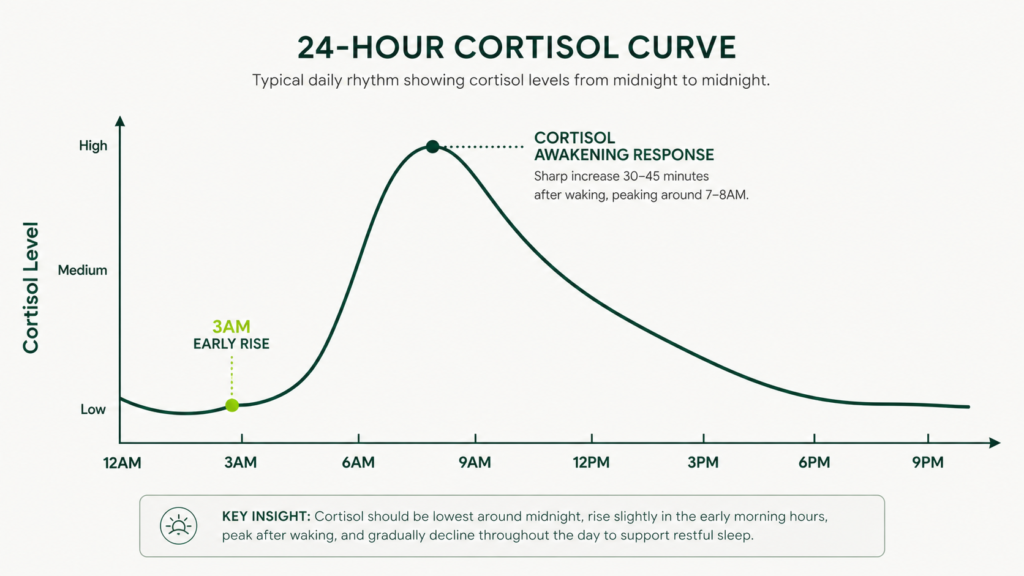
This section covers the specific biological event behind your 3 AM wake-up — and why it’s both completely normal and completely fixable.
Cortisol gets a bad reputation, but it’s the hormone that’s supposed to wake you up. Your adrenal glands run on a 24-hour rhythm called the diurnal cortisol curve. Levels are lowest around midnight, start climbing slowly between 2 and 4 AM, then surge sharply in the 30 to 45 minutes after you naturally wake. That surge is the cortisol awakening response, or CAR, first formally described by researchers Pruessner, Wüst, and colleagues in the late 1990s.
Here’s the part most articles miss. The CAR doesn’t cause your 3 AM wake-up by itself. The slow pre-waking rise does. By around 3 AM, your cortisol has already started its climb. If your stress baseline is elevated — chronic work pressure, unresolved conflict, financial worry, grief — your cortisol curve doesn’t sit politely below the waking threshold. It overshoots. The early rise wakes you several hours before your alarm and dumps you into consciousness with your nervous system already half-mobilised.
Add the fact that your prefrontal cortex — the rational, logical part of your brain — is the last region to come fully online when you wake, and you’ve got the perfect setup for catastrophic thinking. The amygdala, your emotional alarm centre, is fully active. The brake pedal isn’t. So minor worries feel like five-alarm fires.
This is why 3 AM thoughts feel uniquely terrifying and rarely match daytime reality. The same money problem you handle calmly at 2 PM becomes a death-spiral at 3:14 AM, because at 3:14 AM you don’t have access to the part of your brain that does perspective.
Why 3AM Specifically? The Sleep Cycle and Hormone Cocktail
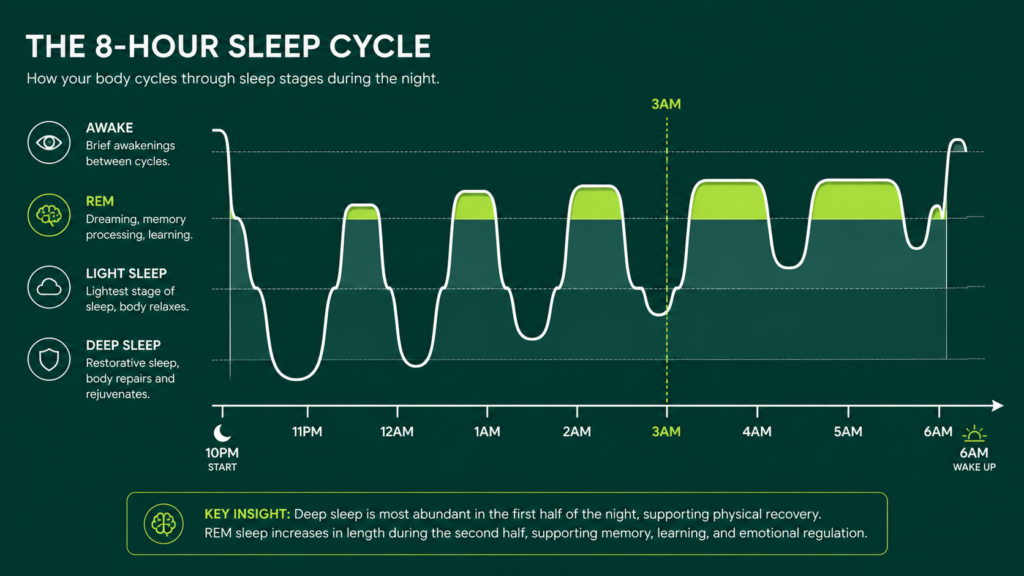
This section explains why the 3 AM mark is so suspiciously consistent across millions of anxious sleepers.
A typical night runs in 90-minute sleep cycles. You drop into deep slow-wave sleep early in the night — that’s when growth hormone releases and physical recovery happens. As the night progresses, the cycles shift. Deep sleep gets shorter. REM sleep gets longer. By the time you’ve completed three to four cycles (roughly 4.5 to 6 hours after sleep onset), most of your remaining sleep is REM.
If you went to bed between 10 and 11 PM, that puts you in REM-heavy territory at — you guessed it — around 3 AM.
REM is the stage where your brain processes emotional memories. Your eyes move under your eyelids. Your heart rate becomes variable. Vivid dreams happen here, including anxious ones. You’re also closer to the surface of consciousness in REM than you are in deep sleep, which means it takes far less to wake you. A noise outside. A partner moving. An emotionally charged dream. Or — most commonly — your own rising cortisol.
There’s also a temperature drop happening. Your core body temperature hits its 24-hour low around 4 AM, then begins rising. The transition is subtle, but it nudges your nervous system toward arousal.
So at 3 AM you have: cortisol rising, melatonin falling, body temperature shifting, REM sleep dominant, and your prefrontal cortex offline. It’s not a coincidence. It’s a setup.
Different types of 3 AM wakings can look identical from the outside but have very different causes. Knowing which one you’re dealing with changes what fixes it.
| Type of Wake-Up | Typical Trigger | What It Feels Like | Likely Root Cause |
|---|---|---|---|
| Anxiety wake | Cortisol rising on a stressed baseline | Heart racing, racing thoughts, can’t return to sleep | HPA axis activation |
| Blood sugar wake | Liver glycogen depletes, adrenaline spikes | Sudden alertness, sweating, hunger | Late dinner, alcohol, low-carb evening |
| REM/dream wake | Vivid or anxious dream pulls you out | Emotional residue, racing pulse | Heavy emotional processing, REM rebound |
| Hormonal wake | Estrogen and progesterone shifts | Hot flash, sweat, sudden alertness | Perimenopause, luteal phase |
| Sleep apnea wake | Brief breathing pause | Gasp, dry mouth, may not remember | Airway obstruction (often undiagnosed) |
Most chronic 3 AM wakers are dealing with two or three of these stacked on top of each other. The good news: addressing the most common one — the cortisol-and-stress combination — usually softens the others too.
The Blood Sugar Connection Most Articles Miss

This section covers the metabolic side of nighttime wakings. It’s the part most “anxiety at 3am” articles skip entirely.

Understanding why it happens doesn't make it stop.
You can know exactly what your nervous system is doing at 3 a.m. and still be awake at 3 a.m. Reading is where it starts. The Calm Reset Bundle is the part where you do something about it.
See the bundle →Your liver stores glucose as glycogen and slowly releases it through the night to keep your brain fed while you sleep. If your dinner was small, late, low in carbohydrates, or paired with alcohol, your glycogen stores can dip too low somewhere between 2 and 4 AM. Your body responds by releasing the only hormone it has on standby for this situation — adrenaline (technically epinephrine), followed by a cortisol pulse to mobilise stored energy.
You wake up. Heart pounding. Wide-eyed. Convinced something is wrong.
Nothing is wrong. Your body just thinks you’re starving and politely woke you up to do something about it. The problem is that adrenaline feels identical to anxiety, and your sleep-fogged brain will absolutely look for a reason to justify the panic. It will find one. Within seconds you’ll be reviewing your tax return, your relationship, or that thing you said in 2014.
Alcohol amplifies this dramatically. A single drink shortens REM early and produces a rebound effect 4 to 6 hours later, which is why two glasses of wine at 8 PM puts you flat on the floor at 3:30 AM. Studies in Alcoholism: Clinical and Experimental Research have repeatedly shown alcohol disrupts sleep architecture in the second half of the night even at moderate doses.
The fix isn’t dramatic. A small protein-and-fat snack before bed — half a banana with almond butter, a spoonful of Greek yogurt, a handful of nuts — keeps your liver’s overnight job manageable. This single change has cleared up 3 AM wakings for a startling number of people, especially anyone in their 30s and 40s who started intermittent fasting and noticed their sleep got worse.
If your wakings come with sweating, sudden hunger, or shakiness, blood sugar is almost certainly part of the picture.
How to Stop Waking Up at 3AM With Anxiety (The Prevention Stack)

This section gives you the daytime habits that actually move the needle. Not the recycled “good sleep hygiene” tips that ignore the cortisol issue.
Start with light. The single biggest signal your circadian rhythm uses to set your cortisol curve is sunlight in the first 60 minutes after you wake up. Work from Andrew Huberman’s lab at Stanford and earlier research by Charles Czeisler at Harvard both reinforce this. Five to ten minutes of outdoor light in the morning anchors your cortisol peak to the right time of day, which means it stops creeping into 3 AM.
Cap caffeine at noon. Caffeine has a half-life of around 5 to 6 hours. A coffee at 4 PM still has 25% of its dose circulating at midnight, keeping cortisol elevated and adenosine suppressed. Most people don’t feel “wired.” Their nervous system is still on a low simmer.
Understanding why it happens doesn't make it stop.
You can know exactly what your nervous system is doing at 3 a.m. and still be awake at 3 a.m. Reading is where it starts. The Calm Reset Bundle is the part where you do something about it.
See the bundle →Front-load your day with movement, not your evening. Hard workouts after 7 PM can spike cortisol for hours. Morning or early-afternoon exercise lowers your overall cortisol baseline within two to three weeks.
Build a worry window. Set 15 minutes during the day — pick the time, write it on your calendar — to write down everything you’re worried about and one tiny next step for each. This technique comes from cognitive behavioural therapy for insomnia (CBT-I), which has stronger evidence than any sleep medication. Your brain stops bringing worries to you at 3 AM because it knows there’s a designated time to address them.
Cool the bedroom. 17 to 19°C (63 to 67°F) is the sleep sweet spot. Most people sleep too warm and don’t realize it.
Eat protein at dinner. Skip the bedtime alcohol. If you’re going to drink, finish at least three hours before bed and drink a full glass of water for every alcoholic one.
These six habits stack. Each one alone trims a small percentage off your cortisol load. Together they often shut the 3 AM wake-up down within two to four weeks.
What to Do When You Wake Up at 3AM With Anxiety (The In-the-Moment Toolkit)

This section is the protocol you’d want if you woke up right now with your heart pounding.
Don’t check the clock. The single most damaging habit is glancing at the time. Your brain learns the number. It conditions itself to wake up to that exact number every night. Cover your clock. Turn your phone face-down. The information helps nothing.
Understanding why it happens doesn't make it stop.
You can know exactly what your nervous system is doing at 3 a.m. and still be awake at 3 a.m. Reading is where it starts. The Calm Reset Bundle is the part where you do something about it.
See the bundle →Don’t fight it. The harder you try to sleep, the more you activate the prefrontal cortex you’re trying to quiet. Paradoxical intention — actively trying to stay awake — works better than trying to sleep. Tell yourself you’re going to lie there, eyes closed, body still, but you’re not allowed to sleep. Most people are out within 10 minutes.
Slow the exhale first. Use a long out-breath. The 4-7-8 method (inhale 4 seconds, hold 7, exhale 8) is popular, but the simpler version — just make your exhale twice as long as your inhale — does the same job. Long exhales activate the vagus nerve and pull your nervous system out of sympathetic dominance.
Use cognitive shuffling. This is a research-backed technique developed by cognitive scientist Luc Beaudoin at Simon Fraser University. Pick a random word — say, “lemon.” Now think of words that start with L: lake, lantern, ladder, lullaby. Visualize each one briefly. When you run out, move to E. The exercise mimics the random associative thinking your brain does as it falls asleep, and it short-circuits rumination because your brain can’t ruminate and free-associate at the same time.
If you’re still awake after 20 minutes, get up. This is counterintuitive but evidence-based. Lying in bed awake teaches your brain that bed equals anxiety. Get up. Sit on the couch under a dim light. Read something deeply boring. Go back to bed when you feel sleepy. CBT-I calls this stimulus control, and it’s one of the most effective insomnia interventions in the published literature.
Don’t reach for your phone. The blue light suppresses melatonin and the dopamine hit of scrolling will wake you up further. If you absolutely must look at a screen, use the lowest brightness and stick to text — no video, no social feeds, no email.
When 3AM Wakings Signal Something More
This section covers the line where this stops being a temporary nuisance and starts pointing at something worth a closer look.
Three or four nights a week of 3 AM wakings, lasting more than three months, with daytime fatigue or persistent low mood, fits the clinical picture of chronic insomnia. The American Academy of Sleep Medicine treats this as its own condition — not a symptom of something else.
Pay attention if you also notice morning headaches, dry mouth, or your partner reporting that you snore or stop breathing. Sleep apnea is wildly under-diagnosed, particularly in women, and one of its hallmark patterns is exactly this: repeated brief wakings in the second half of the night.
If you’re a woman in your late 30s or 40s and the wakings started suddenly, look at perimenopause. Estrogen and progesterone both drop progressively in the years before menopause, and progesterone — which has a calming, GABA-like effect on the brain — is often the first to go. The 3 AM wake during perimenopause is so consistent it’s a textbook symptom.
If you’re recovering from grief, trauma, a breakup, or burnout, the 3 AM wake can hang around for months even after you feel “fine” during the day. Your nervous system processes things on its own timeline, and it tends to do that work in the second half of the night.
A short course of CBT-I with a trained therapist outperforms sleep medication in head-to-head trials. It’s available online through several validated programs (Sleepio and CBT-I Coach are widely cited in the research), takes 6 to 8 weeks, and the results stick after treatment ends. That last part is the difference between fixing the problem and managing it forever.
Common Mistakes People Make With 3AM Anxiety Wakings
These are the mistakes I see most often in people who’ve been trying to fix this for a while and haven’t gotten anywhere.
Doubling down on sleep tracking. Watching your Oura ring score plummet creates a feedback loop where you stress about sleep, which causes worse sleep. Researchers have actually given this a name: orthosomnia. If your sleep tracker is making you anxious, take it off for two weeks and see what happens. Most people sleep better.
Using cannabis or melatonin to “fix” it. Both can help you fall asleep, but neither addresses the cortisol issue. Cannabis suppresses REM (you’ll feel the rebound when you stop, often as more vivid 3 AM wakings). Melatonin doses sold in stores are typically 5 to 20 times what your body actually produces. Lower doses (0.3 to 0.5 mg) work better for most people than the standard 5 to 10 mg gummies.
Skipping dinner because you “shouldn’t eat late.” This is one of the most common drivers of 3 AM wakings I see. Eating too little in the evening — especially after a hard workout or on a low-carb day — sets up the blood sugar crash described earlier. The advice to “stop eating after 6 PM” is not universally true and is actively harmful for people with this wake pattern.
Trying to nap to “catch up.” A long nap after 3 PM steals adenosine pressure from your nighttime sleep drive and makes 3 AM wakings more likely the following night. Keep naps under 25 minutes and finish them before 2 PM.
Treating it as purely psychological. “Just calm your mind” doesn’t work because the trigger is often physiological — cortisol, blood sugar, hormones, temperature. Address the body and the mind quiets on its own. People who only do meditation or therapy without changing their evening routine often stay stuck for months.
FAQ
Why do I always wake up at exactly 3am? The 3 AM hour is when several biological events overlap: cortisol begins its pre-waking rise, melatonin drops, REM sleep peaks, and your core body temperature starts climbing. If your nightly schedule is consistent, your body hits all of these markers at roughly the same clock time every night, which is why the wake-up feels eerily punctual. The exact minute drifts a little — 2:47, 3:14, 3:32 — but the window stays the same.
Is waking up at 3am a sign of depression? It can be. Early-morning waking — particularly between 3 and 5 AM with an inability to return to sleep — is a classic symptom of major depression, separate from anxiety-driven insomnia. If you’re also experiencing low mood, loss of interest in things you used to enjoy, or fatigue lasting more than two weeks, speak with a doctor or therapist about screening. The 3 AM wake on its own isn’t enough to diagnose anything.
How do I get back to sleep when I wake up at 3am with anxiety? Don’t check the clock, don’t reach for your phone, and don’t try to force sleep. Slow your exhale to twice the length of your inhale for two minutes, then run the cognitive shuffling exercise (random words, one letter at a time, visualised briefly). If you’re still awake after 20 minutes, get up, sit somewhere dim, and read something boring until you feel sleepy. Then return to bed.
Does magnesium help with 3am wake-ups? Magnesium glycinate (200 to 400 mg before bed) helps some people, particularly those who are deficient — which is a surprising number of adults eating standard Western diets. It supports GABA activity and can soften nighttime arousal. It won’t fix a circadian rhythm or hormonal issue on its own, but it can take the edge off mild wakings. Glycinate is gentler on digestion than oxide or citrate, which tend to cause loose stools.
Can low blood sugar cause anxiety at night? Yes. When your liver’s overnight glucose supply runs low, your body releases adrenaline to mobilise stored energy. Adrenaline produces sensations identical to anxiety — racing heart, alertness, dread — and your half-asleep brain naturally invents a reason for the feeling. A small protein-and-fat snack before bed (Greek yogurt, nut butter, eggs) often resolves this within a few nights. If your wakings come with sweating or hunger, this is almost certainly the cause.
How long does it take to fix this pattern? Most people see meaningful improvement in 2 to 4 weeks once they address the obvious triggers — caffeine timing, alcohol, dinner size, morning light, worry window. Deeper hormonal or HPA-axis issues take 8 to 12 weeks to settle. If you’re not noticing any change after a month of consistent effort, it’s worth speaking with a sleep specialist or running a basic salivary cortisol panel to see what your curve actually looks like.
Closing
Most people who wake up at 3am with anxiety treat the symptom — the racing thoughts, the dread, the spiralling — and ignore the cause. The cause is almost always physiological: a misfiring cortisol curve, an empty fuel tank, or a nervous system that’s been running too hot for too long. Fix the body’s rhythm and the 3 AM thoughts lose their power source. Tonight, before you sleep, pick one thing from this article — the worry window, the bedtime snack, the morning light — and start there. That’s the first domino.

Quiet the noise — without burning your phone in a field.
Get Beat Information Overload free, plus the occasional calm, no-hype note from me.