



How Lonely Am I Really?
A gentle check on your people, your contact and your alone time. You get a picture of where connection is strong, where it has gone quiet, and small steps to start.
Anonymous. Different questions each time. A general structure for everyday life, not medical or psychological advice.
You can be busy all week, surrounded by people, and still feel like nobody really knows how you are. This page helps you see which part of connection has gone quiet, and gives you small, doable ways to let people back in.
Each answer adds points to Close people, Contact, Being seen, Belonging, Energy for people and Alone time. Your result reads the strongest areas and turns them into a named pattern, a chart, three small steps and the guides that fit. Questions change every time you play.
How Lonely Am I Really: what is really going on
Loneliness is the gap between the connection you have and the connection you need. It is not the same as being alone. Some people live alone and feel fine. Others share a home, an office and a group chat, and still feel unseen. Loneliness is a signal, a bit like hunger. It tells you something is missing, not that something is wrong with you. Almost everyone feels it at some point, and it often comes and goes with the seasons of life.
It tends to grow quietly in ordinary life. A friend moves away. A new job eats your evenings. You become a parent, a carer, or the person who always says 'I'm fine'. Messages turn into likes, and catch-ups turn into 'we should meet soon'. None of these is a big break. Together they can leave you with plenty of contact on paper and very little that feels close, warm or real.
Loneliness often shows up sideways. You might scroll more at night, feel flat after social events, or get oddly hurt when nobody asks about your week. Some people pull back because reaching out feels risky or tiring. Others stay busy so they never notice the quiet. You may feel left out in groups, or feel you have to perform to be liked. These are common, human patterns, and they can be changed.
A structure helps because connection usually comes back through small, repeated actions, not one big gesture. Seeing which area is thin, whether it is close people, regular contact, being seen, belonging, energy or alone time, tells you where to start. A weekly message habit fixes a different problem than joining a group does. Naming your gap turns a heavy, vague feeling into one clear next step you can take this week.
What each area means
Close people
This is your inner circle: the one or two people you could call on a bad day. It is less about how many friends you have and more about whether anyone feels truly close right now.
- You keep good and bad news to yourself.
- You are not sure who you would call in a hard moment.
- Your closest friend is someone you rarely speak to now.
- Conversations stay on the surface.
- Pick one person you would like to feel closer to and reach out first.
- Share one true thing about your week instead of 'fine'.
- Suggest a short, regular call with the same friend.
- Reconnect with an old friend through a shared memory.
Contact
Contact is how often you actually talk to people, in person, by voice or by message. It is the everyday rhythm that keeps relationships warm between the big moments.
- Days pass without a real conversation.
- Your phone mostly buzzes for codes and deliveries.
- You mean to reply, then forget for weeks.
- Weekends feel very quiet.
- Set a weekly reminder to message one person.
- Send a voice note instead of a text.
- Add a small chat to routines you already have, like a walk or coffee.
- Say yes to the next easy invite, even for an hour.
Being seen
Being seen means people know the real you, not just your role or your good face. You can have lots of contact and still feel nobody knows what is going on inside.
- You play a role: the helper, the funny one, the strong one.
- People rarely ask how you really are.
- You edit what you say so you do not seem like a burden.
- You feel unknown even with people you see often.
- Tell one trusted person something small that is really on your mind.
- Ask others deeper questions, and answer them yourself.
- Notice who makes you feel at ease and spend more time there.
- Let someone help you with one small thing.
Belonging
Belonging is feeling part of something: a group, a place, a team, a community. It is the sense that you fit somewhere and would be missed if you did not show up.
- You feel on the edge of groups, even when invited.
- You do not have a regular place where people know your name.
- Work or family groups feel distant.
- You moved, changed jobs or life stages, and the old circle faded.
- Join one regular activity that meets weekly, like a class, club or volunteer shift.
- Go back to the same café, gym or park at the same time.
- Offer to help with something in a group you already belong to.
- Give a new group at least four visits before deciding.
Energy for people
Even when you want connection, you may not have the energy for it. Tiredness, stress and low mood can make social plans feel like one more job.
- You cancel plans because you feel drained.
- Social time leaves you empty instead of lifted.
- Replying to messages feels like a chore.
- You want company but cannot face organizing it.
- Choose low-effort contact: a walk, a call, a short coffee.
- Plan social time on your higher-energy days.
- Keep one or two easy friendships where you do not have to perform.
- Look after sleep and rest so you have something left for people.
Alone time
Alone time can be restful or it can feel empty. This area looks at whether time on your own recharges you or leaves you feeling cut off.
- Evenings alone feel long and heavy.
- You fill quiet time with screens to avoid the silence.
- Solo weekends leave you low on Monday.
- You feel lonely most when the day winds down.
- Give solo evenings a simple shape, like a walk, a hobby, then a call.
- Do things alone in shared spaces, like a library or café.
- Plan one thing to look forward to on quiet weekends.
- Keep one small ritual you enjoy just for you.
What your score means
A low score means connection feels mostly steady right now. You have people, contact and a sense of being known. Keep it that way by protecting the habits that work, like regular calls or a weekly group.
A middle score means some parts of connection are strong and others have gone quiet. That is very common, especially after changes in work, home or life stage. Pick the thinnest area and try one small step there this week.
A high score means loneliness is weighing on you right now, and that is a hard, very human feeling. Start with one small reach: a message, a voice note, or a yes to one invite. If the feeling lasts for weeks or starts to affect sleep, eating or how you see yourself, please talk to a doctor or a counselor.
5 small steps that help
Name your thinnest area
Look at your result and pick the one area that scored highest. Write it down in a single line, like 'I miss having someone close' or 'my weekends are too quiet'. One clear gap is easier to work on than a general sadness.
Send one low-pressure message
Today, message someone you miss with no big ask: a memory, a photo or 'saw this and thought of you'. Small contact is easier to send and easier to answer. It often restarts a connection that just drifted.
Set a repeating contact habit
Put a weekly reminder in your phone to reach out to the same person or rotate between two or three. Connection grows from repetition. A short regular call usually does more than one long catch-up every few months.
Find one weekly place
Choose one activity that meets on the same day each week: a class, a walk group, a volunteer shift or a regular café visit. Going back often lets people get to know you without much effort. Give it a few weeks before you judge it.
Share one true thing
This week, when someone asks how you are, give one honest sentence instead of 'fine'. It does not need to be heavy. Small honesty invites the other person to be real too, which is where closeness starts.
The guides that turn this into a plan
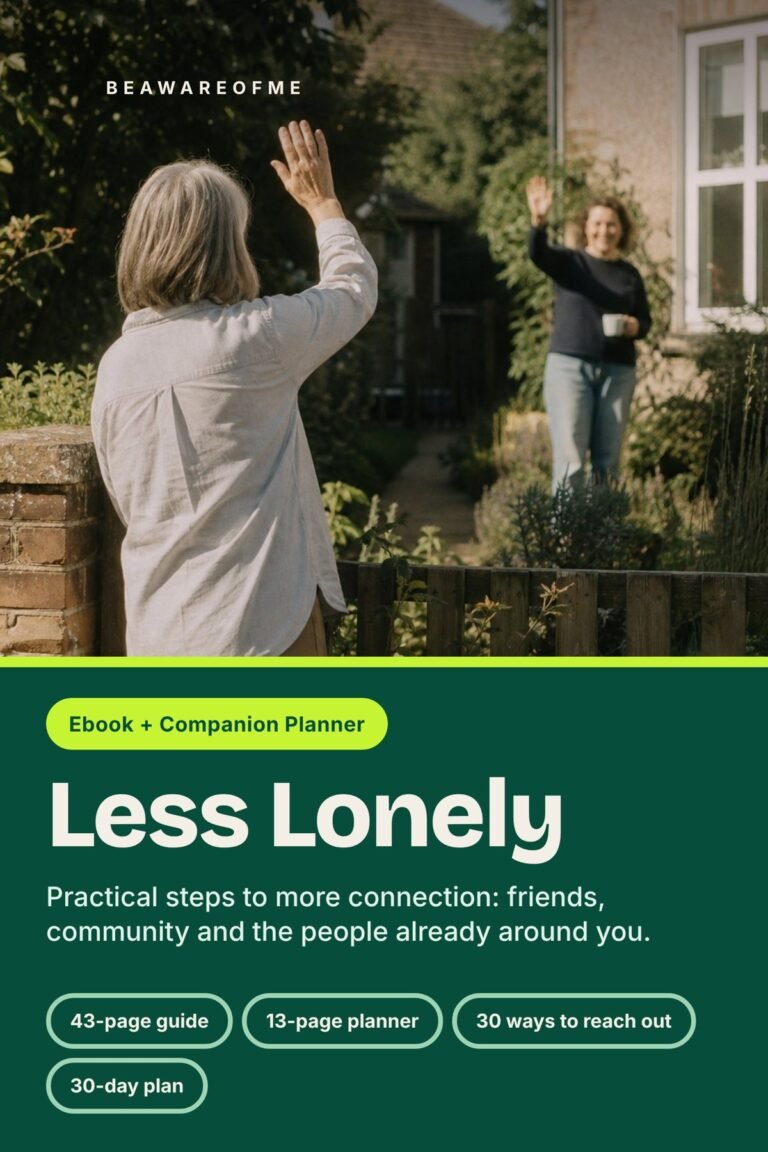 Ebook + Planner
Less Lonely
Small, practical steps back to people, one day at a time.
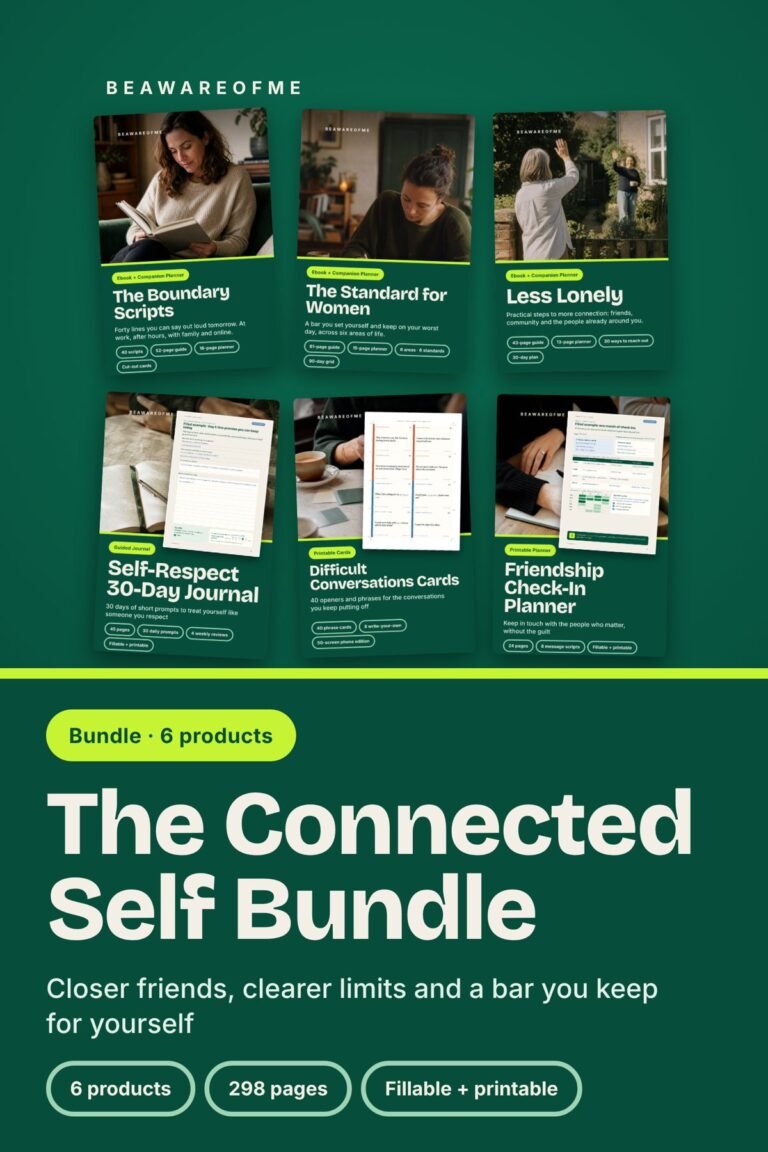 Bundle · 6 products
The Connected Self Bundle
Clear limits, kept promises and people you stay close to.
Six products sold separately for $93, here together for $37.
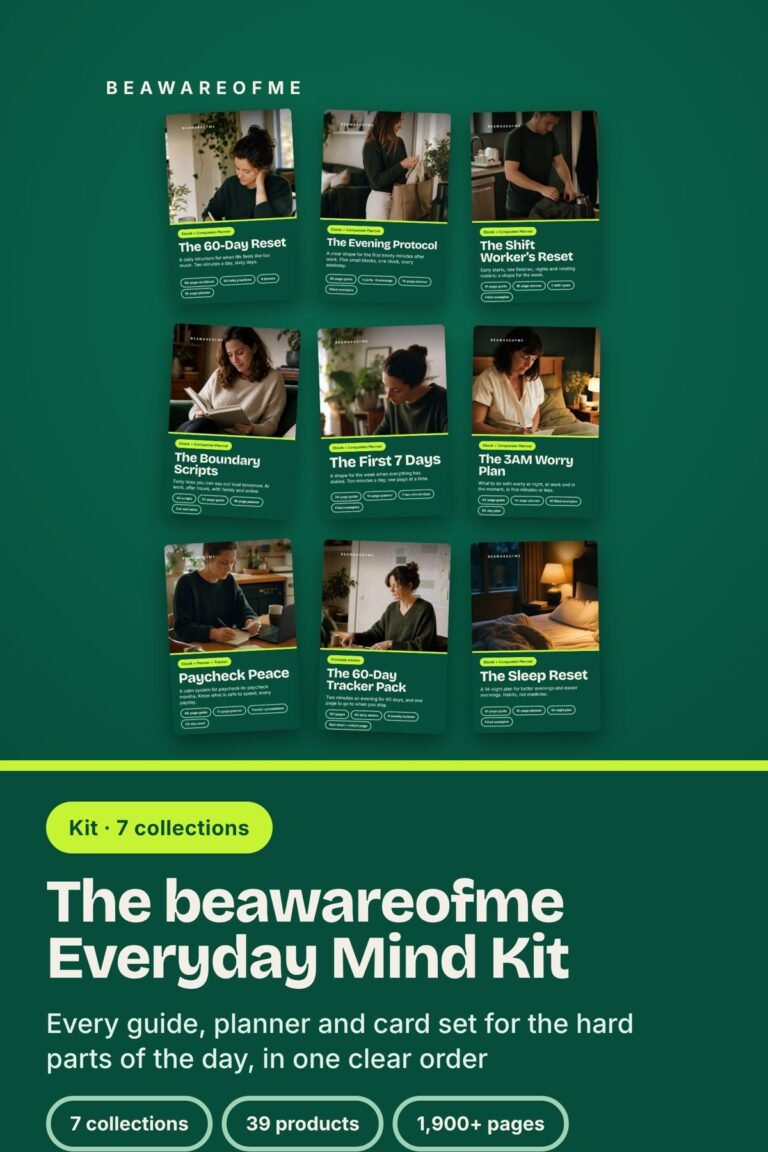 Kit · all collections
The beawareofme Everyday Mind Kit
Every beawareofme collection in one download, in a clear order.
The Standard System and all six bundles cost $289 bought separately; the kit is $127.
Instant download · Digital download · All sales final
Myths and calmer facts
✗ Lonely people just need to get out more.
✓ Many lonely people see others every day. Loneliness is more about feeling close and known than about how often you leave the house.
✗ If people wanted to see me, they would reach out.
✓ Most people are busy and unsure too, and many are waiting for someone else to go first. Reaching out is often welcomed more than we expect.
✗ Feeling lonely means something is wrong with me.
✓ Loneliness is a normal human signal that you need more connection. It says something about your situation right now, not about your worth.
When to get help
Talk to a doctor, counselor or other qualified professional if loneliness has lasted for weeks, if you feel hopeless or numb most days, or if it is affecting your sleep, eating, work or daily care. It can also help to ask for support if you feel unable to reach out to anyone at all. If you are thinking about harming yourself, please contact a crisis line now: in the US call or text 988, in the UK and Ireland call Samaritans on 116 123, or find a line near you at findahelpline.com. You do not have to wait until it feels serious enough.
Frequently asked questions
How do I know if I am lonely or just introverted?
Introverts enjoy and need time alone, and they usually feel restored by it. Loneliness feels different: alone time leaves you empty, unseen or left out. You can be introverted and lonely, or very social and still lonely.
Can you feel lonely in a relationship?
Yes. Many people feel lonely with a partner when conversations stay practical or they feel unseen. It can help to name one small thing you miss, like a daily check-in or time without phones, and ask for it kindly.
Why do I feel lonelier at night or on weekends?
Days are often filled with work, errands and tasks, which keep the feeling at bay. When the structure drops away in the evening or at weekends, the quiet becomes easier to notice. Planning one small thing for those times often helps.
How do I make friends as an adult?
Adult friendships usually grow from seeing the same people again and again in a relaxed setting. Pick a regular activity, go back often, and suggest a coffee once you have chatted a few times. Patience matters; closeness takes time.
Is it normal to feel lonely after moving or changing jobs?
Very normal. Moves, new jobs, new babies, breakups and retirement can all break up old routines and circles. It often takes months to rebuild, so be gentle with yourself and focus on one or two regular places to meet people.
Is this check a medical test?
No. It is a general self-reflection tool, not therapy or medical advice. It gives you a picture of where connection feels thin and some ideas to try. If loneliness feels heavy or lasting, a doctor or counselor can help.
Is this check a diagnosis?
No. Your answers point to a pattern, not a diagnosis. It is a general structure for everyday life, not medical or psychological advice.