
It’s midnight, you were fine three hours ago, and now your brain is doing math it refuses to do during actual business hours. Financial anxiety at night has a specific, cruel shape — the same bill that felt manageable at 2 PM turns into a five-alarm emergency by 11 PM, and no amount of telling yourself “this isn’t productive” makes the spiral stop. Here’s why that happens, and an actual routine for getting your brain to quiet down tonight.

There's a version of this that asks you questions back.
An article can tell you what burnout is. A workbook makes you locate where you actually are in it, on paper, in your own handwriting. That's The Burnout Fix — ninety-odd pages of it.
Look at the workbook →Financial anxiety at night happens because your brain’s threat-detection system stays active while the rational, problem-solving part quiets down as you wind toward sleep — so money worries that felt manageable during the day suddenly feel urgent and unsolvable. The fix isn’t more willpower. It’s giving your nervous system a clear signal that the problem has been captured and can wait until morning, through a short wind-down routine and a specific brain-dump method.

Key Takeaways
- ✓ Financial anxiety at night isn’t a character flaw — your prefrontal cortex genuinely quiets down at bedtime while your threat-detection system stays alert.
- ✓ A 10-minute wind-down routine done consistently trains your brain to stop treating bedtime as financial-planning time.
- ✓ Writing worries down in a specific “brain dump” format works better than journaling in general, because it gives your brain proof the thought was captured.
- ✓ Not all nighttime money anxiety needs the same fix — practical worries need a plan, psychological ones need a different approach entirely.
- ✓ What you do in the first hour after waking up affects how loud your money anxiety gets at 11 PM.
- ✓ If the pattern has lasted more than a few weeks and money isn’t actually the core problem, it’s worth talking to a professional.
Why Financial Anxiety at Night Feels So Much Worse Than During the Day
Here’s the thing nobody tells you: it’s not your imagination, and it’s not a discipline problem. Financial anxiety at night is measurably more common and more intense than daytime money stress, and there’s a real mechanism behind it.
During the day, your prefrontal cortex — the part of your brain responsible for rational thinking, planning, and weighing options — does a lot of the heavy lifting. It can look at a scary number and say, “okay, here’s a plan for that.” But as your body winds down toward sleep, that part of your brain quiets its activity. Meanwhile, your amygdala, the threat-detection system that doesn’t really do nuance, stays wide awake. You’re left with all the alarm and none of the problem-solving.
77%
of U.S. adults lose sleep over money worries at least some of the time
43%
say worrying about paying household bills is what disrupts sleep most
72%
of adults report feeling stressed about money at least sometimes
Those first two figures come from a national Sleep Foundation survey on financial worry and sleep, and they line up with what sleep and psychiatry researchers have been describing for years: money stress isn’t a fringe sleep disruptor, it’s closer to the norm than the exception.
There’s also a compounding effect worth naming. Bad sleep makes you worse at regulating emotion the next day, which makes the next night’s worry spiral easier to fall into. It’s not that you’re bad at managing stress — you’re managing it on four hours of sleep, which is a genuinely different task.
I’ve had nights where the number on my banking app hadn’t moved a single dollar between 3 PM and 11 PM — same balance, same due date — and somehow by midnight it felt like a five-alarm fire. That’s the tell. If the facts didn’t change but the panic did, that’s your nervous system talking, not new information.

Understanding why it happens doesn't make it stop.
You can know exactly what your nervous system is doing at 3 a.m. and still be awake at 3 a.m. Reading is where it starts. The Calm Reset Bundle is the part where you do something about it.
See the bundle →None of this means the money problem isn’t real. It might be, and that’s worth addressing head-on with practical ways to reduce financial anxiety during daylight hours. But your brain at 11 PM is the worst possible tool for solving it, and treating bedtime like a planning session is where most of the suffering comes from.
The 3 AM Money Spiral: What’s Actually Happening in Your Brain
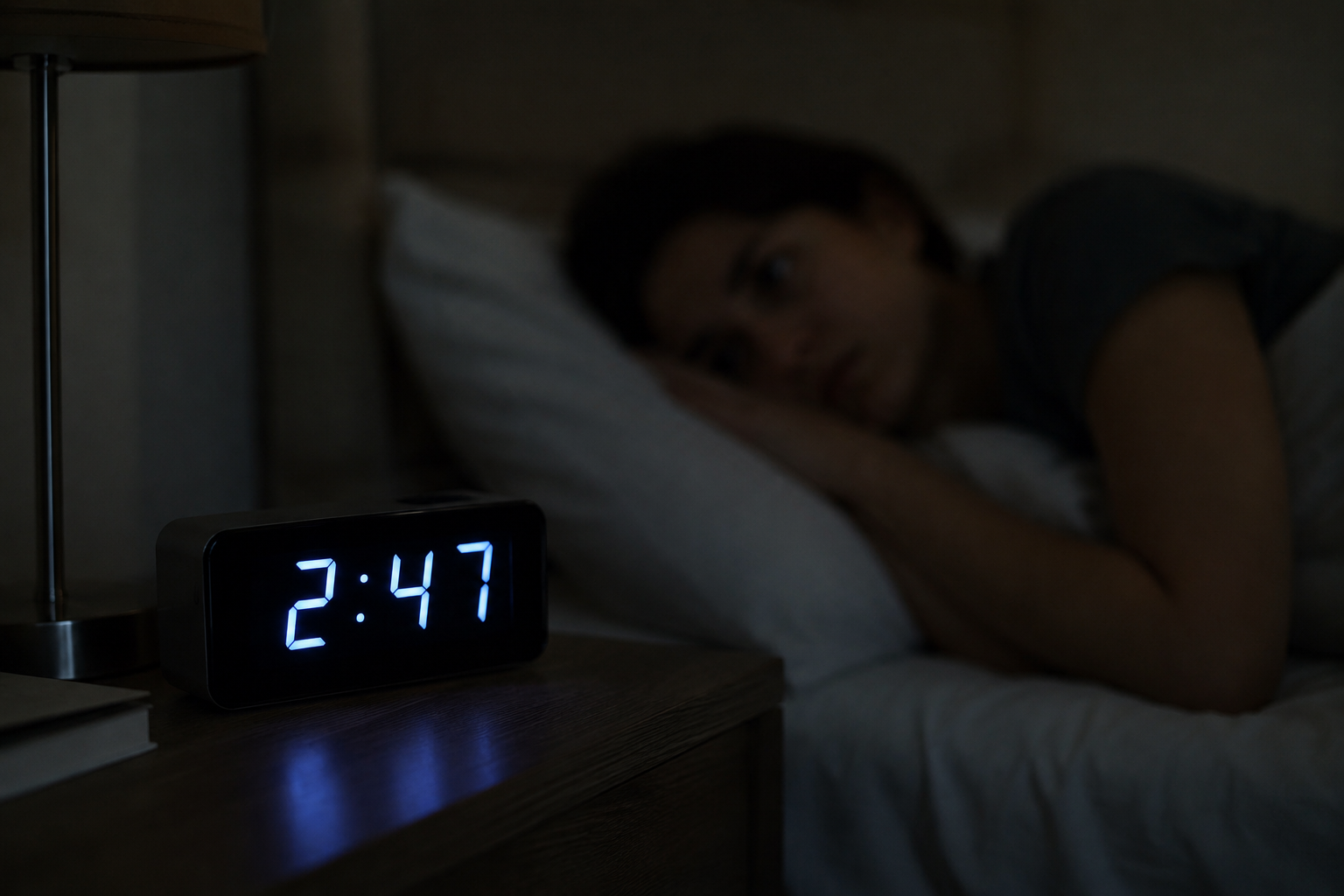
If your nighttime money anxiety has a favorite hour, there’s a good chance it’s somewhere between 2 and 4 AM. That’s not a coincidence — it lines up with something called the cortisol awakening response, a natural rise in the stress hormone cortisol that happens in the early morning hours as your body prepares to wake up.
Cortisol isn’t the villain here; you need some of it just to get out of bed in the morning. The problem shows up when your baseline stress is already elevated — say, because you’re carrying financial worry — and that natural cortisol rise tips you from lightly asleep into wide awake and doing mental math. We’ve written a full breakdown of the cortisol awakening response if you want to go deeper on the mechanism, but the short version for money anxiety specifically: your body picks a rough moment to make you alert, and your brain fills that alertness with whatever’s been sitting unresolved.
This is also why the 3 AM version of a problem always feels bigger than the daytime version. You’re not thinking more clearly at 3 AM — you’re thinking with less prefrontal oversight and more raw alarm, which is exactly backward from what you’d want for actual financial decision-making.
A few things make the 3 AM spiral reliably worse: checking your phone (the light alone delays your return to sleep, and pulling up a bank balance or bill reminder practically guarantees a longer wake-up), trying to “solve” anything with real numbers while half-asleep, and lying there white-knuckling your way toward sleep instead of resetting.

It's rarely a motivation problem. It's five apps and no single page.
Habits in one place, money in another, notes in a third, and nowhere that shows you how the month is actually going. The Digital Life Planner is one spreadsheet that holds all of it and does the arithmetic while you get on with your life.
See how it works →“Your bank account isn’t the reason it’s 2 AM. Your nervous system is.”
The move that actually works, according to sleep researchers, is almost anticlimactic: if you’re not back asleep within roughly 20 minutes, get up, go to another room, do something calm and boring under dim light, and return to bed once you’re drowsy again. Staying in bed fighting it just teaches your brain that the bed is where the spiral happens.

The 10-Minute Wind-Down Routine That Stops Nighttime Money Anxiety
You don’t need an hour-long ritual. You need a short, repeatable sequence that tells your nervous system the day is actually over. Here’s the version that holds up:
Set a hard stop time for anything financial.
No banking apps, no bill emails, no “quick check” of your balance after a set time — 8 PM works for most people. If the number needs your attention, it can have it in daylight, with a clear head.
Do a 2-minute worry capture.
Write down whatever’s circling — not a full budget, just the thought itself. This is the fast version of the brain-dump method below, and it’s the single step people skip that they shouldn’t.
Do a physical download.
Slow, extended-exhale breathing (in for 4, hold for 4, out for 6-8) tells your body the threat has passed, even when your thoughts haven’t fully caught up. Mayo Clinic’s guide to relaxation techniques covers several versions if breathing alone doesn’t do it for you.
Name one true, neutral fact.
Something like “I have a plan for this” or “this is unresolved, but it isn’t an emergency tonight.” You’re not talking yourself out of the problem — you’re giving your brain a stopping point.
Get the phone out of reach.
Not on silent on the nightstand — actually across the room or in another room. If it’s within arm’s reach, “just checking the time” turns into checking your balance in about four seconds flat.
None of these five steps takes more than a couple of minutes. The whole sequence fits in ten. What makes it work isn’t any single step — it’s doing the same five things in the same order enough nights in a row that your brain starts to recognize the pattern as “we’re closing up shop now.”

The Brain Dump Method: Getting Financial Worries Out of Your Head and Onto Paper
Step 2 above deserves its own section, because “just write it down” undersells what’s actually going on. This isn’t the same as general journaling for anxiety — it’s a specific, narrow move, and the difference matters.
Your working memory has a limited number of slots, and an open, unresolved worry occupies one of them whether you’re actively thinking about it or not — that’s part of why it keeps resurfacing. Writing the worry down in concrete terms gives your brain external proof that the thought has been captured somewhere it won’t be lost. That’s often enough for your brain to stop replaying it on a loop, even before you’ve solved anything.
Understanding why it happens doesn't make it stop.
You can know exactly what your nervous system is doing at 3 a.m. and still be awake at 3 a.m. Reading is where it starts. The Calm Reset Bundle is the part where you do something about it.
See the bundle →💡 Tip — the format matters
A brain dump works better with a bit of structure. Try three columns: what’s worrying me, is there an action I can take before Friday, and what’s the actual worst realistic case. Most nighttime money worries fall apart the moment you try to write an honest answer to that third column.
Keep the notebook and pen on your nightstand, not your phone. Typing keeps you in the same alert, screen-lit state you’re trying to leave; handwriting, slower and more physical, tends to settle the nervous system rather than activate it further. If you want a deeper set of prompts for this — including ones built specifically for a racing, ruminating mind — our piece on journaling for anxiety and prompts to quiet overthinking has a full set you can keep on the same nightstand.
One more thing worth saying plainly: the brain dump is not where you solve the problem. If you catch yourself doing full budget math at 11:40 PM “while you’re at it,” you’ve slipped back into problem-solving mode, which is exactly what this step is designed to interrupt. Capture it, close the notebook, move to the next step.

When It’s Practical vs. When It’s Psychological: A Quick Self-Check
Not every case of nighttime money anxiety needs the same fix, and this is where a lot of well-meaning advice falls short. Some money anxiety is genuinely practical — there’s a real gap between what you have and what you owe. Some is psychological — the numbers are actually fine, but the fear doesn’t know that. Most people are dealing with some mix of both, and it helps to know which one is driving tonight’s spiral.
| Signal | Practical money anxiety | Psychological money anxiety |
|---|---|---|
| What the numbers show | A real, specific gap — a bill you can’t cover, debt with a deadline | Finances are stable, but the worry persists anyway |
| What calms it | A concrete plan, even a partial one | A plan rarely helps for long — the anxiety just finds a new target |
| Common root | Unstable income, unexpected expense, insufficient savings | Scarcity conditioning from earlier in life, perfectionism, need for control |
| Best next step | Budgeting, a financial planner, or a specific debt strategy | Addressing the anxiety pattern itself, sometimes with a therapist |
If you’re not sure which column you’re in, here’s a rough test: picture your finances fully resolved — debt paid off, savings padded, a stable paycheck. If the anxious feeling would genuinely lift, you’re likely dealing with the practical kind, and it’s worth reading through practical ways to cope with financial stress. If some version of that dread would still be there — just aimed at something else — you’re likely dealing with the psychological kind, and no amount of budgeting will fully touch it.

From beawareofme
Paycheck Peace
A financial-calm guide, budget tracker, and worksheet set built specifically for the anxious-brain version of money management — not another spreadsheet that assumes you’re already calm about your numbers.
See the kit →Daytime Habits That Prevent Financial Anxiety at Night
The nighttime spiral doesn’t start at night. It starts with what you did — or didn’t do — with your money worry during daylight hours, when your brain actually has the tools to deal with it.
A short, scheduled “money check-in” earlier in the day does more for your sleep than most people expect. Fifteen minutes, same time, same short list: what’s due this week, what’s in the account, one thing you can do about the gap if there is one. It sounds almost too simple, but it works because it gives your brain a designated place to put the worry — so when it shows up again at 10 PM, there’s a real answer available: “already handled that this afternoon.”
⚠️ Watch for this
Doomscrolling financial news or comparing your numbers to strangers online in the evening is one of the most reliable ways to hand your nervous system fresh material right before bed. If you’ve noticed a pattern of picking up your phone “for a second” after dinner and ending up in your banking app or a finance subreddit, that’s worth treating as a bedtime-adjacent habit, not a harmless scroll.
A few other daytime habits that quietly protect your nights: getting movement in earlier in the day (even a walk measurably lowers baseline cortisol by evening), eating on a regular schedule instead of skipping meals when you’re stressed (blood sugar swings mimic and amplify anxiety symptoms), and — this one surprises people — actually looking at your numbers instead of avoiding them. Avoidance feels protective in the moment, but it’s one of the more common patterns behind the psychological impact of debt, and it tends to make the nighttime version of the worry louder, not quieter.

When Financial Anxiety at Night Signals Something Bigger
Most nights of money worry are just that — a rough night, addressed with the routine above and a plan the next day. But there’s a version of this that’s worth naming honestly: sometimes the pattern isn’t really about money at all.
Money can become a stand-in for other fears — loss of control, not being enough, repeating a scarcity you grew up around — even when the actual numbers are fine. If you’ve run the self-check above and landed clearly in “psychological” territory more nights than not, or if the anxiety is affecting your relationships, your ability to function at work, or your sleep for weeks at a stretch rather than the occasional bad night, that’s a reasonable point to bring in outside support.

❗ Important
This article is educational, not a substitute for professional care. A therapist, financial therapist, or Certified Financial Planner can help in ways a nighttime routine can’t when the pattern has become persistent. There’s more on the connection between financial stress and mental health if you want to read further before deciding what kind of support fits.
Reaching out isn’t an admission that you’ve failed to manage this on your own. It’s closer to recognizing that some patterns respond better to a second set of eyes than to another night of trying to out-think them alone.

5 Mistakes That Make Nighttime Money Anxiety Worse
1. Trying to budget “real quick” before bed
It never stays quick, and doing real financial math while your rational brain is offline just hands your amygdala more raw material to work with. Save budgeting for a time when your prefrontal cortex is actually available to help.
2. Checking your bank balance as a way to “feel better”
It rarely works the way you hope. If the number is fine, the relief lasts about ninety seconds. If it’s not what you expected, you’ve just handed yourself a fresh spiral at the worst possible hour.
3. Skipping the wind-down routine on “fine” nights
The routine works because it’s consistent, not because it’s reserved for bad nights. Doing it only when you’re already spiraling is like only brushing your teeth when one already hurts.
4. Trying to think your way out of it
Rumination feels like problem-solving, but it isn’t — it’s the same three worries on a loop, dressed up as productivity. If you notice you’re on lap four of the same thought, that’s the cue to write it down and stop, not to think harder.
5. Treating one bad night as a crisis
An occasional rough night is normal — most adults have them. It becomes worth deeper attention only when it’s a near-nightly pattern lasting weeks, not when it happens once after a genuinely stressful day.
Financial Anxiety at Night — Frequently Asked Questions
The Bottom Line on Financial Anxiety at Night
Financial anxiety at night isn’t a sign that you’re bad with money or bad at managing stress — it’s your nervous system doing exactly what it’s built to do, at exactly the wrong hour to be useful. The routine matters less than the consistency: capture the worry, calm the body, give your brain a stopping point, and let daylight handle the actual math. For more on quieting an anxious mind after dark, our guide to calming an anxious mind at night is a natural next read, and you’ll find the rest of this cluster in our Financial Stress articles.
It's rarely a motivation problem. It's five apps and no single page.
Habits in one place, money in another, notes in a third, and nowhere that shows you how the month is actually going. The Digital Life Planner is one spreadsheet that holds all of it and does the arithmetic while you get on with your life.
See how it works →From beawareofme
The Calm Reset Bundle
Five wellness guides plus a bonus Success Rituals guide, built for exactly this kind of overwhelm — sleep, anxiety, and burnout, all addressed in one place instead of five separate purchases.
See what’s inside →This article is educational content and not a substitute for professional financial or mental health advice, diagnosis, or treatment. If financial anxiety is significantly affecting your daily life, sleep, or relationships, please consult a licensed mental health professional or a qualified financial advisor. Sources: Sleep Foundation, Mayo Clinic, CDC.

Quiet the noise — without burning your phone in a field.
Get Beat Information Overload free, plus the occasional calm, no-hype note from me.