




What Kind of Worrier Are You?
Everyone worries, but not in the same way. Answer a few quick questions about real moments and get your worry style, a map of where your worry goes, and three small ways to turn the volume down.
Anonymous. Different questions each time. A general structure for everyday life, not medical or psychological advice.
Some people worry by planning, some by replaying, some by picturing the worst. If your mind keeps running even when you want it to rest, this page helps you see where your worry tends to go and gives you calm, practical ways to turn the volume down.
Each answer adds points to Planning ahead, Replaying, Body worry, What people think, Worst case and Loved ones. Your result reads the strongest areas and turns them into a named pattern, a chart, three small steps and the guides that fit. Questions change every time you play.
What Kind of Worrier Are You: what is really going on
Worry is the mind trying to keep you safe. It scans ahead for problems, looks back for mistakes and tries to prepare you for anything. In small doses it is useful: it reminds you to pay the bill, check the route or call your mum. The trouble starts when the scanning does not switch off, and the same thoughts loop without leading anywhere useful. Then worry stops being a helper and starts taking up your evenings, your sleep and your attention.
Not everyone worries in the same way. Some people make endless lists and backup plans. Some replay a conversation for days. Some notice every twinge in their body and wonder what it means. Others worry mostly about what people think, about worst-case scenarios or about the safety of the people they love. Most of us have a mix, with one or two styles that show up more than the rest, especially when we are tired or stretched.
Everyday life gives worry plenty to work with. Busy weeks, uncertain plans, group chats, news alerts and long to-do lists all keep the mind in scanning mode. Worry often grows in the gaps: lying in bed, waiting for a reply, sitting in traffic. It can show up as a tight chest, a restless feeling, trouble sleeping, snapping at people or checking your phone over and over for reassurance that never quite lands.
Knowing your style helps because each one responds to slightly different tools. A planner often needs a clear stopping point. A replayer needs a way to close the day. A body worrier needs a calm routine for checking, and a worst-case thinker needs practice weighing the likely outcome. This check maps your worry across six styles so you can start with the one that matters most to you right now.
What each area means
Planning ahead
This style worries by preparing. Lists, rehearsals and backup plans give a short-lived sense of control, but the planning rarely feels finished.
- You rehearse conversations and events in detail.
- Last-minute changes rattle you more than the change itself.
- Planning time spills into evenings and weekends.
- You make backup plans for your backup plans.
- Give planning a set slot with a timer, then close the notebook.
- Write 'good enough' at the end of a list and stop there.
- Split worries into 'mine to do' and 'not mine to control'.
- Leave one small part of the weekend unplanned on purpose.
Replaying
This style looks back. Conversations, emails and small moments get replayed, often at night, with a focus on what you should have said or done.
- You go over conversations long after they end.
- Small mistakes feel bigger the more you think about them.
- Bedtime is when the replays start.
- You reread messages you have already sent.
- Write the replay down once, with one thing you would do differently.
- Ask yourself whether anyone else is likely still thinking about it.
- End the day with three things that went okay.
- If you need to fix something, plan one short message and send it tomorrow.
Body worry
This style focuses on physical sensations. A headache, a skipped beat or a strange ache can quickly turn into a long search for what it might mean.
- You notice small changes in your body quickly.
- You search symptoms online and feel worse afterwards.
- Reassurance helps for a short while, then the worry returns.
- You avoid some activities in case they bring on a sensation.
- Set a limit on symptom searching, such as none after 8pm.
- Keep a simple note of what you noticed and when, to bring to a doctor.
- Book a check-up for real concerns instead of checking again and again.
- Use slow breathing to calm the body before deciding what a sensation means.
What people think
This style worries about how you come across. It can show up before social plans, after meetings or while waiting for a reply.
- You read a lot into short replies or silence.
- You check how a message might sound several times before sending.
- You replay what you said at a gathering.
- You say yes to avoid disappointing people.
- Notice the story you are telling and list two other explanations.
- Send messages after one reread, not five.
- Remember that most people are busy thinking about their own day.
- Practise one small, kind no this week.
Worst case
This style jumps to the most dramatic outcome. A late reply, a work email or a noise in the night can quickly become a full disaster story.
- Your mind skips straight to the worst outcome.
- You feel the dread as if the bad thing has already happened.
- You find it hard to believe the likely outcome is fine.
- You prepare for disasters that rarely come.
- Ask three questions: what is the worst, the best and the most likely?
- Write down what you would actually do if the worst happened.
- Look back at past worries and note how they turned out.
- Bring yourself back to now with five things you can see.
Loved ones
This style worries about the people you care about: their safety, health, choices and happiness. It often comes from love, but it can be heavy to carry.
- You feel uneasy until someone texts that they arrived.
- You picture things going wrong for your children, partner or parents.
- You find it hard to let others make their own choices.
- Checking in turns into checking up.
- Agree on simple check-in habits so you are not left guessing.
- Notice what is in your hands and what belongs to them.
- Turn worry into one helpful action, like a call or a kind message.
- Give yourself a worry window rather than carrying it all day.
What your score means
Your worry seems to come and go without taking over. Keep the habits that help you switch off, like a regular wind-down and talking things through with someone you trust.
Worry is showing up often enough to take some of your time and calm. Pick the style with the highest bar and try one tool from it every day this week.
Your worry seems to be running loud and often, and that is tiring to live with. Start with a short daily worry window and one calming routine, and if the worry keeps getting in the way of sleep, work or relationships, please talk to a doctor or a qualified professional.
5 small steps that help
Name your main style
Look at your highest bar and give your worry a name, like 'the planner' or 'the replayer'. Naming it makes it easier to notice when it starts.
Book a daily worry window
Choose 15 minutes at the same time each day, not close to bedtime. When a worry pops up outside that time, jot it down and save it for the window.
Sort worries into two lists
Write each worry under 'I can act on this' or 'I cannot control this'. Pick one small action from the first list and do it today.
Calm the body first
Try slow breathing with a longer out-breath for two or three minutes when worry rises. A calmer body often makes the thoughts feel smaller.
Close the day on paper
Before bed, write down what is still on your mind and the first step for tomorrow. Then do something calm and screen-free to mark the end of the day.
The guides that turn this into a plan
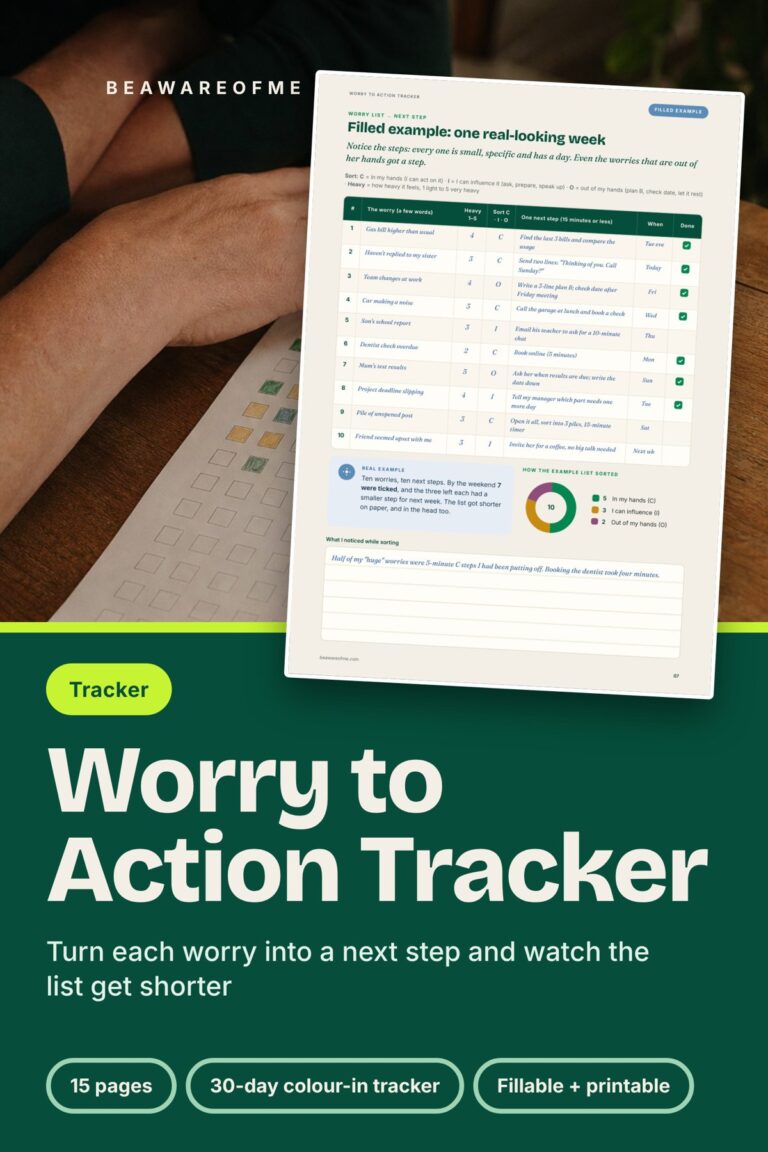 Tracker
Worry to Action Tracker
Give each worry one small next step and tick it off.
Get it →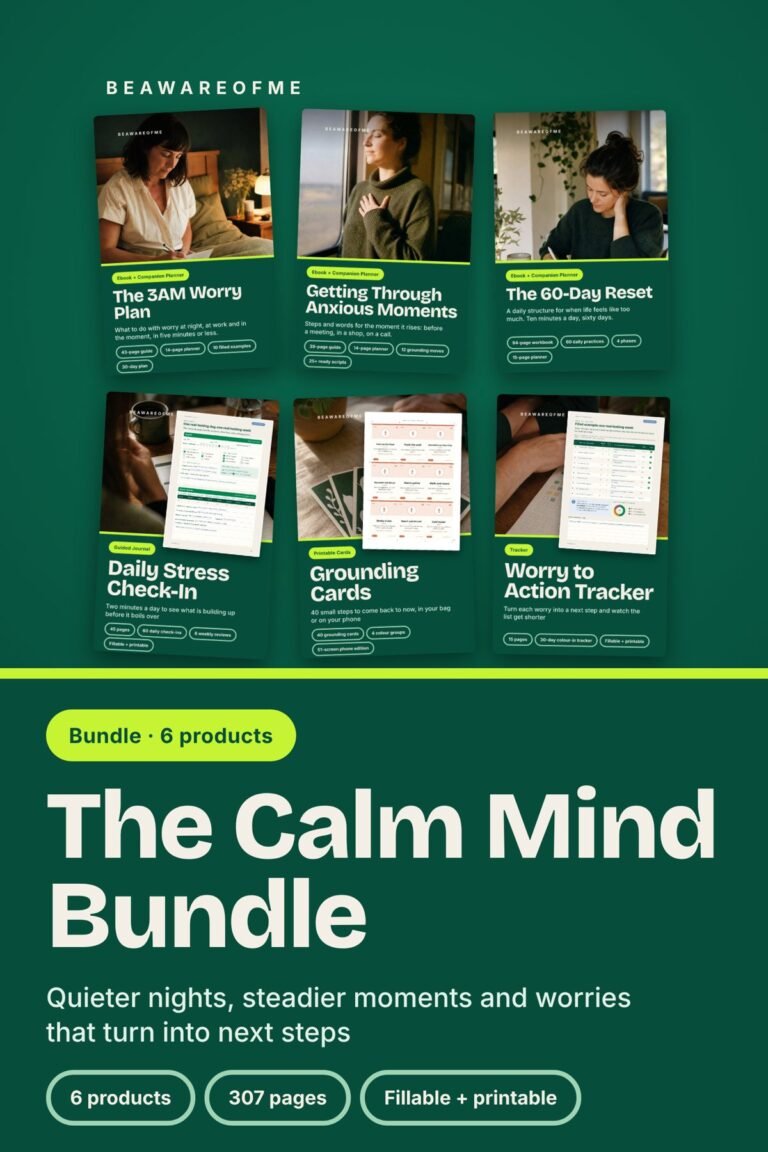 Bundle · 6 products
The Calm Mind Bundle
Simple plans for everyday worry, stress and hard moments.
Six products sold separately for $91, here together for $37.
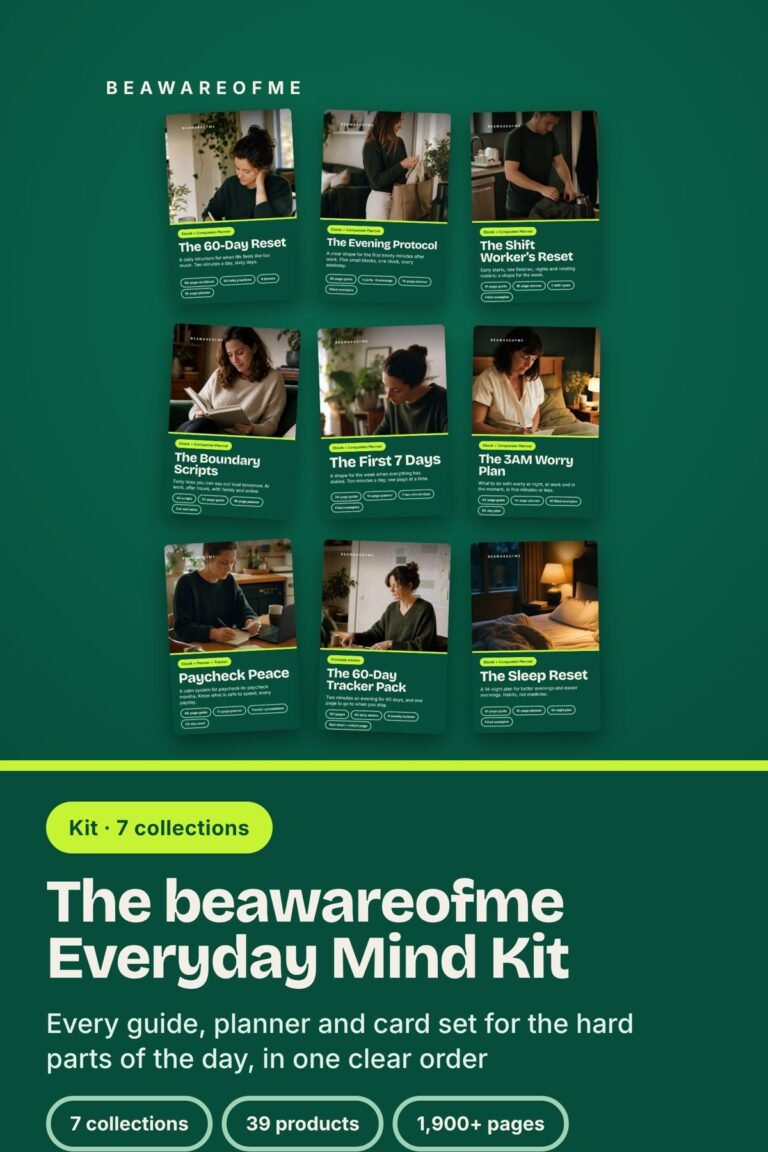 Kit · all collections
The beawareofme Everyday Mind Kit
Every beawareofme collection in one download, in a clear order.
The Standard System and all six bundles cost $289 bought separately; the kit is $127.
Instant download · Digital download · All sales final
Myths and calmer facts
✗ If I worry about it, I am more prepared.
✓ Some planning helps, but repeated worry rarely adds more. A short, focused plan usually prepares you better than hours of going over the same thoughts.
✗ Worriers are just negative people.
✓ Worry often comes from caring, being responsible or wanting to protect others. It is a habit of the mind, not a flaw in your character.
✗ The best way to stop worrying is to push the thoughts away.
✓ Pushing thoughts away often makes them come back louder. Writing them down, scheduling them or gently letting them pass tends to work better.
When to get help
It is time to talk to a doctor or a qualified professional if worry is most of your day, keeps you from sleeping, stops you from working, going out or seeing people, or comes with panic, a racing heart or feeling constantly on edge for weeks. A professional can help you understand what is going on and find support that fits. If you notice a physical symptom that worries you, get it checked rather than searching online. If you are thinking about harming yourself, please reach out now: call or text 988 in the US, call Samaritans on 116 123 in the UK and Ireland, or find a local line at findahelpline.com.
Frequently asked questions
Is it normal to worry all the time?
Everyone worries, and busy or uncertain times can turn the volume up. If worry is taking up most of your day, getting in the way of sleep or daily life, or lasting for weeks, it is a good idea to talk to a doctor.
What is the difference between worry and anxiety?
Worry is mostly thoughts about what might go wrong. Anxiety is a broader word that often includes body feelings like tension, a racing heart or restlessness. They often overlap, and this check is not a test for any condition.
How do I stop worrying at night?
Give your worries somewhere to go before bed: write them down with one next step. Keep a notepad by the bed for anything that pops up, and if you cannot settle, get up and do something calm in dim light for a while.
What is a worry window?
It is a short, set time each day when you let yourself worry on purpose. Outside that time you note worries down and save them. Many people find it helps worry feel less constant.
Why do I always think of the worst case?
The mind is wired to spot danger, and when you are tired or stretched it can lean towards the dramatic. Asking what is most likely, and what you would do if the worst happened, can bring it back into proportion.
Can my worry style change?
Yes. Worry styles often shift with life stages, stress and sleep. Practising the tools for your main style can make it quieter over time.
Is this check a diagnosis?
No. Your answers point to a pattern, not a diagnosis. It is a general structure for everyday life, not medical or psychological advice.