
You want to help people feel less alone with stress, low mood or anxiety, but posters and hashtags feel a bit hollow. You’re right to be suspicious of them. The best ways to promote mental health awareness are small, repeatable and personal: a better question, a kinder word, a useful number shared at the right moment. This guide gives you 11 practical ideas, with scripts, for home, work, online and your community.
The short answer
To promote mental health awareness, focus on three things: talking openly about everyday mental health, changing stigmatising language, and making help easy to find. Start with yourself by mentioning your own self-care plainly. Check in on people with specific questions and listen without fixing. Share trusted resources and crisis numbers, use awareness dates as prompts, and follow safe-messaging guidance online. Small, steady actions shift culture more than one big campaign.
Key takeaways
Mention your own self-care in plain words, because hearing it from someone ordinary makes it feel safe for others.
Swap stigmatising phrases such as “committed suicide” or “so OCD” for neutral, accurate language.
Ask one specific check-in question, then listen for two minutes before offering any advice.
Save one crisis number and one local support link in your phone so you can share them instantly.
Use awareness dates as a reminder for one real action, not just a post.
Keep online posts hopeful and resource-led, and leave out graphic details about self-harm or suicide.
Why Small Acts Promote Mental Health Awareness Better Than Big Campaigns
Awareness isn’t just knowing that mental illness exists. It means people recognise early signs, feel safe to talk, and know where to turn. Everyday conversations do more for those three goals than one slick event.
The need is closer than you think
According to the National Institute of Mental Health statistics page, about 23.1% of US adults live with a mental illness in a given year. That’s more than one in five. Only about half of them received any mental health treatment in the past year.
Those figures mean someone in your family, team or friend group is probably carrying something quietly. You don’t need to guess who. You just need to make it easier for anyone to speak up when they’re ready.
What awareness actually changes
When you promote mental health awareness well, people reach out sooner. They recognise stress before it turns into burnout. They stop treating struggle as a character flaw. For background on the bigger picture, read our guide on what mental health awareness is and why it matters.
📝 Note
You don’t need training, a title or a platform. Ordinary people talking honestly have driven almost every big shift in how society treats mental health, as our look at the history of mental health awareness shows.
Match the idea to the energy you have today
Not every day has room for a big effort. Use this quick map of the 11 ideas in this guide to pick one that fits your time. Any of them can help you promote mental health awareness in a real way.
| Time you have | Ideas that fit |
|---|---|
| 5 minutes | Say your self-care out loud, swap one phrase, send a check-in text, save a crisis number |
| 30 minutes | Do a full check-in conversation, build a resource card, post a sourced, hopeful update |
| An afternoon | Host a lunch-and-learn, organise a walk-and-talk, plan your awareness dates, suggest first aid training |
Start With You: 3 Quiet Habits That Make Openness Normal
The easiest way to promote mental health awareness is to model it in your own daily talk. People copy what feels safe. When you mention your mental health as casually as a sore back, you give others permission to do the same.
1. Say your self-care out loud
Drop small, honest lines into normal chat. “I’m taking a proper lunch break today, my head’s been busy.” “I booked a session with my counsellor this week.” These sentences aren’t dramatic. That’s exactly why they work.
2. Know your own baseline
It’s hard to spot change in others if you never check in with yourself. Try the free 5-minute self check-in once a week. Then compare it with these signs you might be struggling with your mental health, so you can describe your own patterns clearly.
3. Share what helped, not just what hurt
Stories of recovery and coping travel further than stories of crisis. If a walk, a routine or a conversation helped you, say so. Hope is part of awareness, and it’s often the part people remember.
4. Protect your own energy while you help
You can’t promote mental health awareness from an empty tank. Set a limit on how many heavy conversations you take on in a week. If supporting someone starts to affect your sleep or mood, it’s fine to step back and point them toward other help.
✨ Quick win
Today, tell one person about one small thing you do for your mental health. Keep it to a single sentence and don’t over-explain.
Change the Words, Change the Room: Language That Lowers Stigma
Words shape how safe people feel, and they’re the cheapest tool you have. A throwaway phrase like “she’s crazy” or “I’m so OCD about my desk” tells listeners that mental illness is a joke. Swapping a few habits of speech is one of the fastest ways to promote mental health awareness without saying anything about awareness at all.
Simple swaps you can start using today
You don’t have to police anyone. Just change your own words and let people notice. The table below covers the swaps that matter most.
| Instead of | Try | Why it helps |
|---|---|---|
| “Committed suicide” | “Died by suicide” | Removes the sense of crime or sin |
| “I’m so OCD” or “so bipolar” | “I like things tidy” or “my mood’s all over the place” | Keeps real conditions from becoming jokes |
| “Crazy” or “psycho” | “Unusual”, “intense” or the actual behaviour | Avoids linking illness with danger |
| “Suffering from depression” | “Living with depression” | Leaves room for coping and recovery |
| “Just think positive” | “That sounds really hard. What would help?” | Validates instead of dismissing |
| “Attention seeking” | “Asking for support” | Treats distress as a real need |
If someone uses a hurtful phrase, then try this
You don’t need a lecture. A light, curious question usually works better than a correction. Try: “Oh, I’ve stopped saying that one. A friend of mine has OCD and it’s really tough for her.” Then move on.
This approach keeps the mood friendly and lets people save face. Over time, gentle nudges like this promote mental health awareness far more than calling someone out in front of others.
Safe language around suicide
Suicide needs extra care. The Recommendations for Reporting on Suicide advise neutral wording like “died by suicide”, stories of hope and recovery, and always sharing crisis resources. They also warn against describing methods or calling the problem an “epidemic”.
⚠️ Watch out
If someone tells you they’re thinking about ending their life, take it seriously. Stay with them, listen, and help them contact a crisis line such as 988 in the US or Samaritans on 116 123 in the UK and Ireland, or local emergency services.
How to Promote Mental Health Awareness With Friends and Family
The most powerful way to promote mental health awareness happens one conversation at a time. A good check-in shows someone they matter and that their struggle won’t shock you. It doesn’t need to be long or perfect.
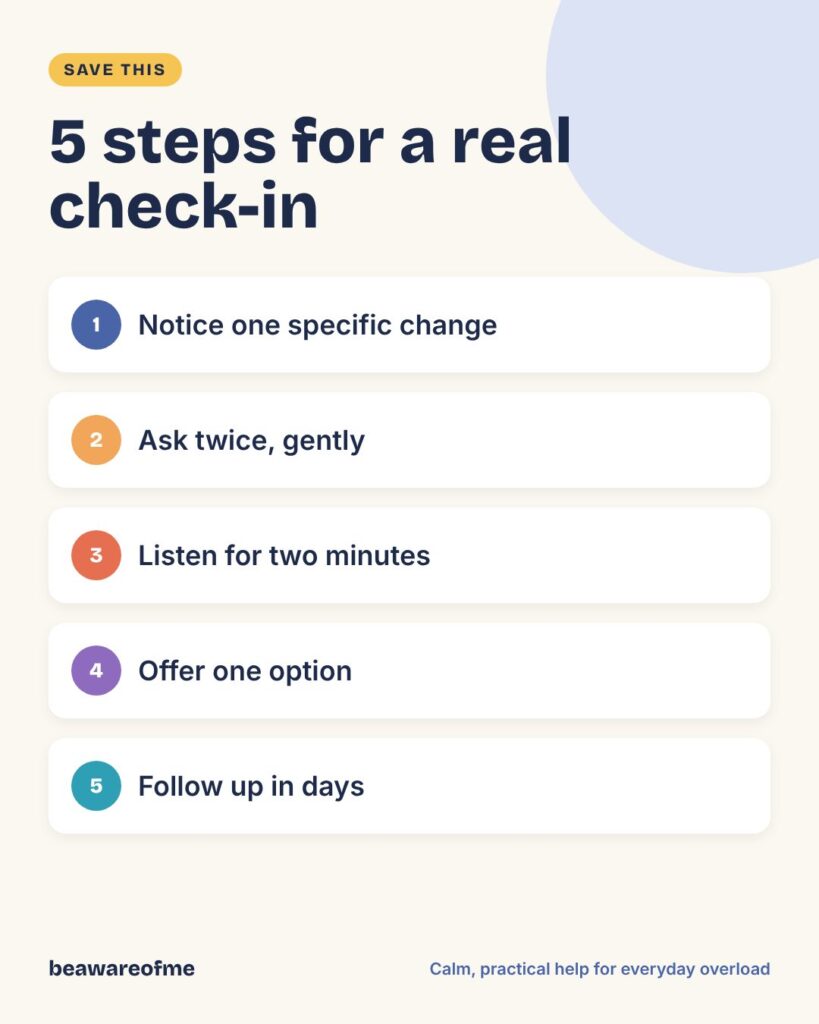
A 5-step check-in that feels natural
Notice one specific change
“You’ve seemed tired the last couple of weeks.” Specific beats general.
Ask twice
“How are you doing? No, really, how are you?” The second ask shows you mean it.
Listen for two full minutes
Don’t fix, compare or rush. Nod, reflect back, and let silence sit.
Offer one option
“Would it help to talk to someone? I can help you look.”
Follow up in a few days
A short text like “Thinking of you” keeps the door open.
What to say if they open up
If someone shares something heavy, your first job is to stay calm and kind. Try: “Thank you for telling me. That sounds really hard.” Avoid comparing it with your own story straight away.
Then ask, “What would feel most helpful right now?” Some people want ideas, some want company, and some just want to be heard. Letting them choose keeps the conversation safe and respectful.
If they don’t want to talk, then keep it light
Some people need time. If they brush you off, say, “No pressure. I’m around if that changes.” Then carry on with normal plans. Being consistent often matters more than the first conversation.
Relationships carry their own pressures, and our guide to mental health and relationships covers how to support a partner without burning out yourself.
Try this today
A check-in text you can send right now
- “Hey, you crossed my mind today. How are things, honestly?”
- “No need to reply fast. Just wanted you to know I’m here.”
- “Fancy a walk this week? No agenda, just fresh air.”
- “If things feel heavy, I’m happy to help you find support.”
At Work: 4 Low-Pressure Ideas Any Team Can Use
Workplaces are where many adults feel least able to admit stress. Small, practical changes can shift that culture without turning every meeting into a therapy circle. Here’s how to promote mental health awareness at work, even if you don’t manage anyone.
Train a few people in mental health first aid
Mental Health First Aid is a course that teaches people to spot signs of distress and offer initial support. The Mental Health First Aid USA site reports more than 5 million people trained across the United States. Ask HR whether your workplace can fund a few places.
Make support easy to find
Put the employee assistance programme details, a crisis number and local services on one simple page. Pin it in the team chat. When someone needs help at 4 pm on a bad day, they shouldn’t have to search.
Set calmer team habits
Agree on no-meeting blocks, quieter evenings and realistic deadlines. Leaders who take their own breaks visibly do more than any poster. For more, see our ideas for a supportive workplace environment and this guide to recognising and reducing stress in the workplace.
If you’re the manager, then go first
Teams follow what leaders do, not what they say. Mention your own break, your own boundary or your own off day in plain words. One honest sentence from a manager can promote mental health awareness across a whole team faster than any policy.
Host a short lunch-and-learn
A 30-minute session on stress, sleep or burnout signs is easy to run. Invite a qualified speaker or share a trusted video, then leave time for questions. Keep attendance optional and never ask people to share personal stories.
Online Without the Overwhelm: Posting That Helps
Social media can spread hope fast, but it can also spread myths and distress. A few simple rules let you promote mental health awareness online without adding noise or harm. Think useful, hopeful and sourced.
If you share a fact, then share the source
Link to an organisation such as NIMH, WHO or a national health service. Unsourced numbers spread quickly and erode trust. If you can’t find where a statistic came from, leave it out.
If you share your story, then set a boundary first
Decide in advance what you’ll share and what stays private. Talk about coping and support, not graphic detail. You’re allowed to delete comments and step away from your phone afterwards.
If you see misinformation, then reply once, calmly
You’ll see posts claiming one supplement cures depression or that anxiety is just weakness. Reply once with a short, kind correction and a trusted link, then leave it. Long arguments rarely change minds and can drain your own energy.
Scrolling itself can wear you down, so pair awareness posts with healthy habits. Our guide on how social media affects mental health shows how to keep the benefits without the drain.
💡 Tip
Add one line with help options to any post about a hard topic, such as “If this hits close to home, you can call or text 988 in the US.” It takes five seconds and could matter a lot to someone reading.
Use the Calendar: Awareness Dates and What to Do on Each
Awareness dates make it easier to promote mental health awareness, because they give everyone a shared, socially safe moment to raise the topic. Use them as prompts for one concrete action. Here are the main ones and a simple idea for each.
| Date | What it is | One simple action |
|---|---|---|
| May | Mental Health Month (US), started by Mental Health America | Share one trusted resource with your team or group chat |
| A week in May | Mental Health Awareness Week (UK) | Swap one stigmatising phrase for a neutral one |
| 10 October | World Mental Health Day | Send three people a genuine check-in text |
| June | Men’s health awareness events | Ask a man in your life how he’s really doing |
Plan your whole calendar in ten minutes
Open your calendar now and add the four dates above as yearly reminders. Under each one, write a single action and the name of one person to contact. That small setup means you’ll promote mental health awareness every few months without having to remember.
Men often find these conversations hardest to start. Our guide on when Men’s Mental Health Month happens has more ideas for reaching them gently.
23.1%
of US adults live with a mental illness in a year.
Source: NIMH
50.6%
of those adults received mental health treatment.
Source: NIMH
5M+
people trained in Mental Health First Aid in the US.
Source: MHFA USA
Community and School Ideas to Promote Mental Health Awareness Locally
When you promote mental health awareness locally, it feels real, because people see neighbours they trust taking part. You don’t need a big budget. A library room, a park or a school hall is enough.
Host a walk-and-talk or calm-hour event
Organise a gentle group walk, a quiet reading hour or a craft table. Keep the focus on connection, not lectures. Creative activities help many people relax, which our article on mental health and the arts explores.
Build a one-page local resource card
List crisis numbers, local clinics, free support groups and helplines on one printable page. Ask libraries, cafes and doctors’ surgeries to display it. If you want to understand what local services can offer, read about community mental health services.
Partner with groups that already meet
Book clubs, running groups, faith groups and parent networks already have trust built in. Ask whether you can share a resource card or add a short wellbeing slot to one meeting. Working with existing groups is the easiest way to promote mental health awareness locally, because you skip the hard part of drawing a crowd.
Support schools without overstepping
Offer to help parents’ groups share wellbeing resources, or donate age-appropriate books on feelings. Leave counselling to trained staff. Your role is to make the topic ordinary and to point toward qualified help.
For more ideas across daily life, work and stress, browse the beawareofme mental health articles.
5 Common Mistakes That Quietly Undercut Awareness Efforts
Good intentions can still misfire when you promote mental health awareness. These mistakes are common, easy to miss, and simple to fix once you see them. Each one can turn a helpful effort into something that leaves people feeling more alone.
Mistake 1: Leading with scary statistics
Opening with alarming numbers can make people feel helpless or overwhelmed. Use facts to show that struggle is common and help exists, then move quickly to what people can do. Hope keeps readers listening.
Mistake 2: Offering advice before listening
Jumping to “Have you tried yoga?” can make someone feel unheard. Listen first, reflect back what you heard, and ask what would help. Advice lands better when people feel understood.
Mistake 3: Treating awareness as a once-a-year task
A single post in May won’t shift much. Spread small actions through the year, such as a monthly check-in or a pinned resource page. Consistency builds the trust that makes people speak up.
Mistake 4: Sharing graphic detail about crisis
Detailed descriptions of self-harm or suicide can harm vulnerable readers. Follow safe-messaging guidance: focus on hope, coping and where to get help. Always include a crisis line.
Mistake 5: Acting like the expert
You can raise awareness without diagnosing anyone. Avoid labels like “you sound depressed”. Instead, say what you notice and suggest a doctor or qualified professional who can actually assess things.
Questions People Ask About Raising Awareness
What are simple ways to promote mental health awareness?
Simple ways to promote mental health awareness include talking openly about your own self-care, checking in on friends with specific questions, and swapping stigmatising language for neutral words. You can also share trusted resources and crisis numbers, mark awareness dates with one real action, and post hopeful, sourced content online. Small, steady actions make the biggest difference over time.
How can I raise mental health awareness at work?
Start by making support easy to find, such as a pinned page with assistance programme details and crisis numbers. Suggest Mental Health First Aid training for a few colleagues, host a short optional lunch-and-learn, and encourage calmer team habits like protected breaks. Leaders who visibly take care of their own wellbeing send a strong, lasting message to everyone.
What colour represents mental health awareness?
Green is the most widely recognised colour for mental health awareness. The green ribbon is the symbol of Mental Health Month in the United States and appears at many events worldwide. People wear it to show support, start conversations and signal that they’re a safe person to talk to. Pair it with a real action to make it count.
When is World Mental Health Day?
World Mental Health Day falls on 10 October every year. The World Health Organization and many partner groups use it to raise awareness and highlight a yearly theme. It’s a good prompt to check in on people you care about, share one trusted resource, or start a calm conversation at work, school or home about everyday mental health.
How do I talk to someone I’m worried about?
Pick a private, relaxed moment and name one specific change you’ve noticed. Ask how they’re doing, then ask again to show you mean it. Listen without fixing or judging. Offer to help them find support, and follow up a few days later. If they mention wanting to end their life, help them contact a crisis line or emergency services.
Can social media help raise mental health awareness?
Yes, social media can help promote mental health awareness when posts are hopeful, accurate and resource-led. Share facts with clear sources, talk about coping and recovery, and add a crisis line to posts on hard topics. Avoid graphic detail about self-harm or suicide. Protect your own wellbeing too, by setting boundaries and taking breaks from scrolling.
You don’t need a stage or a title to promote mental health awareness. A kinder word, a real check-in and a saved crisis number already change the room you’re in. Pick one idea from this guide today, and let small actions add up.
Please note: Educational content, not a substitute for professional care. If you are struggling, talk to a doctor or a qualified professional. If you are thinking about harming yourself, contact local emergency services or a crisis line now (US 988, UK and Ireland Samaritans 116 123, or findahelpline.com).