You keep hearing the phrase on posters, in work emails and all over social media, yet nobody explains what you are supposed to do with it on a hard Tuesday. Mental health awareness is not a slogan or a once-a-year hashtag. It is a set of small, learnable habits that help you notice when you, or someone close to you, is starting to struggle. This guide shows you what it means, why it matters, and how to practice it calmly in your own life this week.
The short answer
Mental health awareness means understanding that everyone has mental health, knowing the common signs that it is slipping, and feeling able to talk about it without shame. It matters because people who notice changes early can rest, adjust or ask for support sooner. In practice, it looks like checking in with yourself, speaking kindly about struggle, knowing where help lives, and making it normal for the people around you to say, “I’m not okay.”
Key takeaways
Treat mental health like physical health: everyone has it, and it shifts from good days to hard ones.
Learn three or four personal warning signs, such as sleep changes or pulling away, so you spot a dip early.
Swap labels like “crazy” or “dramatic” for plain, kind words that make talking feel safe.
Save one support contact and one crisis number in your phone today, before you ever need them.
Check in with one person this week using an open question, then listen more than you advise.
What Mental Health Awareness Really Means (No Jargon)
At its core, mental health awareness is the everyday knowledge that your mind needs care, attention and support, just like your body does. It starts with a simple shift: mental health is not something only some people “have.” Everyone has it, and it moves along a range, from thriving to coping to struggling.
That range matters. You can feel steady for months, then a breakup, a money scare or a brutal season at work tips you toward the struggling end. Awareness is what lets you notice the drift while it is still small.
The one-sentence definition worth remembering
The World Health Organization describes mental health as a state of well-being that lets people cope with the stresses of life, realize their abilities, learn and work well, and contribute to their community. You can read the full framing on the WHO mental health fact sheet. Notice what that definition leaves out. It does not say “never sad” or “always calm.” It talks about coping, not perfection.
So mental health awareness is not about chasing constant happiness. It is about knowing your normal, noticing when you leave it, and having a plan for the way back.
Awareness, literacy and advocacy: three words people mix up
These terms get blended together, which makes the whole idea feel bigger and vaguer than it is. Here is the quick difference.
You don’t need to be an advocate to make a difference. Most of the good happens at the first two levels, in kitchens, group chats and office break rooms.
Why Mental Health Awareness Matters: 4 Real Numbers
The strongest case for mental health awareness is simple: many people struggle, and far fewer get support. The numbers below come straight from public health sources, and they turn a vague idea into something concrete.
1 in 7
people worldwide live with a mental disorder
Source: WHO
23.1%
of US adults had a mental illness in the past year
Source: NIMH
50.6%
of those US adults received treatment
Source: NIMH
1 in 3
people with depression get formal care
Source: WHO
The global figures come from the WHO fact sheet on mental disorders, which also states plainly that most people do not have access to effective care. The US figures come from the National Institute of Mental Health.
The quiet gap between struggling and getting support
Look at those numbers side by side. Roughly half of US adults with a mental illness received any treatment in a year, and globally only about one in three people with depression gets formal care.
Some of that gap comes from cost, waiting lists and distance. But a real chunk comes from something awareness can change: people not recognizing what they feel, or feeling too ashamed to say it out loud.
Why stigma keeps the gap wide open
Stigma means the negative labels and assumptions attached to mental health struggles. It shows up as jokes, as “just toughen up,” or as the fear that your boss will see you differently.
When stigma is loud, people wait. They wait until sleep falls apart, until work suffers, until a relationship cracks. Mental health awareness shrinks that waiting time, and earlier support usually means a shorter, gentler road back.
“Awareness doesn’t fix everything. It just shortens the time between ‘something feels off’ and ‘I’m doing something about it.’”
The 3 Circles of Awareness: You, Your People, Your Places
Awareness works best when you picture it as three circles, starting with yourself and widening out. Each circle needs a slightly different skill, and you can practice all three without any training.
Circle one: noticing your own inner weather
Self-awareness is the foundation. If you can’t spot your own early signs, it’s much harder to spot anyone else’s.
Most people have a personal pattern. Yours might be snapping at small things, scrolling past midnight, skipping meals or cancelling plans you usually enjoy. Write down three of your usual signs. That short list is your early warning system.
If you want a structured start, the free 5-minute self check-in walks you through a quick, private snapshot of how you are doing right now.
Circle two: the people you love
The second circle is the people you see often: a partner, friends, family, roommates. Here, awareness means noticing change, not diagnosing anything.
Is a friend who loved group chats suddenly silent? Has your partner stopped doing the hobby that used to light them up? Changes like these deserve a gentle check-in. Our guide to signs someone might be struggling with their mental health lists more patterns to watch for.
Circle three: work, school and community
The widest circle covers the places you spend your days. This is where policies, culture and everyday language shape whether people feel safe asking for help. You can read about the bigger picture in our piece on the importance of mental health awareness in society.
What this looks like on an ordinary week
Picture a regular week. On Monday you notice you’ve skipped lunch three days running, so you set a reminder and eat away from your desk. On Wednesday a coworker sounds flat on a call, so you send a short private message afterwards. On Friday your sister jokes that she “hasn’t slept properly in a month,” and you ask, gently, how long it has really been.
None of those moments took more than two minutes. Together, they are mental health awareness in action: noticing, naming and making a small move. That is the whole skill, repeated.
📝 Note
You don’t need to fix anything in circles two or three. Your job is to notice, ask and point toward support. Carrying someone else’s whole load is not awareness. It is burnout waiting to happen.
Stress, Struggle or Something More? A Calm Way to Tell
One of the most useful parts of mental health awareness is knowing the difference between a normal hard patch and a sign that you need more support. This comparison is not a diagnostic tool. Think of it as a gentle map.
| Area | Everyday stress | Ongoing struggle | Time to get help |
|---|---|---|---|
| Mood | Dips, then bounces back | Low or edgy most days | Hopeless or numb, hard to shake |
| Sleep | A few rough nights | Poor sleep for weeks | Barely sleeping or sleeping all day |
| Daily life | Still getting things done | Tasks feel heavy and slow | Work, school or home falling apart |
| Connection | Want a quiet night | Avoiding most people | Fully cut off from everyone |
A gentle two-week check you can use
Here’s a simple rule of thumb. If a heavy feeling sticks around most days for two weeks or more, or it starts getting in the way of work, sleep or relationships, book a chat with your doctor or a qualified professional.
You don’t need to wait for things to feel “bad enough.” There is no entry exam for support. If you’re curious what that support can look like, our overview of different types of therapy explains the main options in plain words.
⚠️ Watch out
If you ever feel unsafe or think about harming yourself, skip the two-week check. Contact local emergency services or a crisis line right away: 988 in the US, Samaritans on 116 123 in the UK and Ireland, or find your local line at findahelpline.com.
When stress turns into burnout
Long stretches of pressure, especially at work, can slide into burnout: exhaustion, cynicism and a sense that nothing you do matters. It often hides behind “I’m just busy.” Our guide on stress vs burnout helps you see which one you’re in.
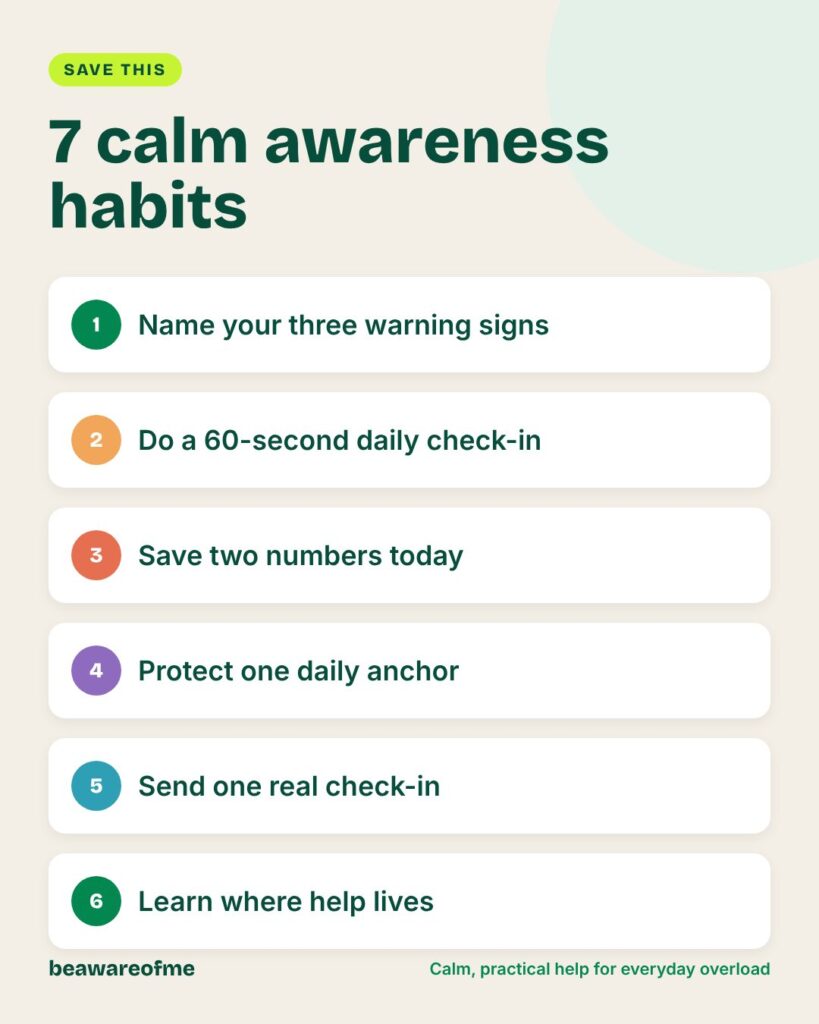
7 Simple Ways to Practice Mental Health Awareness This Week
Practicing mental health awareness is less about big gestures and more about small, repeatable actions. Pick two from this list and try them before the week is out.
Start with yourself (steps 1 to 4)
Name your three warning signs
Write them on a sticky note or in your phone. Examples: skipping lunch, doom-scrolling in bed, snapping at small noises.
Do a 60-second daily check-in
Once a day, ask: “How full is my tank, from 1 to 10?” Anything under 4 two days running is your cue to rest or reach out.
Save two numbers today
Add one trusted person and one crisis line to your favorites. Deciding this on a calm day saves energy on a hard one.
Protect one daily anchor
Choose one steadying habit, such as a short walk, a set bedtime or a screen-free meal, and keep it even on busy days.
✨ Quick win
Pair step 4 with a basic self-care plan. Our guide to why self-care matters for mental health shows how small anchors add up over a month.
Then widen the circle (steps 5 to 7)
Send one real check-in
Text a friend: “Been thinking of you. How are things, honestly?” Then listen more than you advise.
Swap one harsh phrase
Replace “I’m so OCD” or “she’s crazy” with what you actually mean, such as “I like things tidy” or “she seemed upset.”
Learn where help lives
Find out what your workplace, school or local clinic offers. Knowing the door exists makes it easier to point others toward it.
For more ideas at a community level, see our list of ways to promote mental health awareness.
How to Talk About Mental Health Without It Feeling Awkward
Talking is where awareness turns into real support, and the right words matter far less than you think. Most people simply want to feel heard, not fixed.
Words that open a door
🗣️ Try this today: 4 openers you can copy
“You’ve seemed a bit quieter lately. Want to talk, or would a distraction help more?”
“No pressure to explain. I just wanted you to know I’m here.”
“That sounds really heavy. What would help most right now?”
“I’ve had rough patches too. You don’t have to handle this alone.”
Words that quietly close it
Some phrases feel helpful but shut people down. Watch for these:
- “Just think positive.” It suggests the struggle is a choice.
- “Others have it worse.” It turns pain into a competition.
- “You don’t look depressed.” It ties support to how someone appears.
- “Have you tried yoga?” Advice too early can feel like dismissal.
If someone tells you they’re struggling
First, thank them for telling you. That alone takes courage. Then ask what they need, rather than guessing.
If they seem stuck, offer one practical step, such as helping them find a doctor’s number or sitting with them while they book. If they mention not wanting to be alive, stay with them and contact a crisis line or emergency services together.
💡 Tip
Silence is okay. A quiet “I’m here” beats a rushed speech. If you feel out of your depth, say so and offer to find help together.
Awareness at Work: Small Moves That Actually Help
Work is where many adults spend most of their waking hours, so it is one of the most powerful places for mental health awareness to show up. Culture changes through small, consistent signals, not one wellness webinar a year.
If you’re a teammate
- Notice changes in a colleague’s energy or tone and ask privately, not in a meeting.
- Respect off-hours. A late message can quietly raise someone’s stress.
- Share your own small wins with rest, like “I took a proper lunch today,” to make it normal.
If you lead a team
- Mention the support your workplace offers more than once, in plain words.
- Ask “What’s one thing that would make this week easier?” in one-to-ones.
- Model healthy limits yourself. People copy what leaders do, not what they say.
3 signs a workplace takes it seriously
Posters and wellness weeks are easy. These three signals tell you whether mental health awareness at work is real or just decoration.
- People can take sick days for mental health without writing a long excuse.
- Managers talk about workload openly, not only after someone burns out.
- Support options are easy to find, and nobody needs to ask HR in public.
If your workplace misses all three, you can still change your own corner. Protect your breaks, keep your check-ins going, and spot the early signs of stress in the workplace before they pile up.
Our guide to building a supportive workplace for mental health goes deeper on practical steps for teams of any size.
5 Common Mistakes That Quietly Undercut Your Good Intentions
Good intentions can still miss the mark. These five mistakes are easy to make and easy to fix once you see them.
Mistake 1: Treating awareness as a once-a-year event
Awareness days and campaigns help, but a single post does little if nothing changes the rest of the year. Instead, build one small monthly habit, such as a recurring check-in with a friend or a calendar reminder to review your own warning signs.
Mistake 2: Playing amateur diagnostician
Knowing the signs does not make you a clinician. Telling a friend “you definitely have depression” can feel scary or wrong. Describe what you notice instead, such as “you’ve seemed really tired lately,” and gently suggest talking to a professional.
Mistake 3: Only paying attention to other people
Some of the most caring people are the last to notice their own slide. They check on everyone except themselves. Put your own check-in first, the same way you would put on your own oxygen mask before helping others.
Mistake 4: Waiting for a crisis before acting
Many people think help is only for emergencies. That belief keeps them waiting while things get harder. Act on the early signs: rest more, talk sooner, and book a professional chat when a heavy feeling lasts.
Mistake 5: Turning awareness into pressure
Constant self-monitoring can become its own stress, especially if you start scoring every mood. Mental health awareness should feel like a kind friend, not a strict inspector. Check in briefly, then get on with your day.
Quick Answers to the Questions People Ask Most
What is the main goal of mental health awareness?
The main goal of mental health awareness is to help people recognize that everyone has mental health, spot early signs of struggle, and feel safe asking for support. It aims to reduce stigma so people reach out sooner. Earlier support often means problems stay smaller and recovery feels more manageable. It is about understanding and kindness, not diagnosing yourself or others.
Why is mental health just as important as physical health?
Your mind shapes how you sleep, work, eat, connect and handle stress, so it affects nearly every part of daily life. Mental and physical health also influence each other. Poor sleep, ongoing stress and low mood can show up as tiredness, headaches or a weaker appetite. Caring for both together gives you the steadiest foundation for a good, sustainable life.
How can I make home a safer place to talk about feelings?
Start small and make it ordinary. Ask open questions at dinner, such as “What was the hardest part of your day?” Use kind language about struggle, and avoid labels like “crazy.” Share your own small coping habits so others see them as normal. Keep a crisis number on the fridge. Steady, everyday signals teach far more than one big serious talk.
What are early signs that my mental health is slipping?
Common early signs include changes in sleep, appetite or energy, pulling away from people, losing interest in things you enjoy, and feeling more irritable or tearful than usual. Everyone’s pattern differs, so learn your own three warning signs. If these changes last most days for two weeks or more, talk to your doctor or a qualified professional.
Does talking about mental health really make a difference?
Yes, for many people it does. Talking openly helps reduce shame and makes it easier to ask for help when things get hard. Hearing that someone else has struggled can make a person feel less alone. You don’t need perfect words. A simple “How are you, honestly?” followed by real listening often matters more than any advice you could give.
Where can I get help if I’m struggling right now?
Start with your doctor, who can talk through options and point you to local services. Many workplaces and schools also offer confidential support. If you feel unsafe or think about harming yourself, contact emergency services or a crisis line immediately: 988 in the US, Samaritans on 116 123 in the UK and Ireland, or findahelpline.com elsewhere.
Mental health awareness is not a poster on a wall. It is the small, steady habit of noticing, naming and reaching out, first for yourself and then for the people around you. Start with one check-in and one saved number this week, then explore more calm, practical guides in our mental health library. And if you want the backstory, our look at the history of mental health awareness shows how far these conversations have come.
Please read
Educational content, not a substitute for professional care. If you are struggling, talk to a doctor or a qualified professional. If you are thinking about harming yourself, contact local emergency services or a crisis line now (US 988, UK and Ireland Samaritans 116 123, or findahelpline.com).