
You’re getting through the days, but something feels off. Sleep is patchy, small tasks feel huge, and you can’t remember the last time you really enjoyed something. This guide walks you through the 10 most common signs you might be struggling with mental health, how to tell a rough week from a real pattern, and calm, practical steps you can take today.
You might be struggling with mental health if changes in your mood, sleep, appetite, focus or energy last most days for two weeks or more and start getting in the way of work, relationships or daily tasks. Common signs of struggling with mental health include feeling low or numb, pulling away from people, irritability, constant tiredness and losing interest in things you used to enjoy. Noticing these signs early is a strength, and talking to a doctor is a good first step.
- ✓If you suspect you’re struggling with mental health, track how long a change has lasted, because signs that stay most days for two weeks or more deserve a conversation with a doctor.
- ✓Watch for changes from your normal self, such as sleeping far more or less, rather than comparing yourself with other people.
- ✓Notice body signs like headaches, stomach trouble and constant tiredness, since stress and low mood often show up physically first.
- ✓Tell one trusted person what you’ve noticed this week, using a simple script like “I haven’t felt like myself lately.”
- ✓Book a GP or primary care appointment and bring a short list of what changed, when it started and how it affects your day.
- ✓Contact emergency services or a crisis line straight away if you have thoughts of harming yourself.
Struggling With Mental Health Often Looks Quieter Than You Expect
Struggling with mental health rarely arrives as one dramatic moment. More often, it’s a slow drift: a little less sleep, a little more snapping, a few more cancelled plans.

That’s why so many people struggling with mental health miss it at first. You keep working, keep replying to messages and keep looking fine. Inside, though, everything costs more effort than it used to.
Mental health means how you think, feel and cope with daily life. It moves along a range, the same way physical health does. You can have good weeks, wobbly weeks and stretches where you need real support.
The two-week rule worth remembering
The National Institute of Mental Health suggests seeking professional help if severe or distressing symptoms have lasted two weeks or more. Its list includes trouble sleeping, appetite changes, difficulty getting out of bed because of mood, poor concentration and losing interest in things you usually enjoy.
Two weeks is a guide, not a deadline. If something feels frightening or unbearable sooner, reach out sooner. You never need to earn help by suffering for longer.
You’re far from the only one
These figures come from the WHO fact sheet on mental disorders. The last number matters most here. Many people struggling with mental health never get support, often because they didn’t recognise the signs or felt their problems weren’t serious enough.
Signs 1 to 5: What Struggling With Mental Health Feels Like Inside
The first five signs live mostly in your mood and your thinking. They’re easy to explain away, so read each one and ask: is this new for me, and has it lasted?
1. A low, flat or numb mood that won’t lift
Sadness after bad news is normal. A heavy, grey mood that sits with you most days is different. Some people don’t feel sad at all; they feel numb, as if someone turned the colour down on life.
Try this: rate your mood from 1 to 10 each evening for a week. A row of 3s and 4s tells you, and a doctor, far more than “I’ve been a bit off.” You can also read our guide to the early signs of depression.
2. Losing interest in things you used to love
This one is subtle. The hobby you looked forward to now feels like homework. Friends invite you out and your first feeling is dread, not excitement. Doctors call this loss of pleasure anhedonia.
Try this: pick one tiny version of an old favourite, such as ten minutes of music or one chapter of a book. Notice whether any enjoyment comes back. If nothing does for weeks, that’s useful information to share.
3. Worry that runs on a loop
Everyone worries. When worry starts most mornings, follows you to bed and jumps from topic to topic, it’s a sign your stress system is stuck in the on position. You might notice a racing heart, a tight chest or a sense of dread with no clear cause.
Try this: give worry a 15-minute slot each afternoon and write every worry down. Outside that slot, tell yourself “not now, at 4pm.” Our guide to managing anxiety symptoms in daily life has more tools.
4. Brain fog and trouble focusing
You read the same email three times. You walk into a room and forget why. Decisions that used to take seconds now feel impossible. Stress and low mood both drain the brain’s working memory, so focus is often one of the first things to slip.
Try this: work in 20-minute blocks with a written list of three tasks, no more. If you want to understand the feeling better, see what brain fog really feels like.
5. A short fuse with the people you love
Irritability is one of the most overlooked signs. You snap at your partner over a dropped spoon, then feel guilty for hours. Anger can be easier to show than sadness or fear, so it often stands in for them.
Try this: when you feel the flash, name it out loud: “I’m frazzled, give me five minutes.” Then step away and breathe slowly. Repairing later is easier than never pausing.
Signs 6 to 10: How Your Body and Habits Raise the Alarm
The next five signs show up in your body and your behaviour. People often treat them as separate problems, but together they can point to the same root. Spotting several at once is a strong hint that you’re struggling with mental health, not just having a busy month.
6. Sleep that has changed, in either direction
Sleep changes are often the first clue that you’re struggling with mental health. Lying awake at 3am is a classic sign, but so is sleeping ten hours and still waking up exhausted. Poor sleep and low mood feed each other, which our guide to sleep and mental health explains in depth.
Try this: keep the same wake-up time for seven days, even after a bad night. A steady morning anchor often settles the night faster than any sleep trick.
7. Eating much more or much less
Maybe you forget lunch every day. Maybe you find yourself grazing on snacks at night for comfort. Either way, a clear change in appetite or weight that you didn’t plan is worth noting. If eating feels out of control or frightening, talk to a doctor soon.
Try this: set two simple meal anchors, like breakfast before 9am and a proper lunch away from your desk. Regular meals steady both energy and mood.
8. Aches and pains with no clear cause
Headaches, stomach trouble, a tight jaw and muscle tension can all be stress talking. Always get new or lasting physical symptoms checked by a doctor first. If tests come back clear, ask whether stress or mood could play a part.
Try this: do a 60-second body scan at lunch. Drop your shoulders, unclench your jaw and breathe out slowly twice. You’ll often find tension you didn’t know you were carrying.
9. Pulling away from people
You stop replying to group chats. You cancel plans, then feel relieved, then feel lonely. Withdrawal protects you for a day and isolates you over a month. It’s one of the clearest signs that you might be struggling with mental health.
Try this: keep one small contact a day, even a two-line text. Connection doesn’t have to be a big night out to count.
10. Leaning harder on quick escapes
A second glass of wine most nights. Scrolling until 1am. Shopping, gaming or working late so you don’t have to feel anything. These habits numb the discomfort for an evening and usually make tomorrow harder.
Try this: before the habit, ask “what am I trying not to feel right now?” Write the answer down. If you’re worried about alcohol or drug use, your doctor can help without judgement.
A Rough Week or Struggling With Mental Health? Use This Side-by-Side Check
The difference between a rough patch and a real pattern comes down to three things: how long it lasts, how much it affects your day and whether it eases when life calms down.
| Question | Usually a rough patch | Worth talking to a doctor |
|---|---|---|
| How long has it lasted? | A few days, up to about a week | Most days for two weeks or more |
| Is there a clear cause? | Yes, and it fades as the stressor passes | It stays even when things calm down |
| How does it affect daily life? | Annoying but you still cope | Work, sleep, eating or relationships are slipping |
| Do good moments still feel good? | Yes, rest and fun help | Very little lifts your mood |
| How do others see you? | Much the same | People say you seem different or distant |
| Any thoughts of self-harm? | No | Yes: seek help today, not later |
If you ticked mostly the right-hand column, you may be struggling with mental health right now. That doesn’t mean something is wrong with you. It means your mind is carrying a heavy load and deserves the same care you’d give a sprained ankle.
If X, then do Y
- If signs started after a clear event, such as a breakup or job loss, then give yourself kindness and support, and check in with a doctor if they last beyond two weeks.
- If signs appeared with no obvious trigger, then book an appointment sooner, since there may be a physical cause worth ruling out.
- If friends or family have mentioned changes, then take that seriously; people close to you often notice first.
- If you feel unsafe at any point, then contact emergency services or a crisis line right away.
The 10-Minute Self-Check You Can Do Tonight
When you suspect you’re struggling with mental health, a short written check-in turns a vague feeling into clear facts. It also gives you something concrete to bring to an appointment, which makes that first conversation much easier.
Prefer a guided version? Our free 5-minute self check-in walks you through similar questions and gives you a simple summary at the end.
What to bring to your first appointment
- Your list of signs, when each one started and how much it affects your day.
- Any medicines, supplements or alcohol use, so your doctor sees the full picture.
- Recent big changes, such as a move, a loss, a new job or money pressure.
- One or two questions, like “What are my options?” and “What should I do if things get worse?”
Many people struggling with mental health say the appointment felt far less scary than the weeks of waiting before it. A doctor has these conversations every day, and you won’t shock them.
Exactly What to Say When You Reach Out (Scripts That Work)
Reaching out is often the hardest part, so having the words ready helps. You don’t need a perfect explanation, just an honest first sentence.
Telling a friend or family member
Try: “I haven’t felt like myself for a few weeks. I’m not sure what’s going on, but I wanted someone to know.” Then add what would help: “Could we go for a walk this weekend?” A clear, small request is easier for people to say yes to.
Talking to your doctor
Try: “I’ve been struggling with my mood and sleep for about a month. It’s affecting my work. I’d like to talk about what might help.” You don’t have to prove you’re struggling with mental health; describing the changes is enough. Bring your self-check notes. Ask about talking therapy, physical checks and what to do if things get worse.
Curious about your options? Our guide to different types of therapy explains the main approaches in plain language.
Telling your manager (only if you want to)
You don’t have to share details. Try: “I’m dealing with a health issue and I’m getting support. A slightly lighter week would help me get back on track.” Focus on what you need, not on a diagnosis.
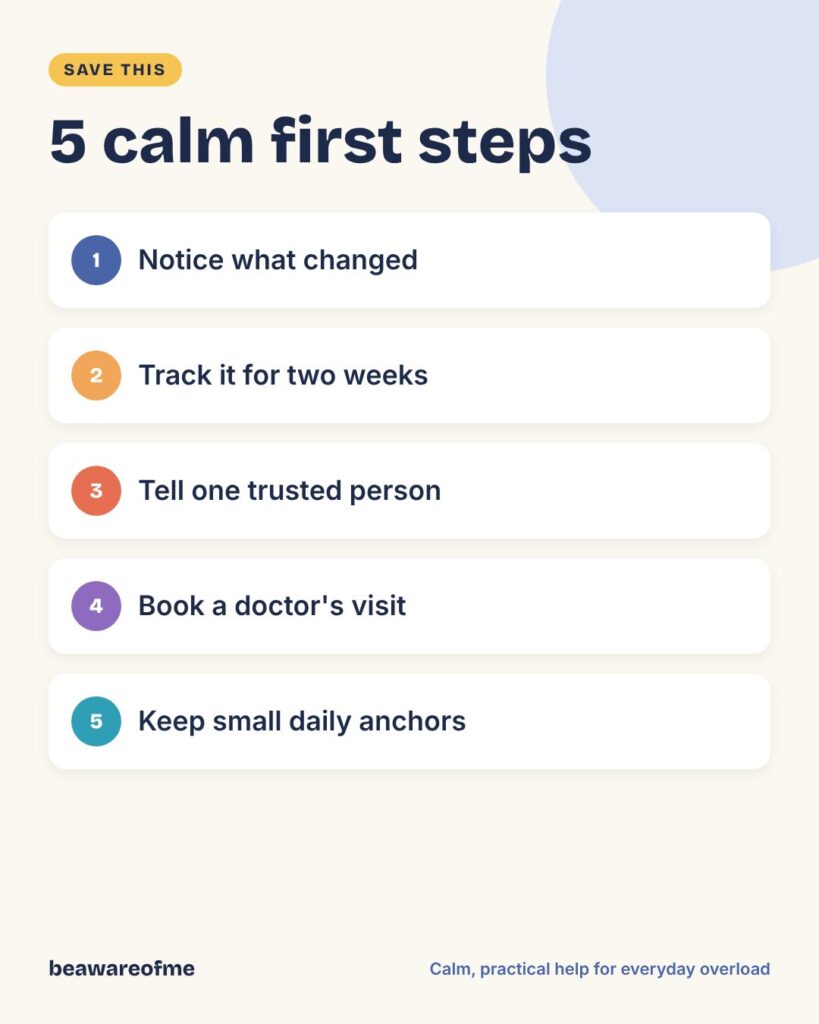
- Pick one person you trust and send the first message.
- Write down three signs and when they started.
- Book a GP or primary care appointment, even if it’s weeks away.
- Save a crisis number in your phone, just in case.
- Plan one small, kind thing for yourself each day.
5 Small Daily Anchors That Steady a Wobbly Week
Daily anchors won’t replace professional support when you’re struggling with mental health, but they give your nervous system a steadier base while you get help. Think of them as handrails, not cures.
- A fixed wake-up time. Your body clock steadies mood, energy and appetite.
- Ten minutes of daylight before noon. A short walk counts, even on a cloudy day.
- One real meal and one glass of water by midday. Low fuel makes every feeling louder.
- One moment of connection. A call, a text or a chat with a neighbour.
- A five-minute wind-down. Dim lights, put the phone away and breathe slowly.
If your thoughts race at night, try our grounding techniques for anxiety. For a broader routine, see why self-care matters for mental health.
5 Common Mistakes That Keep People Stuck
These mistakes are common among people struggling with mental health because they feel sensible in the moment. Each one quietly delays the help that would make things easier.
Mistake 1: Waiting until it’s “bad enough”
Many people think help is only for a crisis. In reality, early support tends to be shorter and gentler. Instead, use the two-week guide and reach out when signs persist, not when they peak.
Mistake 2: Comparing your pain with other people’s
“Others have it worse” is true for almost everyone, which makes it useless as a test. Your struggle counts because it affects your life. Instead, measure against your own normal.
Mistake 3: Treating each symptom as a separate problem
You buy a sleep app, a focus app and a new diet, and nothing sticks. Poor sleep, low focus and appetite changes can share one root. Instead, look at the full picture and share it with a doctor.
Mistake 4: Relying on willpower alone
Telling yourself to snap out of it adds shame to stress. Instead, swap “try harder” for “get support”: a person, a plan and small daily anchors.
Mistake 5: Self-diagnosing from online quizzes
Quizzes can help you notice patterns, but they can’t diagnose. A label from the internet can frighten you or falsely reassure you. Instead, use self-checks as a starting point and let a professional do the assessing.
Frequently Asked Questions About Struggling With Mental Health
How do I know if I’m struggling with mental health?
What are the early warning signs of poor mental health?
Can stress cause physical symptoms?
When should I see a doctor about my mental health?
Is it normal to feel numb instead of sad?
How can I help a friend who seems to be struggling?
Struggling with mental health is common, human and, most importantly, something you can get support for. Pick one step from this guide today, whether that’s a mood log, a text to a friend or a doctor’s appointment. For more calm, practical guides, explore our mental health library and our signs you should not ignore.