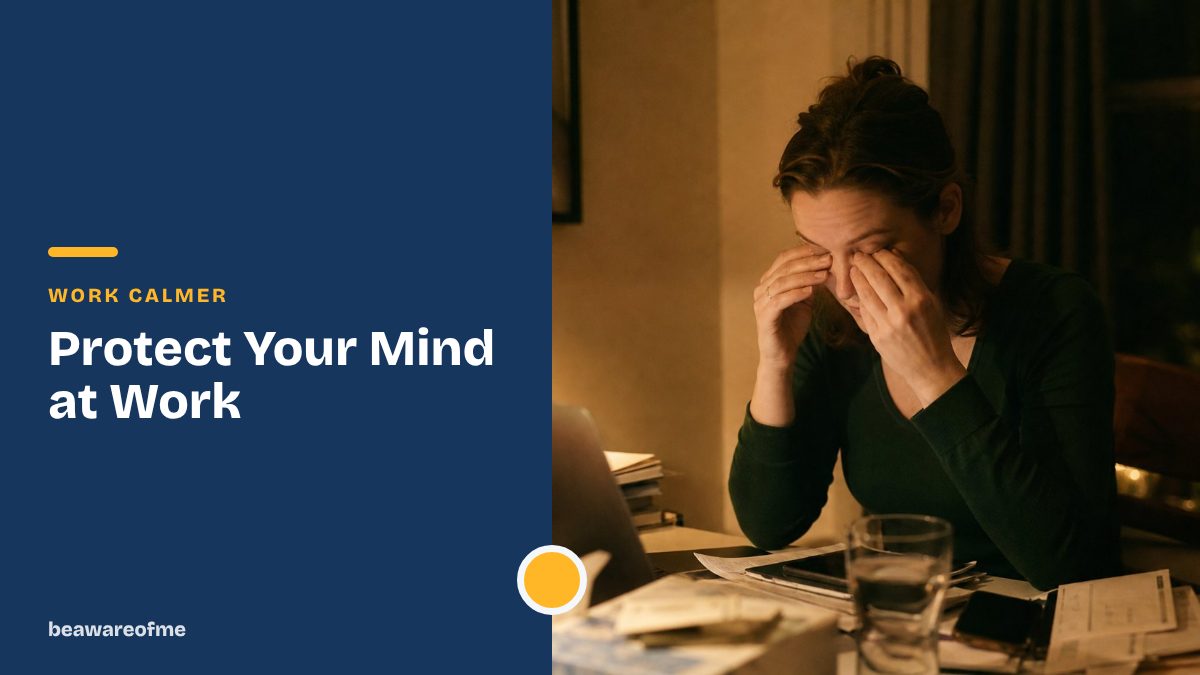
Some weeks you do good work and still drive home feeling hollowed out. That’s usually not a character flaw. It’s a sign that mental health in the workplace, yours, needs a little protection, the same way your back needs a decent chair. This guide gives you the early signs, a quick audit to find what’s draining you, scripts for your manager and daily habits that keep your mind steady at work.
The short answer
Mental health in the workplace means how your job affects the way you think, feel and cope, and how well your work setup supports you. It shapes your focus, your output and your evenings. Protect it by spotting early signs like poor sleep and short patience, naming the main drain (workload, control, support or conflict), asking for one specific change, and building small recovery habits into every working day.
Key takeaways
Treat changes in sleep, patience and focus as early signals, not as proof that you’re bad at your job.
Find your single biggest drain with a 15-minute audit before you try to fix everything at once.
Ask your manager for one concrete change with two options, rather than a vague request for less pressure.
Close each workday with a five-minute shutdown ritual so work stops following you home.
Use your employee assistance program or a doctor early, because support works best before you’re running on empty.
Why Mental Health in the Workplace Shapes Your Whole Day
Your job takes up more waking hours than almost anything else, so it quietly sets the tone for your mood, your sleep and your patience at home. When work goes well, it gives you structure, purpose and people. When it doesn’t, the strain leaks into everything.

Here’s the part most advice skips. Mental health in the workplace isn’t only about big diagnoses or wellness weeks. It’s about ordinary things: a calendar with no gaps, a manager who only replies at midnight, a role nobody ever defined. Small, repeated pressures add up faster than one dramatic crisis. So the best way to think about mental health in the workplace is as daily maintenance.
The numbers behind the feeling
You’re far from alone in this. The World Health Organization’s fact sheet on mental health at work estimates that 12 billion working days are lost every year to depression and anxiety. That costs the global economy about US$1 trillion a year in lost productivity.
12 billion
working days lost each year to depression and anxiety (WHO)
US$1 trillion
in lost productivity every year from those lost days (WHO)
16%
of working-age adults estimated to live with a mental disorder (WHO)
Presenteeism: the hidden cost you might be paying
Presenteeism means turning up to work but running at half power because you’re exhausted, anxious or low. You’re at your desk, yet every email takes three reads. It rarely shows in any report, which is exactly why it drags on for months and why it’s one of the most overlooked parts of mental health in the workplace.
If you recognise that foggy, going-through-the-motions feeling, treat it as information. It tells you something in your setup needs attention, and it’s a much kinder signal than burning out completely.
13 Work Conditions That Quietly Drain Your Mind
Most strain at work comes from the setup, not from you. The WHO lists a set of workplace risks to mental health, and once you see them named, it gets much easier to point at the real problem instead of blaming yourself.
Tick the rows that sound like your week
Read through the table and tick the two or three rows that feel familiar. Each one is a known pressure on mental health in the workplace, and you’ll use your ticks in the audit later.
| Work condition | What it feels like | One small move |
|---|---|---|
| Heavy workload or understaffing | You never finish, so you never rest | List tasks and ask which three matter most |
| Little control over your work | Decisions land on you without warning | Ask to agree deadlines before they’re set |
| Long or unsocial hours | Evenings vanish; weekends feel short | Protect one fixed finish time twice a week |
| Unclear role | You’re unsure what good looks like | Request three written priorities for the month |
| Low support from colleagues | You carry problems alone | Book a 15-minute check-in with one ally |
| Harsh or controlling supervision | You brace before every meeting | Keep notes and move asks into writing |
| Bullying, harassment or exclusion | Dread, shame or feeling unsafe | Record dates and raise it with HR or a union |
| Job insecurity or low pay | Constant background worry | Separate what you control from what you don’t |
| Skills under-used or stretched | Boredom or constant panic | Ask for one task that fits your strengths |
| Home and work demands clash | Guilt in both places | Name your non-negotiable hours to your team |
| Poor physical conditions | Noise, heat or no space to think | Ask for a quiet slot or headphones |
| Under- or over-promotion | Feeling stuck or out of your depth | Ask what support the next step needs |
| A culture that tolerates bad behaviour | Nobody calls out what’s wrong | Find one person you trust to speak with |
📝 Note
Not every row is yours to fix. Some, like harassment or chronic understaffing, belong to your employer. Naming them still helps, because it stops you treating a system problem as a personal weakness.
7 Early Signs Your Job Is Wearing You Down
Your body and habits usually notice job strain weeks before your mind admits it. Catching these signs early gives you far more options than waiting until you’re running on fumes. Early action is the quiet secret of good mental health in the workplace.
- Sunday dread starts on Saturday. The worry about Monday creeps earlier into your weekend.
- Sleep shifts. You wake at 4 a.m. replaying meetings, or you sleep ten hours and still feel flat.
- Your patience shrinks. Small things, like a slow reply, feel personal.
- Focus breaks into pieces. You open six tabs and finish none.
- You stop doing the things that refill you. The gym, the call with a friend, the hobby all slide.
- Your body complains. Tight shoulders, headaches or a jumpy stomach show up on workdays.
- Numbing gets easier. More scrolling, more wine, more snacks at the desk.
If three or more of these have stuck around for two weeks, take it seriously. The free burnout early signs check gives you a quick read on where you are right now.
Strain that looks like ‘doing fine’
Some people look calm and productive while running hot inside. If you over-prepare, can’t switch off and fear any mistake, read about high-functioning anxiety at work. It often hides behind good results, and it’s a side of mental health in the workplace that colleagues rarely see.
⚠️ Watch out
If the signs have lasted more than a few weeks, keep getting worse, or include thoughts of not wanting to be here, don’t wait it out. Talk to a doctor, and if you feel unsafe, contact a crisis line such as 988 in the US or Samaritans on 116 123 in the UK and Ireland.
A 15-Minute Audit to Find Your Biggest Drain
A quick written audit shows you which single problem to tackle first, so you stop trying to fix your whole working life in one weekend. The American Psychological Association’s guide to coping with work stress suggests tracking your stressors in a journal for a week or two, and this audit is a fast version of that idea.
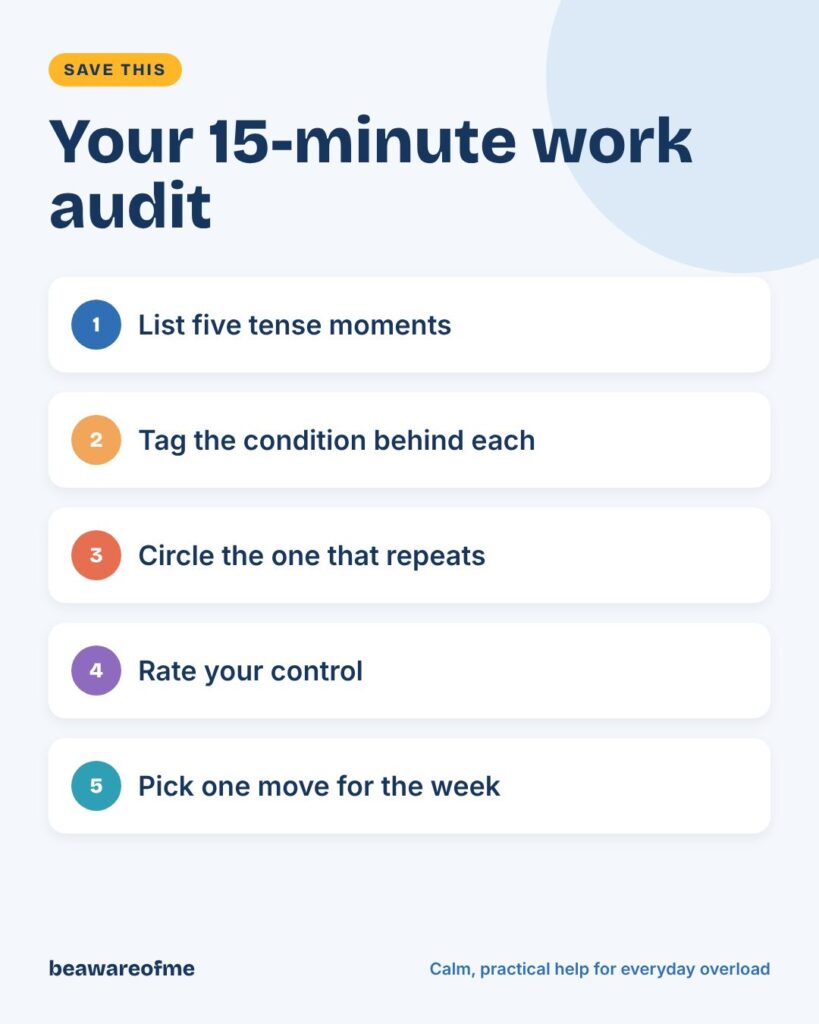
List your week (3 minutes)
Write down the five moments from the last week that left you most tense. Be specific: ‘Thursday 4 p.m. budget call’, not ‘meetings’.
Tag each one (3 minutes)
Next to each moment, write the condition behind it from the table above: workload, control, support, role, conflict or hours.
Spot the repeat (2 minutes)
Circle the tag that appears most. That’s your main drain, and it’s usually only one or two things.
Rate your control (3 minutes)
Mark it ‘mine’, ‘shared’ or ‘not mine’. This tells you whether to change a habit, ask for help or protect yourself.
Pick one move (4 minutes)
Choose one small action for the next five working days. Write when you’ll do it and what ‘done’ looks like.
What to do with your answer
If the drain is ‘mine’, change a habit, such as batching email. When it’s ‘shared’, ask your manager for a specific change. And if it’s ‘not mine’, focus on recovery and on documenting what’s happening.
This simple rule keeps you from wasting energy. You can’t breathe your way out of chronic understaffing, but you also don’t need a meeting with HR to stop checking email in bed.
Daily Habits That Protect Mental Health in the Workplace
Small, repeatable habits protect mental health in the workplace better than a big reset you can’t sustain. Think of them as guardrails for your attention and energy, not another to-do list.
Start the day with three, not thirty
Before you open your inbox, write the three outcomes that would make today a success. Everything else is a bonus. This tiny step gives your brain a finish line, and finish lines calm a busy mind.
Breaks that actually recover you
A break spent scrolling is just more input. Instead, step away from screens for two to five minutes every hour or so. Stand up, look out a window, refill your water or walk to the end of the corridor and back.
The WHO lists leisure-time physical activity as one way workers can protect their mental health in the workplace. You don’t need a full workout. A 10-minute walk at lunch counts, and it’s often the single best reset of the day.
✨ Quick win
Set a recurring calendar block called ‘Walk’ for 10 minutes after lunch. Treat it like a meeting with someone important, because it is.
Protect focus from the ping
Constant notifications keep your nervous system on alert. Check messages at set times, such as 10, 1 and 4, and mute non-urgent channels between them. Tell your team your rhythm so nobody worries when you don’t reply in 30 seconds. Fewer pings, calmer mind: that trade sits at the heart of mental health in the workplace.
The five-minute shutdown ritual
Without a clear end, work keeps running in your head all evening. A shutdown ritual signals to your brain that the day is done. Our guide on how to recover from work stress goes deeper, but this short version works well.
Try this today
Your five-minute workday shutdown
Write down anything unfinished so your brain can let go of it.
Pick tomorrow’s top three outcomes.
Close every tab and app you used for work.
Say a closing phrase out loud, such as ‘Done for today’.
Do one physical transition: change clothes, walk or make tea.
If you work from home, the shutdown matters even more, because there’s no commute to mark the change. These remote work mental health struggles are common, and a firm ritual helps with most of them.
How to Talk to Your Manager Without Over-Sharing
You can ask for support with your mental health in the workplace without telling your manager your whole story. Focus on the work and the change you need; your private details stay private unless you choose to share them.
A simple three-part script
Good requests name the situation, the impact and a specific ask. They also offer options, which shows judgement and makes ‘yes’ easier to say. Book a short meeting in advance rather than catching your manager on the way out.
💬 Scripts you can adapt
Workload: “I’ve got X, Y and Z due this week. I can do two of them really well. Which one should move, or can someone take part of Z?”
Clarity: “I want to make sure I’m focusing on the right things. Could we agree my top three priorities for this month?”
Health: “I’m dealing with a health matter and I’d find a little flexibility helpful for a few weeks. Could we talk about my start time on two days?”
After hours: “I do my best work when I’m offline after 6. If something’s truly urgent, call me; otherwise I’ll pick it up first thing.”
What you can reasonably ask for
The WHO describes reasonable accommodations such as flexible hours, adjusted tasks and time off for health appointments. Depending on where you live, some of these may also have legal protection, so check your local rules or ask HR.
- A temporary change to start or finish times
- Moving one demanding task to a colleague for a set period
- A quieter space or permission to wear headphones
- Regular short check-ins instead of one big review
- Time off for appointments without needing a long explanation
💡 Tip
Many employers offer an employee assistance program (EAP), a free and confidential service for staff. It often includes short-term counselling. Look for it on your intranet or ask HR, without explaining why. It’s one of the most under-used supports for mental health in the workplace.
If You Lead a Team: 5 Moves That Make Health in the Workplace Real
Managers shape health in the workplace more than any poster or app. The WHO recommends manager training to recognise and respond to distress, plus open communication and active listening, and you can start most of that this week.
Ask a better question
Swap ‘How’s it going?’ for ‘What’s taking more energy than it should right now?’ It invites a real answer.
Listen to understand
Repeat back what you heard before suggesting anything. People feel calmer when they feel heard.
Fix the work, not the person
If someone’s struggling, look first at workload, clarity and deadlines. Those are levers you control.
Model the boundary
Don’t send late-night messages. If you must write late, schedule it to arrive in the morning.
Know where to point people
Keep the EAP details and local crisis numbers handy so you can share them in the moment.
You don’t need to be a counsellor. Your job is to notice, ask and connect people with support, which is how mental health in the workplace improves team by team. For a broader view, see our guide on building a supportive work environment.
“You can’t breathe your way out of chronic understaffing, but you can stop answering email in bed.”
Stress, Burnout or Something Else? A Quick Comparison
Not all work strain is the same, and the right response depends on what you’re dealing with. This comparison helps you put a rough name to it, though only a professional can assess your situation properly. Think of it as a map for your own mental health in the workplace.
| Everyday work stress | Burnout | Possible health concern | |
|---|---|---|---|
| How it feels | Pressured but engaged | Empty, cynical, detached | Low mood or worry beyond work |
| Rest helps? | Yes, a weekend resets you | Barely; you return drained | Not much, even on holiday |
| Where it shows | Busy periods | Mostly about the job | Across work, home and sleep |
| Best first step | Habits and boundaries | Change the workload or role | Talk to a doctor |
If burnout sounds familiar, read how stress differs from burnout and our guide on overcoming burnout. If it feels bigger than work, it’s time to talk to someone qualified.
When It’s More Than a Rough Patch
Sometimes job strain turns into something that needs more than better habits. Knowing when to reach out is part of looking after mental health in the workplace, not a sign you failed at it.
Signs it’s time to get support
- Low mood, worry or numbness has lasted more than two weeks.
- You can’t switch off even on holiday.
- Sleep, appetite or energy have changed a lot.
- You’re relying on alcohol or other substances to get through the week.
- You feel hopeless, or have thoughts of harming yourself.
Your GP or family doctor is a good first stop. They can check for physical causes and talk through options. If you ever feel unsafe, contact emergency services or a crisis line straight away.
Build resilience without blaming yourself
Resilience isn’t about tolerating more. It’s about recovering well and having people around you, two pillars of mental health in the workplace. Our guide on building resilience in the workplace shares practical ways to do that, and you can browse more in our workplace mental health articles.
5 Common Mistakes That Make Work Strain Worse
Even smart, caring people fall into these traps, mostly because they look like dedication from the outside. Each one chips away at mental health in the workplace over time. Here’s what to watch for and what to try instead.
1. Waiting for a quieter month
The quiet month rarely comes, so recovery keeps getting postponed. Build small breaks into ordinary weeks instead of saving rest for a holiday that might be months away.
2. Fixing yourself when the job is the problem
Meditation apps won’t fix an impossible workload. If your audit points to workload or role, the fix is a conversation, not more self-discipline. Use habits for what you control and requests for what you don’t. Good mental health in the workplace needs both.
3. Telling everyone or no one
Over-sharing with the whole team can backfire, while telling nobody leaves you isolated. Choose one or two trusted people at work, and keep your manager conversation focused on the work and the change you need.
4. Using evenings to catch up
Late-night catch-up feels productive but steals the sleep you need to work well tomorrow. It also trains your team to expect it. Protect a finish time, even if it’s later than ideal at first.
5. Ignoring the body’s early warnings
Headaches, jaw tension and a churning stomach are easy to dismiss. They’re often the earliest signs of strain. Treat them as a cue to slow down and, if they persist, get them checked by a doctor.
Mental Health in the Workplace: 6 Questions People Ask
These are the questions people type into search most often about mental wellbeing at work, with short, practical answers.
Why is mental health important at work?
Your mental wellbeing affects focus, decision-making, relationships and energy, so it shapes how well you work and how you feel afterwards. When it suffers, mistakes and sick days rise and enjoyment drops. Looking after it helps you do good work without paying for it with your evenings, sleep and health. It also makes teams kinder and more effective.
How can I improve my mental health at work today?
Pick three outcomes for the day before opening your inbox. Take a short screen-free break every hour or so, and walk for ten minutes at lunch. Check messages at set times instead of constantly. End the day with a five-minute shutdown ritual. These small steps calm your nervous system and protect your evening, and they cost nothing to start.
Should I tell my employer about a mental health condition?
That’s your choice, and you don’t have to share details to ask for support. Many people focus on the change they need, such as flexible hours or a lighter task for a few weeks. If you do disclose, some countries offer legal protections and workplace adjustments. Check your local rules, and consider talking it through with your doctor or HR first.
What is an employee assistance program?
An employee assistance program, or EAP, is a confidential service that some employers provide for staff. It often includes short-term counselling, advice lines and help with issues like money, family or stress. Your employer usually won’t know who uses it. Look on your intranet or benefits pack, or ask HR for the contact details without giving a reason.
What are the signs of poor mental wellbeing at work?
Common signs include trouble sleeping, irritability, poor focus, withdrawing from colleagues, constant worry about work and physical symptoms like headaches. You might also notice Sunday dread or numbing with scrolling or alcohol. One bad week isn’t a pattern, but signs that last two weeks or more deserve attention and, if they’re affecting daily life, a chat with a doctor.
How do managers support staff who are struggling?
Managers help most by noticing changes, asking open questions and listening without rushing to fix. They can then adjust the work itself, such as deadlines, workload or clarity, and point people to support like an EAP. Modelling healthy boundaries matters too. Managers don’t need to act as counsellors; their role is to notice, ask and connect.
Mental health in the workplace grows from small, steady choices: noticing early, naming the real drain and asking for one clear change at a time. Start with the 15-minute audit this week, protect your shutdown ritual, and let each calmer workday make the next one a little easier.
Please note: Educational content, not a substitute for professional care. If you are struggling, talk to a doctor or a qualified professional. If you are thinking about harming yourself, contact local emergency services or a crisis line now (US 988, UK and Ireland Samaritans 116 123, or findahelpline.com).