




It’s 12:40am, your eyes sting, and you’re still scrolling, watching one more episode or tidying a drawer nobody asked you to tidy. You know tomorrow will hurt, yet these quiet hours feel like the only time that’s truly yours. That pull has a name, revenge bedtime procrastination, and this guide shows you why it happens and how to get your evenings back without giving up your me-time.
🌱 Key takeaways
What Revenge Bedtime Procrastination Really Is (and Why It Feels Earned)
Revenge bedtime procrastination is the habit of pushing bedtime later and later to claim leisure time, even when nothing outside you is keeping you up. The “revenge” part is the feeling of taking back hours that work, family or chores swallowed during the day. It often feels like a small, justified rebellion.

Here is the whole guide at a glance. Find the sign that sounds most like you and start with its first fix tonight.
| Sign | What it looks like | First fix |
|---|---|---|
| The endless scroll | Phone in bed until after midnight | Charge it outside the bedroom |
| The second evening | Tasks done at 10pm, then fun begins | Book me-time before 9pm |
| The episode trap | “Just one more” turns into three | Decide the number before you press play |
| The guilty morning | Tired, foggy, promising change | Fixed wake time, even on weekends |
| The packed day | No breaks from 7am to 9pm | Two short breaks that are truly yours |
| The heavy feeling | Late nights plus low mood for weeks | Talk to a doctor |
Where the Name Comes From
According to the Sleep Foundation, the English phrase comes from a translation of a Chinese expression. It captured frustration with long, stressful working hours that left little personal time, then spread widely on social media.
Researchers had already studied a related idea called bedtime procrastination: going to bed later than you intended without an outside reason. The revenge version adds a layer of emotion, because the delay feels like reclaiming something that was taken.
Who Tends to Get Caught in the Late-Night Loop
Anyone with a packed, demanding day can slip into revenge bedtime procrastination. It shows up often in people with long working hours, shift-like schedules, young children or caring duties. Students juggling study and part-time jobs report it too.
The common thread is control. When most of your waking hours belong to someone else, revenge bedtime procrastination becomes a quiet way to say, “This part is mine.” Seeing it that way takes the shame out of it and points straight at the real fix.
The Three Signs That Separate It From Being a Night Owl
Not every late night counts. A natural night owl who sleeps from 1am to 9am and feels rested is simply following their body clock. Revenge bedtime procrastination usually has three ingredients together:
- You delay sleep later than you planned, most nights or many nights a week.
- Nothing forces you to stay up; no deadline, baby or shift keeps you awake.
- You know it costs you, yet you do it anyway because the time feels precious.
📝 Note: If you lie in bed for hours wanting to sleep but can’t, that’s a different problem from choosing to stay up. Ongoing trouble falling or staying asleep is worth raising with a doctor.
Why You Stay Up Even When You’re Exhausted
You fall into revenge bedtime procrastination because your day left no room for you, and the night is the first stretch nobody can claim. Exhaustion and the urge for freedom arrive at the same moment, and freedom usually wins. Understanding the pull makes it much easier to work with.
The Daytime Deficit Behind the Late Nights
Most people who struggle with revenge bedtime procrastination don’t have a sleep problem at heart. They have a time problem. If your day runs from alarm to commute to work to dinner to dishes to emails, the hours after 10pm become the only time without demands.
The Sleep Foundation notes that people who procrastinate in other areas of life may be more prone to revenge bedtime procrastination, and that one study found students and women more likely to delay bedtime. Long caring duties and busy jobs often sit behind those patterns.
Why Willpower Runs Out at Night
By late evening, you’ve made hundreds of choices. Your energy for self-control drops, and the easy option, one more video, wins over the wise one. That’s why a plan made at 3pm (“I’ll be in bed by 11”) falls apart at 10:55.
Your phone makes revenge bedtime procrastination even harder to resist. Autoplay, endless feeds and notifications remove natural stopping points, so you never hit a clear moment to stop. If late scrolling leaves you feeling worse, our guide on how to stop doomscrolling has practical exits.
Stress and Worry Can Feed the Habit
Sometimes staying up is a way to avoid the quiet moment when worries rush in. If lying in the dark brings racing thoughts, scrolling feels safer. Our guide to anxiety at night covers calmer ways to handle that moment.
⚠️ Watch out: If you delay bed because tomorrow feels unbearable, notice that feeling. Dread about work or life that lasts for weeks can be a sign of burnout or low mood, and it deserves real support, not just a better routine.
What Those Stolen Hours Really Cost You
The hours you win at night are often borrowed from tomorrow’s mood, focus and patience. The CDC recommends 7 or more hours of sleep for adults aged 18 to 60. Regularly falling short of that leaves less fuel for the very days that made you crave free time.
7+ hrs
of sleep per night is the recommendation for adults aged 18 to 60.
CDC
30 min
is the minimum screen-free buffer before bed the Sleep Foundation suggests.
Sleep Foundation
~40%
of people reported sleep problems during the pandemic, per research the Sleep Foundation cites.
Sleep Foundation
The Loop That Keeps Repeating
Short sleep makes the next day feel longer and harder. You get less done, you feel more drained, and by evening you feel even more entitled to your stolen hours. That is how revenge bedtime procrastination tightens its grip night after night.
- Mood: you may feel irritable, flat or tearful more easily.
- Focus: simple tasks take longer and mistakes creep in.
- Food and energy: tired days often bring more caffeine and sugar.
- Relationships: patience runs thin with the people you live with.
If you’ve started to wonder whether you’re lazy, read the signs you’re burnt out, not lazy. Late nights and constant tiredness often point to overload, not a flaw in your character.
The goal isn’t less time for you. It’s me-time that doesn’t steal from tomorrow.
— beawareofme
How to Stop Revenge Bedtime Procrastination Without Losing Your Me-Time
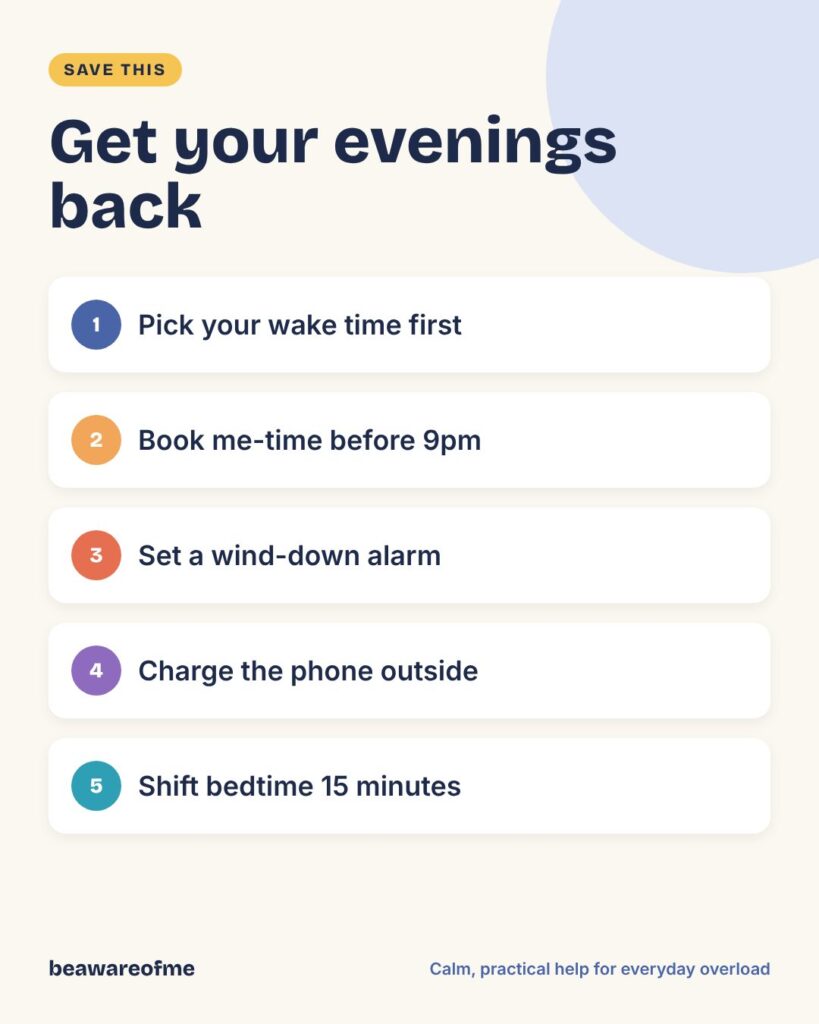
The best way to stop revenge bedtime procrastination is to keep the free time and change when and how it ends. Strict rules alone tend to fail, because they take away the very thing you’re hungry for. These nine steps work with your need for freedom instead of against it.
Pick a time you can keep seven days a week, then count back 7 to 8 hours.
Block 30 to 60 minutes before 9pm for something you enjoy, and protect it.
Choose two episodes or one chapter before you start, not after.
An alarm 45 minutes before bed is your cue to start winding down.
Charge it in the kitchen or hallway and use a cheap alarm clock.
Fresh sheets, a good book, a podcast with a sleep timer.
Lay out clothes and pack bags right after dinner, not at 11pm.
Move bedtime earlier in 15-minute steps every few nights.
One late night is data, not failure. Return to the plan tomorrow.
Why Earlier Me-Time Works Better Than a Strict Bedtime
When you know you’ll get your hour of freedom at 8pm, revenge bedtime procrastination starts to lose its purpose, and the 11pm urge loses its power. Your brain stops treating bedtime as the moment your free time gets stolen. Instead, sleep becomes the natural end of an evening that already gave you something.
This is the core idea most advice skips. People try to force an earlier bedtime and wonder why it lasts three days. The pull to stay up only fades when the need underneath it is met.
💡 Tip: Use the free bedtime calculator to find a bedtime that fits your wake time and sleep cycles. Seeing the number in black and white makes it easier to plan your evening backwards.
A Sample Evening Plan That Actually Works
Here is what an evening without revenge bedtime procrastination can look like for someone who wakes at 6:30am. Adjust the times to your own wake time.
- 7:00pm: dinner and a quick tidy, with tomorrow’s bag packed straight after.
- 8:00pm: protected me-time: a show, a game, a call or a bath.
- 9:45pm: wind-down alarm, phone goes on the kitchen charger.
- 10:00pm: shower, stretch, dim lights, book or audiobook.
- 10:30pm: lights out, about eight hours before the alarm.
Scripts for the Moment You Want One More Episode
- “I already had my time tonight. This is borrowing from tomorrow.”
- “I’ll enjoy this more after a good night’s sleep.”
- “Future me deserves a decent morning too.”
- “The show will still be here tomorrow. My energy won’t be, if I stay up.”
Move Your Free Time Earlier and Fix the Daytime Deficit
Revenge bedtime procrastination shrinks fastest when your day contains a few moments that are truly yours. You don’t need a whole free afternoon. Small pockets of real rest take pressure off the night.
Find Three Pockets of Time in a Packed Day
- A real lunch break: 20 minutes away from the screen, even once or twice a week to start.
- Short breaks at work: our guide to microbreaks for calmer work shows how two-minute pauses add up.
- A commute ritual: a podcast, a song you love or a walk from a further bus stop.
- An evening hour: after dinner, before chores, protected like a meeting.
If You’re a Parent or Carer
Parents and carers often feel revenge bedtime procrastination most sharply, because the evening is the first time nobody needs them. Instead of waiting for the house to go silent, try a short swap with a partner, friend or relative: one evening each where the other covers bedtime duty.
Even 20 minutes alone right after the kids sleep, rather than at midnight, can take the edge off the urge to stay up.
Share the Load and Say No More Often
If your evenings disappear into chores and other people’s needs, the fix may be a conversation, not a routine. Ask a partner or housemate to swap tasks, or let some jobs wait until the weekend. Saying no to one optional request a week can hand you back an hour.
Self-care doesn’t have to be fancy. Our guide to sleep as part of self-care explains why rest counts as care, not as wasted time.
☀️ Try this today: your me-time rescue plan
☐ Write down when you’d like to wake up tomorrow.
☐ Count back 7.5 hours and write your target bedtime.
☐ Block one hour before 9pm as “mine” in your calendar.
☐ Choose what you’ll do with it: show, game, bath, call or book.
☐ Set a wind-down alarm 45 minutes before your target bedtime.
Say to your household: “From 8 to 9 is my hour. After that I’m all yours, and I’m going to bed on time.”
Build an Evening That Ends on Its Own
A good evening has a clear finish line, so you don’t have to rely on willpower at midnight. A short, repeatable routine tells your body sleep is coming. The Sleep Foundation recommends putting screens away at least 30 minutes before bed and keeping a steady sleep schedule, even on days off.
Swap the Habits That Keep You Up
| Late-night habit | Easy swap | Why it helps |
|---|---|---|
| Scrolling in bed | Paper book or audiobook | No endless feed, a natural stop |
| Autoplay on | Turn autoplay off | Each episode becomes a choice |
| Evening coffee | Herbal tea after lunch | Less caffeine in your system at night |
| Bright overhead light | Lamp or warm light | Signals evening to your body |
| Emails at 11pm | Shutdown time at 8pm | Work stays out of the bedroom |
| Weekend lie-ins | Same wake time daily | Steadier body clock all week |
A 20-Minute Wind-Down That Feels Good
Think of your wind-down as part of your me-time, not a chore. Dim the lights, have a warm shower, stretch for five minutes, then read or listen to something calm. For more ideas, see our list of ways to relax before bed.
A digital curfew helps many people stick to it. Our guide on setting a phone bedtime shows how to set app limits and grayscale mode so your device gets boring at night.
✨ Small step: Turn on your phone’s grayscale mode at 10pm. Colour is part of what keeps feeds so gripping, and a grey screen loses much of its pull.
What to Do on Nights It Happens Anyway
Some nights you’ll still stay up too late, and that’s fine. Revenge bedtime procrastination rarely disappears in one go. The next morning, get up at your usual time anyway, get some daylight, and skip the long nap that would push tonight later.
Then ask one gentle question: what did I need yesterday that I didn’t get? The answer, whether rest, fun or quiet, tells you what to schedule earlier today.
When to Talk to a Doctor
Most late-night habits improve with a better routine, but some need more help. Talk to a doctor if you sleep badly even when you go to bed on time, you feel very sleepy during the day, or late nights come with low mood, anxiety or hopelessness for more than a couple of weeks.
5 Common Mistakes When Fighting Revenge Bedtime Procrastination
Most mistakes with revenge bedtime procrastination come from good intentions, which is why they’re so easy to make. Each one tends to backfire within a week.
Mistakes That Make Nights Harder
- Cutting all evening fun. Removing leisure makes the pull stronger. Instead, move it earlier and keep it.
- Jumping two hours earlier overnight. You’ll lie awake and give up. Instead, shift in 15-minute steps.
- Keeping the phone “just for the alarm”. It rarely stays just an alarm. Instead, use a simple alarm clock.
Mistakes That Make Mornings Harder
- Sleeping in to catch up. Long lie-ins push your body clock later. Instead, keep your wake time and nap briefly if needed.
- Beating yourself up. Guilt adds stress, and stress feeds the late nights. Instead, treat each night as a fresh start.
📚 Keep reading
Improve sleep when stressedHow doomscrolling affects youCreate screen-free zonesMore on everyday lifeLate-Night Questions: 6 Quick FAQs
Why do I stay up late when I’m tired?
Many people stay up late because the day left no time that felt like their own. Once the demands stop, the quiet hours feel precious, and tiredness loses to the wish for freedom. Low willpower at night and phones without natural stopping points make it harder to stop. Moving some free time earlier usually weakens the late-night pull.
Is staying up for me-time bad for you?
Wanting personal time is healthy; the problem is losing sleep to get it. Adults aged 18 to 60 need 7 or more hours a night, according to the CDC. Regularly falling short can affect mood, focus and patience. The goal is to keep your me-time but move it earlier, so it doesn’t eat into the sleep your body needs.
How do I stop staying up late on my phone?
Charge your phone outside the bedroom and use a basic alarm clock. Turn off autoplay, set app time limits for the evening, and switch on grayscale mode at night so feeds feel less gripping. Replace the scroll with a paper book or an audiobook with a sleep timer. Small barriers work better than relying on willpower at midnight.
Is it a sign of burnout?
It can be. If your days feel so full or draining that the only free time comes after 11pm, that pattern often points to overload. Signs like constant tiredness, dread about tomorrow and feeling detached from work suggest burnout may be part of the picture. A doctor or counsellor can help you sort out what is going on.
How long does it take to fix the habit?
Many people notice a difference within one to two weeks of moving me-time earlier and keeping a fixed wake time. Shift your bedtime in 15-minute steps every few nights rather than all at once. Expect some off nights, especially at weekends. Each late night is information about what you need, not proof that the plan failed.
When should I see a doctor about my sleep?
See a doctor if you struggle to fall or stay asleep even when you go to bed on time, feel very sleepy during the day, or snore loudly. Also seek help if late nights come with low mood, anxiety or hopelessness lasting more than two weeks. Poor sleep and mental health often affect each other, and support helps both.
Revenge bedtime procrastination is a signal that your days need more room for you, not a sign that you lack discipline. Give yourself that time earlier, let your evening end on purpose, and you’ll find the night no longer has to pay for everything the day took.
📝 Please read: Educational content, not a substitute for professional care. If you are struggling, talk to a doctor or a qualified professional. If you are thinking about harming yourself, contact local emergency services or a crisis line now (US 988, UK and Ireland Samaritans 116 123, or findahelpline.com).