Your heart pounds, your chest tightens, and a wave of dread tells you something is badly wrong. A panic attack can feel like an emergency even when your body is safe, and that mismatch is what makes it so frightening. This guide gives you the full plan in one place: what a panic attack is, exactly what to do during and after one, how to make the next one less likely, and when to get urgent care.
🤝 Not sure if it’s panic?
If you have chest pain, trouble breathing that does not ease, fainting, or symptoms you’ve never had before, call your local emergency number now. It’s always okay to get checked. If panic comes with thoughts of harming yourself, contact a crisis line: US 988, UK and Ireland Samaritans 116 123, or findahelpline.com.
🌱 Key takeaways
What a Panic Attack Actually Is (and Why It Feels Like Danger)
A panic attack is your body’s alarm system firing at full volume when there is no real threat to fight or flee. Stress hormones flood your system, your heart speeds up, and your breathing gets fast and shallow. The feelings are real and intense, yet they are not dangerous in themselves.
Here is the whole plan at a glance. Save it, screenshot it, or come back to it whenever you need a reminder.
| Phase | What’s happening | What to do |
|---|---|---|
| First 60 seconds | Heart races, fear spikes | Stay put, say “this is panic, it will pass” |
| Minutes 1 to 10 | Symptoms peak | Slow out-breaths, 5-4-3-2-1 grounding |
| Minutes 10 to 20 | The wave eases | Keep breathing, sip water, unclench |
| The first hour after | Tired, shaky, on edge | Rest, eat, write a short note |
| The weeks after | Fear of the next one | Daily calm habits, talk to a doctor |
| Red flags | Chest pain, new or different symptoms | Call emergency services |
Your Body’s Alarm Explained in Plain Words
Your brain has a built-in threat detector that can trigger the fight-or-flight response in seconds. It speeds your heart to move blood to your muscles, quickens your breathing to take in oxygen, and sharpens your focus on danger. In a real emergency that helps; during a panic attack it just leaves you feeling terrified.
Over-breathing adds to the storm. Breathing fast lowers carbon dioxide in your blood, which can bring tingling fingers, dizziness and a feeling that you can’t get enough air. That last feeling makes you breathe even faster, so the loop tightens.
How Long It Lasts, in Real Numbers
According to the NHS guide to panic disorder, most panic attacks last between 5 and 20 minutes, although some people report longer ones. The National Institute of Mental Health estimates that 2.7% of US adults had panic disorder in the past year, with a lifetime figure of 4.7%.
5-20 min
is how long most panic attacks last, according to the NHS.
NHS
2.7%
of US adults had panic disorder in the past year.
NIMH
4.7%
of US adults experience panic disorder at some point in life.
NIMH
Panic, Anxiety Attack or Panic Disorder: Which Is It?
These terms get mixed up all the time, so here is a simple way to tell them apart. Only a doctor can assess what’s going on for you, but knowing the words helps you describe it clearly.
| Term | What it usually means | Typical pattern |
|---|---|---|
| Panic attack | A sudden surge of intense fear with strong body symptoms | Peaks within minutes, then fades |
| Anxiety attack | An everyday phrase for a build-up of worry and tension | Grows gradually, can last longer |
| Panic disorder | Repeated unexpected attacks plus ongoing fear of more | Worry about attacks lasting a month or longer |
If your symptoms creep up over hours with tight shoulders and racing thoughts, our piece on how anxiety attacks show up in your body covers that slower pattern.
During a Panic Attack: Your 5-Step Plan for the Next 10 Minutes
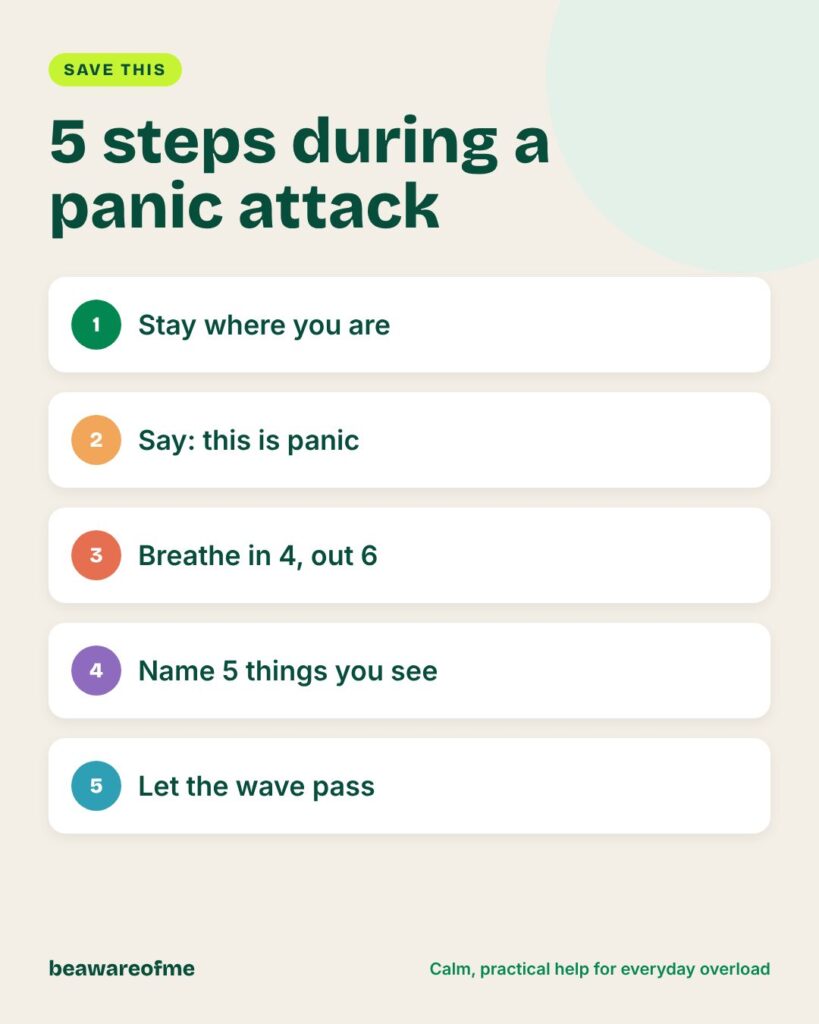
During a panic attack your only job is to ride the wave until it passes, not to make it stop instantly. That shift sounds small, but fighting the feelings usually makes them stronger. Use these five steps in order.
If you’re safe, stop and sit or lean against a wall. Running tells your brain the danger is real.
Say, “This is panic. It feels awful, and it will pass.”
Breathe in through your nose for 4, out through your mouth for 6.
Find 5 things you can see, 4 you can touch, 3 you can hear.
Notice the peak, then notice it easing. You don’t need to push it away.
Breathing That Calms Instead of Adding Pressure
Slow breathing with a longer exhale is the fastest tool you carry with you. The NHS advises breathing slowly and deeply during an attack, and counting gives your mind something steady to hold. Try box breathing if you prefer a simple pattern: in for 4, hold for 4, out for 4, hold for 4.
If counting feels hard, let the free box breathing coach pace you on screen. Don’t gulp big breaths, though, because deep, fast breathing can make dizziness worse.
💡 Tip: Put one hand on your belly and one on your chest. Aim to move the belly hand more than the chest hand. It gives your attention a job and slows the breath without forcing it.
Grounding Tricks When Your Mind Is Racing
Grounding pulls your attention away from fear and back into the room. Press your feet into the floor, hold something cold, or describe an object in detail in your head. For a full toolbox, read our guide to grounding techniques that stop a panic attack quickly.
Need the fastest version? Our step-by-step page on how to stop a panic attack fast walks you through a 90-second routine you can save to your phone.
What to Say to Yourself in the Middle of It
- “My body is sounding a false alarm. I’m safe right now.”
- “I’ve felt this before, and every time it has passed.”
- “I don’t have to fix this. I only have to breathe.”
- “This is the peak. It gets easier from here.”
If It Happens at Work or in Public
A panic attack in a meeting, queue or train can feel doubly scary, because you worry about people noticing. In reality, most people around you are busy with their own day. Step to a quieter spot if you can, such as a bathroom, stairwell or outside, and run the same five steps.
If you can’t leave, sit down, rest your feet flat and breathe out slowly through pursed lips. A short line like “I just need a minute” is enough explanation. You owe nobody more detail than that.
⚠️ Watch out: If you’re driving when panic hits, signal and pull over somewhere safe before you try any technique. Your safety comes first, and the breathing can wait 30 seconds.
The First Hour After: How to Recover Without Dreading the Next One
The hour after a panic attack shapes how you’ll feel about the next one, so treat it as recovery time. Many people feel shaky, drained or embarrassed. That tiredness is normal; your body just ran a sprint without moving.
Look After Your Body First
- Sit or lie down for 10 to 15 minutes if you can, and let your heart rate settle.
- Drink water and eat something small, especially if you skipped a meal.
- Move gently, such as a slow walk, to burn off leftover adrenaline.
- Skip extra caffeine and alcohol, which can stir up the same body sensations.
Write Two Lines, Not a Whole Essay
A short note helps you spot patterns without dwelling on the fear. Write where you were, what you noticed first, and what helped. After a few entries you may see links to skipped meals, poor sleep, crowded places or stressful calls.
Keep it kind. You’re collecting clues, not building a case against yourself. If writing helps, our guide to journaling for anxiety has simple prompts.
📝 Note: Fear of the next panic attack often causes more trouble than the attacks themselves. If you start avoiding shops, transport or exercise because of it, that’s a good moment to talk to a doctor.
A panic attack is a wave, not a wall. You don’t have to stop it; you only have to let it pass through.
— beawareofme
Prevent the Next Wave: 8 Habits That Lower Your Baseline
You can’t guarantee you’ll never panic again, but you can lower the background tension that makes attacks more likely. The Mayo Clinic lists major stress, big life changes, smoking and heavy caffeine use among the risk factors, and recommends regular physical activity and early treatment.
Daily Habits That Calm Your Nervous System
- Move most days. A brisk 20-minute walk helps your body get used to a raised heart rate without fear.
- Watch the caffeine. Try cutting back for two weeks and notice whether your heart feels calmer.
- Protect sleep. Short nights raise anxiety, so keep a steady wake time.
- Eat regularly. Low blood sugar can mimic shakiness and set off worry.
- Practise breathing when calm. Five minutes a day makes it automatic when panic arrives.
- Ease off alcohol. The rebound anxiety the next day can trigger symptoms.
- Schedule worry time. Ten minutes of writing worries down keeps them from building all day.
- Use quick resets. Our list of quick relaxation techniques gives you options for busy days.
Learn Your Early Warning Signs
Many people notice small signals before a full panic attack: a flutter in the chest, a tight throat, a sudden urge to leave. Spotting these early gives you a head start. The moment you notice one, begin your slow breathing rather than waiting to see if it grows.
Your two-line notes from the recovery hour make these signals easier to see. Over a few weeks, you may find a clear sequence, such as poor sleep, then an extra coffee, then a crowded commute.
Practise the Sensations So They Lose Their Power
Therapists sometimes guide people to bring on mild panic sensations on purpose, such as spinning in a chair for dizziness or jogging on the spot for a fast heartbeat. The aim is to teach your brain that these feelings are uncomfortable, not dangerous. Do this with a professional if your attacks are frequent or intense.
☀️ Try this today: a 10-minute panic-proofing routine
☐ Practise 4-in, 6-out breathing for two minutes while you’re calm.
☐ Write your three favourite calming phrases on your phone’s lock screen.
☐ Walk briskly for five minutes and notice your heart rate without judging it.
☐ Pick one grounding object to keep in your bag or pocket.
☐ Tell one trusted person what helps you during a panic attack.
Text to a friend: “If I ever get panicky, the best thing you can do is sit with me, breathe slowly, and remind me it will pass.”
✨ Small step: If your attacks cluster at night, read our guide to waking up at 3am with anxiety. It covers the bedtime habits that keep the alarm quieter.
When a Panic Attack Needs Urgent Care
Treat any new, severe or unusual symptoms as a medical question first and a panic question second. Panic symptoms can look like other serious problems, and the Mayo Clinic notes they can resemble a heart attack. Getting checked is never an overreaction.
Call Emergency Services If You Notice
- Chest pain, pressure or tightness, especially spreading to your arm, jaw or back.
- Your first-ever episode, or one that feels different from your usual pattern.
- Fainting, confusion, or trouble speaking or seeing.
- Breathing trouble that does not ease after several minutes of slow breathing.
- Symptoms after a new medicine, a drug or an injury.
- Any thoughts of harming yourself.
⚠️ Watch out: Never let fear of “wasting their time” stop you. Emergency teams would much rather rule out a heart problem than miss one. If it turns out to be panic, that’s useful information too.
Book a Regular Doctor Visit If
See your doctor if panic attacks keep coming, you worry about the next one for weeks, or you’ve started avoiding places. The NHS notes that doctors may examine you to rule out other causes. That check alone often brings relief.
Getting Help That Works: Therapy, Medicine and Support
Panic responds well to treatment, and many people see real improvement within months. The NHS describes panic disorder as regular, unexpected attacks followed by at least a month of ongoing worry about having more. If that sounds familiar, you deserve proper support, not just tips.
Talking Therapy Comes First for Many People
Cognitive behavioural therapy (CBT) is the main talking therapy the NHS recommends. It helps you understand the panic loop, change frightening thoughts about body sensations, and gradually return to places you’ve avoided. In England you can self-refer to NHS talking therapies; elsewhere, ask your doctor where to start.
Medicine Is a Conversation With Your Doctor
Some people also take medicine, often a type of antidepressant. The NHS notes these can take a few weeks to start working. Talk to your doctor or pharmacist about benefits and side effects, and never stop a medicine suddenly without advice.
Panic sometimes travels with other worries, such as unwanted thoughts or health fears. Our guides to intrusive thoughts and health anxiety and symptom googling can help you name what else is going on.
How to Help Someone Who Is Panicking Right Now
If someone near you is having a panic attack, your calm presence matters more than perfect words. Stay with them, speak slowly, and keep your own breathing steady so they can copy it. Avoid telling them to “just calm down”, which can make them feel judged.
- Ask, “Have you had this before? What usually helps?”
- Move somewhere quieter if they want to.
- Breathe slowly alongside them: in for 4, out for 6.
- Offer water once the peak has passed.
- Call emergency services if they have chest pain, faint, or it’s their first episode.
Afterwards, let them rest and don’t rush them back into activity. A simple “I’m glad I was here” helps more than a long talk about what went wrong.
5 Common Mistakes That Make Panic Worse
These mistakes feel protective in the moment, which is exactly why they’re so common. Each one brings short relief and a longer cycle of fear.
Mistakes in the Moment
- Fighting the feelings. Trying to force panic away adds a second layer of alarm. Instead, allow the wave and focus on slow breathing.
- Breathing into a paper bag. It’s an old trick that isn’t safe for everyone, especially with heart or lung problems. Instead, slow your out-breath.
- Escaping straight away. Leaving every time teaches your brain the place was dangerous. Instead, stay a few minutes longer if you’re safe.
Mistakes in the Days After
- Building a life around avoidance. Skipping the gym, trains or shops makes your world smaller. Instead, return step by step, with support if needed.
- Googling every symptom. Searching feeds health fear and keeps your body on alert. Instead, get checked once by a doctor, then trust that check.
📚 Keep reading
Stop a panic attack fastGrounding techniques for panicCalm anxiety quicklyMore on anxietyYour Panic Questions Answered: 6 Quick FAQs
How long do panic attacks last?
Most panic attacks last between 5 and 20 minutes, according to the NHS, and symptoms usually peak within the first few minutes. Some people feel shaky, tired or on edge for an hour or more afterwards. If symptoms keep going far longer, feel different from usual, or include chest pain, seek medical help rather than waiting it out.
Can a panic attack hurt you?
A panic attack feels terrifying, but in itself it is not dangerous for most people. The racing heart, dizziness and breathlessness come from your body’s alarm response. However, panic symptoms can resemble a heart attack, so get urgent care for chest pain, a first-ever episode or anything unusual. A doctor can rule out other causes and give you peace of mind.
What should I do right after one?
Rest for 10 to 15 minutes, drink water and eat something small if you haven’t recently. Move gently to burn off leftover adrenaline and skip extra caffeine or alcohol. Then write two short lines about where you were and what helped. These notes help you spot patterns and make the next episode feel less mysterious and less frightening.
Why do I get panic out of nowhere?
Panic can arrive without an obvious trigger because background stress, poor sleep, caffeine or a body sensation you barely noticed can set off the alarm. Your brain may react to a small change, such as a skipped heartbeat, before you consciously register it. Tracking episodes for a few weeks often reveals hidden patterns worth discussing with a doctor.
Is it panic or a heart problem?
You can’t always tell the difference on your own, and that’s why getting checked matters. Chest pain, pressure spreading to the arm or jaw, fainting, or a first-ever episode all deserve urgent care. If a doctor has already ruled out heart problems and your symptoms match your usual pattern, the steps in this guide can help you ride it out.
Can panic go away for good?
Many people find that panic becomes much less frequent, or stops, with the right support. Cognitive behavioural therapy helps you change how you respond to body sensations, and some people also use medicine prescribed by a doctor. Daily habits such as regular movement, steady sleep and less caffeine lower your baseline. Recovery is often gradual, with setbacks along the way.
A panic attack is frightening, but it follows a pattern you can learn: it rises, peaks and passes, usually within minutes. With a clear plan for during, after and in between, and help from a doctor when you need it, the next panic attack can lose much of its grip on you.
📝 Please read: Educational content, not a substitute for professional care. If you are struggling, talk to a doctor or a qualified professional. If you are thinking about harming yourself, contact local emergency services or a crisis line now (US 988, UK and Ireland Samaritans 116 123, or findahelpline.com).