Some days, getting out of bed feels like lifting the whole house. Then a cat walks across your chest, or a dog nudges your hand, and for one small minute the weight shifts. This guide explains how pets can help with low mood and depression, what the research really supports, and seven practical ways to let an animal give a hard day some shape, starting today.
Pets can help with depression by adding the things low mood strips away: touch, routine, movement, company and a reason to get up. Interacting with animals is linked to lower stress hormones, and dog owners tend to walk more each day. A pet is not a treatment, and research results are mixed. But as one support beside professional care, sleep and real people, an animal can make the hardest hours feel less empty.
- ✓Use your pet’s feeding and walking times as fixed anchors when the rest of the day falls apart.
- ✓Spend five slow minutes of touch with your animal when your mind starts to spiral.
- ✓Let a dog walk count as movement, even if it’s only ten minutes around the block.
- ✓If you can’t own a pet, try fostering, pet-sitting or volunteering at a local shelter.
- ✓Never treat an animal as a replacement for professional help or people who care about you.
- ✓If low mood lasts more than two weeks or brings hopeless thoughts, talk to a doctor or crisis line.
Why Pets Can Help When Your Mood Feels Too Heavy to Lift
Pets can help because depression shrinks your world, and an animal quietly pulls it back open. Low mood tends to remove structure, contact and movement from your day. A pet puts small pieces of all three back, without asking you to feel motivated first.

Depression here means more than a sad afternoon. Doctors use the word for low mood, loss of interest and changes in sleep, energy or appetite that last most days for at least two weeks. If that sounds familiar, a pet is not the answer on its own. Still, it can be one steady thread while you get the right support.
What the research can and can’t say
Here’s the honest picture. According to NIH News in Health, interacting with animals has been shown to lower cortisol, a stress hormone, and to lower blood pressure. Some studies also find that animals reduce loneliness, increase social support and may boost mood.
The same article is clear about the limits. Research on human-animal interaction is still fairly new, and results have been mixed. There’s no single answer about how a pet helps someone with a specific condition. So treat the benefits below as real possibilities, not promises.
Why small things matter so much on low days
Most advice about depression asks for big effort: exercise more, see friends, change your thinking. On a bad day, those feel impossible. Pets can help because they ask for tiny, concrete actions instead. Fill a bowl. Open a door. Stroke a back. Those micro-actions are often the only ones you can manage, and they still count.
7 Proven Ways Pets Can Help Lift Your Mood, Day by Day
These seven ways pets can help all work through ordinary daily life, not dramatic moments. You don’t need to feel better first for any of them to start working. Notice which ones already happen in your home, then lean into them on purpose. Pets can help most when you notice what they already give you.
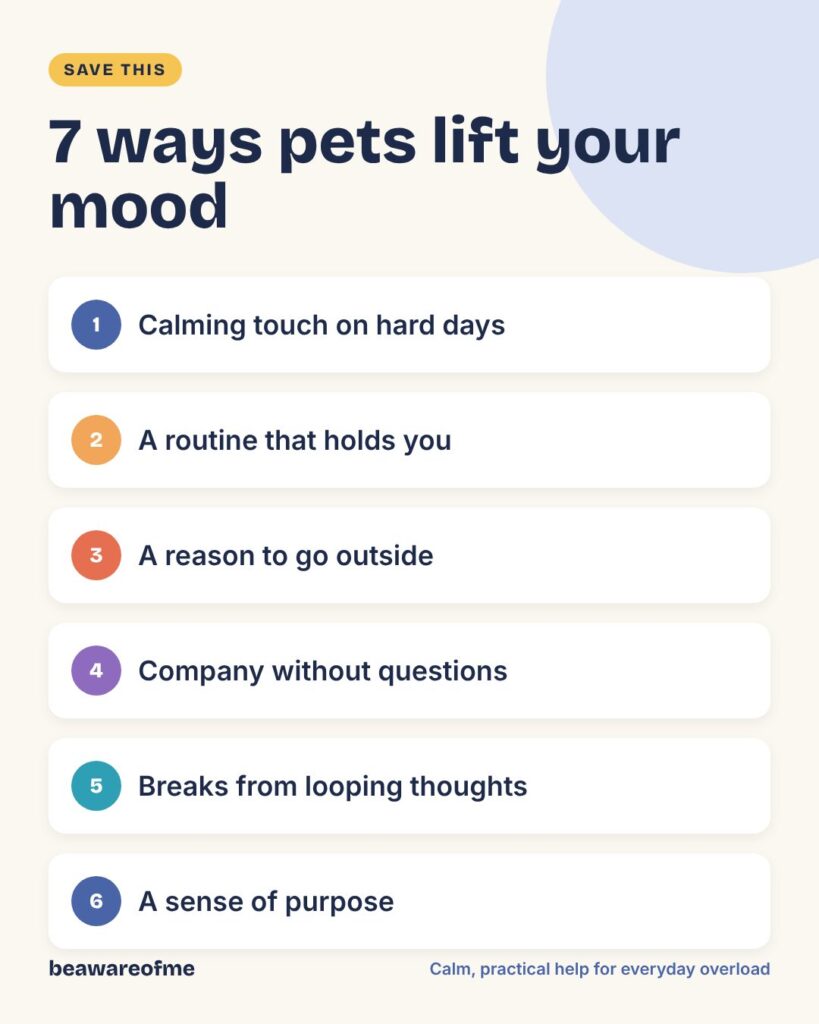
1. Touch that calms your body before your mind catches up
Stroking a cat or resting a hand on a dog gives your body warm, rhythmic contact. That contact can settle you faster than thinking your way out of a spiral. When your chest feels tight, try five slow strokes, matching each one to a long breath out.
This is one of the simplest ways pets can help, and it needs no energy at all. You can do it lying down. You can do it in the dark at 3 a.m. Weighted, soft and alive is a combination few other things offer.
2. A routine that holds you when motivation is gone
Animals need food, water and care at roughly the same times every day. That rhythm becomes a skeleton for your own day. If X happens (you feed the cat at 7), then Y follows (you make yourself tea while you’re up).
Low mood often scrambles sleep and meals. A pet’s schedule gives you fixed points to hang other small tasks on. It’s not discipline. It’s borrowing structure from someone who refuses to skip breakfast.
3. A reason to go outside, even for ten minutes
Dogs need walks, and walks put daylight and movement into your day. Our guide on how exercise helps manage depression and anxiety explains why gentle activity matters so much for mood. A dog simply makes it harder to skip.
Keep the bar low, because this is where pets can help without any planning. Ten minutes around the block still counts. On better days, add a longer loop or a park. On worse days, standing in the garden while your dog sniffs is enough.
4. Company that never asks you to explain yourself
Loneliness and low mood often feed each other. A pet offers presence without questions, judgment or advice. You can cry, sit in silence or talk out loud, and your animal stays.
That doesn’t replace human contact, but it softens the empty hours between it. If you’re unsure how isolated you feel, the free How Lonely Am I Really self-check can help you put it into words.
5. A gentle interruption for looping thoughts
Rumination means replaying the same worries or regrets on repeat. Pets interrupt that loop with something real and present: a toy dropped at your feet, a sudden zoomie, a demand for dinner. Those moments pull your attention out of your head and into the room.
Pets can help here only if you let the interruption land. You can use this on purpose. When you catch yourself looping, spend three minutes playing with your animal. Then ask yourself one question: what is one small thing I can do next?
6. Small social moments that feel safe
Dog walks and pet chats create low-pressure contact with other people. A neighbour asks your dog’s name. Someone at the vet’s office shares a story. These tiny exchanges matter when bigger social plans feel like too much.
The animal carries the conversation, so you don’t have to. Pets can help tired people connect more than any pep talk. Over time, a nodding hello can turn into a regular chat, which is how many friendships quietly begin.
7. A sense of purpose when you feel useless
Depression often whispers that you don’t matter. A pet who waits at the door says otherwise. Being needed, even by a goldfish, gives you a small, undeniable role in another life.
That sense of purpose is one of the quieter ways pets can help. It won’t fix everything. Yet on days when you can’t do anything for yourself, doing one thing for your animal is still a real win.
You don’t have to feel ready. You just have to fill the bowl, open the door and take the first step outside.
A Daily Pet Routine That Gives a Low Day Some Shape
A simple routine built around your pet turns the ways pets can help into something you actually do. Think of it as a scaffold, not a schedule to fail. Keep the steps tiny so they still work on your worst days.
How to adjust the routine on harder days
If a step feels impossible, shrink it rather than skipping it. Can’t manage a walk? Throw a toy down the hallway. Can’t brush your pet? Rest a hand on its back for one minute.
If several days in a row feel unmanageable, that’s useful information. It may be time to ask a friend for help with pet care and to talk to your doctor. Our list of self-care tips for managing depression and low moods offers more small steps to pair with this routine.
- Fed my pet and drank a glass of water
- Spent two quiet minutes with my animal
- Got outside or moved for ten minutes
- Sent one message to a real person
- Did five slow minutes of touch before bed
Which Pet Fits Your Energy? An Honest Comparison
The best pet for low mood is the one you can care for on your worst week, not your best one. A dog offers the most structure, but it also asks the most. Pets can help at every energy level if the match is right. Use the table below to match the animal to your real life.
| Pet | Mood support | Daily effort | Good fit if… |
|---|---|---|---|
| Dog | Walks, touch, strong routine, social contact | High: walks, training, company | You can commit to daily outings and have back-up help |
| Cat | Touch, calm company, light play | Medium: feeding, litter, play | You want affection without fixed walks |
| Rabbit or guinea pig | Gentle handling, quiet routine | Medium: cleaning, space, diet | You like calm animals and have room for a pen |
| Fish | Calming to watch, simple routine | Low to medium: tank care | You want structure with little physical demand |
| Bird | Sound, interaction, routine | Medium to high: social needs | You’re home often and enjoy chatter |
Questions to ask before you adopt
Bringing home an animal is a long commitment, so pause before you decide. Ask yourself these questions honestly, ideally with someone who knows you well.
- Could I still meet this animal’s basic needs during a bad week?
- Who could step in if I’m unwell, away or overwhelmed?
- Can I afford food, vet visits and emergencies without new money stress?
- Does my home, lease and schedule genuinely suit this pet?
- Am I hoping the animal will fix everything, or support me alongside other help?
No Pet at Home? 6 Ways to Borrow the Benefits
You don’t need to own an animal for pets to help lift your mood. Many of the same benefits come from regular, shorter contact. Pets can help you without living in your home. These options also let you test whether a pet suits you before committing.
Low-commitment ways to spend time with animals
- Volunteer at a shelter: walking dogs or socialising cats gives you routine, movement and purpose.
- Foster an animal: short-term care helps a shelter and shows you what daily pet life feels like.
- Pet-sit for friends or neighbours: a weekend of company with an exit date built in.
- Join a dog-walking rota: some neighbours or older people welcome help with walks.
- Visit animal spaces: city farms and some cafés offer calm time with animals.
- Watch wildlife: a bird feeder outside your window brings small, regular moments of life.
Hospitals and care homes sometimes host therapy animals for this reason. NIH notes that therapy dogs are brought in to help reduce patients’ stress and anxiety. You can borrow that same idea in your own community.
Pair animal time with other mood supports
Pets can help most when animal contact sits inside a wider plan. Combine it with daylight, sleep and movement, all covered in our guide to natural mood boosters. And if mornings are your hardest stretch, our article on morning depression and what helps gives practical starting points.
When Pets Can Help Less: Honest Limits and Hard Days
Pets can help a great deal, but they also bring real costs, and pretending otherwise isn’t kind. Knowing the limits protects you and the animal. It also stops you from blaming yourself if a pet doesn’t lift your mood the way you hoped.
Care can feel heavy when energy is low
On very low days, even feeding a pet can feel huge. That guilt can pile onto depression fast. If X happens (you’re struggling to meet basic care), then do Y: ask for help early, from a friend, family member or local pet-care service.
Pets can help you, and people can help you care for them. Needing help doesn’t make you a bad owner. It makes you a responsible one. Animals do best with owners who plan for hard weeks instead of hoping they won’t come.
Health, money and grief
The NIH article points out that allergies can make pets do more harm than good for some people. Animals can also carry germs, so handwashing matters. Harvard Health adds that dogs can pose a fall risk for anyone with balance or walking problems.
Money matters too. Vet bills can add financial worry, which rarely helps low mood. And because pets live shorter lives than we do, losing one can bring deep grief. That grief is real and deserves the same care as any other loss.
Signs it’s time to get more support
A pet can’t spot when you need more help, but you can. Talk to a doctor if low mood lasts most days for two weeks or more, if you’ve lost interest in almost everything, or if sleep and appetite have changed sharply. Our guide to early signs of depression you shouldn’t ignore lists what to watch for.
5 Common Mistakes That Stop Pets From Helping Your Mood
Most of these mistakes come from good intentions. Each one is easy to fix once you see it, and the fixes make life better for you and your animal.
Mistake 1: Expecting the pet to be the whole plan
It’s tempting to think an animal will fix low mood on its own. It won’t, and that pressure isn’t fair to either of you. Instead, treat your pet as one support beside sleep, movement, people and, where needed, professional care.
Mistake 2: Choosing the pet for your best days
People often pick a high-energy dog during a hopeful week. Then a dip arrives and the needs feel overwhelming. Choose for your hardest realistic week instead, and line up back-up help before you adopt.
Mistake 3: Using pet time to avoid every human
An animal’s company feels easier than people, so it can quietly replace them. Over time, that can deepen isolation. Use your pet as a bridge: share a photo with a friend, chat at the dog park, or invite someone on a walk.
Mistake 4: Scrolling while you sit with your pet
Lots of people stroke the cat with one hand and scroll with the other. The phone steals the calming effect. Put the screen away for those five minutes, and let your attention rest fully on fur, warmth and breathing.
Mistake 5: Hiding care struggles out of shame
When care slips, many people go quiet instead of asking for help. That makes things worse for everyone. Tell one trusted person early, and look up local pet-care or shelter support lines before you need them.
Pets and Depression: Your Questions Answered
Can pets really help with depression?
Pets can help some people with low mood by adding touch, routine, movement and company. Interacting with animals is linked to lower stress hormones, and some studies find animals reduce loneliness. However, research results are mixed, and a pet is not a treatment. The best results come when an animal supports, rather than replaces, professional care, healthy habits and contact with people.
What is the best pet for depression?
There’s no single best pet for everyone. Dogs offer the strongest routine and the most reasons to go outside, but they need a lot of time. Cats give affection with less daily effort. Fish and small animals suit people who want gentle structure. Choose the animal you could still care for during your hardest realistic week, with back-up help ready.
Should I get a pet if I’m depressed?
It depends on your energy, finances, home and support. A pet can add structure and comfort, but care can feel heavy on very low days. If you’re in crisis, focus first on getting help. If you’re steadier, try fostering or pet-sitting before adopting, and talk honestly with someone you trust about whether a pet fits your life right now.
How do pets reduce loneliness?
Pets offer steady, non-judging company that fills quiet hours at home. Dogs in particular create small social moments, such as chats on walks or at the vet. NIH notes that some studies find animals reduce loneliness and increase social support. The key is using that company as a bridge to people, not a replacement for them, especially when you feel withdrawn.
Can an emotional support animal help with depression?
An emotional support animal is a pet that provides comfort to someone with a mental health condition. Many people find that comfort meaningful. Pets can help in this role, but rules about housing and travel differ by country and change over time, so check official local guidance. Talk to your doctor or therapist about whether an emotional support animal could fit into your wider care plan.
What if I can’t have a pet but want the benefits?
You can still enjoy many of the same benefits through regular contact with animals. Volunteer at a shelter, foster short term, pet-sit for friends, or join a neighbour on dog walks. Even a bird feeder outside your window adds small moments of life. These options give routine, movement and purpose without a long commitment or big costs.
A hard day doesn’t need a grand fix. It needs small, steady anchors, and pets can help by offering exactly that: warmth, rhythm, fresh air and a reason to keep going. Lean on that support, keep reaching for people and professional care, and let each fed bowl and short walk remind you that tomorrow can feel a little lighter. For more steady reading, browse our depression guides.