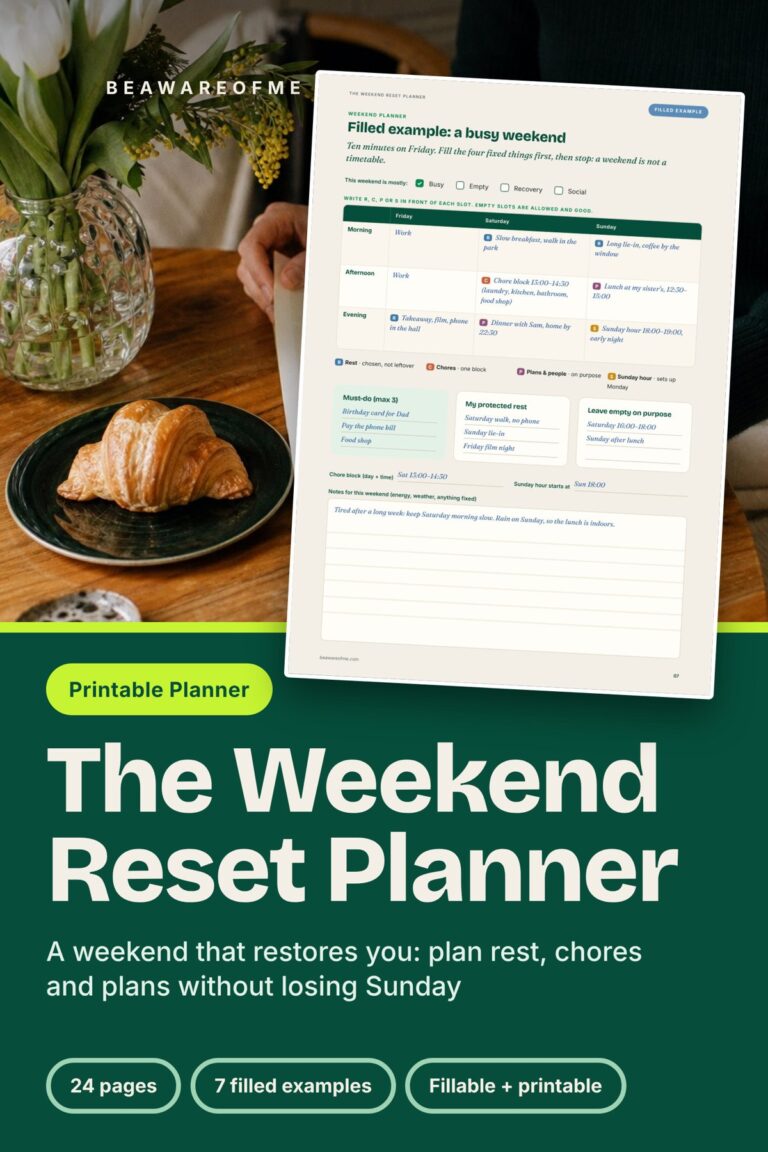





A good sunday reset routine checklist should take about 90 minutes, not your whole Sunday. Most versions online read like a list of every chore you have ever skipped, and then people wonder why they reach Sunday evening tired and still dreading Monday. This guide gives you a fixed, time-boxed reset in three rounds (space, plan, food), a 20-minute version for low-energy weeks, and a clear rule for when to stop.
- Give your reset a hard limit of 90 minutes and an end time, so it never eats the whole day.
- Do the three rounds in the same order every week: space first, then plan, then food.
- Write Monday’s first ten minutes down before you close the planner; that single line does more for Sunday dread than any tidy room.
- On a heavy week, use the 20-minute version instead of skipping the reset completely.
- Finish by 6pm and protect the evening, because rest is part of the reset, not a reward for finishing it.
If you are new to this site, start with the free Sunday Scaries Score. It takes a minute and tells you whether your Sunday needs more planning, more rest, or simply an earlier finish line.
Why most Sunday resets fail by 3pm (and what to do instead)
This section explains why the popular version of the Sunday reset backfires for so many people. The idea itself is sound: a short weekly routine that lowers the friction of the coming week. The problem is the way it gets sold. Videos show four hours of deep cleaning, colour-coded fridges and a candle-lit bath at the end. Try to copy that after a full working week and you burn through your only full day off.

Here’s the pattern we see over and over. You start at 11am with energy. By 1pm you are reorganising a drawer nobody opens. By 3pm the list is half done, you feel behind, and the old Sunday feeling creeps in: the week is coming and you have used up the day. That’s not a discipline problem. It’s a design problem. A list with no end time will always expand to fill the day.
So the fix is structural. Your reset needs three things the viral version lacks: a time box (90 minutes, in three blocks of 30), a fixed order (so you don’t spend energy deciding what comes next), and a stop rule (when the timer ends, the round ends, even if something is unfinished). The NHS advice on stress makes the same point in plainer words: split big tasks into smaller steps and notice each one as you finish it.
The Sunday reset routine checklist: 90 minutes in 3 rounds
This is the whole routine on one screen, so you can see the shape before the detail. Each round has one job. You do them in order, with a five-minute pause between rounds to drink something and sit down. Set a timer for each round; when it rings, you move on.

| Round | Time | The one job | Done when… |
|---|---|---|---|
| 1. Space | 30 min | Get the home back to a calm baseline | Laundry is running, surfaces are clear, one bag of clutter is out |
| 2. Plan | 30 min | Put the week on one page | Calendar checked, 3 priorities chosen, Monday’s first 10 minutes written |
| 3. Food | 30 min | Make Monday to Wednesday easier | 3 dinners decided, groceries ordered or bought, 1 thing prepped |
| Close | 5 min | End the reset on purpose | Timer off, list closed, evening plan named |
Why this order? Space comes first because physical clutter is the loudest signal in the room; once the counters are clear, planning feels lighter. Plan comes second because it is the most mentally demanding round and you want it done while you still have focus. Food comes last because it is the most physical and the easiest to do on autopilot while a podcast plays.
What you need before you start
- A timer (your phone is fine, on Do Not Disturb).
- One notebook or a printed weekly page for Round 2.
- Your calendar and any work rota or school schedule for the week.
- A shared grocery list or the app you normally use.
- One empty bag or box for clutter that leaves the house.
Round 1: reset your space in 30 minutes
This round is about getting your home back to a baseline, not about deep cleaning. The question for every task is simple: will this make Monday morning smoother? If yes, it is in. If it is a project (re-organising the wardrobe, cleaning behind the fridge), it goes on a list for a different day.
Notice what is missing: mopping, windows, the oven. Those belong to a separate cleaning rhythm, not to the reset. If you live with other people, give each person one item from the list instead of doing all of it yourself. A household reset is faster and far less resentful when it is shared out loud.
Round 2: plan the week on one page in 30 minutes
This round turns a vague week into a short, written plan, which is what actually quiets Sunday dread. The goal is not a perfect schedule. It is a single page you can glance at on Monday morning without thinking.

If the planning round stirs up a wave of worry, that is normal. Writing tomorrow’s to-do list before bed is one of the tips the NHS gives for falling asleep faster and sleeping better, and the same logic works on Sunday afternoon: the list holds the week so your head doesn’t have to. If the worry keeps looping, our guide on how to stop overthinking has a short exercise that fits right after this round.
Round 3: make Monday to Wednesday easier with food
This round makes the first half of the week lighter, because that is when energy is lowest and decisions feel heaviest. You are not meal-prepping for seven days. You are deciding three dinners and getting one thing ready.

Three dinners is the sweet spot for most households. Plan seven and the plan breaks by Thursday, which feels like failure. Plan three and Thursday becomes a simple question on Wednesday night. If money worry makes the grocery part stressful, the bills check in Round 2 helps; our guide on money worries at night has a calmer way to look at the numbers.
Pick the Sunday reset routine checklist that fits this week
This section matters because no single routine fits every Sunday. Some weeks you have energy and a free afternoon; some weeks you worked Saturday, slept badly and can barely face the dishes. The worst choice is to skip the reset entirely, because then Monday arrives with nothing decided. Pick a version instead.

| Your week | Version | What you do | Time |
|---|---|---|---|
| Normal week, some energy | Full reset | All three rounds, in order | 90 min |
| Busy weekend, plans on Sunday | Short reset | Round 2 in full, 10 minutes each of Rounds 1 and 3 | 45 min |
| Tired, low or unwell | 20-minute reset | One surface, Monday’s first ten minutes, one easy dinner | 20 min |
| Shift work or Sunday is a workday | Moved reset | Same routine on your last day off before the run of shifts | 45–90 min |
| Big week ahead (deadline, travel, move) | Plan-first reset | Round 2 for 45 minutes, Rounds 1 and 3 at 20 minutes each | 85 min |
The 20-minute low-energy version
This is the version for the weeks that feel heavy. It keeps only the three tasks with the biggest effect on Monday morning.
If most Sundays feel like low-energy Sundays, that is worth paying attention to. Our article on emotional exhaustion explains the difference between a tiring week and a pattern that needs more support.
How to make the reset stick after week three
Most people find the reset easy for two Sundays and then drift. The trick is to make it boring on purpose. Keep the same start time, the same order, the same notebook and the same playlist. After about a month the routine stops feeling like a project and starts feeling like brushing your teeth: something you just do. It also helps to pair it with something you enjoy, such as a favourite podcast during Round 1 or a proper coffee during Round 2. If you miss a week, don’t try to catch up with a double reset; just do the normal one next Sunday. And once a month, look back at your plan pages. You will usually spot one task that never matters and can be dropped, which keeps the list short as your life changes.
Close the reset and keep the rest of Sunday yours
This last part is the one people skip, and it is the part that makes the reset feel restful rather than like an unpaid shift. You need a deliberate end, because without one your brain keeps scanning for the next task until bedtime.

If Sunday evenings still bring a knot in your stomach after the reset, read our step-by-step plan to stop dreading Monday on Sunday night, which picks up exactly where this routine ends. For the nights when sleep does not come easily, try the wind-down timeline in how to calm anxiety at night.
Common mistakes with a Sunday reset (and what to do instead)
These are the mistakes that trip up people who already know the basics and have tried a reset a few times.
1. Turning the reset into a deep clean
Mopping floors and cleaning the oven feel productive, but they don’t make Monday easier. They just make Sunday longer. Keep deep cleaning on its own day or split it into ten-minute jobs during the week. The reset only covers what touches the next three days.
2. Planning the whole week in detail
Hour-by-hour schedules break by Tuesday and leave you feeling behind. Three priorities and Monday’s first ten minutes hold up much better, because they survive surprises. Detail belongs to each morning, not to Sunday.
3. Starting too late in the day
A reset that starts at 7pm pushes work thoughts right up to bedtime. Start between 2pm and 4pm if you can, so there is a real gap between closing the planner and trying to sleep.
4. Doing it all alone in a shared home
If you live with a partner or housemates and quietly do the whole reset yourself, resentment builds fast. Read the Round 1 list out loud on Sunday at lunch and let each person pick two items. It takes two minutes and halves the work.
5. Skipping it entirely on bad weeks
The weeks you most want to skip are the weeks it helps most. Use the 20-minute version. A tiny reset keeps the habit alive, and keeping the habit alive is what makes the full version easy again next week.
Sunday reset routine checklist: FAQ
What should be on a Sunday reset checklist?
A good Sunday reset checklist covers three areas: your space (laundry, clear surfaces, one bag of clutter out), your week (calendar, three priorities, Monday’s first ten minutes) and your food (three dinners decided, groceries sorted, one thing prepared). Keep anything that is a bigger project, like deep cleaning or re-organising, off the list so the reset stays short.
How long should a Sunday reset take?
Around 90 minutes is enough for most people: three rounds of 30 minutes with short breaks. On busy weekends a 45-minute version works, and on low-energy weeks a 20-minute version keeps the habit going. If your reset regularly takes more than two hours, it has turned into a cleaning day, and you should cut the list back.
What time should I start my Sunday reset?
Early to mid-afternoon works best, roughly between 2pm and 4pm. That gives you a clear end before dinner and leaves the evening for rest. Starting late in the evening tends to keep work thoughts active close to bedtime, which can make it harder to wind down and sleep on Sunday night.
Does a Sunday reset help with Sunday anxiety?
For many people it helps, because it turns a vague, looming week into a short written plan with a first step. Writing down the task you dread and Monday’s first ten minutes is usually the most calming part. It is a practical routine, not therapy, so if Sunday anxiety is intense or constant, talking to a professional is a good idea.
What is a weekly reset routine vs a Sunday reset?
They are the same idea. A weekly reset routine is a short block of time once a week to reset your space, plan and food. Sunday is popular because it comes right before the working week, but shift workers and anyone who works weekends can do the same routine on their last day off before a run of working days.
What if I don’t have energy for a Sunday reset?
Do the 20-minute version: clear one surface, write Monday’s first ten minutes and decide one easy dinner. That small reset still makes Monday morning easier and keeps the habit alive. If you feel low on energy most weeks, it is worth looking at rest, workload and support, and speaking to a doctor if it continues.
Bottom line
The best sunday reset routine checklist is short, fixed and finished by early evening: space, plan, food, then stop. Try the 90-minute version this Sunday, keep the 20-minute version for heavy weeks, and protect the evening as part of the routine. For more calm, practical guides like this one, browse our stress management articles, and pair this routine with our plan to stop dreading Monday on Sunday night.