

You look at your life and it feels like everyone else got a map you never received: the career, the home, the savings, the calm inbox. The feeling follows you into the evening, even on days you worked hard. If you want to stop feeling behind, this guide gives you a quick reality check, practical reframes that actually shift the feeling, and a one-page plan for real progress this week.
🌟 Key takeaways
Why You Can’t Stop Feeling Behind, Even When You’re Doing Fine
It is hard to stop feeling behind because the feeling usually measures you against a timeline you never chose. Somewhere along the way, you picked up a set of “by now” rules: by now I should earn this, live here, have that. When real life doesn’t match, your brain files it as failure.

If you want to stop feeling behind, start here: the whole article at a glance. Screenshot it for the next time the feeling hits.
| Type of “behind” | What it sounds like | First step |
|---|---|---|
| Timeline worry | “I should be married or own a home by now” | Ask whose timeline this is |
| Comparison sting | “My friends are all ahead of me” | Swap them for your past self |
| Real backlog | “These bills and emails are overdue” | Triage and schedule one block |
| Overload | “I’m behind on everything at once” | Drop or delay two things |
| Untracked progress | “I did loads but feel I did nothing” | Keep a done list for a week |
The Invisible “By Now” Rules
Many of these rules come from family expectations, school, films and adverts. They often reflect another generation’s economy and life path. Holding yourself to them is like being graded on a test you never sat. Spotting them is often the moment people begin to stop feeling behind.
The Numbers Have Shifted More Than the Rules
According to a Pew Research Center analysis of US data, only 22% of 25-year-olds were married in its latest figures, compared with 63% about four decades earlier. The share who had a child fell from 39% to 17%. Life paths are changing, yet many of the old “by now” rules never updated.
22%
of 25-year-olds in the US were married, down from 63% about four decades earlier.
Pew Research Center
68%
of 25-year-olds lived outside their parents’ home, down from 84%.
Pew Research Center
17%
of 25-year-olds had a child, down from 39% four decades before.
Pew Research Center
📝 Note: These figures describe US young adults and are not a target for anyone. They simply show that “normal” timing has moved, so the timeline in your head may be older than you think.
Unfinished Tasks Shout Louder Than Finished Ones
Your brain keeps open loops on a mental to-do list, while finished jobs quietly drop out of view. So at the end of a full day, you remember the three things you didn’t do, not the twelve you did. That imbalance alone can make it hard to stop feeling behind.
Behind Whom? The 4 Timelines You Might Be Measuring Against
Every “I’m behind” hides a comparison, and naming it is the first real step to stop feeling behind. Most people measure themselves against one or more of these four timelines. Read each one and notice which feels most familiar.
1. The Social Script
This is the broad cultural story: study, job, partner, house, children, promotion, in a neat order. It rarely fits real lives, which include illness, caring duties, career changes, moving countries and money shocks. Following the script is optional, even if it doesn’t feel that way. Seeing that clearly can help you stop feeling behind on a path you never picked.
2. The Family Timeline
Your parents may have bought a home or started a family at a certain age. Their path happened in a different economy, with different prices and different pressures. Loving them doesn’t mean you must copy their schedule, and you can stop feeling behind them without rejecting what they built.
3. The Peer Feed
Old classmates and colleagues post their wins online, and your brain treats them as the average. This is the timeline that stings most often. Our guide to why scrolling makes you feel worse about yourself explains the comparison psychology behind it.
4. Your Younger Self’s Plan
At 18 or 22 you may have pictured a very specific future. That younger you didn’t know what you know now. It’s okay to update the plan; in fact, it’s often wise. See why it’s okay to change your goals for a kinder way to let old plans go.
You cannot be late for a schedule you never agreed to.
— beawareofme
Why the Behind Feeling Spikes at Certain Moments
The feeling is rarely constant; it tends to spike at predictable moments, and knowing them helps you stop feeling behind before the spike lands. When you can see a wave coming, you can plan a calmer response. Here are the most common triggers.
Birthdays, Reunions and Big Announcements
Birthdays invite a mental audit: “Where am I compared with where I thought I’d be?” Reunions, weddings and baby announcements do the same, because they put many timelines side by side. If you know one is coming, plan something kind for yourself that day, like a walk or a call with someone who knows the real you.
Sunday Evenings and Month Ends
Sunday evenings often bring a rush of unfinished jobs to the front of your mind. Month ends can trigger money comparisons and missed goals. A ten-minute planning session on Sunday afternoon, using the one-page plan above, can take the edge off before the evening dip arrives.
After Scrolling or Late at Night
Tired brains are harsher judges. A scroll at 11pm can turn a fine day into evidence that you’re failing. If you notice the feeling mostly at night, make a simple rule: no life audits after 9pm. Write the worry down and look at it in daylight, when it usually shrinks.
| Trigger | Why it hits | Kind response |
|---|---|---|
| Birthday | Invites a “where am I now” audit | Plan one small treat and a call |
| Reunion or wedding | Many timelines side by side | Prepare one honest, upbeat update |
| Sunday evening | Unfinished jobs crowd your mind | Do the one-page plan earlier |
| Late at night | Tired brains judge harshly | No life audits after 9pm |
The 3-Step Reality Check: Are You Actually Behind?
A short reality check helps you separate real problems from comparison, so you can stop feeling behind where it isn’t true and act where it is. Grab a notebook. Answer each question in a sentence or two.
Behind on what, exactly?
Write the specific thing, such as “tax return” or “savings,” not “life.”
By whose deadline?
Is there a real due date, or a “by now” rule from somewhere else?
What is the cost of waiting?
Will anything bad actually happen if this takes another month?
How to Read Your Answers
If the item has a real deadline and a real cost, it’s a backlog. Backlogs need a plan, and section six below shows you how. If there’s no real deadline and the only cost is a feeling, it’s a timeline worry, and reframes help more than effort.
When people try to stop feeling behind with this check, most find that one or two items are real backlogs and the rest are comparison. That’s a relief, because it shrinks a vague, crushing “everything” into a short, manageable list.
💡 Tip: If you feel stuck rather than simply behind, the free why am I stuck self-check can help you see what is holding you in place and what might help you move.
7 Practical Reframes That Shrink the Behind Feeling
Reframes are honest, alternative ways of looking at the same situation, and they can help you stop feeling behind without pretending everything is perfect. The NHS describes a simple version in its guide to reframing unhelpful thoughts: catch the thought, check it against the evidence, then change it to something more balanced.
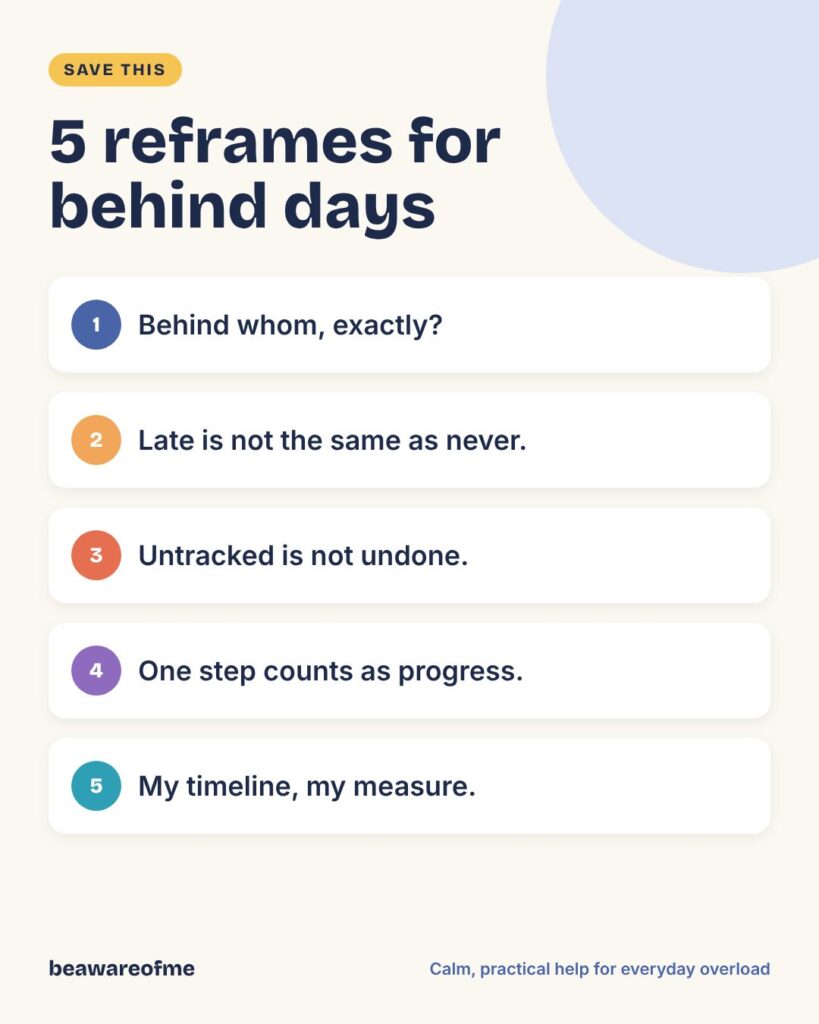
The 7 Reframes
- “Behind whom, exactly?” Name the person or rule, then ask if they set your goals.
- “Late is not the same as never.” Many milestones have no expiry date.
- “Untracked is not undone.” You may be doing more than you can see.
- “Different is not behind.” A different path is not a slower version of theirs.
- “Seasons, not a race.” Some seasons are for building, others for resting or caring.
- “One step counts.” Progress at any speed is still progress.
- “My timeline, my measure.” Compare yourself with last month’s you, not someone else’s now.
How to Make a Reframe Stick
A reframe works best when it’s specific and believable. “I’m doing amazing!” may feel false on a hard day. “I paid two bills and called my mum this week, and that counts” feels true, so your brain accepts it.
Write your favourite reframe on a sticky note or your phone lock screen. Read it when the feeling arrives. Over time, the new thought starts to show up on its own, and it gets easier to stop feeling behind before the spiral starts.
✨ Quick win: Right now, write down three things you finished in the last seven days, however small. Look at the list for ten seconds. That small pause is often enough to loosen the “I’ve done nothing” story.
A One-Page Plan to Stop Feeling Behind This Week
A single page that shows your priorities and your progress is one of the fastest ways to stop feeling behind. It moves the to-do list out of your head and makes finished work visible. You only need ten minutes on a Sunday or Monday.
🧭 Try this today: your one-page week
☐ Top three: write only three things that would make this week feel good enough.
☐ One backlog block: schedule one 30-minute slot for the most overdue real task.
☐ Drop or delay: cross out two things that can wait until next month.
☐ Done list: leave space at the bottom to tick off everything you finish, even small jobs.
☐ Friday check: circle what you finished and write one sentence about how the week went.
Why Three Is the Magic Number
When everything is a priority, nothing feels finished. Three priorities are few enough to complete and enough to feel meaningful. If you finish them early, add one more. Our guide to realistic goal setting explains how to size goals so they fit your real energy.
The Done List Changes Everything
Most people track what they need to do, never what they did. A done list reverses that. By Friday, you have proof on paper, which is harder to argue with than a vague feeling.
⚠️ Watch out: Don’t fill your page with ten “top” priorities. An overloaded plan recreates the exact feeling you are trying to escape. Keep it short, even if it feels too easy.
How to Catch Up on a Real Backlog Without Burning Out
Some things genuinely pile up, and catching up calmly is part of how you stop feeling behind for good. The goal isn’t to clear everything this weekend. It’s to make steady progress while still sleeping, eating and resting.
Triage Your Backlog in Four Boxes
| Box | What goes here | What to do |
|---|---|---|
| Urgent and important | Bills, deadlines, health appointments | Do first, this week |
| Important, not urgent | Savings plan, a course, a hard conversation | Schedule one small step |
| Urgent, not important | Some emails, minor requests | Do quickly or hand off |
| Neither | Old “shoulds,” nice-to-haves | Drop or park for later |
Use Short, Regular Blocks
A 30-minute block three times a week beats a heroic six-hour Saturday that leaves you exhausted. Set a timer, work on one item, then stop. Stopping on time teaches your brain that the backlog is safe to approach.
Ask for Help Early
If the backlog involves money, paperwork or work deadlines, asking for help is a strength. A manager can reset priorities; a friend can sit with you while you open letters. If the pile comes from long-term exhaustion, read our guide to emotional exhaustion before you push harder.
A Script for Asking Your Manager
Try this: “I want to do good work on all of this, but I can’t finish everything by Friday. Can we agree on the top two priorities, and move the rest to next week?” It’s calm, specific and offers a solution. Most managers prefer an early, honest heads-up to a late surprise.
If money is part of the pile, list every bill with its due date on one sheet. Seeing the full picture is often less frightening than the vague dread, and it shows you exactly where to start.
What to Do on Days the Behind Feeling Comes Back
The feeling will return sometimes, and that’s normal, so have a short plan ready for those days. You’re not starting from zero, and learning to stop feeling behind is a skill you keep building. You’re simply noticing an old habit and responding differently.
A Two-Minute Reset
- Pause: put your hand on your chest and take three slow breaths.
- Name it: “This is the behind feeling, not the truth.”
- Check: “Is there a real deadline today?”
- Act small: do one five-minute task from your page, then tick it off.
Words for Your Comparing Days
Try saying: “I’m on my own path, at my own pace. Today I’ll do one useful thing and let that be enough.” It may feel odd at first. Said often enough, it becomes a calmer default.
If you notice yourself replaying the same worries for hours, our guide to stop overthinking and relax your mind has practical tools for loosening the loop.
📝 Note: If feeling behind comes with constant low mood, hopelessness, or trouble getting through the day, please talk to a doctor or counsellor. You don’t have to sort this out alone.
5 Common Mistakes That Keep You Feeling Behind
These are the habits that quietly keep the feeling alive, even when you’re working hard. Each one is easy to swap.
1. Trying to Catch Up on Everything at Once
A huge catch-up push usually ends in burnout and a new backlog. Instead, choose one area per week. Steady beats dramatic when you want to stop feeling behind for good.
2. Measuring Yourself Against Your Busiest Friend
Your most visible peer is rarely average. They may have more help, more money or different priorities. Compare yourself with your own last month instead, which is fairer and more useful.
3. Treating Rest as Falling Further Behind
Skipping rest to catch up drains the energy you need to make progress. Rest is part of the plan, not a break from it. Schedule it like any other task.
4. Waiting to Feel Caught Up Before Enjoying Life
“I’ll relax once I’m on track” can stretch on for years. Enjoy small things now: a walk, a meal with a friend, an hour of a hobby. Joy is not a reward for being on schedule.
5. Keeping Every Old Goal Forever
Some goals belonged to an earlier version of you. Holding onto them adds weight without adding meaning. Review your list each season and gently let go of what no longer fits. Our guide on coping with unfulfilled ambitions can help.
📚 Keep reading
Your Questions About Feeling Behind, Answered
Why do I always feel behind in life?
Feeling behind usually comes from comparing your life with a timeline you never chose, such as family expectations, social media highlights or your younger self’s plans. Unfinished tasks also grab more attention than finished ones, so you notice gaps more than progress. A short reality check, a few honest reframes and a visible done list can ease the feeling over time.
How do I stop feeling behind my peers?
Start by noticing which peers trigger the feeling and why. Remember that you see their highlights, not their struggles, debts or doubts. Mute accounts that sting, and compare yourself with your own past instead. Then choose three small priorities for the week and track them, so your own progress becomes visible and harder to dismiss.
Is it normal to feel behind in your 20s or 30s?
Yes, it is very common to feel behind in your 20s and 30s. Many traditional milestones now happen later than they did for earlier generations, yet the old expectations often remain. Feeling behind does not mean you are failing. It usually means you are measuring yourself against a timeline that no longer fits real life for many people.
How can I stop feeling behind at work?
Ask your manager to confirm your top priorities so you know what truly matters. Write a short daily list of three tasks and a done list for everything you finish. Block focused time for overdue work and turn off non-urgent notifications. If the workload is genuinely too large, raise it early with specific examples and a suggested plan.
What is a good way to catch up on life?
Pick one area at a time, such as money, admin or health. Sort tasks into urgent, important, minor and optional, then schedule short 30-minute blocks for the most important items. Drop or delay what can wait. Catching up steadily over several weeks works better than one exhausting push that leaves you drained and behind again.
When is feeling behind a sign of something more?
If feeling behind comes with lasting low mood, hopelessness, losing interest in things you used to enjoy, or trouble sleeping and functioning, it may be more than everyday stress. Please talk to a doctor or a qualified mental health professional. Support can help, and you deserve care that goes beyond planning tips and reframes.
To stop feeling behind, you don’t need to catch up with everyone; you need to check whose race you are running and choose your own pace. Run the reality check, keep one reframe close and fill in your one-page week. Small, visible progress adds up, and the calm that follows is yours to keep.
📝 Please read: Educational content, not a substitute for professional care. If you are struggling, talk to a doctor or a qualified professional. If you are thinking about harming yourself, contact local emergency services or a crisis line now (US 988, UK and Ireland Samaritans 116 123, or findahelpline.com).