You said no to something reasonable, and now your stomach is in knots. Maybe you replayed the text five times, or you almost called back to take it all back. This guide shows you how to set boundaries without feeling guilty, using a quick guilt test, a four-part formula, copy-ready scripts and a plan for the first 24 hours after you speak up.
✨ Key takeaways
Ask “Did I cause harm, or did I cause disappointment?” before you act on any guilty feeling.
Keep boundary sentences short, because every extra reason gives the other person something to argue with.
Plan your reply to pushback in advance so you don’t cave in the moment.
Expect the guilt to peak within hours and soften over the next day or two, then let it pass.
Practise on low-stakes requests first, like a group chat or a small favour, before the big conversations.
Treat repeated guilt-tripping from one person as information about the relationship, not about your worth.
Why Guilt Shows Up Even When Your Boundary Is Fair
Guilt after a boundary is an old alarm, and it often rings for the wrong reason. If you grew up keeping the peace, your nervous system learned that someone else’s frown meant danger, so a calm “no” can still feel like a crime.
At a glance: your guilt-free boundary toolkit
| Tool | What it does | Use it when |
|---|---|---|
| The harm-or-hurt test | Separates real guilt from habit guilt | Guilt hits right after you say no |
| The 4-part formula | Turns a feeling into one clear sentence | You need to say something new |
| Copy-ready scripts | Gives you words that are kind and firm | You freeze or over-explain |
| The 24-hour wave plan | Helps you sit with guilt without caving | You want to text “sorry, forget it” |
| The pushback ladder | Lets you repeat calmly instead of arguing | Someone tests the line |
| The 7-day practice | Builds the habit in small steps | You want this to feel normal |
Here’s the thing most advice about boundaries without feeling guilty gets backwards. It tells you to stop feeling guilty first and then set the boundary. In real life, the order runs the other way: you set the boundary while guilty, and the guilt shrinks afterwards.
Real guilt versus borrowed guilt
Real guilt points to something you did that went against your own values, such as breaking a promise or being cruel. It’s useful, because it nudges you to repair.
Borrowed guilt is different. It shows up when you did nothing wrong but someone felt let down, annoyed or inconvenienced. That feeling belongs to their expectations, not to your conduct. Learning to spot the difference is the core skill behind boundaries without feeling guilty.
Where the habit usually comes from
Most people who struggle here share a few patterns. They were praised for being easy, helpful or low-maintenance. They learned that conflict ended badly. Or they became the reliable one at work or in the family, and everyone grew used to it.
None of this makes you weak. It makes you trained. People who seem to hold boundaries without feeling guilty usually weren’t born that way; they practised. And anything trained can be retrained, one small sentence at a time.
6 steps
from knowing your needs to following through and adjusting over time.
Cleveland Clinic
Fades
Guilt at first is common and usually eases with practice, starting small.
📝 Note
A boundary is about what you will do, not what the other person must do. “I’m leaving at six” is a boundary. “You can’t call me after six” is a demand. The first one is far easier to hold.
The Harm-or-Hurt Test: 3 Checks Before You Apologise
The fastest way to set boundaries without feeling guilty is to question the guilt before you obey it. These three checks take under a minute and stop you from apologising for things that need no apology.
Question 1: Did I break a promise or a value?
If you promised to help a friend move and then cancelled the night before for no reason, guilt is fair. Repair it. But if you never agreed to help, saying no now breaks nothing.
Question 2: Was I cruel, or just clear?
Cruel sounds like mocking, shouting or ignoring someone. Clear sounds like “I can’t take this on this week.” If your tone was calm and your words were respectful, you were clear. Disappointment on the other side doesn’t turn clarity into cruelty.
Question 3: Would I judge a friend for doing this?
Picture your closest friend saying the exact same sentence to the exact same person. Would you think they were selfish? Most people say no right away. That gap shows you the double standard your guilt runs on.
💡 Tip
Write the three answers in your phone’s notes app the first few times. Seeing “no promise broken, tone was kind, I’d back a friend” in writing quiets the guilt faster than arguing with it in your head.
If all three answers point to no harm, the guilt is borrowed, and you can keep your boundaries without feeling guilty about them. Thank it for trying to protect the relationship, and keep the boundary. If one answer points to real harm, repair that specific thing without giving up the whole boundary.
The 4-Part Formula for Boundaries Without Feeling Guilty
A good boundary sentence is short, warm and specific. This formula keeps you from rambling, and less rambling means less guilt, because you’re not defending yourself in a trial no one called.
The four parts (say them in under 20 seconds)
Warm opener
Start with one true, kind line, like “Thanks for thinking of me” or “I know this matters to you.”
The clear limit
Say what you will or won’t do in plain words: “I can’t make Saturday.”
One reason, or none
Give a single short reason if you like. Skip it if the reason would only invite debate.
Optional offer
Suggest what you can do, only if you genuinely want to: “I could help for an hour on Sunday.”
Put together, it sounds like this: “Thanks for asking me. I can’t take on the report this week. I could review the first draft on Monday.” That’s three sentences. There’s no apology and no essay, and it’s still friendly. This is what boundaries without feeling guilty sound like in practice: calm, brief and warm.
Why fewer reasons make boundaries without feeling guilty easier
Over-explaining feels polite, but it sends a hidden message: “Please approve my reason.” Each reason also becomes a target. If you say you’re tired, the other person can say “It’ll only take ten minutes.”
One reason is plenty. No reason is also fine. As the UNC guidance on saying no puts it, you don’t owe anyone a long explanation. A short answer is not rude; it’s respectful of both people’s time.
Soft words that weaken the line
Watch for phrases like “I’m so sorry, but maybe,” “if that’s okay,” or “I’ll try.” They sound gentle, but they leave the door half open. Swap them for “I won’t be able to,” “That doesn’t work for me,” and “No, but thank you.”
You can be kind and clear in the same sentence. You don’t have to choose.
beawareofme
12 Copy-Ready Scripts for Work, Family, Friends and Partners
Scripts take the pressure off, because you’re not inventing words while your heart is racing. They’re the most practical shortcut to boundaries without feeling guilty, since the hard thinking happens before the conversation. Pick the ones that sound like you, change a few words, and save them where you can find them.
At work: protect your time without sounding difficult
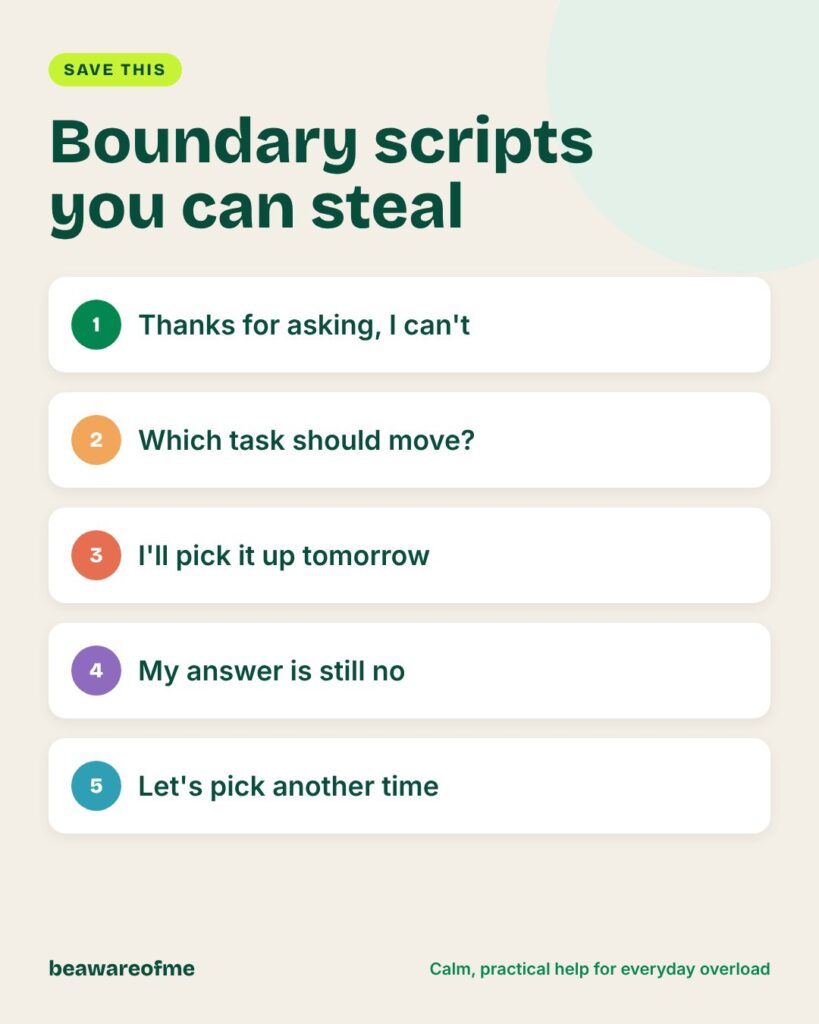
- Extra task: “I’d like to help. If I take this on, which of my current tasks should move?”
- After-hours message: “I saw this after work. I’ll pick it up first thing tomorrow.”
- Meeting overload: “Could I get the notes instead? I need this hour to finish the client file.”
Work boundaries feel riskier, so tie them to the quality of your output. Managers tend to hear “so I can do this well” more easily than “I’m too busy.” For more wording ideas, see these ways to say no to extra work without hurting your career and this guide to assertive communication when you’re overworked.
With family: love and limits at the same table
- Unwanted advice: “I know you care. I’ve made my decision, and I’d like to talk about something else.”
- Last-minute visit: “Today doesn’t work. Can we pick a time next week?”
- Money request: “I’m not able to lend money right now. I’m happy to help you look at other options.”
Family guilt runs deep, because roles formed long ago. Boundaries without feeling guilty take longer here, so go easy on yourself if the first few feel shaky. If one relative keeps crossing the line, these steps for setting boundaries with overbearing relatives go further.
With friends: honest without drama
- Plans you don’t want: “I’m going to sit this one out, but have a great time.”
- Venting overload: “I want to support you, and I’m running on empty tonight. Can we talk tomorrow?”
- Group chat pressure: “I’m muting the chat for a bit. Message me directly if you need me.”
With a partner: needs, not accusations
- Alone time: “I need an hour to myself after work. It’s not about you; it helps me be better company.”
- Phone during dinner: “Can we keep phones away while we eat? I miss talking to you.”
- Old arguments: “I don’t want to go over that again tonight. Can we set a time this weekend?”
✨ Quick win
Save your three most-needed scripts as notes on your phone, titled “My words.” When guilt makes your mind go blank, you’ll have the sentence ready to read or paste.
How to Ride Out the 24-Hour Guilt Wave
The guilt usually hits hardest right after you speak and then fades over a day or so. Nobody gets to boundaries without feeling guilty by skipping this wave; you get there by surviving it a few times. Knowing that the wave has a shape helps you wait it out instead of texting “Never mind, I’ll do it.”
Hour zero to two: the urge to undo
This is when your body feels it most. Your chest tightens and your thoughts race: “They hate me now.” Don’t send any follow-up message in this window. Instead, slow your breathing for a minute or try a guided round with the box breathing coach.
Hours two to twelve: the story phase
Now your mind starts writing stories. “I’ve ruined the friendship.” “My boss will remember this.” Write the story down, then write the most likely version next to it. Usually that’s “They were a bit disappointed and have moved on.”
The next day: the evidence phase
Look at what actually happened. In most cases the other person replied normally, or the topic simply moved on. Each time you notice this, your brain files one more piece of proof that boundaries without feeling guilty are safe.
🧭 Try this
Talk to yourself the way you’d talk to a friend who just said no for the first time: “That was hard and you did it kindly. The guilt is just the old habit.” These self-compassion techniques for tough days give you more lines like this.
If the guilt doesn’t fade after several days, or it comes with heavy low mood, that’s worth talking through with a doctor or counsellor. Persistent guilt can be a sign that you need more support, and asking for it is a strength.
When People Push Back: Holding Boundaries Without Feeling Guilty
Pushback is normal, especially from people who benefited from your old habit of saying yes. It doesn’t mean your boundary was wrong. Having a plan for it means you can stay calm and kind while the boundary holds.
The pushback ladder
Use these rungs in order. Most situations end at rung one or two.
- Repeat once, warmly: “I hear you. My answer is still no.”
- Name the pattern: “I’ve said no a few times now. I need you to accept that.”
- State your action: “If this comes up again, I’ll end the call and we can talk another day.”
- Follow through: Do exactly what you said, calmly and without a lecture.
The follow-through matters most, and it’s where boundaries without feeling guilty either take root or fall apart. A boundary you don’t act on teaches people to wait you out. A boundary you act on once, gently, rarely needs a second test.
Spotting a guilt trip
A guilt trip is when someone uses your guilt to change your choice. It sounds like “After everything I’ve done for you,” “Fine, I’ll just do it myself,” or a long silence designed to make you crack.
Guilt trips work because they target the exact feeling you’re trying to retrain. You can name it softly: “It sounds like you’re upset, and I understand. I’m still not able to do it.” The Cleveland Clinic puts the key point well: healthy boundaries aren’t about controlling the other person. You’re not trying to change their feelings, only your own actions.
⚠️ Watch out
If someone responds to your boundaries with threats, intimidation or punishment, that goes beyond normal pushback. This guide on how toxic relationships affect your mental health can help you think it through, and a counsellor or local support line can help you plan safely.
A 7-Day Plan to Make Boundaries Without Feeling Guilty Feel Normal
Confidence comes from reps, not from reading. Think of boundaries without feeling guilty as a skill you train, like learning to drive. This short plan gives you one small boundary a day, starting tiny, so your nervous system learns that saying no is survivable.
🧭 Your 7-day boundary practice
☐Day 1: Decline one small thing, such as a free sample or an extra newsletter.
☐Day 2: Wait 10 minutes before answering any request. Notice the pause feels fine.
☐Day 3: Say no to one group plan with “I’ll sit this one out.”
☐Day 4: Reply to one after-hours message the next morning instead of right away.
☐Day 5: Use the four-part formula once, out loud, with someone safe.
☐Day 6: Write down one boundary you held this week and what actually happened.
☐Day 7: Pick one bigger boundary to set next week, and draft your script now.
Not sure where your limits are weakest? The free are your boundaries healthy check points to the area that needs attention first. You can also browse more everyday guides in our life and wellbeing section.
💡 Tip
Guilt tends to drop once you see a pattern on paper. A few lines each evening, like the prompts in this guide to journaling for mental health, turn scattered wins into evidence you can reread.
Common Mistakes That Keep the Guilt Alive
Most people who struggle with boundaries without feeling guilty aren’t doing anything wildly wrong. They’re making small, understandable moves that keep the guilt loop running.
Mistake 1: Waiting until you feel ready
If you wait for the guilt to vanish first, you’ll wait forever. Guilt shrinks after action, not before. Instead, set one small boundary while still feeling guilty and notice that nothing breaks.
Mistake 2: Setting the boundary while furious
When resentment builds for months, the boundary often comes out as an explosion. Then you feel guilty about the tone, and the real point gets lost. Speak up early, at a three out of ten, not a nine.
Mistake 3: Apologising as a reflex
“Sorry, I can’t” teaches both of you that saying no is a wrongdoing. Swap “sorry” for “thanks”: “Thanks for asking, I can’t make it.” It feels just as polite and carries no shame. Small word swaps like this make boundaries without feeling guilty much easier to repeat.
Mistake 4: Taking it back to fix their mood
Reversing a boundary to calm someone down feels kind in the moment. However, it teaches them that pressure works, so the next request comes with more pressure. Let them have their feelings while you keep your answer.
Mistake 5: Setting rules for other people
“You need to stop asking me” is hard to enforce and easy to resent. “I won’t be taking on extra shifts” stays in your control. Boundaries about your own actions are calmer to hold and much harder to argue with. They’re the easiest route to boundaries without feeling guilty, because you’re never policing anyone.
📚 Keep reading
Questions People Ask About Guilt-Free Boundaries
Why do I feel guilty when I set a boundary?
Guilt often shows up because you learned early that keeping others happy kept you safe or loved. When you set a limit, that old rule fires, even though you did nothing wrong. Ask yourself whether you caused harm or only disappointment. If it was disappointment, the guilt is a habit talking, and it usually softens each time you hold the line calmly.
Is it selfish to set boundaries?
No. Boundaries tell people how to treat you well, which protects the relationship over time. Saying yes to everything usually leads to resentment, exhaustion or quiet withdrawal, which helps no one. Looking after your time and energy means you can show up more fully for the people and things you care about. Selfish would be ignoring others completely, which is very different.
How do I set boundaries without feeling guilty with my parents?
Start with appreciation, then state the limit in one sentence: “I love seeing you, and Sundays work better than Saturdays for us.” Keep reasons short, because long explanations invite debate. Expect some pushback, since parents are used to older patterns. Repeat your boundary calmly, and remember that loving someone and disagreeing with them can happen at the very same time.
How long does the guilt last after saying no?
For many people, the strongest guilt hits within the first few hours and eases over the following day or two. It tends to get shorter and weaker with each boundary you set. If guilt lingers for many days, feels overwhelming, or comes with persistent low mood, it’s worth speaking to a doctor or counsellor for extra support.
What do I say when someone guilt-trips me?
Acknowledge the feeling without changing your answer: “I can see you’re disappointed, and my answer is still no.” You don’t need to defend yourself or match their emotion. If the guilt trip continues, state what you’ll do next, such as ending the conversation, and then follow through calmly. Their reaction is theirs to manage, and that’s okay.
Can boundaries be kind and firm at the same time?
Yes, and the best ones are. Kindness lives in your tone and your opener, like “Thanks for thinking of me.” Firmness lives in the clear limit and in your follow-through. Together they say “I care about you, and I also care about myself.” Most people respect that combination more than a vague maybe or a resentful yes.
Learning to set boundaries without feeling guilty isn’t about becoming hard; it’s about letting your kindness include you too. Start with one small no this week, let the guilt wave pass, and watch how quickly calm, clear limits start to feel like home.
🛟 Please read
Educational content, not a substitute for professional care. If you are struggling, talk to a doctor or a qualified professional. If you are thinking about harming yourself, contact local emergency services or a crisis line now (US 988, UK and Ireland Samaritans 116 123, or findahelpline.com).