Maybe you turned down a job because of the commute, or you plan whole days around avoiding one highway. Maybe your hands sweat at the thought of merging, and you have started to feel like driving anxiety is ruining your life. You are not dramatic, and you are not stuck forever. This guide explains why the fear takes hold, how to stay safe when it spikes, and the gentle, step-by-step way people rebuild confidence behind the wheel.
🌱 Key takeaways
Why Driving Anxiety Feels So Big (and Why It Is Not Your Fault)
Driving anxiety feels huge because driving combines speed, other people and a sense that you cannot simply step out. Your nervous system reads that mix as danger and sounds the alarm. That alarm is your body trying to protect you, even when it gets the timing wrong.

| What you feel | What is happening | First calm step |
|---|---|---|
| Racing heart, sweaty hands | Adrenaline preparing you for danger | Slow your breathing before you start |
| Dread hours before a drive | Anticipatory anxiety building the story | Plan the route, then stop rehearsing |
| Panic on highways or bridges | Feeling trapped with no easy exit | Practise on quieter roads first |
| Avoiding certain routes | Avoidance keeping the fear alive | Add one small step back each week |
| Fear as a passenger | Lack of control raising alarm | Talk with the driver about pace |
| Shame about the fear | Common, human, treatable | Talk to someone you trust |
Fear of driving is a recognised anxiety pattern
Some people call an intense fear of driving a specific phobia. The NHS guide to phobias describes phobias as an anxiety condition, often set off by a particular situation, and notes that treatment can help. You do not need a formal label to deserve support.
Others feel driving anxiety as part of wider worry or panic. Either way, the fear follows the same rules. It grows with avoidance and softens with steady, safe practice.
📝 Note: This article offers general self-help information. It cannot assess you. If your fear is severe, began after a crash, or sits alongside panic attacks, a doctor or therapist can help you understand what is going on.
7 Signs Driving Anxiety Is Quietly Running Your Life
Driving anxiety starts to run your life when your choices bend around the fear instead of your needs. It often creeps in slowly. These signs can help you see the pattern clearly, without judging yourself.
- You take long detours to avoid highways, bridges, tunnels or left turns.
- You say no to plans because getting there means driving.
- You rely on others for lifts and feel guilty or stuck because of it.
- You only drive at certain times, such as early morning when roads are empty.
- Your body reacts before you leave, with a churning stomach or a racing heart.
- You replay worst-case scenarios long before and after each drive.
- Work or study choices shrink because of the commute.
If three or more of these feel familiar, the fear is shaping your life more than it needs to. That is not a verdict. It is useful information about where to start.
A quick self-check before you start
Ask yourself three honest questions. Which drives do I avoid completely? Which drives do I manage, but with dread? And which drives feel fine? Your answers become the raw material for the gentle plan later in this guide, because driving anxiety is easiest to work with when you can see its edges.
The cost nobody talks about
Driving anxiety can quietly chip away at independence and confidence. Some people feel embarrassed and hide it from friends or colleagues. Others notice their world getting smaller, one avoided route at a time.
If worry follows you well beyond the car, our guide to recognising anxiety symptoms in daily life may help you spot the wider pattern.
Where the Fear Comes From: 5 Common Roots
Most driving anxiety grows from a mix of experience, body sensations and the stories your mind tells about danger. Knowing your root helps you choose the right first step.
Even a minor accident can leave your body on high alert in similar situations.
A panic attack in the car can create fear of the next one, more than fear of the road.
Highways, traffic jams and bridges can feel like places you cannot leave quickly.
Worry about making a mistake, freezing or hurting someone can dominate.
Long gaps behind the wheel or late learning can leave confidence thin.
When the fear is really about panic
For many people, the deepest fear is not the road. It is having a panic attack while driving. That fear of fear can feel even stronger than the original trigger.
If this sounds like you, learning how panic works can take away some of its power. Our calm guide on how to stop a panic attack explains what happens in your body and how to ride it out.
💡 Good to know: Write down which of these five roots fits you best. If a crash started it, or flashbacks or nightmares come with it, mention that to your doctor. Support after a frightening event looks a little different.
What to Do When Driving Anxiety Hits Behind the Wheel
When driving anxiety spikes on the road, your only job is to stay safe and let the wave pass. You do not have to fight it or prove anything. Here is a calm plan to memorise before you need it.
Your in-the-car safety plan
Never use calming exercises that need closed eyes while driving.
Breathe in through your nose, then let a longer breath out through your mouth.
Say aloud, “This is anxiety. It is uncomfortable, and it will pass.”
Feel the steering wheel, notice the seat, name a few things you can see.
If you feel unable to concentrate, stop in a safe, legal place and wait.
⚠️ Watch out: If you feel faint, dizzy, unable to focus or too panicked to drive, pull over safely and stop. Call someone for help if you need to. No exposure practice is worth driving while unsafe.
Grounding that works with your eyes on the road
Grounding means bringing your attention back to the present through your senses. In the car, keep it simple. Notice the texture of the wheel, the colour of the car ahead and the sound of the engine.
Our guide to grounding techniques for anxiety offers more techniques to practise at home first. Practise them on the sofa, so they feel familiar when your heart starts to race.
You do not have to beat driving anxiety in one brave drive. You only have to take the next small, safe step.
— beawareofme
Passenger Fear, Partners and Kind Support at Home
Anxiety about cars does not always sit in the driver seat. Some people feel the fear most as passengers, and partners or family often want to help but are unsure how. A little shared understanding can ease a lot of tension.
If you feel anxious as a passenger
Passenger fear often comes from a lack of control. You cannot brake, steer or choose the speed. It helps to agree a few things with the driver before you set off.
- Agree on a calm pace, with gentle braking and plenty of space to the car ahead.
- Choose a signal that means “I need a break when it is safe to stop.”
- Give your eyes a job, such as reading road signs or watching the scenery ahead.
- Keep conversation light, so your mind has something steady to hold.
How loved ones can help without pushing
If someone you love has a fear of driving, patience matters more than pep talks. Avoid comments like “just get over it” or surprise trips onto busy roads. Those moves usually add shame and make the next drive harder.
Instead, ask what would feel helpful. Offer to sit calmly in the passenger seat during a small practice drive. Praise effort, not speed. Our guide to overthinking and how to quiet it explains why the “what if” story can feel so convincing to an anxious mind.
💡 Good to know: Partners can make a quiet difference by staying relaxed. A calm voice, no sudden comments and a willingness to stop when asked can help an anxious driver feel safe enough to keep practising.
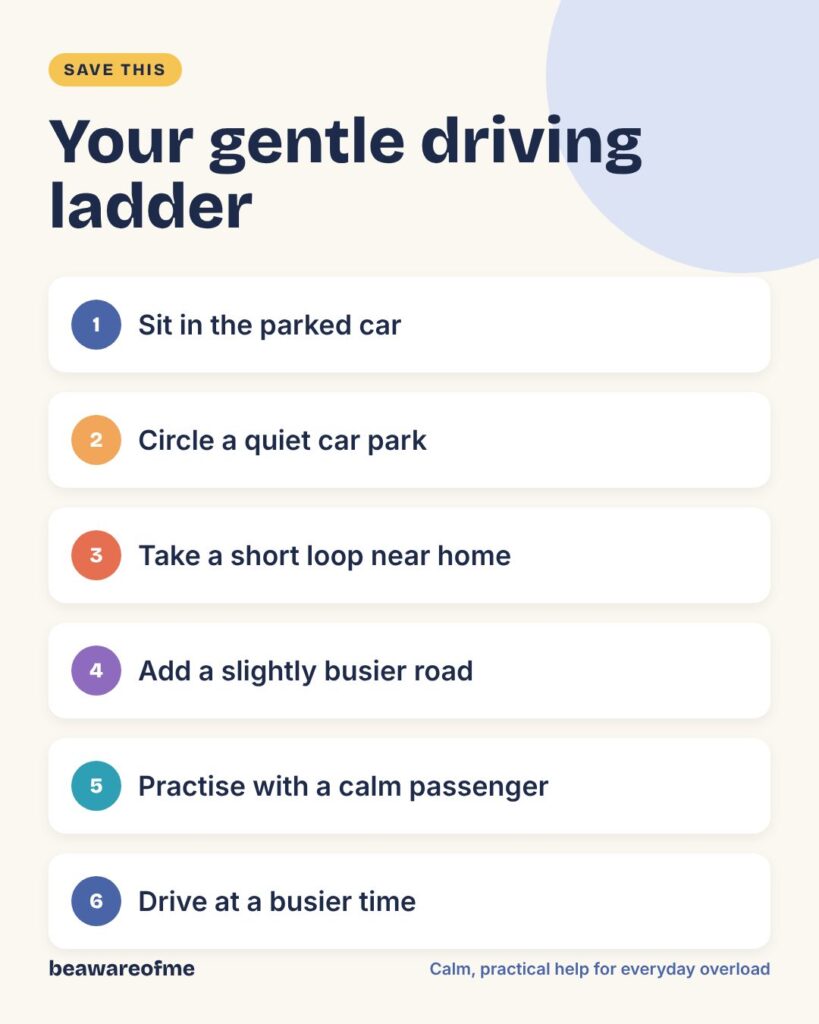
The Driving Anxiety Ladder: A Gentle 8-Step Exposure Plan
The driving anxiety ladder is a list of small driving tasks, ordered from easiest to hardest, that you climb slowly. Mayo Clinic explains that gradual, repeated exposure helps people learn to manage anxiety, often starting with imagining the situation and building from there.
Build your own ladder
Rate each step from easy to hard. Stay on a rung until your anxiety drops noticeably and the task feels manageable. Then move up. Here is an example you can adapt.
Turn the engine on, breathe slowly, and notice the feelings settle.
Practise starting, stopping and turning with no traffic around.
Choose quiet streets you know well, at a calm time of day.
Pick a familiar route with a little more traffic.
A trusted, relaxed person can sit with you, then later you go alone.
Repeat a known route during moderate traffic.
Rungs for the hardest parts
Highways, bridges and night driving often sit at the top of the ladder. Break each into smaller pieces. For example, drive one junction on a quieter stretch of highway, then exit and rest.
A qualified driving instructor who works with nervous drivers can help with these higher rungs. Dual controls can make the hardest steps feel far safer.
How to track progress on your ladder
Keep a simple note after each practice drive. Write the rung, how anxious you felt at the start and how you felt by the end. Over a few weeks, these notes show that driving anxiety rises, peaks and falls, even when it feels endless in the moment.
Notes also help on hard days. When your mind says nothing is changing, you can look back and see the rungs you have already climbed. That evidence is often more convincing than any pep talk.
✨ Small step: Repeat a rung several times before moving on. Repetition, not one heroic attempt, is what teaches your nervous system that this situation is safe enough.
Calming Skills to Practise Before You Drive
Calming skills work best when you train them before you need them. Think of them as tools you pack before a trip. A few minutes a day at home can make a real difference on the road.
Slow breathing you can use anywhere
Slow, steady breathing tells your body it is safe to stand down. Practise breathing out a little longer than you breathe in. Our free box breathing coach walks you through a simple rhythm at home.
Quieting the “what if” loop
Much driving anxiety lives in the hours before a drive. Your mind rehearses crashes, wrong turns and panic. Try writing the worry down, then add one sentence: “If that happens, I will pull over safely and call someone.”
Our guide to managing anticipatory anxiety offers more ways to calm future-focused worry. You can also explore quick relaxation techniques for quick resets.
☀️ Try this today: your pre-drive reset
☐ Plan your route and one safe place to stop.
☐ Do two minutes of slow breathing in the parked car.
☐ Say your coping line out loud.
☐ Set one small goal for this drive, then end on a success.
“My body might react, and that is okay. I know how to breathe, ground myself and pull over safely. I only need to do this one small drive.”
When Self-Help Is Not Enough: Getting Real Support
It is time to get help for driving anxiety when the fear limits your work, relationships or daily freedom, or when self-help is not shifting it. Asking for support is a smart move, not a failure.
Signs it is time to reach out
- The fear is spreading, from highways to local roads, or from driving to being a passenger.
- You have stopped driving altogether and miss the freedom it gave you.
- Panic attacks are showing up in the car or in other places too.
- A crash keeps replaying through flashbacks, nightmares or constant jumpiness.
- Low mood is creeping in because your world feels smaller.
Any one of these is reason enough to talk to a doctor. You do not need to wait until things feel unbearable.
Treatments that tend to help
Mayo Clinic describes exposure therapy as the most effective treatment for specific phobias. CBT, or cognitive behavioural therapy, combines gradual exposure with new ways to think about and cope with fear. A therapist can tailor the steps to you.
The NHS phobias guide also lists talking therapies, and notes that in England you can refer yourself to NHS talking therapies without seeing a GP. Our overview of different types of therapy explains the main options in plain words.
Exposure
therapy is described as the most effective treatment for specific phobias.
Mayo Clinic
CBT
blends gradual exposure with new ways to view and cope with fear.
Mayo Clinic
Self-refer
to NHS talking therapies in England without a GP referral.
NHS
A note on medication and driving
Some medicines can ease anxiety but may also cause drowsiness. Never take anything that could affect your driving without clear advice. Always talk to your doctor or pharmacist about medication and whether it is safe to drive.
🧭 Try this: Before an appointment, note when the fear started, which situations trigger it and what you now avoid. These three details help a professional understand your driving anxiety quickly.
5 Common Mistakes That Keep the Fear Stuck
Most mistakes with driving anxiety come from trying too hard, too fast, or not at all. Each one is understandable. Each one also has a kinder alternative.
Mistake 1: Avoiding driving completely
Total avoidance brings relief but tells your brain driving is truly dangerous. The fear then grows. Instead, keep some tiny, safe drives in your week, even short ones.
Mistake 2: Jumping straight to the hardest drive
A forced highway trip can end in panic and deepen the fear. Instead, start low on your ladder and climb slowly, one rung at a time.
Mistake 3: Leaving the moment anxiety peaks
Ending practice at the worst moment teaches your body that escape is the only fix. Instead, when it is safe, stay with an easier task until the feelings ease, then finish.
Mistake 4: Leaning on safety behaviours forever
Always having a passenger, or only driving one route, can keep confidence thin. Instead, drop one safety behaviour at a time as each step gets easier.
Mistake 5: Judging yourself for every setback
Bad days happen, especially when you are tired or stressed. Instead, note what was harder and go back one rung. Progress is rarely a straight line.
Driving Anxiety FAQ: Honest Answers to Common Questions
Is fear of driving a real condition?
Yes. Fear of driving is a common form of anxiety, and when it is intense it can fit the pattern of a specific phobia. It can follow a crash, grow from panic attacks or appear with no clear trigger. It is not weakness or a lack of skill. Talking therapies, especially gradual exposure work, help many people feel calmer on the road.
Can a fear of driving go away on its own?
Sometimes mild fear fades with steady practice. Often, though, avoidance keeps it going or makes it stronger. The most reliable approach is gradual, repeated exposure in small, safe steps. If the fear has lasted a while or is limiting your life, a therapist can guide you and help you move forward faster and more safely.
What should I do if I panic while driving?
Keep your eyes on the road and slow your breathing, letting each breath out be longer. Name the feeling as anxiety and ground yourself through what you can see and feel. If you cannot concentrate, pull over in a safe, legal place and wait for the wave to pass. Call someone if you need support.
Why do I get anxious on highways but not local roads?
Highways often feel harder because of higher speed, heavier traffic and fewer easy exits. That sense of being trapped can trigger the alarm system more strongly. Breaking highway driving into small pieces helps, such as driving one quiet junction, then exiting to rest. A calm instructor can support you on these steps.
Can a driving instructor help with fear of driving?
Yes. Instructors who work with nervous drivers can be a great help, especially for harder steps like highways. Dual controls can make practice feel much safer. Lessons work well alongside therapy or self-help, because the instructor builds skill while you build calm. Tell them about your anxiety at the start, so they can pace the lessons.
How long does it take to overcome a fear of driving?
It varies from person to person. Some people notice change after a handful of practice sessions, while others need longer, especially after a crash. Regular, gradual practice tends to work better than rare, big attempts. Focus on steady progress up your ladder rather than a deadline, and celebrate each step you complete.
Driving anxiety can feel like it has taken over, but it responds well to patience, safety and small steady steps. Start with the lowest rung you can manage today, keep yourself safe, and ask for help when you want it, because driving anxiety does not get the final word on where your life can go.
📝 Please read: Educational content, not a substitute for professional care. If you are struggling, talk to a doctor or a qualified professional. If you are thinking about harming yourself, contact local emergency services or a crisis line now (US 988, UK and Ireland Samaritans 116 123, or findahelpline.com).