
Knowing what to text someone with anxiety can feel oddly high-stakes, because you care and you don’t want one clumsy message to make their day harder. The good news is that the texts that help most are short, warm and easy to answer, or easy not to answer at all. Below you’ll find more than 30 exact messages to copy, a send-this-not-this table, and a simple rule for when a text should turn into a call or a visit. You’ll also find ways to look after yourself, because steady support lasts longer when you’re not running on empty.
The BeAwareOfMe editorial team · Sources cited below
Quick answer
Send short, calm texts that show you’re there without asking for anything back, like “I’m here. No rush to reply.” Offer one concrete thing (a call, a walk, a distraction), skip advice such as “calm down,” and let them set the pace. If they mention not feeling safe, contact emergency services instead of texting.
Key facts
- Short beats long: one or two sentences are easier to take in when someone’s mind is busy.
- The kindest texts remove the pressure to reply, for example “No need to answer this.”
- Offers work better than open questions: “Want me to call?” is easier to answer than “What’s wrong?”
- Silence often means overwhelm, not anger. A gentle check-in a day or two later is usually enough.
- A text supports a person; it doesn’t replace professional care. In the US, anyone can call or text 988.
The shape behind every text below
Notice. Offer. Release.
Say what you see, give one small thing, take away the pressure to reply.
Why a short text often helps more than a long talk
Many people describe anxiety as a mind that won’t stop scanning for trouble, paired with a body that feels switched on: a tight chest, a restless stomach, trouble focusing. Health services such as the National Institute of Mental Health describe anxiety as more than everyday worry when it hangs around and starts getting in the way of daily life. In that state, a phone call can feel like one more performance. A text can be read when they’re ready, reread at 2 a.m., and saved for later.
A good text gives them something warm to hold without handing them a task. It doesn’t need to fix anything.
Almost every helpful message follows the same three-part shape. You don’t need all three every time, but when you’re stuck, build from these:
Notice
Name what you’ve seen or what’s coming up, without judging it. “Big day tomorrow.” “Last night sounded rough.”
Offer
Give one small, concrete thing. “I can call at 8 if you want a voice.” “I’ll bring soup.”
Release
Take away the pressure to answer. “No need to reply.” “A thumbs up is plenty.”
Put together, it sounds like this: “Big day tomorrow. I can call at 8 if you want a voice. No need to reply.” That’s seventeen words, and it covers comfort, a practical offer and permission to stay quiet. If you want the wider picture beyond your phone, our guide on how to help someone with anxiety in everyday life covers conversations, routines and what to do in person.
Tip
Read your text out loud before you send it. If it sounds like a manager or a doctor, soften it. If it sounds like a friend sitting next to them on the sofa, send it.
What to text someone with anxiety: 36 copy-ready messages by situation
Here’s the library. Each group matches a moment that tends to come up between partners, friends, siblings and coworkers. Swap in names, times and details so it sounds like you.
Before a stressful event: interview, flight, appointment or big meeting
Anticipation is often the hardest part. Aim for the night before and, if you know the timing, about an hour before. If it’s a work moment, our guide to calming anxiety before a meeting has a few things you can pass along if they ask.
Before the big moment · copy and send
During a spiral or a panic moment
When someone is in the thick of it, long paragraphs are hard to read. Use very short lines, one idea each, and steady repetition. You’re not trying to talk them out of the feeling; you’re keeping them company through it. For more on what helps in those minutes, see our guides on how to get through a panic attack and these grounding techniques for anxiety.
In the middle of it · copy and send
When they cancel plans
Cancelling can come with a wave of guilt for an anxious person. Your reply decides whether they feel relief or more shame.
After a cancellation · copy and send
When they go quiet and don’t reply
Not replying is rarely about you. Replying can feel like a task when someone is stretched thin. These texts keep the connection warm without asking them to do anything.
When it’s gone quiet · copy and send
The morning after a hard night
Rough nights often leave people tired, a little embarrassed and fragile. Keep it light and practical. If nights are a pattern, they may find our pieces on calming anxiety at night and waking up at 3am with anxiety useful when they’re ready.
The next morning · copy and send
Long-distance support
When you can’t be in the room, specific offers matter even more. Mention time zones, small deliveries or shared activities so the support feels real, not abstract.
From far away · copy and send
Check-ins that don’t demand a reply
These are the quiet heroes of the list. Send them on ordinary days, not only bad ones, so your texts don’t become a signal that something’s wrong.
Just because · copy and send
Quick win
Pick two texts from this list and save them in your phone’s notes right now. When the moment comes, you won’t have to find words while your own heart is racing.
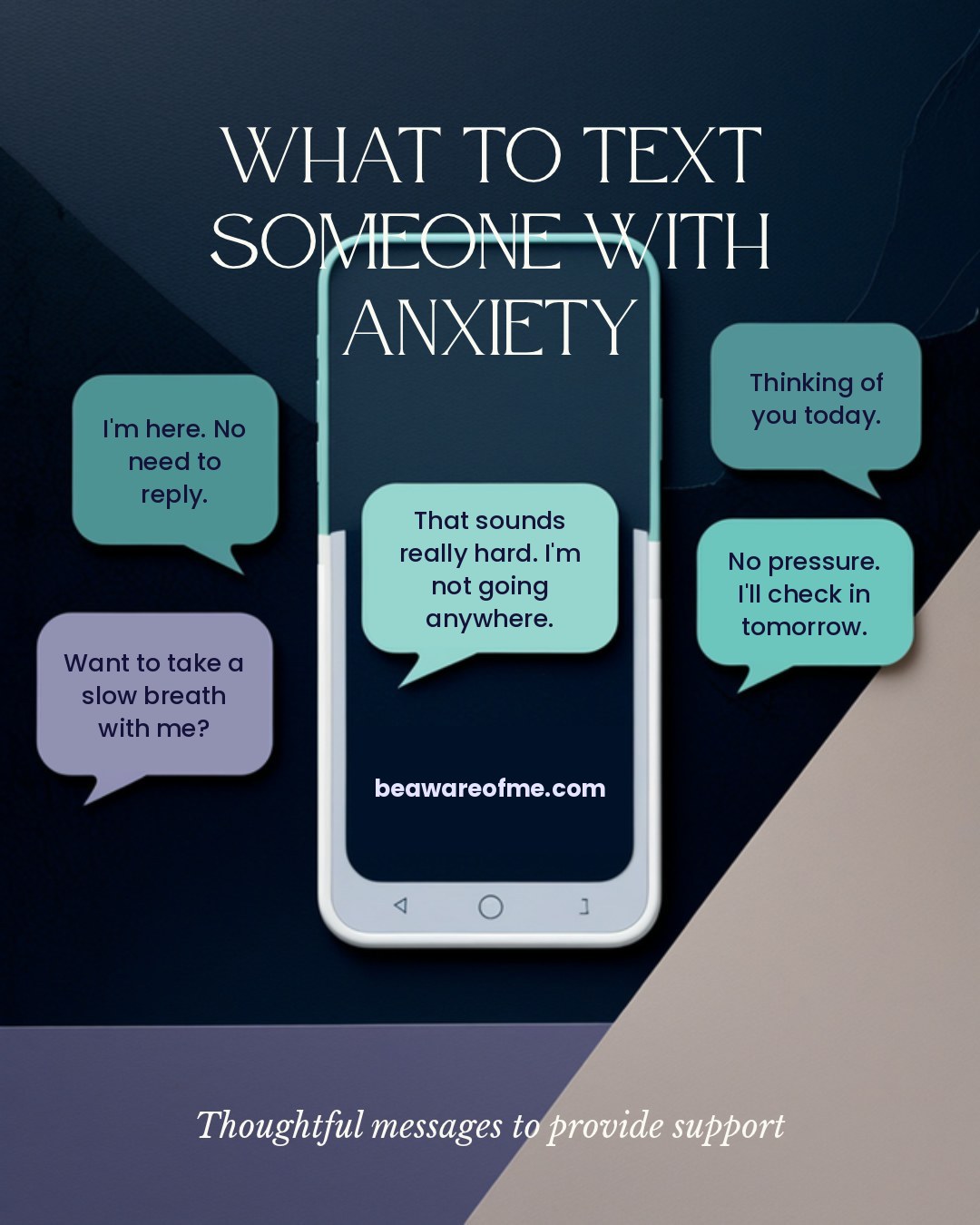
Send this, not this: 10 swaps that feel kinder on a screen
Most unhelpful texts come from a good place. On a screen, though, there’s no tone of voice or hug to soften the words, so small phrasing changes carry a lot of weight.
| Not this | Send this | Why it lands better |
|---|---|---|
| Calm down. | I’m here. No rush to reply. | Asks for nothing, which is calming on its own. |
| What’s wrong now? | Want to tell me, or want a distraction? | Two easy choices instead of an interrogation. |
| You’re overthinking it. | Your mind sounds really busy. Want to talk it through? | Names the experience without blame. |
| Everyone gets stressed. | That sounds really hard. | Validates instead of shrinking the feeling. |
| Just don’t think about it. | Want to think about something else for 10 minutes? I’ve got a story. | Offers a real exit, not an order. |
| Why didn’t you reply? | No need to reply, just thinking of you. | Removes guilt and keeps the door open. |
| You’ll be fine. | Whatever happens, I’m here after. | A promise you can actually keep. |
| Have you tried meditating? | Want to do a slow breath with me? | Joins them instead of handing over homework. |
| You always cancel. | Totally fine. Rain check whenever works. | Protects their dignity and the friendship. |
| Hello?? You there?? | Hi, just checking in. Hope today’s gentle. | Stacked question marks can read as alarm. |
Notice the pattern: the better versions either offer something, validate something or release pressure. None of them argue with the feeling. If the person you love often gets stuck in loops, our guide on how to stop overthinking explains why “just stop” rarely works, and what tends to help instead.
Note
“How are you?” can be surprisingly hard to answer when someone’s anxious, because the honest reply is long and messy. A smaller question such as “What’s one okay thing about today?” is much easier to send back.
Text, call or show up? A simple rule for choosing
Texting is a great default, but it isn’t always enough. Here’s the rule we’d use: match the channel to how much energy the person has right now, and ask before you switch. A surprise ringtone can spike anxiety; “Can I call?” gives them a choice.
Text
They’re stressed but getting through the day, they’ve said they prefer messages, or you’re checking in on an ordinary day.
Call
They ask for one, their replies turn very short or scattered, or they say they can’t think straight. Offer first: “Want me to call? You don’t have to talk.”
Show up
They say yes to a visit, they’ve struggled to eat, sleep or leave home for days and welcome company, or you’re seriously worried about their safety.
A good bridge text between channels is: “Texting is fine, or I can call, or I can come over. Pick whichever feels easiest, or none.” It hands back control.
Ask before you switch channels. “Can I call?” respects them more than a surprise ringtone ever could.
A shape for worry days
The Calm Mind Bundle
If worry days keep coming back, it helps to have something on paper, not just in your messages. The Calm Mind Bundle gives the anxious person (or you, as the one supporting them) guides, trackers and worksheets that put a simple shape around worry: what to do first, what to write down, and how to wind down when the day has been loud.
See the Calm Mind BundleHow to time your texts so they feel like support, not pressure
The same text can feel lovely at 8 a.m. and intrusive at midnight.
Pick moments that matter
- The night before and an hour before a known stressful event, if they’ve told you about it.
- Right after the event, when the adrenaline drops and the replay starts.
- The morning after a hard night, with something light rather than a debrief.
- Ordinary days, so your name on their screen doesn’t only mean “something’s wrong.”
- Not late at night unless they’ve asked for it; a buzzing phone can pull someone out of hard-won sleep.
Emoji, punctuation and tone
Small details read loudly on a screen. A soft emoji (a heart, a sun, a cup of tea) can warm up a short line. Single-word replies with a full stop, like “Ok.”, can read colder than you mean. All caps, stacked question marks and “Call me NOW” can feel like alarms. When in doubt, add a few extra words of warmth: “Okay, no worries at all” instead of “Ok.”
Voice notes, photos and memes
Voice notes can be comforting because they carry your actual tone. Keep them under a minute and say up front that there’s no need to reply. Photos, songs and gentle memes make great no-pressure check-ins. A picture of your dog doing something ridiculous says “I’m thinking of you” without asking a single question.
Tip
Ask once, on a calm day: “When you’re having a rough time, what helps more: texts, calls or just space?” Then follow their answer. Their preference beats any list, including this one.

What to text someone with anxiety who goes quiet for days
When someone stops replying, it’s easy to fill the silence with your own worries: “Did I say something wrong?” Usually the answer is no. Many anxious people go quiet because replying feels like one more thing they can’t do well right now. Some look completely fine from the outside, which is why high-functioning anxiety often goes unnoticed by the people closest to them.
A gentle rhythm works better than a flood of messages. Here’s one you can adapt:
- Day 1: one warm, no-reply text. “Thinking of you. No need to answer.”
- Day 3: a low-effort option. “A single emoji back is plenty, just so I know you’re okay.”
- Day 5 to 7: a specific, kind offer. “I’m dropping groceries at your door on Thursday. Tell me if there’s anything you don’t want.”
- After that: keep a steady, light rhythm, perhaps once or twice a week, and consider reaching them another way if you’re genuinely worried.
What you’re avoiding is the escalation spiral: three texts in an hour, then a call, then “Why are you ignoring me?” If you have a real concern for their safety, though, silence is a reason to act, not wait. Skip ahead to the section on when a text is not enough.
Looking after yourself while you support an anxious person
Being someone’s steady person is meaningful, and it can be tiring. You’re allowed to have limits, and saying them kindly is part of good support, not a failure of it.
A few things that keep support sustainable:
- Remember your role. You’re a friend, partner or relative, not their therapist. You can listen and encourage professional help without carrying it all.
- Say your limits out loud. “I want to be there for you. I’m off my phone after 10, so if it’s urgent at night, please call someone or a helpline.”
- Share the load. If they’re comfortable with it, others in their life can check in too.
- Get your own outlet. Talk to someone you trust about how it feels for you, without breaking their confidence.
- Write it down. A few minutes of journaling can help you sort your own worry from theirs.
Texts for you, the supporter · copy and send
Quick win
Set one small boundary this week and say it warmly. Clear limits make you more reliable, and reliability is one of the most calming things you can offer an anxious person.
When a text is not enough
Texts are good for comfort, but they have limits. If anxiety seems to be shaping most of their days, affecting sleep, work, eating or leaving the house for weeks, gently encourage them to talk to a doctor or a mental-health professional. The NHS page on generalised anxiety explains that talking to a GP is a common first step, and similar routes exist in most countries.
Gently suggesting more help · copy and send
Important
If someone mentions not being safe, wanting to hurt themselves or not wanting to be here, don’t rely on texting. Call your local emergency services (911 in the US and Canada, 999 in the UK, 000 in Australia). In the US you can also call or text 988 to reach the 988 Suicide & Crisis Lifeline, available around the clock. Stay with them, in person or on the phone, if you can.
A shape for worry days
Give worry days a gentle structure
Texts get someone through a moment; a simple routine helps with the days around it. The Calm Mind Bundle is a practical stress and worry toolkit with guides, trackers and worksheets for calming worry, made for the person who’s anxious and for anyone who wants a clearer way to support them.
See the Calm Mind BundleCommon mistakes when texting someone with anxiety
1. Sending advice before comfort
Tips about breathing, sleep or caffeine can wait. Lead with “That sounds hard” and let them ask for ideas.
2. Firing off a wall of text
Long messages full of reassurance are hard to read when attention is scattered. One or two short lines usually land better than five paragraphs.
3. Reading silence as rejection
Taking a quiet spell personally can turn into guilt-tripping texts. Assume overwhelm, not dislike, and keep your rhythm gentle.
4. Making every message about their anxiety
If every text is “How’s your anxiety today?”, they become a problem to manage. Mix in normal life: jokes, plans, photos, gossip about the show you both watch.
5. Promising what you can’t keep
“I’ll always answer straight away” sounds kind, but it breaks the first time you’re asleep or busy. Honest, smaller promises build more trust.
What to text someone with anxiety: answers to common questions
What do you say to someone with anxiety over text?
Keep it short, warm and low-pressure. Something like “I’m here. No rush to reply” or “Want to talk, or want a distraction?” works well. Name what you’ve noticed, offer one small concrete thing, and make it clear they don’t owe you an answer. Avoid advice, comparisons and “calm down,” which can feel dismissive even when meant kindly.
How do you comfort someone with anxiety over text?
Validate first, then offer company. Try “That sounds really hard, and you’re not alone with it.” Use short lines, steady repetition and simple grounding ideas, such as naming three things they can see. Offer a call where they don’t have to talk. Follow their lead on how much they want to share, and check in again later.
What should you not say to someone with anxiety?
Skip “calm down,” “you’re overthinking,” “just don’t think about it” and “everyone gets stressed.” These shrink the feeling or suggest it’s a choice. Also avoid guilt-heavy lines like “Why are you ignoring me?” Swap them for validation and offers, for example “Your mind sounds busy. Want to talk it through, or think about something else?”
Should I text someone with anxiety if they don’t reply?
Yes, gently. Silence often means overwhelm rather than anger. Send one warm message that needs no answer, then a low-effort option a couple of days later, like “An emoji back is plenty.” Avoid stacking texts or demanding a response. If you’re seriously worried about their safety, contact them another way or reach emergency services.
How often should I check in on someone with anxiety?
There’s no perfect number, but a steady, light rhythm usually feels better than bursts. On hard weeks, a daily no-pressure text can help; on ordinary weeks, once or twice is plenty. The best guide is them, so ask on a calm day what feels supportive. Mix check-ins with normal chat so texts don’t signal trouble.
Is it better to call or text someone who is anxious?
Text is a gentle default because they can answer in their own time. A call can help when replies get short or scattered, or when they ask for one. Either way, ask first: “Want me to call? You don’t have to talk.” If you’re worried about their safety, call them or local emergency services rather than texting.
The bottom line on what to text someone with anxiety
When you’re unsure what to text someone with anxiety, go back to three moves: notice, offer, release. Keep it short, make one real offer, and let them off the hook for replying. Save a couple of the scripts above, ask them once what helps, and keep showing up gently on good days as well as hard ones. For more ways to support yourself and the people you love, browse our anxiety guides or try one of our free calming tools.
This article is educational and is not a substitute for professional care. If things feel heavy or unsafe, reach out to a mental-health professional or local emergency services.
Sources
- National Institute of Mental Health: Anxiety Disorders
- NHS: Generalised anxiety disorder in adults
- 988 Suicide & Crisis Lifeline: 988lifeline.org