








A sudden image of swerving into traffic, a flash of shouting something awful in a quiet meeting, a cruel “what if” about someone you love. If intrusive thoughts like these leave you shaken, you are far from alone. This guide explains why they happen, why they say nothing about who you are, and the calm, evidence-based steps that help them fade.
🤝 If a thought feels like more than a thought
If you are thinking about harming yourself, or a thought feels like an urge you might act on, please reach out now. Contact local emergency services or a crisis line: US 988, UK and Ireland Samaritans 116 123, or findahelpline.com for other countries. You deserve support today, and talking to someone is a strong first step.
🌱 Key takeaways
What Intrusive Thoughts Really Are (and the One Thing They Are Not)
Intrusive thoughts are sudden, unwanted thoughts, pictures or urges that arrive uninvited and feel wrong, scary or embarrassing. The key word is unwanted. You don’t choose them, you don’t enjoy them, and they usually upset you precisely because they go against what you care about.

Here is the whole article in one table. Find the row that sounds like you, then read the section that matches.
| Thought type | What it can sound like | Calm first response |
|---|---|---|
| Harm | “What if I hurt someone?” | Label it and keep doing the task |
| Embarrassing urges | “What if I shout in this silent room?” | Notice, breathe, stay in the room |
| Relationship doubt | “Do I really love them?” | Skip the mental checking |
| Health worry | “What if this headache is serious?” | Delay the search for 30 minutes |
| Moral or religious | “Did I just think something terrible?” | Name it as noise, not sin |
| Sticky and daily | Hours of looping, rituals, avoidance | Talk to a doctor or therapist |
Why Your Brain Throws Out Random Thoughts
Your mind produces a constant stream of ideas, most of them useless. A brain that scans for danger will sometimes hand you the worst possible scenario, simply because it can. Think of it like a smoke alarm that beeps when you make toast.
The thought itself is not the problem. The problem starts when you treat it as meaningful. If you think, “Only a terrible person would think that,” your alarm goes off, and the brain learns to watch for that thought again.
The 94% Fact That Changes How You See Them
Researchers at Concordia University worked with colleagues in 13 countries and asked 777 students about unwanted thoughts. As ScienceDaily reported on the study, 94% had at least one unwanted, intrusive thought, image or impulse in the previous three months. In other words, the person next to you on the bus probably had one today too.
94%
of people in a 13-country study reported an unwanted intrusive thought in three months.
Concordia University via ScienceDaily
1.2%
of US adults had obsessive-compulsive disorder (OCD) in the past year.
NIMH
2.3%
of US adults will have OCD at some point in their life.
NIMH
Put those numbers side by side and the picture gets clearer. Intrusive thoughts are nearly universal, while OCD affects a much smaller group. Having the thoughts is human; what matters is how stuck they get.
7 Common Thought Types People Rarely Say Out Loud
Most intrusive thoughts fall into a handful of familiar themes, and naming the theme takes away some of the shock. You may recognise one, several or none of these. Each one is common, and none of them means something is wrong with your character.
Harm, Blurting and “What If I Lose Control” Thoughts
- Harm thoughts: a flash of pushing someone, dropping a baby or grabbing the steering wheel. New parents often report these and feel horrified by them.
- Blurting urges: the sudden idea of yelling, swearing or saying something cruel at a funeral, a meeting or a wedding.
- Loss-of-control fears: “What if I snap?” or “What if I jump?” when you stand near an edge, which is often a fear of the thought rather than a wish.
Doubt, Health, Morality and “Not Quite Right” Thoughts
- Relationship doubts: repeated questions like “Am I with the right person?” that pop up even when things feel fine.
- Health fears: a tingle becomes a disease in your mind within seconds, which overlaps with health anxiety and late-night symptom searching.
- Moral or religious thoughts: blasphemous images or the fear of having done something wrong, sometimes called scrupulosity.
- Contamination or “just right” thoughts: a pull to wash again, or a sense that something must feel exactly right before you can move on.
📝 Note: Unwanted sexual thoughts belong on this list too. They feel deeply upsetting, yet they are common and they don’t reveal hidden desires. The distress you feel is the clue that they clash with who you are.
Intrusive thoughts can also attach to whatever you value most. A loving parent gets thoughts about their child, and a careful driver gets thoughts about crashing. That pattern is a sign of care, not danger.
Why Intrusive Thoughts Get Louder When You Fight Them
Trying to push a thought away tends to bring it straight back, and this is the most useful fact in the whole guide. Psychologists showed this decades ago in the classic “white bear” experiments: tell people not to think of a white bear and the bear keeps showing up. Your mind has to check for the thought to make sure it is gone, and that checking keeps it close.
The Stickiness Loop: Thought, Alarm, Check, Relief
Most sticky intrusive thoughts follow the same four-step loop. Once you can see it, you can step out of it.
An odd image or urge appears, as it does for almost everyone.
You judge it as dangerous or meaningful and your body floods with anxiety.
You analyse, seek reassurance, google, pray, avoid or replace the thought.
You feel better briefly, so the brain learns the thought was a real threat.
The relief is the trap. Every check teaches your brain that the thought deserved an emergency response. Next time it arrives faster and feels heavier, which is why so many people say intrusive thoughts “come out of nowhere” more and more often.
Stress, Poor Sleep and Big Life Changes Turn Up the Volume
You’ll often notice more intrusive thoughts during stressful seasons. A new baby, a new job, exams, grief, illness or money pressure all raise the background alarm level. When you’re short on sleep, your mind also has less room to shrug thoughts off.
Overthinking adds fuel. If you already tend to replay and analyse everything, an intrusive thought gives your mind a new puzzle to chew on. The free overthinking decoder can help you spot which thinking habits show up most for you.
⚠️ Watch out: Seeking reassurance feels kind, but it often keeps the loop going. If you ask a partner “You don’t think I’m a bad person, right?” five times a day, the relief lasts minutes and the doubt returns stronger.
9 Calm Ways to Respond When a Scary Thought Shows Up
The goal is not to stop thoughts from appearing; it is to change how much power you give them. These nine steps come from the same ideas used in cognitive behavioural therapy (CBT), a talking therapy that works on the link between thoughts, feelings and actions.
Catch the moment the thought lands, without judging yourself for having it.
Say quietly, “That’s an intrusive thought.” Labels create distance.
A spike of fear or disgust is normal; it passes faster when you allow it.
Skip the debate about whether it’s true. Arguing keeps the thought centre stage.
Imagine the thought as a radio playing in another room. You don’t have to turn it off.
Try four slow breaths with a longer out-breath to settle your body.
Go back to washing up, typing or talking, even if the thought hangs around.
Delay checking, confessing or googling by 15 minutes, then try 30.
Remind yourself that having the thought took courage to sit with.
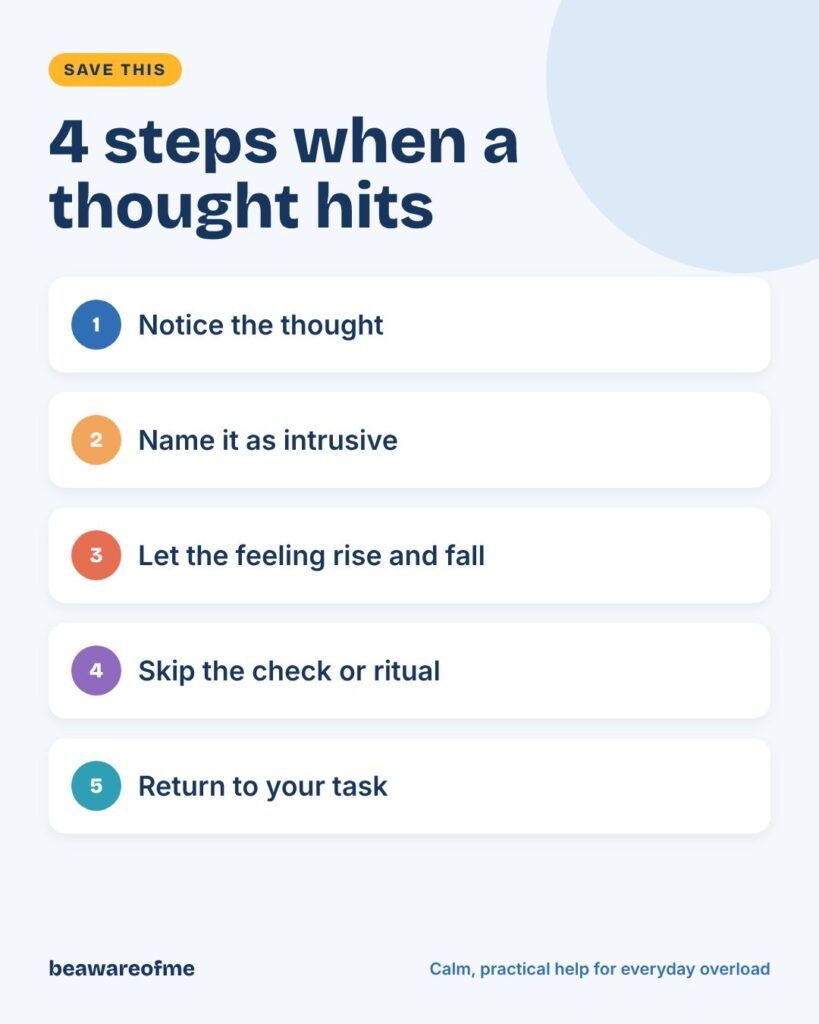
The Notice, Name, Allow, Return Method in Real Life
Picture this: you’re chopping vegetables and a flash of hurting someone with the knife appears. Your heart races. Instead of dropping the knife and searching for answers, you think, “Intrusive thought. My brain is being a smoke alarm.” You keep chopping, a little shaky, and the wave settles within a few minutes.
That small act matters more than it looks. You’ve just taught your brain that the thought did not need an emergency response. If you repeat it day after day, intrusive thoughts usually lose their sharp edge.
You don’t have to win an argument with your own mind. You only have to stop treating every thought as an emergency.
— beawareofme
Scripts You Can Say to Yourself
- “This is an intrusive thought. It’s uncomfortable, and it’s not a fact.”
- “My brain is offering me the scariest option. I don’t have to take it.”
- “I can feel anxious and still keep doing what I’m doing.”
- “Maybe, maybe not. I’m not going to solve this right now.”
💡 Tip: The “maybe, maybe not” line works because it refuses to chase certainty. Certainty is the thing intrusive thoughts demand, and it never arrives, so stop paying the ransom.
Gentle Practice Builds Confidence Over Time
Some people find it helps to practise on purpose. You might write the feared thought on a card and read it slowly once a day, or keep using the kitchen knife you’ve avoided. Start small and stay with the discomfort until it eases a little.
Track your progress in a notebook. Many people notice that intrusive thoughts which once ruined an afternoon become a brief blip after a few weeks of this kind of practice. Progress is rarely a straight line, so a rough day is not a reset.
This idea is a simple version of exposure work. If a thought triggers intense distress or the practice feels overwhelming, do it with a trained therapist rather than alone.
When Intrusive Thoughts May Point to OCD
Intrusive thoughts become a possible sign of obsessive-compulsive disorder when they get stuck, cause lasting distress and pull you into repeated behaviours. Only a qualified professional can assess this, so treat the signs below as a reason to ask for help, never as a self-diagnosis.
The NHS overview of OCD describes obsessions as unwanted, distressing thoughts, images or urges, and compulsions as repeated actions or mental acts that briefly relieve the distress. It also notes that OCD is unlikely to improve without proper treatment, which is good news in disguise: help exists, and it works for many people.
For scale, the National Institute of Mental Health estimates that 1.2% of US adults had OCD in the past year. That is a real group of people, and a far smaller one than the 94% who get odd thoughts.
Typical Thoughts vs. Signs Worth Checking
| Typical unwanted thoughts | Signs worth talking about | |
|---|---|---|
| Frequency | Occasional, come and go | Daily, often taking an hour or more |
| Your reaction | Brief “ugh, weird” moment | Intense fear, guilt or disgust |
| Behaviour | Little change to your day | Checking, washing, counting, confessing |
| Mental rituals | Rare | Replaying, praying or reviewing to feel safe |
| Avoidance | None or very little | Avoiding knives, kids, places or people |
| Impact | Life goes on as normal | Work, sleep or relationships suffer |
What Getting Help Usually Looks Like
According to the NHS, the main treatments are a type of CBT that helps you face fears without doing compulsions, and medicine, usually an SSRI antidepressant. This approach often goes by the name exposure and response prevention (ERP). A doctor or pharmacist can explain whether medicine suits you; never start or stop it on your own.
In the UK you can self-refer to NHS talking therapies or see your GP. Elsewhere, start with your doctor and mention the word “intrusive” so they understand quickly. If these thoughts began during pregnancy or after birth, tell your doctor, midwife or health visitor, because support exists for that stage too.
📝 Note: Some people with OCD have mostly mental rituals and few visible ones, a pattern people sometimes nickname “Pure O”. If your rituals happen inside your head, they still count, and they are still treatable.
For a closer look at how these patterns can show up at home, read about OCD and parenting. It covers family life, which is where many harm thoughts first appear.
Daily Habits That Quietly Turn Down the Mental Static
Small daily habits won’t erase intrusive thoughts, but they lower the background stress that makes them loud. Think of these as turning down the volume, not switching off the radio.
Sleep, Movement and a Lower Baseline
- Guard your sleep: keep a steady wake time, because a rested brain lets thoughts slide past more easily.
- Move every day: a 20-minute walk burns off the restless energy anxiety leaves behind.
- Cut late caffeine: stop coffee by early afternoon if your thoughts spike at night.
- Ground yourself: use quick grounding techniques for anxiety such as naming five things you can see.
Write It Down, Then Put It Away
Writing gives looping thoughts somewhere to land. Try a 10-minute daily “worry window”: jot down what came up, without analysing, then close the notebook and do something else. If you’d like prompts, our guide to journaling for anxiety shows simple formats that don’t take long.
You can also practise noticing thoughts without obeying them. Mindfulness exercises train exactly this skill, and so does reframing negative thoughts with CBT. Pick one approach and stick with it for two weeks before you judge it.
☀️ Try this today: a 5-minute thought reset
☐ Write the thought in one line, exactly as it showed up.
☐ Underneath, write: “This is an intrusive thought, not a fact.”
☐ Rate your anxiety from 0 to 10, then breathe slowly for one minute.
☐ Go back to one small task and rate your anxiety again after 5 minutes.
☐ Notice that the number dropped without you solving anything.
Script for tonight: “Thank you, brain, for trying to protect me. I’ve got this one. I’m going back to what I was doing.”
✨ Small step: If your thoughts surge at bedtime, set the worry window for early evening instead. Our guide to nighttime anxiety has more ideas for quieter nights.
5 Common Mistakes That Keep Unwanted Thoughts Stuck
Most people make these mistakes because they feel sensible in the moment. Each one offers short relief and a longer loop.
Mistakes 1 to 3: Fighting, Fixing and Asking
- Trying to replace every bad thought with a good one. It feels positive, yet it turns into a ritual. Instead, let the thought be there and carry on.
- Looking for proof you’re a good person. Reviewing your past for evidence keeps the question alive. Instead, accept uncertainty with “maybe, maybe not”.
- Constant reassurance from loved ones. Each answer soothes for minutes. Instead, agree with them on one kind reply such as, “I hear you’re anxious; I’m here.”
Mistakes 4 and 5: Avoiding and Waiting Too Long
- Avoiding triggers. Hiding the knives or skipping time with your baby shrinks your life and tells your brain the threat is real. Instead, return to triggers gradually, with support if needed.
- Waiting years to ask for help. Shame keeps many people silent. Instead, remember that doctors and therapists hear about intrusive thoughts often, and they won’t be shocked.
📚 Keep reading
How to stop overthinkingWhy memories keep replayingWhat to do in a panic attackMore on anxietyIntrusive Thoughts FAQ: 6 Questions People Ask Most
Is it normal to have intrusive thoughts?
Yes. Most people have intrusive thoughts, images or urges that feel strange or upsetting. A study across 13 countries found that 94% of participants had at least one within three months. They become a concern only when they get stuck, cause lasting distress, or lead to rituals and avoidance that affect your daily life. In that case, talk to a doctor or a therapist.
Does a dark thought mean I secretly want to act on it?
No. Intrusive thoughts usually clash with your values, which is why they feel so upsetting. A person who is horrified by a harm thought is showing care, not hidden intent. The distress itself is a clue that the thought goes against who you are. If a thought ever feels like an urge you might act on, contact a crisis line or emergency services now.
How do you stop having intrusive thoughts?
You can’t switch intrusive thoughts off on demand, and trying usually makes them louder. What helps is changing your response: notice the thought, label it as intrusive, allow the anxiety to rise and fall, and return to what you were doing. Over a few weeks, this teaches your brain the thought is not an emergency, and it tends to show up less often.
Can anxiety make scary thoughts worse?
Anxiety and stress often make intrusive thoughts more frequent and more intense. When your body is on high alert, your brain scans harder for danger and sometimes serves up the worst possible image. Lowering everyday stress with steady sleep, movement and calming breathing can turn the volume down. If anxiety and thoughts persist for weeks, speak to a doctor about support options.
When are unwanted thoughts a sign of OCD?
Intrusive thoughts may point to OCD when they take up a lot of time, cause strong distress and push you into compulsions such as checking, washing, counting, confessing or mental reviewing. Avoiding people or places because of the thoughts is another sign. Only a qualified professional can assess this. OCD responds well to treatment, usually a form of CBT and sometimes medicine.
Should I tell someone about my dark thoughts?
Telling a trusted person or professional can bring real relief, because shame grows in silence. Doctors and therapists hear about intrusive thoughts often and understand they are common. You don’t need to describe every detail; saying “I keep getting upsetting thoughts I don’t want” is enough to start. Try not to turn telling into repeated reassurance-seeking, which can feed the loop.
Intrusive thoughts feel loud, yet they are one of the most ordinary things a human brain does. The less you fight, check and fear them, the quieter they tend to become, and if they’ve taken over your days, reaching out to a professional is a sign of strength that opens the door to real relief.
📝 Please read: Educational content, not a substitute for professional care. If you are struggling, talk to a doctor or a qualified professional. If you are thinking about harming yourself, contact local emergency services or a crisis line now (US 988, UK and Ireland Samaritans 116 123, or findahelpline.com).