
The bill sits unopened on the counter. You check your balance three times a day, then avoid it for a week. At night, the numbers run laps in your head. Financial stress is one of the heaviest kinds of worry because it touches everything: sleep, relationships, work and how you see yourself. This guide gives you seven calm, practical tips to cope, with scripts, a 20-minute money routine and a plan for the 2 a.m. spiral.
To cope with financial stress, start by facing the numbers in a short, scheduled session instead of avoiding them. Then build a simple spending plan, automate bills and savings, and calm your body before you open hard letters. Make the call you’ve been dreading, talk about money without shame, and protect your sleep with a set worry time. If money worry starts to affect your mood or daily life, free debt advice and a doctor can both help.
- ✓Book a 20-minute weekly money date so your finances get attention without taking over your whole week.
- ✓Write a spending plan that includes a small amount of joy money, because plans that feel like punishment rarely last.
- ✓Automate at least one bill and one small saving so fewer decisions depend on your mood.
- ✓Take five slow breaths before opening any bill or bank app, since a calm body reads numbers more accurately.
- ✓Call lenders early and use free, nonprofit debt advice rather than waiting until a payment is missed.
- ✓Talk to a doctor if financial stress is affecting your sleep, appetite or mood for more than two weeks.
Why Financial Stress Hits Your Mind and Body So Hard
Financial stress is the worry, tension and dread that come from money problems or the fear of them, and it rarely stays in your bank account. The mental health charity Mind describes how poor mental health can make money harder to manage, while money worries can make mental health worse: a vicious cycle.

If you’re living with financial stress, you’re far from alone. In one of the American Psychological Association’s Stress in America surveys, 87% of adults named rising prices of everyday items as a source of stress. When basics like food and rent cost more, almost everyone feels it.
Money worry also triggers the same alarm system as a physical threat. Your heart speeds up, your thinking narrows, and long-term planning feels impossible. That’s why smart, capable people still freeze in front of a bank statement.
Signs money worry is spilling into the rest of your life
The APA lists common signs of financial avoidance. See how many feel familiar:
- You try to put money out of your mind completely.
- You avoid talking about money with your partner, family or friends.
- Bank statements and card bills stay unopened.
- You don’t know your credit score or what you owe in total.
- You feel a jolt of dread when your phone shows a bank notification.
Ticking two or more is common with financial stress, not shameful. It simply means your brain is protecting you from a feeling. The tips below swap that short-term relief for long-term calm. For a quick snapshot of where you stand, try our free money stress check.
Tip 1: Face the Numbers in a 20-Minute Money Date
The first and most powerful tip for financial stress is to stop avoiding, in small, safe doses. APA notes that avoidance tends to backfire: ignoring finances often creates more money problems and more anxiety over time.
A money date is a short, scheduled session each week where you look at your finances with a timer running. It has a start, an end and a reward. That structure tells your brain the task is limited, so it feels less like staring into a hole.
What to do if the numbers are scary
If the total shocks you, pause and breathe before doing anything else. A big number is information, not a verdict on your worth. Then sort debts into two groups: priority ones, like rent, mortgage, energy and tax, and everything else.
Priority bills come first because missing them has the most serious consequences. Our guide on the psychological impact of debt explains why debt weighs so heavily on the mind.
Tip 2: Build a Spending Plan, Not a Punishment Budget
A spending plan decides in advance where your money goes, and it eases financial stress because fewer choices are left to panic. APA suggests focusing on what you want to spend on rather than only on what to cut, which can feel less restrictive than a strict budget.
Start with one month. List your take-home pay, then fill the four buckets below. Use real numbers from your money date, not wishful ones.
| Bucket | What goes in it | Calm rule |
|---|---|---|
| Must-pays | Rent or mortgage, energy, water, council tax, insurance | Pay these first, ideally on payday |
| Everyday living | Food, transport, phone, medicines | Set a weekly amount and track it |
| Debts | Cards, loans, buy-now-pay-later | Minimums first, then extra to one debt |
| Joy and buffer | A small treat, a tiny emergency pot | Keep it small but never zero |
A filled-in example to copy
Here’s how a spending plan might look for someone who takes home 2,400 a month in their local currency. The numbers are an example only, so swap in your own.
- Must-pays: 1,300. Rent, energy, water and insurance leave the day after payday.
- Everyday living: 650. That’s about 150 a week for food and transport, with a little left for the phone.
- Debts: 350. Minimums on two cards, plus a small extra on the one with the highest interest.
- Joy and buffer: 100. Sixty into a tiny emergency pot and forty for something that makes the month feel human.
Notice what the plan does. It gives every unit of money a job before the month begins, so there’s less to decide when you feel tired or anxious. If the buckets don’t add up, that’s useful too: it tells you exactly where to look for help or a change.
Tip 3: Automate the boring parts
Automation eases financial stress by removing daily decisions, which is exactly what a tired, worried brain needs. APA recommends automatic transfers to savings and automatic bill reminders. Set your must-pays to leave your account the day after payday.
Then automate one small saving, even a tiny amount. The sum matters less than the signal: you’re someone who saves. Over months, a buffer turns a surprise bill from a crisis into an annoyance.
Tip 4: Calm Your Body Before You Open the Bills
A calm body reads numbers more clearly, so this tip comes before every money task. When financial stress spikes, your nervous system shifts into threat mode, and threat mode is bad at maths.
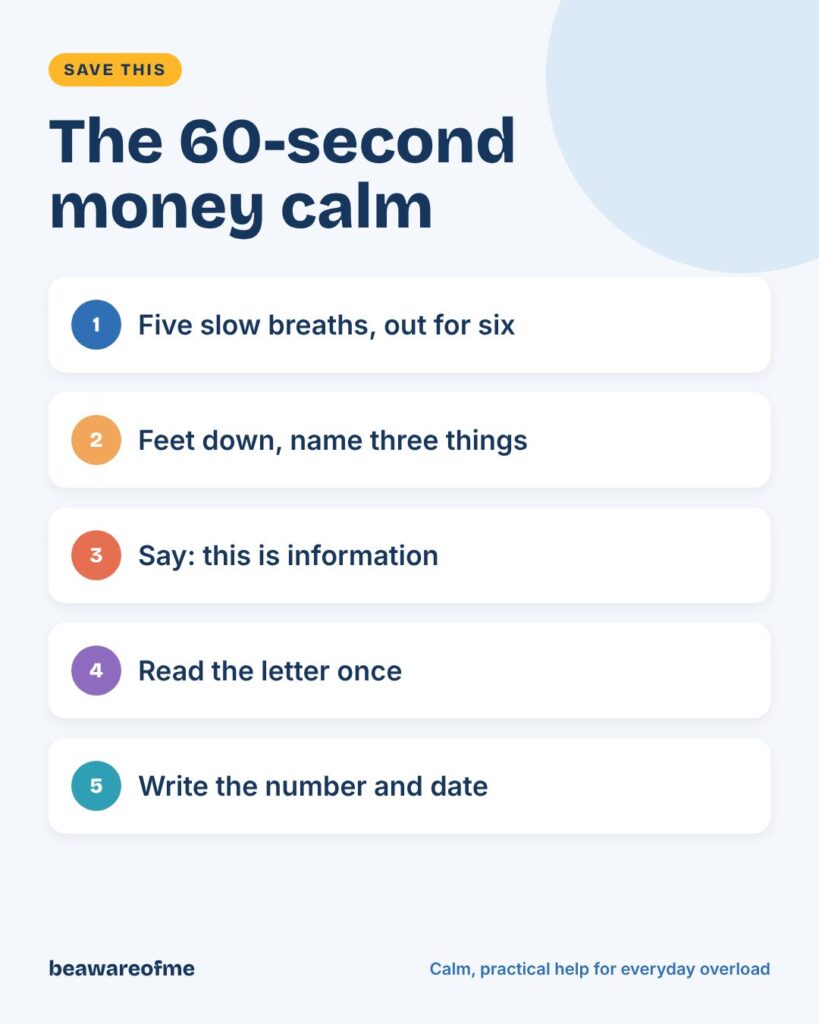
Try this before opening a letter, logging in to your bank or making a call. It takes about a minute.
If your mind races off into worst-case stories, our guide to grounding techniques for anxiety has more ways to come back to the room. You can also pair this habit with our tips to stop overthinking.
Tip 5: Make the Phone Call You’ve Been Dreading
Early contact with lenders and service providers usually gives you more options than silence does. Mind suggests telling services that you have a mental health problem and shares tips for handling phone calls and opening letters.
Many lenders have hardship teams, payment breaks or lower repayment plans, but they can only offer them if they know you’re struggling. Waiting until you miss a payment shrinks your choices.
A script you can read word for word
Keep a notebook beside you, because written notes lower financial stress after the call ends. Write the date, the name of the person you spoke to and what they agreed. That record turns a scary call into a simple paper trail.
Get free, nonprofit debt advice
If you owe several lenders, a free, nonprofit debt advice service can help you see all your options in one place. Look for organisations that are free to use and regulated where you live. Avoid companies that charge upfront fees or promise to make debt vanish.
Tip 6: Talk About Money Without the Shame
Shame is a big driver of financial stress and keeps people stuck, and naming it is one of the quickest ways to shrink it. APA suggests letting go of self-blame and focusing on concrete steps, and it encourages you to reflect on the money beliefs you picked up growing up.
Three questions about your money story
- What did your family say, or not say, about money when you were a child?
- What do you believe a person who struggles with money is like?
- Would you judge a friend in your position as harshly as you judge yourself?
You don’t need perfect answers. Simply noticing an old rule, such as “money problems mean you’ve failed”, gives you the choice to set it down.
How to raise money with a partner
Money talks go better when they’re planned, short and blame-free. Pick a calm moment, not the minute a bill arrives. Try: “I’ve been worrying about money and I’d feel better if we looked at it together. Could we take 20 minutes on Sunday?”
If money differences cause friction, our guide to financial inequality in relationships offers ways to talk it through as a team.
Tip 7: Protect Your Sleep From 2 a.m. Money Spirals
Night is when financial stress grows teeth, because there’s nothing to do with the worry except replay it. Tired brains then make tomorrow’s money choices harder, and the cycle repeats.
Give money worries a set daytime slot, say 15 minutes at 6 p.m. When a worry arrives at night, write it on a notepad by the bed and tell yourself, “That’s for tomorrow’s slot.” Writing it down tells your brain it won’t be lost.
- Look at nothing money-related in the hour before bed.
- Write any money worry on a bedside pad in one line.
- Add one next step beside it, if there is one.
- Do five long-exhale breaths lying down.
- If you’re still awake after 20 minutes, get up and read something calm in dim light.
Our guide to financial anxiety at night goes deeper into why money worries get louder after dark. If sleep keeps slipping, read about stress-induced insomnia too.
If This, Then That: Your Financial Stress Rescue Table
Use this table when you’re too frazzled to think. Find the line closest to your situation and take the matching first step.
| If this happens | Then do this first | Why it helps |
|---|---|---|
| A scary letter arrives | Do the 60-second calm, then read it once | You take in facts, not panic |
| You can’t pay a priority bill | Call the provider today and ask about options | Early contact keeps more doors open |
| You owe several lenders | Contact a free, nonprofit debt adviser | One plan beats many separate fires |
| You keep checking your balance | Limit checks to your weekly money date | Breaks the anxious checking loop |
| You and your partner argue about money | Book a planned 20-minute talk | Calm timing lowers defensiveness |
| Worry wakes you at night | Write it down for tomorrow’s slot | Your brain can let go once it’s recorded |
When Financial Stress Needs More Than a Money Plan
Sometimes financial stress affects mood so much that a budget alone can’t fix it, and that’s a signal to get support for your mind as well as your money. APA notes that research shows psychological treatment can reduce distress and anxiety and even improve financial behaviours.
Signs it’s time to talk to a doctor
- You’ve felt low, hopeless or numb most days for two weeks or more.
- You can’t sleep, or you sleep far more than usual.
- You’ve lost interest in things you used to enjoy.
- You’re drinking more or using other substances to cope.
- Worry about money stops you working, eating or seeing people.
A doctor can check how you’re doing and talk through options. Our guide to financial stress and mental health explains the link in more depth, and these practical ways to reduce financial anxiety add more tools.
5 Common Mistakes That Make Financial Stress Worse
These mistakes are easy to make because each one feels protective at the time. Here’s what to do instead.
1. Waiting until you have a full plan before acting
Many people delay calling a lender until they’ve sorted everything out. Meanwhile, interest and fees grow. Instead, make the first call with just your account number and say you’re working on a plan.
2. Cutting every bit of pleasure at once
Extreme cutbacks feel responsible, but they often lead to a rebound spend that wipes out weeks of effort. Instead, keep a small, fixed joy amount so your plan can survive real life.
3. Checking your balance over and over
Repeated checking feels like control, but it feeds the anxiety loop. Each check gives a tiny hit of relief or fear, never lasting calm. Instead, limit money checks to your weekly date, plus one quick look before a big purchase.
4. Keeping it secret from the people closest to you
Hiding money worry protects you from an awkward talk, but it adds loneliness on top of stress. Instead, tell one trusted person, even if you share only the headline.
5. Treating it as purely a money problem
Financial stress shows up in sleep, mood and your body, so spreadsheets alone often aren’t enough. Instead, pair each money step with a calming step: a walk after your money date, a breath before each call.
Money Worry: 6 Questions People Ask Most
How do money worries affect mental health?
What is the first step to cope with money worries?
Should I call my lender if I can’t pay?
How do I stop worrying about money at night?
Is a budget or a spending plan better for stress?
When should I get help for money worries?
For more calm, practical reading, browse our financial stress guides.
Financial stress shrinks when you replace avoidance with small, steady steps: one money date, one call, one calm breath before each bill. Start with the tip that feels easiest this week, and let each small win make the next one lighter.