




Money Stress Check
A calm, private check on how money worry is showing up for you: avoiding, bills, the payday gap, money talks, sleep and the future. No judging and no financial advice, just a clear picture and three small steps to give your money a shape.
Anonymous. Different questions each time. A general structure for everyday life, not medical or psychological advice.
Money worry can sit in the background all day: in the bank app you avoid, the bill you keep meaning to open, the tight days before payday. This page helps you see how money stress is showing up for you and gives you calm, simple steps to feel more in control, without judgment.
Each answer adds points to Not looking, Bills, Payday gap, Money talks, Sleep and body and Future worry. Your result reads the strongest areas and turns them into a named pattern, a chart, three small steps and the guides that fit. Questions change every time you play.
Money Stress Check: what is really going on
Money stress is the worry, tension and dread that build up around paying for life. It can come from a real shortage of money, from not knowing exactly where you stand or from fear about what is coming. Most people feel some of it at times. It becomes heavy when it runs all the time, affects your sleep and mood, and makes it harder to look at the very numbers that could help you plan.
It shows up in different ways for different people. Some stop looking at their balance altogether. Some feel ambushed by bills because the dates live in five different places. Some get through the month fine until the last week, when everything tightens. For others the hardest part is talking about money with a partner, family or friends. And many people carry a constant low worry about the future: retirement, emergencies, rising costs.
Money worry often affects the body as well as the mind. It can keep you awake, make you tense when the post arrives, or leave you snappy and tired. It also tends to feed itself: avoiding the numbers keeps the worry vague and large, and vague worry makes looking even harder. Shame can make all of this worse, even though money pressure is extremely common and says nothing about your worth.
A simple structure helps because it turns a big fog into a few clear pieces. Knowing your balance, your bill dates and your payday gap makes the problem specific, and specific problems are easier to work on. This check looks at six areas: not looking, bills, the payday gap, money talks, sleep and body, and future worry. It is not financial advice. It is a calm way to see where to start.
What each area means
Not looking
Avoiding the bank app, unopened letters and skipped statements are very common ways of coping with money worry. They bring short relief but keep the worry running in the background.
- You swipe away bank notifications without reading them.
- Letters about money wait unopened.
- You would rather not know what you spent last week.
- You push money thoughts away as soon as they appear.
- Open your banking app for one minute today, just to look.
- Pick a set weekly money minute, same day and time.
- Open one waiting letter with a cup of tea beside you.
- Do your money check with a friend on the phone for company.
Bills
This area is about knowing what goes out, when and how much. When bills feel like surprises, every payment adds stress, even if the money is there.
- Bill dates catch you off guard.
- There is no single list of what goes out each month.
- A higher bill than expected makes you freeze.
- Subscriptions renew that you forgot about.
- Write every regular bill, its date and amount on one page.
- Put bill dates in your calendar with a reminder two days before.
- Check your statements for subscriptions you no longer use.
- If you can, ask to move some bill dates closer to payday.
Payday gap
The payday gap is the stretch before money comes in when things get tight. Many people manage fine for most of the month and then feel squeezed at the end.
- The last week before payday is always stressful.
- You use a card or overdraft to get to payday.
- You check your balance before every small purchase.
- Payday feels like relief, then the cycle starts again.
- Split your spending money into weekly amounts.
- Set aside bill money first, as soon as you are paid.
- Plan simple, low-cost meals for the last week of the month.
- Build a small buffer, even a little each payday.
Money talks
Talking about money with a partner, family or friends can feel awkward or tense. Avoiding it often leads to misunderstandings and carrying the worry alone.
- Money conversations at home often turn into arguments.
- You avoid telling people when you cannot afford something.
- You feel embarrassed about your money situation.
- You and your partner have different ideas about spending.
- Choose a calm, set time for money talks, not in the middle of a row.
- Start with shared goals before going into numbers.
- Use a simple script like 'That's not in my budget this month, could we do something cheaper?'
- Agree on a small amount each person can spend without checking.
Sleep and body
Money worry often comes out at night or in the body. It can mean lying awake doing sums, tension when the post arrives or feeling tired and on edge.
- You lie awake thinking about money.
- Your stomach tightens when you check your balance.
- You feel tense when bills or letters arrive.
- Money worry leaves you tired and snappy.
- Write money thoughts down before bed with one next step.
- Keep money tasks to the daytime, not late at night.
- Use slow breathing before you open the bank app.
- Remind yourself that a plan on paper is better than sums in the dark.
Future worry
This is worry about what is ahead: emergencies, rising costs, job security or retirement. It can feel big and hard to act on, which makes it easy to keep circling.
- You worry about money you might need later.
- An unexpected cost feels like it could tip everything over.
- You feel behind compared to others.
- You find it hard to enjoy spending even on small treats.
- Start a small emergency pot and add a little regularly.
- Write down your top three money worries and one step for each.
- Focus on the next few months rather than the next few decades.
- Use free, reputable guidance services to learn the basics.
What your score means
Money seems to be on your mind without taking over. Keep the habits that help, like knowing your bill dates and checking in on your balance regularly, so it stays that way.
Money worry is showing up often enough to wear on you. Pick your highest area and try one small step this week, like a weekly money minute or a single list of bills.
Money seems to be weighing on you heavily right now, and that is hard to carry. Start with one gentle step, like looking at your balance for one minute, and reach out to a free, non-profit debt or money advice service if you are falling behind on bills or debts.
5 small steps that help
Look for one minute
Open your banking app and just look at the balance, without fixing anything. Write the number on paper. Seeing it plainly is the first step to planning.
Make one bill list
Write every regular payment on one page with its date and amount. Add the dates to your calendar with reminders a couple of days before.
Plan the payday gap
When you are paid, put bill money aside first, then split what is left into weekly amounts. This makes the last week of the month easier to see coming.
Book a weekly money minute
Choose the same short slot each week to check your balance, upcoming bills and spending. Keep it brief and finish with something you enjoy.
Talk to one person
Share one money worry with a partner, friend or a free advice service. Saying it out loud often makes it feel smaller and easier to act on.
The guides that turn this into a plan
 Ebook + Planner
Money Without Panic
A gentle way back to your money, one step a week.
 Bundle · 6 products
The Money Peace Bundle
A calm, simple system for bills, spending and money talks.
Six products sold separately for $85, here together for $37.
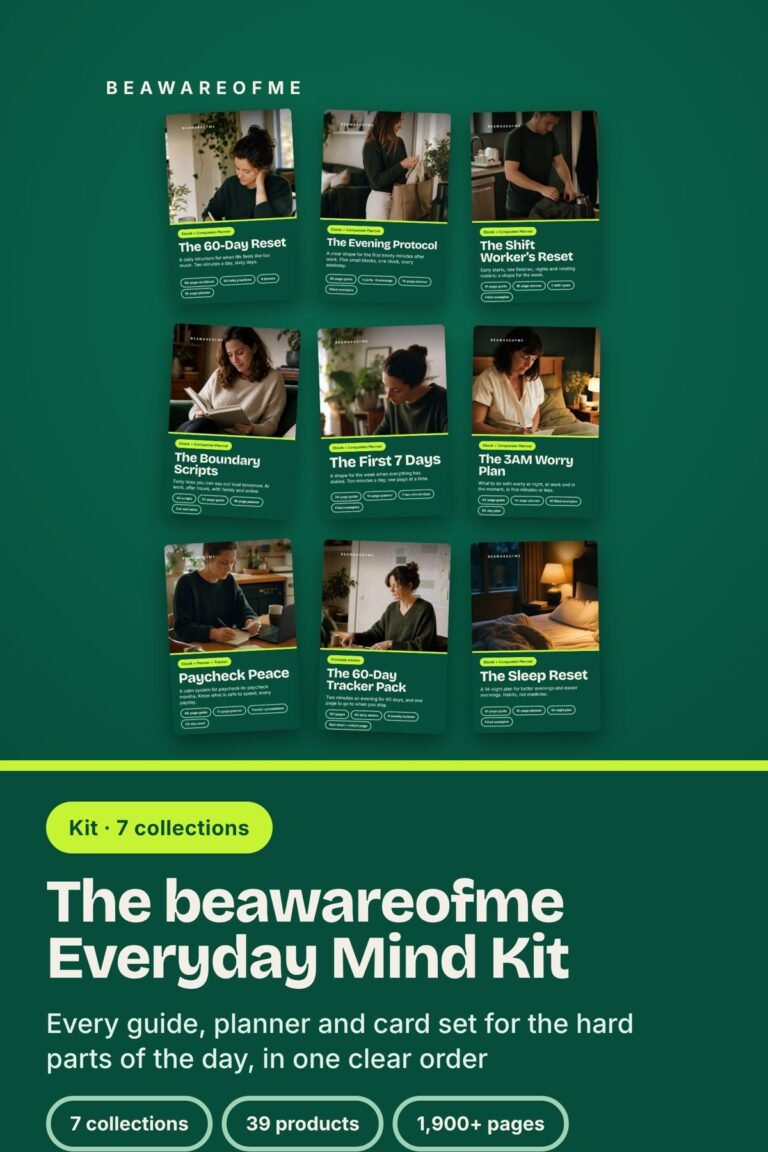 Kit · all collections
The beawareofme Everyday Mind Kit
Every beawareofme collection in one download, in a clear order.
The Standard System and all six bundles cost $289 bought separately; the kit is $127.
Instant download · Digital download · All sales final
Myths and calmer facts
✗ If I do not look at my balance, I will worry less.
✓ Not looking can feel easier for a while, but it usually keeps the worry vague and running. A short, regular check often brings more calm than avoiding it.
✗ Money stress only happens to people who are bad with money.
✓ Money worry is very common at every income level. Rising costs, irregular income and life events all play a part, and it says nothing about your worth.
✗ I need a big plan before I can start.
✓ Small steps, like one list of bills or a weekly check-in, often make the biggest difference to how money feels. You can build from there.
When to get help
If you are falling behind on bills, rent or debt repayments, contact a free, non-profit debt or money advice service in your country as early as you can; they can help you understand your options. Talk to a doctor or a qualified professional if money worry is affecting your sleep most nights, making it hard to function, or leaving you feeling hopeless or panicky. Be wary of quick-fix loans or offers that sound too good to be true. If you are thinking about harming yourself, please reach out now: call or text 988 in the US, call Samaritans on 116 123 in the UK and Ireland, or find a local line at findahelpline.com.
Frequently asked questions
How do I stop worrying about money?
Worry usually shrinks when the picture gets clearer. Look at your balance, list your bills and dates, and set a weekly money minute. Small, regular steps tend to help more than one big overhaul.
Why do I avoid looking at my bank account?
Avoiding the numbers is a very common way to cope with stress, because it brings short relief. The catch is that not knowing often keeps the worry going, so starting with a one-minute look can help.
How can I make money last until payday?
Put bill money aside as soon as you are paid, then split what is left into weekly amounts. Plan simple meals for the last week and keep a small buffer if you can.
How do I talk to my partner about money without fighting?
Pick a calm, set time rather than raising it in the middle of a disagreement. Start with what you both want, then look at the numbers together and agree on one small change.
Can money stress affect sleep?
Yes, for many people money worry shows up at night as lying awake or waking early. Writing worries down with a next step before bed, and keeping money tasks to the daytime, can help.
Is this check financial advice?
No. It is a calm way to notice how money stress is affecting you and choose a first step. For advice on debt or your finances, contact a free, non-profit money advice service.
Is this check a diagnosis?
No. Your answers point to a pattern, not a diagnosis. It is a general structure for everyday life, not medical or psychological advice.