
You pick up your phone to check one message and surface forty minutes later, tired and a little flat. If that keeps happening, you might be wondering whether you have a social media addiction, or just a stubborn habit. This guide gives you a clear way to tell, a 14-day reset that doesn’t depend on willpower, and the long-term habits that keep the balance once you’ve found it.
The short answer
Social media addiction describes compulsive scrolling that keeps going even when it costs you sleep, focus, mood or time with people. It isn’t a formal diagnosis, but the pattern is real. Long-term balance rarely comes from deleting every app. It comes from changing your phone so it pulls less, filling the freed time with something you enjoy, and running a short monthly check so old habits don’t quietly creep back.
Key takeaways
Judge your scrolling by its cost, not its minutes: lost sleep, missed tasks and a worse mood matter more than any screen-time number.
Change your environment first, because moving apps, muting notifications and charging your phone outside the bedroom beat willpower every time.
Replace scrolling with one specific activity for each trigger moment, or the empty slot will pull you straight back.
Cut back rather than quit forever, since a small daily limit is easier to keep for months than a dramatic detox.
Run a ten-minute monthly audit to catch the slow drift that turns a fixed habit back into a problem.
Talk to a doctor or therapist if scrolling hides low mood, anxiety or loneliness that doesn’t lift when you cut back.
What Social Media Addiction Really Means (and Why Willpower Isn’t the Problem)
Social media addiction is a loose, everyday term for scrolling you can’t easily stop, even when you can see it hurting you. Doctors don’t list it as an official diagnosis, and you don’t need a label to want change. What matters is the pull you feel and the price you pay.

Most advice about social media addiction gets one thing backwards. It treats the problem as a lack of discipline, when the apps work hard to keep you there. Infinite feeds, autoplay and unpredictable likes all reward you on a random schedule, and random rewards feel especially hard to walk away from.
The four-step loop behind every long scroll
Nearly every unplanned session follows the same loop. Once you can see it, you can break it at the weakest point.
- Trigger. Boredom, a pause in the queue, a hard email, or the moment you lie down in bed.
- Reach. Your hand finds the phone before your mind decides anything.
- Reward. A funny clip, a new like, a small hit of novelty.
- Repeat. The feed never ends, so nothing tells you to stop.
Notice that only one step involves the app. The other three happen in your body and your surroundings, and that’s exactly where you have the most control.
Heavy use versus a habit that costs you
Plenty of people spend hours online and feel fine, and that’s not social media addiction. Time alone doesn’t decide it. The real question is whether you keep scrolling after it stops serving you, and whether you’ve tried to cut down and found you couldn’t.
📝 Note
Social media isn’t all bad. It can keep you close to faraway friends, help you find support and teach you real skills. The goal here is balance, so you choose when you log on instead of the feed choosing for you.
7 Quiet Signs Your Scrolling Has Crossed the Line
The clearest signs of a problem are small and easy to explain away. You might recognise one or two in yourself and still be fine. If four or more feel familiar, social media addiction may be part of the picture, and it’s worth treating your phone habits as something to change.
- You check apps within minutes of waking, before you’ve even sat up.
- You open an app, close it, then open it again a few seconds later without meaning to.
- Bedtime slides later because one more video always sounds harmless.
- You feel restless, irritable or bored the moment your phone isn’t in reach.
- Your mood rises and falls with likes, replies or what other people post.
- You’ve set limits before and broken them within a day or two.
- Work, chores or conversations get half your attention because the feed has the other half.
If you want a deeper checklist, our guide to the signs you’re addicted to social media walks through each one with examples. Doomscrolling, the habit of reading bad news on repeat, deserves its own look, and you’ll find it in how doomscrolling affects your mental health.
Run a 3-day reality check before changing anything
Before you set rules, gather honest data for three ordinary days. Open your phone’s screen-time report each night and write down three numbers: total time, number of pickups and your most-used app. Then add one line about how you felt after your longest session.
This tiny log turns a vague feeling of social media addiction into something you can actually work with. Most people discover that their biggest problem isn’t total hours but a few predictable moments, like the commute, lunch or the half hour in bed.
💡 Tip
Rate your mood from 1 to 10 before and after one long scroll each day. If the number drops more often than it rises, you’ve found your strongest reason to change, and it’s yours, not someone else’s rule.
Your First 14 Days: A Reset That Doesn’t Rely on Willpower
A two-week reset for social media addiction works best when you change your surroundings first and your behaviour second. Willpower runs out by evening, while a rearranged phone keeps working all day. Follow these steps in order, one or two a day.
Days 1-2: Turn off the pings
Switch off every social notification except direct messages from real people. Fewer alerts mean fewer triggers to reach for the phone.
Days 3-4: Move the apps
Take every social app off your home screen and put it in a folder on the last page. That extra swipe gives your brain a second to decide.
Days 5-6: Pick your windows
Choose two short windows for social apps, such as 12:30 and 18:30, for fifteen minutes each. Outside them, the apps stay closed.
Days 7-9: Clear the bedroom
Charge your phone outside the bedroom and use a cheap alarm clock instead. This one change protects both ends of your day.
Days 10-12: Edit your feed
Unfollow or mute any account that leaves you feeling worse, envious or anxious. Keep the people and topics that genuinely add something.
Days 13-14: Review and keep
Compare your new screen-time numbers with your 3-day log. Keep what worked, drop what didn’t, and set your limits for the next month.
For more structured breaks, our article on how a social media detox can boost your mental health explains short and long pause options.
What the research on cutting back actually found
You don’t have to quit completely to ease social media addiction. In a University of Pennsylvania experiment, students limited themselves to ten minutes per platform per day on three apps for three weeks. Compared with a group that kept their usual habits, they reported significant drops in loneliness and depression.
143
students took part in the Penn experiment on limiting social media.
Source: Penn Today
10 min
per platform per day was the limit the experimental group followed.
Source: Penn Today
3 weeks
of tracking were enough to see lower loneliness and depression scores.
Source: Penn Today
The researchers used real phone data rather than guesses, which makes the result more convincing. Still, they studied young adults and only three apps, so treat it as encouragement rather than a precise prescription.
Redesign Your Phone So Social Media Addiction Has Less to Grab
Your phone’s settings can do much of the hard work of fighting social media addiction for you. Every small barrier you add, such as an extra tap or a duller screen, gives you a moment to choose. These changes take about twenty minutes and keep paying off for months.
Settings worth changing tonight
| Setting | What it does | Why it helps |
|---|---|---|
| App limits | Locks an app after a daily time you choose | Creates a natural stopping point the feed never gives you |
| Grayscale mode | Turns the screen black and white | Makes bright, colourful feeds feel less exciting |
| Notification summary | Delivers alerts in batches at set times | Stops constant pings from pulling you back in |
| Logged-out apps | Requires a password each time you open them | Adds friction so you open them on purpose |
| Browser instead of app | Uses the website rather than the full app | Removes autoplay and many attention tricks |
| Bedtime mode | Silences and dims the phone at night | Protects your sleep from late-night scrolling |
You don’t need all six. Pick the two that fit your weakest moment, and add more only if those don’t hold. If you’d like help from software, our list of apps that cut screen time compares the options.
Create phone-free places, not just phone-free times
Places often work better than rules, because you don’t have to remember them. Make the dinner table, the bathroom and the bedroom no-phone areas, so social media addiction loses its easiest openings. Our guide to creating screen-free zones at home shows how to set them up so the whole household joins in.
✨ Quick win
Put a book, a puzzle or a notebook exactly where your phone usually sits. When your hand reaches for the familiar spot, it finds something better waiting.
Fill the Gap: What to Do With the Hours You Get Back
Cutting back leaves empty time, and empty time pulls you straight back to the feed unless you fill it on purpose. Recovery from social media addiction depends less on removing scrolling and more on what replaces it. Match each trigger moment with a specific, easy alternative.
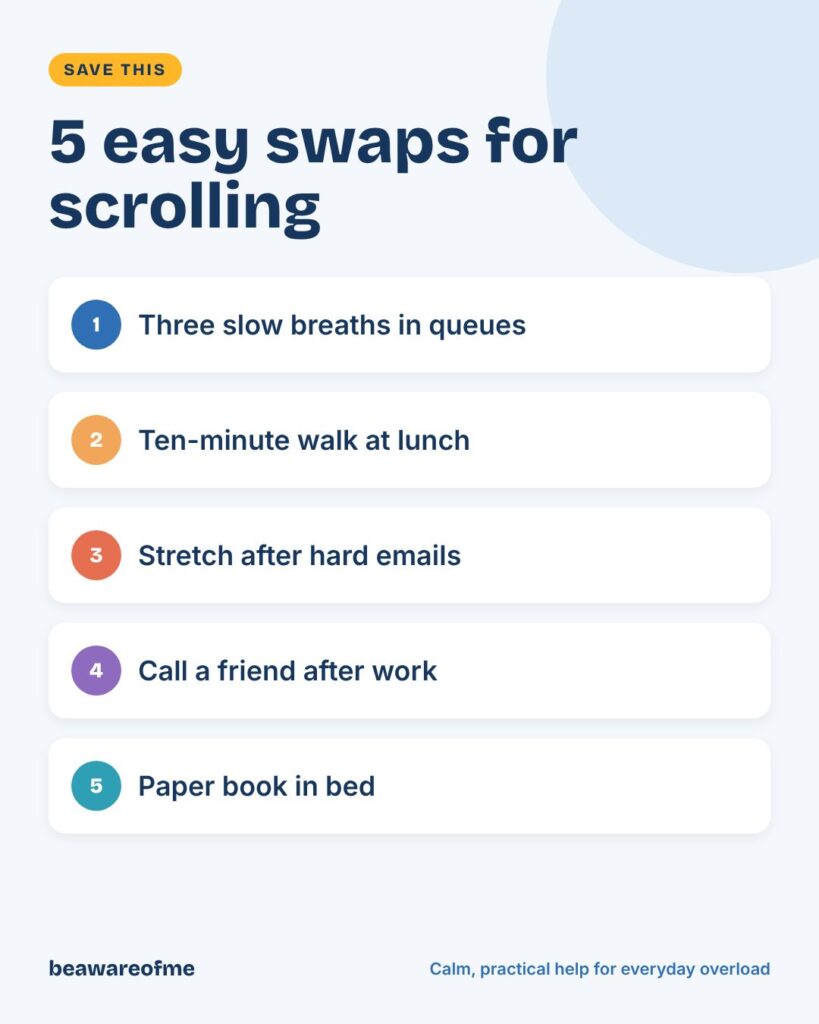
Swap each trigger for something just as easy
| When you usually scroll | Try this instead |
|---|---|
| Waiting in a queue | Three slow breaths, then look around and notice five things |
| Lunch break | A ten-minute walk outside, phone in your pocket |
| After a hard email | Stand up, stretch, refill your water |
| On the sofa after work | A podcast, a short show you chose, or a call to a friend |
| Lying in bed | A paper book or a few lines in a journal |
The best swap feels almost as easy as scrolling. If it takes effort to start, you won’t do it when you’re tired, so keep the alternatives close and simple.
Rebuild the offline connections the feed replaced
Loneliness feeds social media addiction: many people scroll because they feel lonely, and then feel lonelier afterwards. If that sounds familiar, read whether social media leaves you connected or isolated. Then pick two people and plan one real catch-up each this month, even a short walk or a coffee.
Try this today
Your one-week swap plan
Write down your three most common scrolling moments.
Choose one easy replacement for each moment.
Put the replacement where you’ll see it, like a book on your pillow.
Send one friend a message suggesting a real meet-up.
Each evening, tick the swaps you managed, without judging the misses.
The Long Game: 5 Habits That Keep Social Media Addiction From Creeping Back
Most people who beat social media addiction don’t relapse in one dramatic moment. Instead, the habit drifts back slowly, one extra app and one later night at a time. These five habits catch the drift before it becomes a pattern again.
1. The 10-minute monthly audit
On the first weekend of each month, open your screen-time report and ask three questions. Has my total crept up? Which app grew the most? How do I feel after I use it? Adjust one setting based on the answers.
2. Log on with a reason
Before you open an app, name your purpose in a few words: “reply to my sister” or “check the event time”. When the purpose is done, close the app. This small pause turns automatic use into intentional use. For more ideas, see our guide to mindful social media techniques.
3. Guard against comparison
Feeds show everyone’s best moments, so it’s easy to feel behind. When you notice envy, mute the account for thirty days and see whether you miss it. Our article on how to stop comparing yourself on social media has practical scripts.
4. Plan for high-risk weeks
Stress, holidays, illness and big news all make relapse more likely. During those weeks, tighten your limits in advance rather than waiting until you notice the slide. If fear of missing out drives you back, try the steps in managing social media anxiety and FOMO.
5. Treat slips as data, not failure
A long scroll on a bad day doesn’t mean social media addiction has won, and it doesn’t erase weeks of progress. Ask what triggered it, adjust one thing, and carry on tomorrow. Shame makes relapse more likely, while curiosity makes the next attempt easier.
“You don’t need to win against the feed forever. You only need to make the next choice a little easier than the last one.”
Protect Your Evenings From the Late-Night Scroll
Night-time is where social media addiction does the most quiet damage, because it steals sleep you need for a steady mood. The Sleep Foundation recommends making the hour before bed a relaxing, screen-free time. It notes that stimulating content such as social media makes it harder to unwind.
Build a simple digital curfew
Pick a fixed time, about an hour before you want to sleep, when your phone goes to its charger outside the bedroom. Use that hour for a wind-down routine: a shower, tidying for tomorrow, reading or gentle stretching. Our guide to digital curfews and phone bedtimes offers more options.
If you can’t fall asleep without your phone
Many people with social media addiction use scrolling to quiet a busy mind at night. Try a replacement that also calms, such as an audiobook with a sleep timer, a breathing exercise, or writing tomorrow’s to-do list on paper. Give it a week before you judge it, because new routines feel awkward at first.
⚠️ Watch out
If you regularly scroll past 1 a.m. and then feel exhausted and low the next day, the sleep loss itself may be driving much of the low mood. Protect sleep first, then reassess how you feel.
When Scrolling Hides Something Deeper
Sometimes social media addiction is a symptom rather than the main problem. People often scroll to escape stress, loneliness, worry or low mood. If you cut back and those feelings rush in, that’s useful information, not a reason to give up.
Questions to ask yourself
- What am I usually feeling right before I reach for my phone?
- If I couldn’t scroll right now, what would I have to face?
- Has my mood, sleep or appetite changed for more than two weeks?
- Do I still enjoy things I used to love when I’m offline?
If your answers point to stress or worry, our free energy battery self-check can help you see how drained you feel. You can also browse more everyday guides in our life and wellbeing section.
When to talk to someone
Reach out to a doctor or therapist if low mood, anxiety or loneliness lasts for weeks, or if scrolling seriously affects your work, relationships or sleep. Cognitive behavioural approaches, which help you notice and change unhelpful thought and behaviour patterns, often help with compulsive habits, including social media addiction. Asking for help is a practical step, not a sign of weakness.
5 Common Mistakes That Quietly Undo Your Progress
Even with good intentions, a few common mistakes in tackling social media addiction can send you straight back to old habits. Each one looks reasonable at first, which is why it catches so many people.
Going cold turkey without a plan
Deleting every app overnight feels powerful, but it often ends in a binge a week later. Without replacements, the empty time becomes unbearable. Instead, cut back in stages and add an alternative for each moment you used to scroll.
Swapping one feed for another
Many people quit one platform and simply spend the same hours on another. The habit stays the same, only the logo changes. Watch your total screen time, not just a single app, during the first month.
Relying only on screen-time limits
App limits help, but tapping “ignore for today” takes one second. Limits work best alongside physical changes, like charging the phone in another room, which add real distance rather than a pop-up.
Judging success by zero use
If your goal is never touching social media again, any slip feels like failure. That all-or-nothing thinking fuels relapse. Set a realistic target, such as thirty minutes a day, and celebrate staying close to it.
Ignoring what drives the scrolling
If you scroll to escape stress or loneliness, cutting back without addressing those feelings leaves a gap. Notice what you feel before you reach for your phone, and look after that need directly.
6 Honest Questions About Breaking the Scrolling Habit
Is social media addiction a real condition?
It isn’t an official diagnosis in the main psychiatric manuals, but many researchers study problematic social media use as a real pattern. The term describes compulsive scrolling that continues despite harm to sleep, work, mood or relationships. You don’t need a formal label to benefit from change. If the habit causes distress or affects daily life, it deserves attention and practical steps.
How much social media use is too much?
There’s no single safe number, because the cost matters more than the minutes. Warning signs include lost sleep, missed tasks, feeling worse after using it and failing to cut down when you try. In one Penn experiment, students who kept to ten minutes per platform per day for three weeks reported less loneliness and depression than those who didn’t.
How long does it take to break a social media habit?
Many people notice a calmer mind within one to two weeks of changing their phone settings and routines. Building a lasting new habit usually takes longer, often a couple of months of steady practice. Expect a few slips along the way. Progress shows up as fewer automatic pickups, better sleep and less urge to check, not perfect days.
Should I delete my social media accounts completely?
Not necessarily. Deleting accounts works for some people, but many find a planned reduction easier to keep for months. Try removing apps from your phone and using the browser version at set times first. If you still can’t control your use after a few weeks, a longer break or full deletion may be the right next step.
Can social media addiction affect sleep and mood?
Yes, it often affects both. Late-night scrolling delays bedtime, and stimulating content keeps your mind alert when it should be winding down. Short sleep then makes stress and low mood harder to handle. Many people also feel worse after comparing themselves with curated posts. Protecting the hour before bed is one of the most helpful changes you can make.
When should I get professional help for compulsive scrolling?
Talk to a doctor or therapist if you can’t cut back despite real effort, or if scrolling seriously harms your work, relationships or sleep. Seek help too if low mood, anxiety or loneliness lasts for more than two weeks. A professional can help you understand what drives the habit and build strategies that fit your life. Reaching out is a strong, practical step.
Balance with your phone isn’t a finish line you cross once; it’s a set of small choices you keep making, and each one gets easier with practice. Start with the change that fits your hardest moment of the day, then build from there. You can loosen the grip of social media addiction and keep the parts of online life you actually enjoy.
A gentle note
Educational content, not a substitute for professional care. If you are struggling, talk to a doctor or a qualified professional. If you are thinking about harming yourself, contact local emergency services or a crisis line now (US 988, UK and Ireland Samaritans 116 123, or findahelpline.com).