







Your teenager’s phone is where their friendships, jokes, worries and plans live, so it’s natural to wonder what it’s doing to their mood. Banning it feels impossible, and ignoring it feels risky. This guide gives you a balanced view of social media and teen mental health: the real risks, the real benefits, the warning signs to watch for, and calm, practical ways to guide your teen without turning every evening into a fight.
The short answer
Social media affects teen mental health in both directions. It can help teens stay connected, find support and express themselves, especially if they feel isolated offline. It can also disrupt sleep, fuel comparison and expose them to bullying or harmful content. Heavy use, such as more than three hours a day, is linked with higher risk. The most protective steps are protecting sleep, coaching younger teens closely and keeping honest conversations going.
❤️ If things feel unsafe right now
If your teen talks about harming themselves or seems in danger, act now. Contact local emergency services or a crisis line (US 988, UK and Ireland Samaritans 116 123, or findahelpline.com), and stay with them while you get help.
Key takeaways
Focus on what your teen does online and how it makes them feel, not only on the number of hours.
Keep phones out of bedrooms overnight, because protecting sleep is one of the strongest safeguards for teen mental health.
Coach and monitor more closely in the early teen years, then hand over control step by step as your teen shows good judgement.
Ask open questions about online life every week, so your teen comes to you when something goes wrong.
Watch for changes in sleep, mood, school or friendships that last more than two weeks.
Model the habits you want to see, since teens copy what adults do far more than what they say.
The Honest Picture: What Research Says About Teen Mental Health and Social Media
Research shows a real link between heavy social media use and poorer teen mental health, but it doesn’t show that every app harms every teen. The American Psychological Association health advisory puts it clearly: using social media is not inherently beneficial or harmful to young people. Effects depend on the teen, their situation and what they actually do online.
What the numbers tell us
Frequent use is now the norm. In a national CDC survey of high school students, 77% reported using social media at least several times a day. Frequent users were more likely to report persistent sadness or hopelessness than infrequent users, at 42.6% compared with 31.9%.
That survey took a single snapshot, so the authors note it can’t show cause or direction. Still, other research points the same way. Mayo Clinic summarises a study of more than 6,500 young teens in which spending three hours a day on social media was linked with a higher risk of mental health concerns.
77%
of US high school students use social media several times a day or more.
Source: CDC
42.6%
of frequent users reported persistent sadness, versus 31.9% of infrequent users.
Source: CDC
3 hrs
a day of use was linked with higher risk in a study of young teens.
Source: Mayo Clinic
📝 Note
Not every study finds a link between time online and mental health risk, and Mayo Clinic says so openly. That’s why the details of how your teen uses social media matter more than a single rule.
Why Teenage Brains Feel the Feed More Strongly
Adolescence is a time when approval from peers feels huge and self-control is still developing. That combination makes likes, comments and group chats feel unusually important. It’s not weakness; it’s a normal stage of growing up meeting technology designed to hold attention.
Three features that hit teens hardest
- Visible popularity. Like counts, followers and views turn friendship into a scoreboard teens can check all day.
- Endless feeds and autoplay. There’s no natural stopping point, which is hard for anyone and harder for a developing brain.
- Appearance-focused content. The APA advisory links appearance-based comparison with poorer body image and depressive symptoms, particularly among girls.
Understanding this helps you respond with empathy rather than frustration. Your teen isn’t choosing their phone over you out of disrespect. They’re responding to a powerful social pull, and they need your help building skills to manage it. Our article on why teens feel more anxious after using social media goes deeper.
Sleep: the hidden link
The APA advisory stresses that social media shouldn’t cut into sleep, noting teens need at least eight hours a night. Late-night scrolling delays sleep, and tired teens find it harder to manage worry, mood and schoolwork. When parents ask where to start protecting teen mental health, sleep is usually the answer.
The Real Risks Every Parent Should Know
The main risks to teen mental health online fall into a handful of clear groups. Knowing them lets you focus your attention where it counts instead of worrying about everything at once.
| Risk | What it can look like | What helps |
|---|---|---|
| Lost sleep | Scrolling or chatting late, tired mornings | Phones charge outside bedrooms overnight |
| Comparison | Low confidence, body worries, feeling left out | Talk about edited images; follow varied accounts |
| Cyberbullying | Upset after checking phone, avoiding school | Save evidence, block, report, involve school |
| Harmful content | Self-harm or extreme dieting content in the feed | Report, mute, adjust settings, talk openly |
| Displacement | Less homework, exercise or family time | Phone-free times and agreed limits |
| Oversharing | Posting personal details or impulsive stress posts | Privacy settings and “pause before posting” rule |
Bullying and harsh interactions
Cyberbullying can follow a teen home and into their bedroom, so there’s no break from it. Mayo Clinic notes it can raise the risk of anxiety and depression. If your teen is targeted, stay calm, save screenshots, block and report the account, and talk to the school if classmates are involved.
Harmful content and the algorithm
Feeds can steer teens toward content about self-harm, eating disorders or risky challenges. The APA advisory calls for reducing exposure to this kind of material. Check your teen’s settings together, use sensitive-content filters, and make sure they know they can show you anything upsetting without getting in trouble. For body image worries, read our guide on how social media shapes body image.
⚠️ Watch out
If you see signs your teen is viewing or posting about self-harm, don’t panic or confiscate the phone in anger. Stay close, listen and contact a doctor or mental health professional promptly.
The Real Benefits Worth Protecting
Social media can genuinely support teen mental health when it’s used well. Cutting off every benefit in the name of safety can leave some teens lonelier than before, especially those who struggle to fit in at school. Good teen mental health depends on connection as well as protection.
Connection and belonging
Group chats keep friendships going after school and over holidays. For teens who feel different, online spaces can offer a place to belong. The APA advisory notes that social media may benefit LGBTQIA+ and questioning youth, who can find peer support and accurate health information there.
Support, learning and self-expression
Mayo Clinic highlights that online networks can support teens who are lonely, stressed, marginalised or living with long-term health conditions. Teens also learn skills, share creative work and see how others cope with stress. These positive sides are part of the picture too, and our guide to the positive effects of social media on mental health shows how to grow them.
Practising social skills safely
For some shy or anxious teens, chatting online gives them a lower-pressure way to practise conversation. The APA advisory notes it can help young people with social anxiety practise interactions in a more controlled way. The goal is for those skills to carry over into face-to-face friendships, not to replace them.
“The aim isn’t a teen who never uses social media. It’s a teen who knows how to use it, and knows they can come to you when it goes wrong.”
Warning Signs That Social Media Is Hurting Teen Mental Health
Most teens go through moody days, so look for changes that last and affect daily life. A single bad week is common, and it doesn’t mean teen mental health is at risk. A pattern of several signs over two weeks or more deserves a closer look and a gentle conversation.
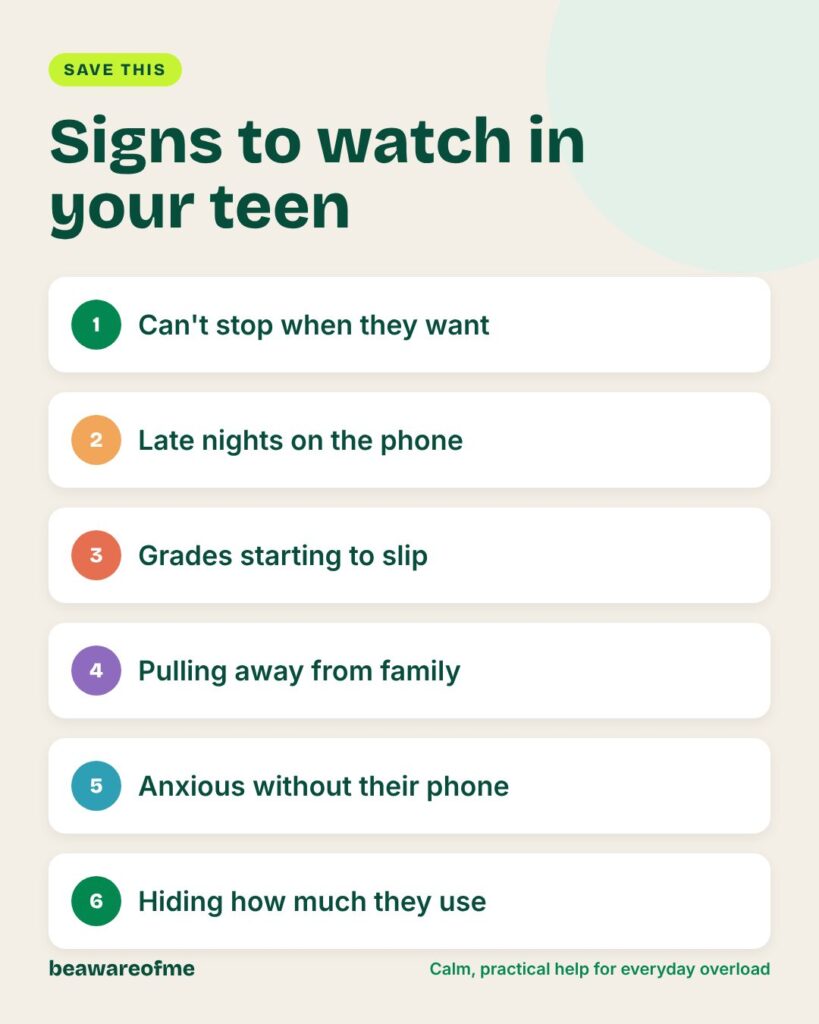
Signs to watch for
- Using social media even when they say they want to stop.
- Staying up late on their phone and struggling to get up.
- Grades slipping or homework left undone.
- Pulling away from family and in-person friends.
- Becoming anxious, angry or tearful when they can’t check their phone.
- Lying about or hiding how much they use social media.
- Seeming low, withdrawn or more self-critical about their looks.
Mayo Clinic lists several of these as reasons to talk with a healthcare professional. If you’re unsure whether your teen’s habits have crossed a line, our guide to teen social media addiction symptoms walks through each sign. For mood changes specifically, read about adolescent depression warning signs and support.
When to get professional help
Contact your teen’s doctor or a mental health professional if low mood, worry or withdrawal lasts more than two weeks, or if school, sleep or friendships are clearly suffering. Seek help immediately if your teen mentions harming themselves. Early support protects teen mental health and usually makes recovery smoother.
A Family Plan That Protects Teen Mental Health Without Constant Fights
A clear, shared family plan works better than rules handed down in the middle of an argument. Build it together, write it down and review it every few months as your teen grows. Teens are far more likely to follow rules they helped shape.
Start with a calm conversation
Pick a relaxed moment, not right after a conflict. Ask what your teen enjoys online and what bothers them, and listen more than you talk.
Agree on phone-free times
Choose times like family meals, homework and the hour before bed. Mayo Clinic suggests these kinds of limits, and they work best when adults follow them too.
Set overnight charging outside bedrooms
A shared charging spot in the kitchen protects sleep, the foundation of teen mental health.
Review privacy settings together
Turn on privacy options, limit who can message them and check what personal details appear on their profiles.
Match oversight to age
Coach and check more in the early teens, then give more freedom as your teen shows good judgement.
Schedule a monthly check-in
Revisit the plan, ask what’s working and adjust. Treat it as a team review, not an inspection.
Age-by-age guide to oversight
The APA advisory recommends that adults review, discuss and coach social media use in early adolescence, roughly ages 10 to 14, and gradually reduce oversight as teens mature. Here’s how that can look in practice.
| Age | Oversight level | Focus |
|---|---|---|
| 10 to 12 | Close: shared accounts or regular reviews together | Safety basics, privacy, kindness online |
| 13 to 14 | Regular check-ins and agreed limits | Comparison, group-chat drama, sleep |
| 15 to 16 | More independence with agreed boundaries | Self-regulation, news and misinformation |
| 17+ | Mostly self-managed, open door for help | Healthy habits they’ll carry into adulthood |
Need help with daily screen-time arguments? Our guide to managing screen-time battles offers practical scripts, and a parent’s guide to social media boundaries covers family rules in more detail.
Teach Skills, Not Just Rules: Helping Your Teen Manage Their Own Feed
Rules protect teens today, but skills protect them for life. The APA advisory recommends social media literacy training, such as judging accuracy and spotting misinformation, before heavy use begins. Teaching these skills supports teen mental health long after you stop checking their phone.
Five skills worth teaching
- Curating a feed. Show your teen how to mute, unfollow and use “not interested” so the algorithm learns what helps them.
- Spotting edited images. Look at filtered photos together and talk about lighting, angles and editing apps.
- Checking information. Ask, “Who posted this, and how do they know?” before sharing health or news claims.
- Pausing before posting. Agree on a ten-minute pause for anything posted while upset.
- Noticing feelings. Encourage a quick check after scrolling: better, worse or the same?
Let them lead some of the time
Ask your teen to teach you how an app works, or to show you a creator they admire. Teens feel respected when adults learn from them, and you gain a window into their online world. That respect makes future conversations about teen mental health far easier.
You can also invite your teen to set their own goals, such as a bedtime for their phone or one app-free afternoon a week. Self-chosen goals stick better than imposed ones. Praise effort, not perfection, because occasional slips are part of learning.
✨ Quick win
Try a family “feed swap” night: everyone shows one account that makes them laugh or learn something. It turns social media into a shared conversation instead of a battleground.
Over time, these habits shift responsibility from you to your teen. That shift is the real goal, because they’ll soon manage their phones without you. Building these skills now gives teen mental health a sturdy foundation for adulthood.
How to Talk to Your Teen About Social Media (Scripts That Work)
The way you start a conversation decides whether your teen opens up or shuts down. Curious, calm questions work better than lectures. Aim for short, frequent chats rather than one big talk.
💬 Conversation starters to try this week
“What’s the funniest thing you saw online this week?”
“Is there anyone online who makes you feel bad about yourself?”
“How do you feel after a long scroll, better or worse?”
“If something upsetting happened online, would you feel okay telling me?”
“What do you wish adults understood about social media?”
What to say if they share something hard
Stay calm and thank them for telling you, even if what they share worries you. Avoid jumping straight to taking the phone away, because that teaches them not to tell you next time. Say something like, “I’m glad you told me. Let’s figure this out together.”
Model the habits you want to see
Teens notice when parents scroll at dinner or check work emails in bed. Share your own struggles with your phone and the changes you’re making. Creating screen-free zones at home that apply to everyone sends a stronger message than any rule. For more on the anxiety side, read about social media’s role in anxiety and depression.
Try this today
This week’s family check-in
Ask one open question about online life over dinner.
Agree on a shared overnight charging spot.
Review privacy settings on one app together.
Plan one phone-free family activity this weekend.
Share one change you’re making to your own phone habits.
💡 Tip
Car rides and late-evening snacks are often the best times for real talk. Side-by-side conversations feel less intense for teens than sitting face to face.
5 Common Mistakes Parents Make (and What to Do Instead)
Even loving, well-informed parents slip into a few patterns that backfire. Each one comes from a good place, which is why it’s easy to miss. Small shifts can make your efforts far more effective for teen mental health.
Focusing only on screen-time numbers
Hours matter, but content and context matter just as much. An hour messaging close friends differs greatly from an hour of appearance-focused videos at midnight. Ask what your teen does online and how it makes them feel, not just how long.
Taking the phone as punishment for every problem
Confiscating the phone can feel like a quick fix, but it often teaches teens to hide problems instead of sharing them. Keep consequences linked to the issue, and protect your teen’s trust so they still come to you when something goes wrong.
Banning everything without explanation
Strict bans without reasons tend to push use underground. Teens may set up secret accounts or use friends’ phones. Explain your concerns, involve them in setting rules and adjust as they show responsibility.
Assuming your teen is fine because they seem busy
Some teens hide distress well, especially online. A teen who seems constantly connected may still feel lonely. Keep regular check-ins even when things look calm, because steady contact protects teen mental health quietly.
Ignoring your own phone habits
Rules that apply only to teens feel unfair, and teens notice instantly. If you want them to put the phone away at dinner, do it yourself. Shared family habits are easier to keep and build trust at the same time.
6 Questions Parents Ask About Teens and Social Media
How does social media affect teen mental health?
Social media can affect teen mental health both positively and negatively. It helps many teens stay connected, find support and express themselves. It can also disrupt sleep, fuel comparison and expose teens to bullying or harmful content. Heavy use, especially more than three hours a day, is linked with higher risk. How teens use it matters as much as how long.
How much social media is safe for a teenager?
There’s no single safe limit for every teen. Research links more than three hours a day with higher risk of mental health concerns, so that’s a useful upper guide. More important is whether use cuts into sleep, homework, exercise or family time. Agree on limits together, protect the hour before bed and keep phones out of bedrooms overnight.
What are the signs social media is hurting my teen?
Watch for changes that last more than two weeks. Signs include staying up late on the phone, slipping grades, withdrawing from family and friends, anxiety when they can’t check their phone, hiding their use or seeming low and self-critical. If several signs appear together, talk gently with your teen and consider contacting their doctor or a mental health professional.
Are there benefits of social media for teens?
Yes. Social media can help teens keep friendships going, find communities where they belong and access support, especially if they feel isolated offline. It offers ways to share creative work, learn new skills and see how others cope with stress. Some shy teens use it to practise social skills. The goal is to protect these benefits while limiting the risks.
Should I monitor my teen’s social media?
Experts suggest closer coaching and monitoring in early adolescence, roughly ages 10 to 14, then gradually more independence as teens mature. Monitoring works best when it’s open rather than secret, and when it comes with regular conversations. Explain why you check, review privacy settings together and respect growing privacy as your teen shows good judgement.
When should I get help for my teen’s mental health?
Contact your teen’s doctor or a mental health professional if low mood, worry, withdrawal or sleep problems last more than two weeks, or if school and friendships are clearly suffering. Seek help immediately if your teen talks about harming themselves, by contacting emergency services or a crisis line. Early support usually makes a big difference.
You don’t need to be a tech expert to protect teen mental health; you need steady conversations, a few shared rules and a calm presence your teen can count on. Start with sleep and one honest question this week, and keep building from there. Find more family guides in our mental health section.
A gentle note
Educational content, not a substitute for professional care. If you are struggling, talk to a doctor or a qualified professional. If you are thinking about harming yourself, contact local emergency services or a crisis line now (US 988, UK and Ireland Samaritans 116 123, or findahelpline.com).