Stress at work rarely stays in your head. It settles in your jaw, climbs into your shoulders and sits low in your back by mid-afternoon. The good news is that a few gentle desk exercises can release a lot of that tension without leaving your chair. This guide gives you 12 simple moves, ready-made 2, 5 and 10-minute routines, and a quick map to match each move to where you hold stress.
🧭 Key takeaways
Do two minutes of desk exercises every 30 to 60 minutes rather than one long session at the end of the day.
Breathe out slowly during each stretch, because a long exhale helps your body settle.
Start with the area that feels tightest, often the neck, shoulders or upper back.
Move gently and only as far as is comfortable, and stop straight away if you feel pain.
Talk to your doctor or a physiotherapist before starting if you have an injury, recent surgery or a health condition.
⚠️ Watch out
Safety first: these moves should feel easy and pleasant. Stop if you feel pain, dizziness or numbness. If you have an injury, back or neck problem, recent surgery, a heart condition or are pregnant, talk to your doctor or a physiotherapist before trying new exercises.
Why Desk Exercises Ease Stress, Not Just Stiffness
Desk exercises help with stress because tension and posture feed each other. When you feel pressured, your muscles brace, especially around your neck and shoulders. Long sitting then locks that bracing in place, so you carry the day’s stress in your body.
Here’s the whole guide at a glance. Find the area that bothers you most and start your desk exercises there.
Desk exercises at a glance
| Where you feel it | Best move to start | Time it takes |
|---|---|---|
| Neck and jaw | Neck turns and jaw release | 1 minute |
| Shoulders | Shoulder rolls and shrug-and-drop | 1 minute |
| Chest and posture | Seated chest opener | 30 seconds |
| Upper and lower back | Seated twist and cat-cow | 1 minute |
| Hips and legs | Hip marching and ankle pumps | 1 minute |
| Wrists and hands | Wrist circles and finger spreads | 30 seconds |
| Whole body | Stand-and-reach with slow breathing | 1 minute |
The tension loop, in plain words
Stress tightens muscles, and tight muscles send signals that you’re under strain. That can keep your body on alert even when the stressful email is long gone. Gentle movement breaks the loop from the body side.
You don’t need a workout to feel this. A few slow rolls and a long breath can tell your body the moment has passed. That’s the quiet power of desk exercises: they speak to your nervous system through your muscles.
7 signs your body is carrying work stress
Physical tension often shows up before you consciously feel stressed. Check yourself against this list right now, without judging what you find.
- Your shoulders sit higher than usual or feel hard to the touch.
- You clench your jaw or grind your teeth while reading emails.
- You notice you’ve been holding your breath or breathing high in your chest.
- Your neck feels stiff when you turn to look over your shoulder.
- Your lower back aches after long meetings.
- Your hands or wrists feel tight after typing.
- You feel restless or fidgety but can’t settle on a task.
If you ticked two or more, gentle movement through the day is a kind place to start.
What the guidelines say about moving more
The World Health Organization states that physical activity reduces symptoms of depression and anxiety in adults, and advises everyone to limit time spent sitting. Desk exercises won’t replace a brisk walk, but they help you sit less in one long stretch.
Mayo Clinic suggests taking a break from sitting every 30 minutes, for example to stretch or get water. That’s a simple rhythm to build your desk exercises around.
12 Desk Exercises to Reduce Stress, From Head to Toe
These twelve moves work from your neck down to your ankles, so you can release tension wherever it builds. Each takes 20 to 60 seconds. Move slowly, breathe out as you stretch and stay within a comfortable range.
Neck, jaw and shoulders
Moves 1 to 4: the top of the body
Neck turns
Sit tall, look ahead, then slowly turn your head towards one shoulder, hold for 5 seconds and return. Repeat 3 times each side.
Ear to shoulder
Tilt your ear towards your shoulder until you feel a gentle stretch. Hold for three slow breaths, then switch.
Shoulder rolls
Roll your shoulders up, back and down in slow circles, 5 times, then reverse.
Jaw release
Let your teeth part, rest your tongue behind your lower teeth and gently massage the jaw hinge for 20 seconds.
The neck turn follows the NHS sitting exercises guidance: turn only as far as is comfortable and keep your shoulders down. Never roll your head in full circles if that feels uncomfortable.
Chest, back and posture
Moves 5 to 8: the middle of the body
Seated chest opener
Sit away from the chair back, pull your shoulders back and down, open your arms and lift your chest. Hold 5 to 10 seconds, 5 times.
Seated twist
Cross your arms to your shoulders, keep your hips still and turn your upper body one way. Hold 5 seconds, 5 times each side.
Seated cat-cow
Hands on knees, gently arch your back as you breathe in, then round it as you breathe out. Repeat 5 times.
Shoulder-blade squeeze
Draw your shoulder blades together and down, hold for 5 seconds, release. Repeat 5 times.
These middle-body desk exercises counter the forward slump that long screen days encourage. They also make it easier to take a full, deep breath.
Hips, legs, wrists and hands
Moves 9 to 12: the lower body and hands
Hip marching
Hold the sides of your chair, lift one bent knee as far as is comfortable, lower it with control. Five per leg.
Ankle pumps
Straighten one leg, point your toes away, then pull them back towards you. Two sets of 5 per foot.
Wrist circles
Make slow circles with both wrists, 5 each way, then gently shake out your hands.
Finger spreads
Spread your fingers wide, hold for 3 seconds, then make a soft fist. Repeat 5 times.
💡 Tip
Use a stable chair without wheels for seated desk exercises if you can, as the NHS suggests. If your office chair rolls, keep both feet flat and avoid twisting too quickly.
Ready-Made Routines for 2, 5 and 10 Minutes
Ready-made routines take the thinking out of it, so you can just press start. Choose the length that fits your gap, not your ideal day. All three routines use the same twelve desk exercises, just in different amounts. A two-minute routine done three times beats a ten-minute routine you never start.
Pick your routine
| Routine | Moves | When to use it |
|---|---|---|
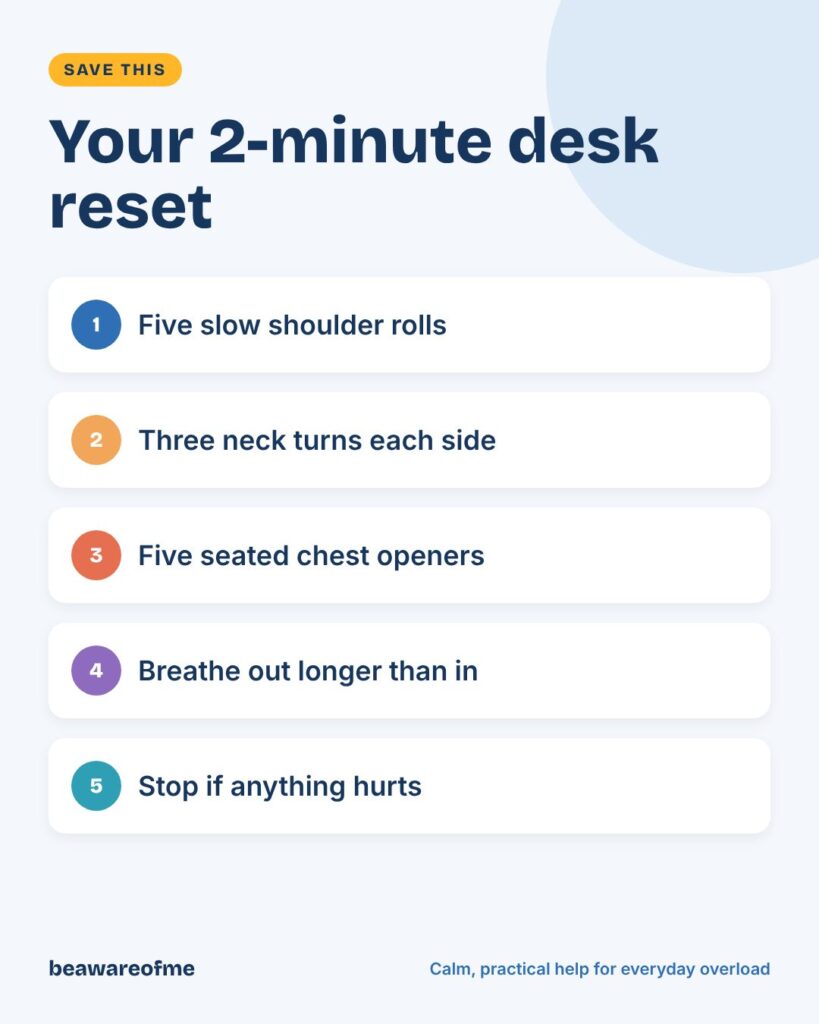
| 2-minute reset | Shoulder rolls, neck turns, seated chest opener, three slow breaths | Between tasks or after an email |
| 5-minute unwind | Add seated twist, cat-cow, wrist circles and ankle pumps | Mid-morning and mid-afternoon |
| 10-minute release | All 12 moves, then stand and reach with slow breathing | After a tense meeting or at lunch |
The 2-minute reset, step by step
Start with five shoulder rolls each way. Then do three neck turns per side, followed by five seated chest openers. Finish with three slow breaths, in for four and out for six.
That’s it. Two minutes, no equipment, and nobody needs to notice.
The 5-minute unwind for mid-afternoon slumps
Many people feel tension peak after lunch. Use the 2-minute reset, then add five seated twists each side, five rounds of cat-cow, wrist circles and two sets of ankle pumps. Stand up at the end and take a short walk to refill your water.
The 10-minute release after a tough meeting
After a hard conversation, your body may stay braced for a while. Work through all twelve desk exercises slowly, then stand, reach both arms overhead and breathe out as you lower them. This guide on how to reset after a high-stress meeting adds steps for your thoughts as well.
A two-minute routine done three times beats a ten-minute routine you never start.
beawareofme
A 5-Day Starter Plan for Desk Exercises
A simple weekly plan helps you build desk exercises into your routine without overthinking it. Each day adds one small step, so the habit grows gently. By Friday you’ll have a full routine that feels familiar.
Your first week, one step a day
| Day | Focus | What to do |
|---|---|---|
| Monday | Shoulders | Five shoulder rolls after every call |
| Tuesday | Neck | Add three neck turns each side, twice a day |
| Wednesday | Posture | Add the seated chest opener before lunch |
| Thursday | Back and hips | Add the seated twist and hip marching mid-afternoon |
| Friday | Whole routine | Try the full 5-minute unwind once, then notice how you feel |
How to track progress without pressure
Keep a small tick list on a sticky note or in your phone. Each time you do your desk exercises, add a tick. You aren’t aiming for perfection, just a few more ticks than last week.
At the end of each day, rate your shoulder and neck tension from one to five. After a week, look back. Many people notice the numbers drift down slowly, which is motivating in itself.
If you miss a day
Missing a day is normal and doesn’t undo your progress. Just pick up where you left off the next morning. Habits survive gaps; they fade when we decide one slip means failure.
If your energy feels low overall, the free how empty is your battery check can help you see whether you need more rest, not just more movement.
🧭 Try this
Pair your desk exercises with your first coffee or tea of the day. While the kettle boils or the machine runs, do the 2-minute reset standing up.
Breathe While You Move: The Calm Multiplier
Pairing desk exercises with slow breathing gives you more calm from the same minute. Many people hold their breath when they stretch, which keeps tension in place. A long, easy exhale helps the muscle let go.
The simple breathing rule
Breathe in through your nose as you prepare, then breathe out slowly as you move into the stretch. Aim for an exhale that’s a little longer than the inhale. Keep it gentle; you shouldn’t feel light-headed.
If you like a guide, the free box breathing coach paces you through even counts. You can follow it while doing shoulder rolls.
Notice, then release
Before each move, take a second to notice where you feel tight. After the move, notice again. This tiny check-in builds body awareness, so you catch tension earlier next time.
✨ Quick win
Next time you finish an email you’ve dreaded, do one seated chest opener with a slow breath out. It takes ten seconds and signals the end of that task.
How to Turn Gentle Moves Into a Daily Habit
The easiest habit is one tied to something you already do every day. Willpower fades by Wednesday. Cues and tiny starts last much longer, and they make desk exercises feel automatic rather than like one more job.
Anchor moves to existing cues
- After every call, do five shoulder rolls.
- When you refill your water, do a standing reach.
- After sending a big email, do a seated chest opener.
- When a meeting reminder pops up, do three neck turns.
- Before lunch and before home time, do the 2-minute reset.
Start smaller than feels useful
Begin with one move, three times a day, for a week. Once it feels automatic, add a second. Tiny wins build confidence and keep the habit from feeling like another task.
Short movement breaks fit neatly into wider pause habits too. These microbreaks for calmer workdays show how to space out recovery across the day.
Make your desk support you
Your setup can either help or fight your efforts. A screen at eye level and feet flat on the floor reduce the strain that builds between sessions. This guide on how ergonomics reduces workplace stress explains the basics, and remote workers can use these tips to create a stress-free workstation at home.
🧭 Try this today
☐Pick the body area where you hold stress most.
☐Choose two desk exercises for that area from the list.
☐Do them after your next call or email, with slow breaths out.
☐Set a 45-minute reminder and repeat three times today.
☐Tonight, notice whether your shoulders or neck feel any lighter.
Smart Moves for Open Offices, Home Desks and Standing Jobs
You can adapt desk exercises to almost any setting, including busy offices where you’d rather not draw attention. The trick is choosing moves that suit your space and comfort level. Desk exercises should fit around your work, not the other way round.
Discreet moves for a busy office
In an open office, choose subtle moves: shoulder-blade squeezes, ankle pumps, finger spreads and the jaw release. Most people won’t notice. If noise adds to your tension, these mindfulness practices for noisy office focus pair well with gentle movement.
Fuller moves for a home desk
At home you have more freedom. Stand up for every routine, add a gentle forward fold if it feels comfortable, and take your 5-minute unwind near a window. A change of view helps your mind reset too.
Standing desks and on-your-feet days
If you stand most of the day, your body needs variety rather than more standing. Shift your weight, do ankle pumps on a chair, and sit for a few minutes to stretch your hips. Standing still for hours brings its own stiffness.
📝 Note
If you already live with ongoing pain, gentle movement can sometimes help, but it’s best to get personal advice. These guides on stress relief exercises for chronic pain and the chronic pain and stress cycle offer background to discuss with your doctor.
5 Common Mistakes That Make Desk Stretching Backfire
Gentle stretches are simple, yet a few habits can turn them into more strain or a forgotten chore. Avoid these and your desk exercises will feel better and last longer.
Mistake 1: Stretching into pain
Many people think a stretch must hurt to work. It doesn’t. Pain is a signal to stop, not push. Move only to the point of a mild, comfortable stretch, and back off if anything feels sharp.
Mistake 2: Bouncing or rushing
Quick, jerky movements can strain muscles and keep your body tense. Move slowly, hold each position steadily and breathe out. Slow is calming; fast is not.
Mistake 3: Saving it all for the end of the day
One long session at five o’clock can’t undo eight hours of bracing. Short, regular desk exercises through the day work better, because they release tension before it builds up.
Mistake 4: Holding your breath
Breath-holding during stretches is common and keeps muscles tight. Breathe out slowly into each move. If you notice you’ve stopped breathing, pause and take one easy breath before continuing.
Mistake 5: Ignoring what your body tells you
Persistent pain, numbness, tingling or headaches that don’t ease with movement need attention. Exercises aren’t a fix for every problem. If symptoms continue, see your doctor or a physiotherapist rather than stretching harder.
📚 Keep reading
Desk Stretching Questions People Ask (FAQ)
Can desk exercises really reduce stress?
Desk exercises can help ease the physical side of stress, such as tight shoulders, a stiff neck and shallow breathing. Gentle movement and slow breathing can help your body settle. The WHO notes that physical activity reduces symptoms of depression and anxiety in adults. Desk moves are one helpful piece alongside regular activity, sleep and support.
How often should I stretch at my desk?
For desk exercises, a good rhythm is two minutes every 30 to 60 minutes. Mayo Clinic suggests taking a break from sitting every 30 minutes, for example to stretch or get water. Short, frequent sessions tend to work better than one long session, because they release tension before it builds up and fit easily into a busy workday.
What are the best stretches for neck and shoulder tension at work?
Try slow neck turns, ear-to-shoulder tilts, shoulder rolls and shoulder-blade squeezes. Move gently, only as far as is comfortable, and breathe out during each stretch. A seated chest opener also helps by reversing the forward slump. Stop if anything hurts, and see your doctor if neck or shoulder pain continues or spreads.
Are office stretches safe for everyone?
Most gentle seated stretches are suitable for many people, but not everyone. If you have an injury, back or neck problem, recent surgery, a heart condition or are pregnant, talk to your doctor or a physiotherapist first. The NHS advises checking with a health professional if you’re unsure. Always stop if you feel pain or dizziness.
Can I stretch at work without anyone noticing?
Yes. Shoulder-blade squeezes, ankle pumps, finger spreads, wrist circles and a jaw release are all subtle. You can do them while reading or listening on a call. Slow breathing is invisible too. Save fuller moves, like standing reaches or seated twists, for breaks or quieter moments if you feel self-conscious.
Do desk stretches count as exercise?
They’re helpful movement, but they usually don’t replace the WHO guidance of at least 150 minutes of moderate activity a week for adults. Think of desk exercises as a way to break up sitting and release tension. Add walks, cycling or other activities you enjoy outside work for the fuller benefits of being active.
Stress may settle in your body, but it doesn’t have to stay there. Pick two desk exercises for your tightest spot, pair them with a slow breath out and repeat them through the day. Over a few weeks, these small desk exercises can make your workday feel lighter, calmer and far less stiff.
🛟 Please read
Educational content, not a substitute for professional care. If you are struggling, talk to a doctor or a qualified professional. If you are thinking about harming yourself, contact local emergency services or a crisis line now (US 988, UK and Ireland Samaritans 116 123, or findahelpline.com).