You sit for breakfast, sit on the commute, sit through meetings, then sit on the sofa to recover from all that sitting. It adds up fast, and your body notices even when you don’t. This guide explains what sitting too much really does to your heart, metabolism, back and mood, what the research actually says, and the small daily changes that undo most of the harm. No gym membership, no standing desk required.
🌱 Key takeaways
Sitting Too Much: What Happens Inside Your Body Every Hour
Sitting too much slows the systems that keep your blood sugar, blood fats and circulation healthy. Your largest muscles, in the legs and bottom, barely work when you sit. That matters because working muscles pull sugar and fat out of the blood and use them for fuel.

When those muscles switch off for hours, your body clears sugar and fat more slowly. Blood flow in the legs also slows, and your hips and lower back stay in one shortened position. One long film or a long-haul flight won’t harm you on its own. The trouble starts when that pattern fills most of your waking day, day after day.
Sitting is not the same as resting
Rest is meant to restore you. Hours of slumped sitting often does the opposite, leaving you stiff and oddly drained. If you’ve ever felt wiped out after a day of doing very little, our guide on why you feel tired after doing nothing explains how low movement and mental load feed that heavy feeling.
How much sitting counts as too much?
There’s no single official cut-off. The World Health Organization simply advises all age groups to limit sedentary time and replace some of it with movement of any intensity. Sedentary behaviour means any low-energy time while you’re awake, such as sitting, reclining or lying down.
A useful rule: if you sit for more than 30 minutes without a break, or more than eight hours across the day with little activity, treat that as your signal to move more. The exact number matters less than the direction. Less sitting, more interruptions, more activity.
5 Health Risks of Sitting Too Much That Researchers Keep Finding
The risks of sitting too much show up mainly in the heart, metabolism, weight, muscles and lifespan. Large reviews keep landing on the same pattern, and the effects grow when long sitting meets very little exercise.
8+ hours
Sitting more than eight hours a day with no activity carried a death risk similar to obesity and smoking, in a review of 13 studies.
Source: Mayo Clinic
7+ hours
Many adults spend more than seven hours a day sitting, and people over 65 often spend 10 hours or more sitting or lying down.
Source: NHS
31%
Nearly one third of the world’s adults, about 1.8 billion people, are physically inactive.
Source: WHO
1. Heart disease and stroke
The NHS lists heart disease and stroke among the conditions that research ties to long periods of sitting. Slower blood flow, higher blood fats and rising blood pressure all play a part. This is the risk that makes the headlines, and for good reason.
2. Type 2 diabetes and blood sugar problems
Idle muscles take up less sugar from your blood. Over time, that can push blood sugar higher and make your body less responsive to insulin. Mayo Clinic links extended sitting to metabolic syndrome, a cluster that includes high blood pressure, high blood sugar and extra fat around the waist.
3. Weight gain
Sitting burns very little energy. Swap even a few hours of sitting for light movement and you use noticeably more across a week. Weight is complicated, of course, and sleep, stress and food all matter too. Sitting too much is one factor among many, not the whole story. Still, constant sitting quietly tilts the scales.
4. Back pain, stiff hips and sore necks
Your spine likes variety, and sitting too much gives it very little. Hours in one position, especially leaning toward a screen, can leave your neck tight and your lower back aching. Tight hip flexors, the muscles at the front of your hips, are another common complaint after long days in a chair.
5. A higher risk of dying early
Mayo Clinic notes that too much sitting overall also seems to raise the risk of death from heart disease and cancer. The WHO fact sheet reports similar links between higher sedentary time and deaths from all causes. That sounds scary, but here’s the part most articles bury: activity changes the picture a lot.
📝 Note
These findings show links, not certainties. Sitting too much raises risk across large groups of people; it doesn’t mean a desk job will make you ill. Your genes, sleep, diet, stress and activity all shape your health together.
Why Long Days in a Chair Drain Your Mood, Focus and Energy
Sitting too much doesn’t only affect your body; it can leave your mind flat and foggy too. Long, still stretches tend to come with screens, little daylight and fewer chances to talk to people. That combination often feeds low energy and restless thinking.
The slump that coffee can’t fix
Ever notice how a 10-minute walk clears your head better than a third coffee? Sitting too much keeps your body in low gear, and your brain tends to follow. Movement raises your heart rate, gets blood flowing and gives your eyes a break from the screen. Many people find their afternoon slump eases more with a short walk than with caffeine. Our article on how exercise boosts mental health covers why movement works so well on mood.
When stillness feeds overthinking
Sitting still with a busy mind often means sitting still with your worries. Long sofa evenings with a phone in hand can turn into scrolling, comparing and replaying the day. Getting up, even to walk around the block, interrupts that loop. If that pattern sounds familiar, read how doomscrolling affects your mental health.
Body and mind run on the same battery
Physical and mental health aren’t separate systems. Poor sleep, low activity and stress tend to travel together, and each makes the others harder. Our guide to the connection between physical and mental health explains why small physical habits can lift your mood. Curious how depleted you feel right now? Try the free How empty is your battery? self-check.
💡 Tip
If your energy dips at the same time every day, schedule a walking break 15 minutes before it usually hits. You’ll catch the slump before it catches you.
Does Exercise Cancel Out a Day in a Chair? The Honest Answer
Exercise helps a lot, but a single workout doesn’t fully erase a whole day of sitting too much. The best protection comes from both regular activity and frequent breaks from sitting. Think of them as two separate habits that work as a team.
What the numbers say
Mayo Clinic points to research showing that 60 to 75 minutes of moderate activity a day offset the effects of too much sitting. Other studies found that sitting time had little effect on death risk for the most active people. So yes, a very active lifestyle can protect you.
Most of us aren’t there, though. A typical office week includes long stretches of sitting too much and only a few active hours. The NHS warns that you can hit your weekly activity target and still face health risks if you spend the rest of the time sitting or lying down. That’s why breaking up long sits matters even if you go to the gym.
The two habits you need
- Habit one, the weekly base: the WHO recommends at least 150 minutes of moderate-intensity activity a week for adults. Brisk walking counts.
- Habit two, the daily breaks: stand up, stretch or walk every 30 minutes you sit, as Mayo Clinic suggests as a starting point.
- The bonus: fold light movement into ordinary moments, like pacing on calls or walking to a colleague instead of messaging.
You don’t need a perfect workout. You need fewer long, unbroken hours in a chair.
beawareofme
If you can’t exercise much right now
If pain, illness, caring duties or exhaustion make workouts unrealistic, start with breaks alone. Standing up and moving gently every half hour is still worth doing. Then talk to your doctor about what kind of activity suits your body. Even gentle chair stretches, a slow walk to the letterbox or standing while the kettle boils chip away at sitting too much.
9 Simple Ways to Stop Sitting Too Much at Work and Home
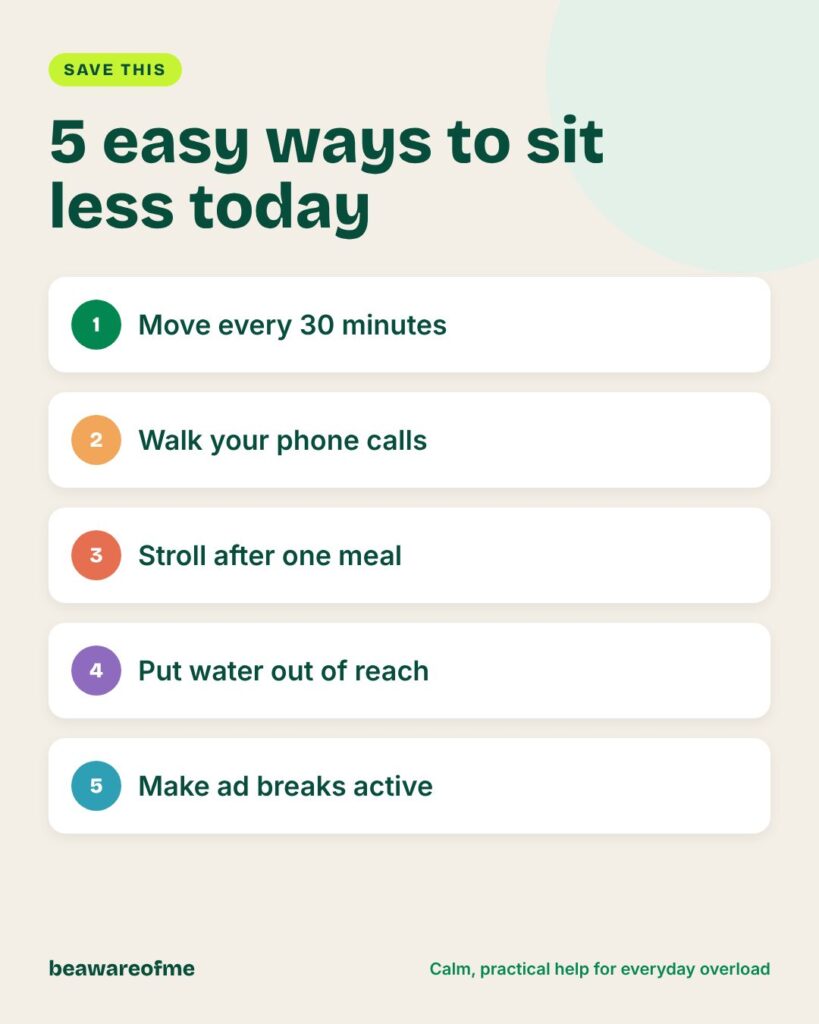
The easiest way to stop sitting too much is to tie movement to things you already do. Willpower fades by mid-afternoon; habits don’t. Pick two or three of these ideas and practise them for a week before adding more. The best swap is the one you’ll actually repeat on a busy, tired day.
Your 9 movement swaps
Use the 30-minute rule
Set a gentle timer and stand, stretch or walk for one to two minutes every half hour.
Walk your calls
Take phone calls standing or pacing; save video calls for sitting.
Refill often
Use a small water glass so you get up more to top it up.
Move the essentials
Put the bin, printer and charger across the room.
Stand for short tasks
Read emails, sort mail or plan your day on your feet.
Walk after meals
A 10-minute stroll after lunch or dinner breaks a long sitting block.
Make ad breaks active
Stand, stretch or tidy during breaks in shows or between episodes.
Choose the far option
Park further away, take the stairs, get off one stop early.
Meet on foot
Suggest a walking catch-up instead of coffee in a café.
At work: small breaks that don’t look odd
You don’t have to do lunges in the office. Stand to read a document, walk to a colleague’s desk, or take the long way to the kitchen. Our list of desk exercises that ease stress has quiet moves you can do in a meeting room or at your desk.
If you work from home, it’s even easier to sit for hours, because the commute and office walks disappear. Build in short microbreaks for calm, focused work and treat them as part of your job, not a distraction.
At home: break the sofa spell
Evenings are where sitting too much quietly piles up. Try a simple rule: before you sit down for the night, take a 10-minute walk or do one household task on your feet. Then, during the evening, get up at every episode break.
✨ Quick win
Right now, stand up and walk to the furthest window in your home. Look outside for 60 seconds, roll your shoulders and come back. That’s your first break done.
Set Up Your Space So Moving Becomes the Easy Choice
Your environment decides more of your movement than your motivation does. If everything sits within arm’s reach, you’ll stay put. A few small changes to your desk and home can cut sitting too much without any extra effort.
Desk tweaks that help
- Screen at eye level and an arm’s length away, so you don’t hunch forward.
- Feet flat on the floor and knees roughly level with your hips.
- Phone, water and notes placed so that reaching them means standing up.
- A reminder on your screen or watch that nudges you every 30 minutes.
For a deeper look at posture and comfort, see how ergonomics reduces physical and mental stress at work, or follow our steps to create a stress-free workstation at home.
Do you need a standing desk?
Not necessarily. Standing still all day brings its own aches, so the goal is changing position, not swapping one fixed posture for another. If you have a standing desk, alternate between sitting and standing. If not, a kitchen counter or high shelf works for short standing tasks.
Simple if-then rules
- If you finish a task, then stand and stretch before starting the next one.
- If you take a call, then stand or walk for it.
- If you feel stuck or foggy, then walk outside for five minutes.
- If it’s raining, then climb the stairs or walk laps of your home.
⚠️ Watch out
Sudden chest pain, unusual breathlessness, or pain and swelling in one leg after long sitting, especially after a long flight or drive, need urgent medical attention. Don’t wait it out.
Your Gentle 7-Day Plan to Break the Sitting Habit
A short, gentle plan beats a big promise you drop by Thursday. This week-long plan adds one small habit a day, so by day seven moving more feels normal rather than forced.
Track it the simple way
Use a notebook or the notes on your phone. Write down roughly how many hours you sat and how many breaks you took. You’re looking for patterns, like the 3-hour afternoon block or the long evening, not a perfect score. Most people find that sitting too much clusters in two or three predictable stretches. Fix those first, and the rest of the day often takes care of itself.
☀️ Try this today
☐ Set a 30-minute timer for your next sitting block.
☐ Stand up for your next phone call.
☐ Take a 10-minute walk after lunch or dinner.
☐ Move your water bottle out of arm’s reach.
☐ Stand and stretch at every break in tonight’s show.
If you work long hours at a desk, our guide to how a walk outside eases office anxiety shows why stepping out, even briefly, helps your head as well as your body. You’ll find more everyday ideas in our mental health in life section.
5 Common Mistakes People Make When They Try to Sit Less
Most people who try to cut back on sitting too much stumble on the same few traps. Knowing them in advance saves you a frustrating first week.
Mistake 1: Relying on one workout to fix everything
An evening run is great, but it doesn’t undo eight unbroken hours in a chair. Keep the workout and add the 30-minute breaks too.
Mistake 2: Swapping sitting for standing still
Standing in one spot for hours can tire your legs and back. Variety is the goal. Move between sitting, standing and walking through the day.
Mistake 3: Forgetting the evening
People often fix their workday, then sit for four hours on the sofa. Evenings count just as much, so build in active breaks after dinner and during shows.
Mistake 4: Going too hard, too fast
Jumping from no activity to daily intense workouts often ends in soreness and quitting. Start with breaks and walks, then build up slowly. Check with your doctor first if you have a health condition.
Mistake 5: Waiting to feel motivated
Motivation rarely shows up at 3 pm. Set reminders and tie movement to existing habits, so you don’t have to decide each time.
📚 Keep reading
Desk exercises to ease stressMicrobreaks for calm workExercise for low mood and anxietyRemote work and your wellbeingFAQ: Quick Answers About Sitting Too Much
How many hours of sitting a day is too much?
There’s no official limit, but research often flags risk when people sit more than eight hours a day with little activity. Mayo Clinic cites a review of over a million people that found this pattern carried a death risk similar to obesity and smoking. A practical goal is to break up sitting every 30 minutes and move more overall.
Can exercise undo the effects of sitting all day?
Partly. Mayo Clinic notes that 60 to 75 minutes of moderate activity a day appeared to offset the risks of too much sitting. Most people get far less, so frequent breaks still matter. The NHS warns you can meet weekly activity targets and still face risks if you spend the rest of your time sitting or lying down.
Is a standing desk better than sitting?
A standing desk can help if you use it to switch positions through the day. Standing still for hours has its own downsides, like sore legs, feet and lower back. The healthiest pattern is variety: alternate between sitting, standing and walking, and take short movement breaks every half hour or so.
What happens to your body when you sit for long periods?
Your big leg muscles barely work, so your body clears sugar and fat from the blood more slowly. Blood flow in your legs slows, and your hips and back stay in one position. Over months and years, this pattern links to heart disease, type 2 diabetes, weight gain and back pain, according to health bodies like the NHS.
Does sitting too much affect mental health?
Long stretches of sitting often come with screens, little daylight and less social contact, which can leave you sluggish, foggy and low. Movement, by contrast, tends to lift mood and clear your head. If low mood lasts more than two weeks or affects daily life, talk to a doctor or a qualified professional.
What is the easiest way to start sitting less?
Start with one habit: stand up and move for a minute or two every 30 minutes. Set a timer or watch reminder to prompt you. Then add a 10-minute walk after one meal a day. Small, repeatable changes stick far better than big plans, and they add up quickly over a week.
Sitting too much is one of the easiest health risks to shrink, because the fix is built from tiny moves you can start in the next five minutes. Stand up often, walk a little more each day, and let your space nudge you, and your body and mind will feel the difference within weeks.
🤍 A gentle reminder
Educational content, not a substitute for professional care. If you are struggling, talk to a doctor or a qualified professional. If you are thinking about harming yourself, contact local emergency services or a crisis line now (US 988, UK and Ireland Samaritans 116 123, or findahelpline.com).