








You swore you’d do it differently, and then one ordinary evening you heard your parent’s voice come out of your own mouth. If you carry childhood trauma, parenting can stir up old feelings faster than almost anything else. This guide gives you nine practical, kind ways to break the cycle: how to catch triggers, repair after hard moments, and get support so your children grow up with something better.
🗝️ Key Takeaways
If you feel unsafe, overwhelmed or think about harming yourself, please reach out right now. Call local emergency services, call or text 988 in the US, call Samaritans on 116 123 in the UK and Ireland, or find a free line in your country at findahelpline.com. If you’re worried about a child’s safety, contact local emergency services or child protection services.
How Childhood Trauma Shows Up in Everyday Parenting
Childhood trauma tends to surface in parenting during ordinary stress points, like bedtime battles, crying, mess or defiance, because those moments echo your own early experiences. You might feel a rush of anger, panic or shutdown that seems bigger than the situation.

At a glance: nine ways to break the cycle of childhood trauma
| Way to break the cycle | What it looks like | First step this week |
|---|---|---|
| 1. Know your triggers | You spot your hot moments early | List three moments you overreact |
| 2. Build a pause | A gap between feeling and reacting | Practise one pause script |
| 3. Repair ruptures | You reconnect after hard moments | Try one repair conversation |
| 4. Name feelings | Emotions get words, not punishment | Label one feeling a day |
| 5. Listen fully | Your child feels heard and safe | Five minutes of eye-level listening |
| 6. Rewrite family rules | You choose your own values | Write one old rule you’ll drop |
| 7. Set boundaries with family | Your home stays a calm base | Prepare one boundary sentence |
| 8. Refill yourself | You parent from steadier ground | Ten protected minutes a day |
| 9. Get support | You don’t heal alone | Contact one therapist or group |
Why the reactions feel so automatic
Your nervous system learned early what danger felt like, and it still reacts to reminders. A child’s scream or a slammed door can set off an alarm before your thinking brain catches up. That’s not a character flaw. It’s an old survival response doing its job too well.
You can learn to notice the alarm and respond differently. If you’d like to understand this better, our guide to the science of triggers explains it in plain language.
You’re already breaking the cycle
Most parents who repeat old patterns never stop to question them. The fact that you’re reading this, worried and wanting to do better, is itself a break from the past. Hold onto that on hard days.
If you’re not sure how childhood trauma affects you, start with our gentle guide to the signs of unresolved childhood trauma in adulthood. This article focuses on parenting.
3 in 4
high school students reported experiencing one or more adverse childhood experiences (ACEs).
Source: CDC
1 in 5
high school students experienced four or more ACEs.
Source: CDC
Prevention
Safe, stable, nurturing relationships and environments help prevent ACEs.
Source: CDC
Adverse childhood experiences (ACEs) are potentially traumatic events in childhood. The CDC’s ACEs overview says creating safe, stable, nurturing relationships and environments for all children prevents ACEs. That’s exactly what cycle-breaking parents work toward.
Ways 1 and 2: Spot Your Triggers and Build a Pause
Knowing your triggers and having a ready-made pause are the two skills that change parenting moments fastest. Triggers are situations that set off a strong emotional reaction linked to past experiences. A pause is the small gap where you get to choose.
Way 1: Map your top three triggers
For one week, jot down any moment you react more strongly than you’d like. Note the time, what happened, what you felt in your body and what you did. Patterns usually appear within days.
Common parenting triggers for people with childhood trauma include crying that won’t stop, being ignored, mess, back-talk, and feeling judged by other adults. Tiredness and hunger make every trigger louder, so watch the late-afternoon slump.
Write your three triggers on a note inside a kitchen cupboard. Seeing them daily helps your brain spot them in the moment.
When your child reaches the age you were
Many parents notice old feelings rising when their child turns the age they were when hard things happened. You might feel unusually anxious, irritable or sad without knowing why. That timing is common, and it isn’t a sign that something is wrong with you.
If this happens, name it gently to yourself: “My child is seven, and seven was a hard year for me.” Then add extra support for a while, such as more rest, a check-in with a friend or a therapy session. Awareness alone often takes some of the sting out of the feeling.
Way 2: Build a pause that actually works
Notice the signal
Tight jaw, hot face, racing heart. Your body warns you first.
Say your pause line
“I’m feeling frustrated. I’m taking a breath before I answer.”
Step back safely
If your child is safe, move a few steps away or to another room for a minute.
Breathe out long
Exhale slower than you inhale, three or four times.
Return and choose
Come back and respond with the tone you want, not the one you learned.
Saying the pause out loud does two jobs. It slows you down, and it shows your child how a grown-up handles big feelings. The free box breathing coach can help you practise on calm days.
Way 3: Rupture and Repair Matters More Than Perfection
Repair is the most hopeful skill in breaking the cycle of childhood trauma, because it means mistakes don’t have to become wounds. A rupture is any moment of disconnection, like yelling or snapping. Repair is coming back to reconnect.
Why repair is so powerful
Many people with childhood trauma never got an apology from a parent. Hard moments just hung in the air, unexplained. When you repair, your child learns that conflict can end in closeness, that feelings matter, and that adults take responsibility.
You’ll still yell sometimes. Every parent does. The goal is not zero ruptures; it’s reliable repair afterward.
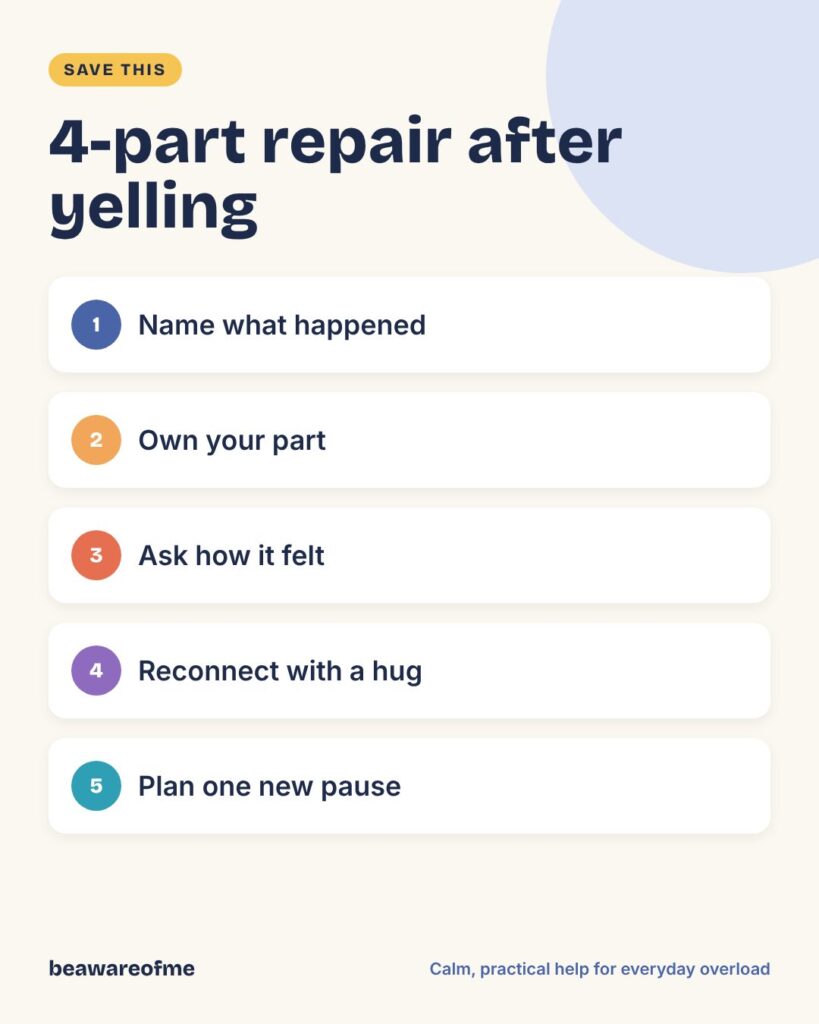
A four-part repair script
Repair script for after a hard moment
1. Name it: “Earlier, I raised my voice when you spilled the juice.”
2. Own it: “That wasn’t okay. It was my job to stay calm, not yours.”
3. Feel it: “I bet that felt scary. Did it?”
4. Reconnect: “I love you. Next time I’ll take a breath first. Want a hug or a story?”
Avoid repairs that slip back into blame, like “I’m sorry I yelled, but you made me.” Keep the responsibility with you. Your child’s behaviour can be addressed separately, later.
If guilt hits hard after these moments, our guide to overcoming parental guilt can help. Guilt that leads to repair is useful; shame that leads to hiding isn’t.
Ways 4 and 5: Teach the Feelings Language You Never Got
Naming feelings and listening fully give your child the emotional skills that childhood trauma often took from you. You can learn these skills alongside your child, and that’s completely okay.
Way 4: Name feelings out loud
Simple labels help children understand what’s happening inside them. Try: “You look disappointed the park is closed” or “It sounds like you’re really angry with your sister.” You’re not fixing the feeling. You’re showing it’s allowed.
Name your own feelings too: “I’m feeling tired and a bit grumpy, so I’m going to sit for a minute.” Our article on building emotional intelligence in kids has more ideas.
Way 5: Listen like you’re on their level
The CDC’s tips for communicating with your child suggest active listening: give your undivided attention, get down to your child’s eye level, then restate what they said and name the feeling you notice. It also encourages using eye contact, body language and touch with consent to show empathy and safety.
Swap old scripts for new ones
| Old pattern | Cycle-breaking alternative |
|---|---|
| “Stop crying or I’ll give you something to cry about.” | “You’re really upset. I’m here. Let’s breathe together.” |
| “Because I said so.” | “Here’s why this rule matters to me.” |
| Silent treatment after conflict | “I’m calm now. Let’s talk about what happened.” |
| “You’re too sensitive.” | “That really mattered to you.” |
| Ignoring feelings to keep the peace | “It’s okay to feel angry. It’s not okay to hit.” |
Explaining your reasons, rather than relying on power, builds trust. Our piece on why “because I said so” doesn’t work goes deeper.
Tonight at bedtime, ask: “What was the best and hardest part of your day?” Then just listen. No fixing.
Ways 6 and 7: Rewrite the Family Rules and Protect Your Home
Every family passes down unspoken rules, and breaking the cycle of childhood trauma means choosing which ones stop with you. You get to keep the good and gently let go of the rest.
Way 6: Write your new family values
Take ten minutes with a notebook. On the left, write rules you grew up with, such as “Don’t talk about feelings,” “Children should be seen, not heard” or “Mistakes mean punishment.” On the right, write what you want instead.
- “Don’t cry” becomes “All feelings are welcome; not all behaviour is.”
- “Never question adults” becomes “You can ask why, and I’ll explain.”
- “Keep family problems secret” becomes “We can ask for help.”
- “Love is earned” becomes “You’re loved, even when you mess up.”
Keep the list short, three to five values. Read it when you feel lost. It’s your compass, not a contract you must follow perfectly.
Way 7: Set boundaries with your own family
Sometimes breaking the cycle means limiting behaviour from grandparents or relatives that echoes your childhood trauma, such as harsh criticism or shaming in front of your kids. You can love people and still protect your children’s emotional safety.
Try a calm, clear line: “We don’t use that kind of punishment in our home. Please follow our way when they’re with you.” Our guide to setting boundaries with overbearing relatives has more scripts, and the free boundaries self-check can show where you’re stretched.
Pick one boundary sentence and practise it out loud three times before the next family visit. Rehearsed words come out calmer.
Ways 8 and 9: Heal Your Own Childhood Trauma While You Parent
Caring for your own healing isn’t selfish; it’s one of the most direct ways to protect your children from childhood trauma patterns. A calmer, more supported parent has more room to respond instead of react.
Way 8: Refill before you run dry
Exhaustion shrinks your window of patience fast. Protect small daily resets: ten minutes alone, a short walk, an earlier night once a week. Swap tasks with a partner or friend when you can.
If you’re not sure how depleted you are, the free energy battery check gives a quick snapshot. Our guide to building a support system as a busy parent helps you find practical backup.
Way 9: Get trauma-informed support
A trauma-informed therapist can help you understand where your reactions come from and build new responses at a safe pace. They put your safety and choice first and won’t push you to share before you’re ready.
Some parents also find parenting groups, family therapy or parent-child programmes helpful. Ask your doctor or your child’s health provider about local options. Our article on breaking intergenerational trauma in parenting explores the family-wide picture.
Be kind to the parent who’s learning
You’re parenting and healing at the same time, which is hard work. When you slip, speak to yourself the way you’d speak to your child after a mistake. Our guide to self-compassion in trauma recovery offers short practices that help.
You don’t have to have had a good childhood to give your child one. You just have to keep coming back.
— beawareofme
What Children Actually Need From a Cycle-Breaking Parent
Children don’t need a perfect parent; they need a safe, warm and reliable one who repairs mistakes. That standard is far more reachable than the impossible bar many parents with childhood trauma set for themselves.
The “good enough” standard
Psychologists often talk about “good enough” parenting: meeting a child’s needs well most of the time, not all of the time. Small frustrations, followed by comfort and repair, actually help children learn to cope.
- Safety: your child knows you won’t hurt or frighten them on purpose.
- Warmth: affection, play and interest in their world.
- Predictability: routines and consistent responses they can rely on.
- Repair: when things go wrong, you come back and reconnect.
- Guidance: clear, calm limits explained in words they understand.
Signs your efforts are working
Look for small shifts: your child comes to you when upset, you recover faster after a hard moment, or you notice a trigger before it takes over. Our guide to signs of healing from childhood trauma lists more quiet markers of progress.
Common Mistakes Cycle-Breaking Parents Make
Most mistakes in breaking the cycle come from caring a lot, not too little. Here are five to watch for, with kinder alternatives.
1. Swinging to the opposite extreme
If you grew up with harsh rules, it’s tempting to set none at all. But children feel safer with calm, clear limits. Aim for warm and firm together, not strict or soft alone.
2. Expecting never to yell
Setting a goal of zero mistakes sets you up for shame and giving up. Aim for fewer ruptures and reliable repair instead. Progress, not perfection.
3. Over-explaining your past to your kids
Children don’t need details of your childhood trauma, and sharing too much can burden them. Keep it simple and age-appropriate: “When I was little, grown-ups yelled a lot. I’m learning to do it differently.”
4. Waiting until you’re healed to get help
Some parents think therapy is for later, once the kids are older. Support now helps you and your children at the same time. You don’t need to be in crisis to deserve help.
5. Parenting alone on hard days
Trying to hold everything solo drains the patience you need most. Ask for backup, swap childcare with a friend or join a parent group. Asking for help is itself a cycle-breaking act.
📚 Keep reading
Reparenting your inner childParenting with anxietyHealthy ways to manage angerMore mental health guidesQuestions Parents Ask About Breaking the Cycle
Can you be a good parent if you had childhood trauma?
What does breaking the cycle mean in parenting?
Why do I get so angry at my kids?
How do I repair after yelling at my child?
Should I tell my child about my childhood trauma?
Does therapy help parents with childhood trauma?
Every pause, every repair and every named feeling is a small break from the past. You don’t need to undo your childhood trauma before you start; you heal and parent side by side, with support. The cycle can end with you, one ordinary evening at a time.
If you feel unsafe, overwhelmed or think about harming yourself, please reach out right now. Call local emergency services, call or text 988 in the US, call Samaritans on 116 123 in the UK and Ireland, or find a free line in your country at findahelpline.com. If you’re worried about a child’s safety, contact local emergency services or child protection services.