








Your mother-in-law reorganises your kitchen. Your uncle comments on your child’s weight at dinner. Your own parent hands your toddler sweets right after you said no. Overbearing relatives usually mean well, which is exactly why their pushing feels so hard to stop. This guide gives you word-for-word scripts, a calm plan for each type of relative and a simple age-by-age checklist for what to protect, so you can keep the relationship and still run your own family.
🧭 Key takeaways
Pick your top three non-negotiables before the next visit, so you’re not deciding under pressure.
The parent whose family it is should usually deliver the message, while the other parent backs them up.
Use one short sentence that names the behaviour and the new rule, then stop talking.
Plan a mild, real consequence in advance, like leaving early, and use it without drama.
Protect different things at different ages, from sleep and feeding for babies to privacy for teens.
Expect pushback for a few weeks, because people test new limits before they accept them.
Why Overbearing Relatives Push So Hard (and Why It’s Rarely About You)
Overbearing relatives usually act from love, fear or habit, not from a plan to undermine you. A grandparent who ignores your nap schedule often wants closeness. A sibling who gives constant advice may want to feel useful. Seeing the need behind the behaviour helps you respond with less anger and more clarity.

Here’s the whole guide on one page. Save it for the next big family gathering.
Boundaries with overbearing relatives at a glance
| The behaviour | What’s often behind it | Your first move |
|---|---|---|
| Unsolicited advice | Wanting to feel useful | “Thanks, we’ve got a plan for that.” |
| Ignoring your rules | Different era, old habits | State the rule once, privately |
| Unannounced visits | Wanting closeness | Offer a regular, fixed visit time |
| Criticism in front of kids | Anxiety or control | Pause, redirect, talk later in private |
| Guilt trips | Fear of losing their role | Name the feeling, hold the line |
| Oversharing your news | Pride or excitement | Ask before you share, every time |
The pressure is real, and it peaks at gatherings
Family events concentrate the friction. In the American Psychological Association’s holiday survey, 89% of US adults said worries such as missing loved ones, money or anticipating family conflict caused them stress during the season. And 43% said that stress got in the way of enjoying the holidays at all.
89%
of US adults said holiday concerns, including anticipated family conflict, caused them stress.
41%
said their stress goes up during the holidays compared with other times of year.
American Psychological Association
43%
said holiday stress interferes with their ability to enjoy the season.
American Psychological Association
Three common reasons behind the pushing
First, generational habits. Advice on sleep, feeding and screens has changed a lot, and older relatives may simply repeat what they once learned. Second, a shifting role. When grandparents become “second in line”, some feel a loss they can’t name. Third, anxiety. For some people, control is how they manage worry about the child or about you.
None of this means you must accept the behaviour. It just means you can address it without treating your relative as an enemy. That shift alone takes a lot of heat out of the conversation. Many overbearing relatives soften quickly once they feel understood rather than accused.
📝 Note
A boundary is a statement about what you will do, not a rule you force on someone else. “We leave when the teasing starts” is a boundary. “You must stop teasing” is a request they can ignore.
Get Your Team Aligned Before You Say a Word
The most effective boundaries with overbearing relatives start with you and your partner agreeing on the rules first. When parents disagree in front of family, relatives quickly learn which parent to lobby. A ten-minute talk at home prevents months of mixed messages. It also means overbearing relatives hear the same answer from both of you.
The 10-minute alignment talk
Run this talk before the next visit
List what bothers you
Each of you writes down every friction point, big and small.
Circle three non-negotiables
Pick only the rules that truly affect your child’s safety, health or your home.
Let go of the rest
Decide what you’ll tolerate, like extra sweets at grandma’s on birthdays.
Choose the messenger
Usually the parent whose relative it is speaks first.
Agree on the consequence
Pick one calm, real step you’ll take if the rule is ignored.
Why the “blood relative speaks” rule works
Relatives tend to hear limits more easily from their own child or sibling. The same sentence from an in-law can sound like rejection, while from a son or daughter it sounds like parenting. The Gottman Institute’s guide to grandparent boundaries also suggests talking privately and naming the need behind the behaviour before stating what you need.
The other parent’s job is visible support. Stand nearby, nod and repeat the rule if asked. Never correct each other in front of relatives. If you disagree, sort it out later at home. Overbearing relatives notice any gap between you and will often lean on it.
⚠️ Watch out
Avoid “My wife thinks…” or “He doesn’t want…”. It makes your partner the villain. Use “we” every time: “We’ve decided no screens before bed.”
21 Word-for-Word Scripts for Overbearing Relatives
Short, warm scripts work better than long explanations, because every reason you give becomes something to argue with. Pick the line that fits, say it in a calm voice, then change the subject. You can copy these straight into your phone notes before a visit. With overbearing relatives, the shorter line almost always wins.
When they give unsolicited advice
- “Thanks, we’ve looked into it and we’re happy with our plan.”
- “I know you care. We’re going to do it our way for now.”
- “Interesting. I’ll keep that in mind.” (Then change the subject.)
- “If we need ideas, you’ll be the first person we ask.”
When they ignore your rules with the kids
- “We don’t do sweets before dinner. Can you help me stick to that?”
- “Please follow the nap schedule today. It really matters for the evening.”
- “I need you to back me up on this one, even if you’d do it differently.”
- “If the rule keeps getting skipped, we’ll have to keep visits shorter.”
When they show up unannounced or stay too long
- “We love seeing you. Please text first so we can make sure we’re home.”
- “Today’s not a good day. How about Sunday afternoon?”
- “We’re wrapping up now, the kids need their evening routine.”
- “Let’s set a regular visit day so you always know when to come.”
When they criticise you in front of the children
- “Let’s talk about that later, just the two of us.”
- “I’m not going to discuss my parenting in front of the kids.”
- “That’s not okay to say to her. Let’s move on.”
When the guilt trips start
- “I hear that you’re hurt. The answer is still no.”
- “This isn’t about loving you less. It’s about what works for our family.”
- “I’m not going to argue. I’ll call you tomorrow when we’re both calmer.”
When they overshare your news or your child’s story
- “Please check with us before posting photos of the kids.”
- “That’s our news to share. I’d like you to keep it private for now.”
- “We’re asking everyone the same thing, so it’s not personal.”
💡 Tip
Use the “broken record” method. Repeat the same calm sentence, word for word, two or three times. Don’t add new reasons. People stop pushing once they see the answer doesn’t change.
An Age-by-Age Checklist: What to Protect at Every Stage
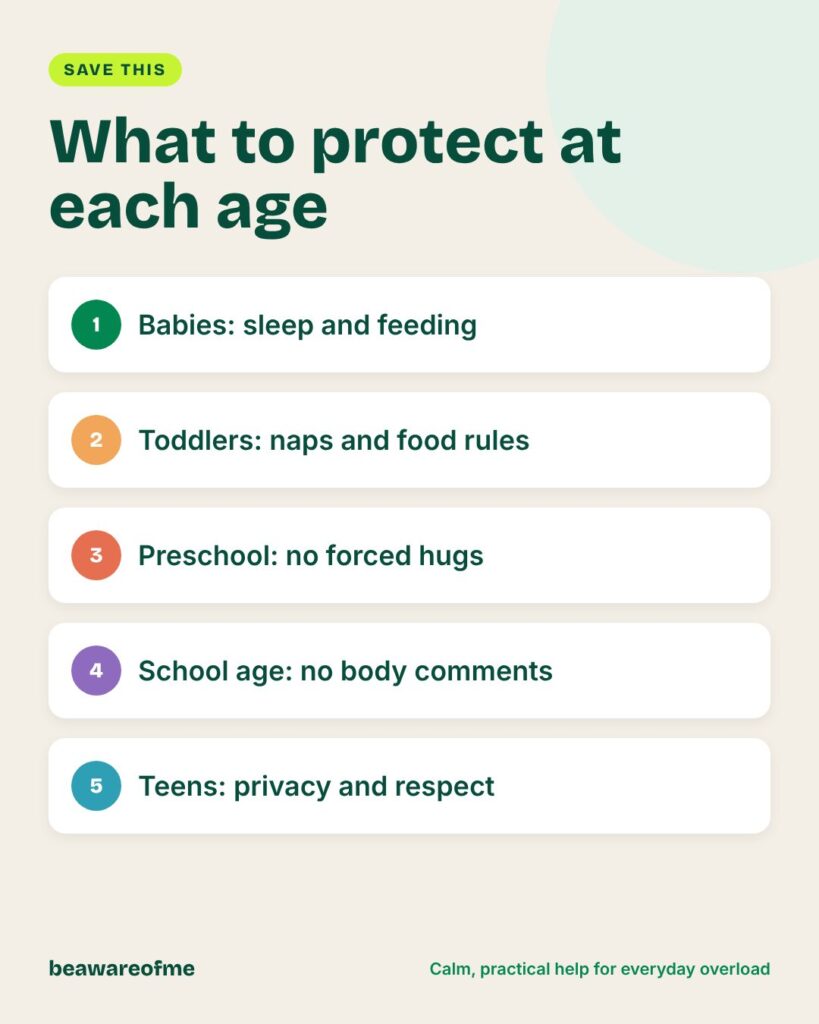
The boundaries that matter most change as your child grows, so your list should change too. A baby needs protected sleep and feeding. A teen needs privacy and respect. Matching your rules to your child’s age keeps you focused on what really counts, instead of policing every small thing. It also gives overbearing relatives fewer, clearer rules to remember.
What to protect at each age
| Child’s age | Top boundaries to hold | Easy to let go |
|---|---|---|
| Baby (0-1) | Safe sleep, feeding choices, sick visitors, kissing the baby’s face | Outfits, gifts, nicknames |
| Toddler (1-3) | Nap schedule, food rules, no forced hugs | Extra stories, messy play |
| Preschool (3-5) | Consistent discipline, screen limits, body autonomy | Treats on special days |
| School age (6-12) | No comparing siblings, no comments on weight or looks, homework routine | Later bedtime at grandma’s |
| Teens (13+) | Privacy, no teasing about dating or bodies, respect for opinions | Style, music, hobbies |
Babies and toddlers: health and sleep first
In the early years, keep your list short and health-based. Ask sick relatives to visit another time. Keep the nap schedule, even when grandparents want more playtime. If someone keeps overriding your feeding or sleep choices, say: “Our doctor gave us this advice, so we’re following it.”
Preschool and school age: body and dignity
From around age three, children notice when adults ignore their “no”. Let your child decline hugs and kisses. Offer a high five or a wave instead. Stop comments about weight, eating or comparing siblings straight away, calmly and in front of the child, so they hear you defending them.
Teens: privacy and respect
Teenagers need relatives to respect their privacy and opinions. Ask family not to quiz them about dating, grades or appearance at gatherings. Let your teen help set their own boundaries, and back them up when they use them. This is how they learn to protect themselves later.
✨ Quick win
Before each family event, ask your child: “Is there anything you’d like me to help with today?” Kids often mention one thing, like a cousin’s teasing, that you can quietly handle in advance.
Handling Each Type of Overbearing Relative
Different relatives push in different ways, so one approach rarely fits all. A grandparent who adores your child needs a different tone than a sibling who competes with you. Use these quick profiles to choose your strategy. Most overbearing relatives fit one of these four patterns, at least on a bad day.
The devoted grandparent
They want time and influence, and they often have plenty of both. Give them a clear, generous role, like a weekly grandparent afternoon, with two or three firm rules. Thank them often. Overbearing relatives who feel appreciated push far less. Gratitude makes it easier for them to accept the limits.
The critical in-law
Here the partner who is their child should lead every hard conversation. Keep visits structured and shorter. Have a polite exit line ready. Avoid defending each choice; you don’t owe anyone a full explanation for how you raise your children.
The competitive sibling
Comparisons like “my kids sleep through the night” are often about their own worries. Respond lightly: “Every kid is different. We’re doing fine.” Then steer the talk elsewhere. If it keeps happening, say privately: “I’d like us to stop comparing the kids.”
The relative who crosses serious lines
Some behaviour goes beyond overbearing. If a relative insults you constantly, ignores safety rules, or makes your child afraid, more distance is reasonable. Our guide on how toxic relationships affect your mental health can help you tell the difference. Your child’s safety and wellbeing always come first.
You can love someone deeply and still decide they don’t get a vote on how you raise your child.
beawareofme
How to Hold the Line When the Family Pushes Back
Pushback from overbearing relatives is normal and usually temporary, so plan for it rather than being surprised. Most relatives test a new limit a few times. If your response stays calm and the same each time, the testing usually fades.
Use consequences, not threats
A consequence is a calm action you take, while a threat is a warning you rarely follow. “If the teasing starts, we’ll head home” is fine, as long as you actually leave. Keep consequences small and proportional. Ending a visit early works better than cutting someone off over one comment.
Expect the first three reactions
Relatives often respond with hurt (“I was only trying to help”), anger (“You’re so sensitive”) or recruiting (“Your dad agrees with me”). Each one is a test, not a verdict. Respond to all three the same way: acknowledge the feeling, repeat the rule, move on. Overbearing relatives often settle once they see the rule survives all three.
💡 Tip
Keep a short note after each visit: what happened, what you said, what worked. After a few weeks you’ll see patterns, like which topics always trigger conflict, and plan around them.
Look after yourself afterwards
Setting limits with family is draining, even when it goes well. Plan something restful after big visits, like a quiet walk or an early night. If guilt lingers, our guide on how to set boundaries without feeling guilty walks through why that guilt doesn’t mean you did anything wrong. You can also check where you stand with our free are your boundaries healthy self-check.
Keeping the Relationship Warm After the Limits Land
Good boundaries make relationships with overbearing relatives last longer, not shorter. When people know the rules, they stop guessing and you stop resenting. The goal is a family that spends more time together, with less tension.
Give them a “yes” for every “no”
When you limit one thing, offer something they can do. “No sweets before dinner, but would you bake cookies with her on Saturday?” A clear yes gives relatives a way to feel close without crossing your lines. This one habit turns many overbearing relatives into genuine helpers.
Build connection on your terms
- Set a regular call or visit day so contact feels reliable.
- Share photos and updates in a private family group, not on public social media.
- Invite grandparents to school events, sports or recitals.
- Ask relatives to teach your child a skill, like a recipe, a game or a craft. Overbearing relatives with a meaningful job tend to push less.
Staying connected also builds a wider support system for you. Our guide to building a support system as a busy parent has ideas for turning family into real help, not extra stress.
🧭 Try this today: your boundary prep sheet
☐Write your three non-negotiables on one line each.
☐Pick one script from this guide for each rule.
☐Agree with your partner who says what.
☐Decide one calm consequence, like leaving early.
☐Choose one “yes” you can offer each relative.
☐Plan one restful thing for after the next visit.
5 Common Mistakes When Setting Limits With Family
Most boundary problems come from timing and delivery, not from the boundary itself. Avoid these five slips and your limits with overbearing relatives will land far better. Each one is common, and each one is fixable.
Mistake 1: Waiting until you explode
Many parents tolerate small things for months, then snap at a holiday dinner. The outburst becomes the story, not the rule. Instead, raise each issue early and privately, while you’re still calm. Overbearing relatives take a quiet word far better than a public scene.
Mistake 2: Over-explaining
Long explanations sound like you’re asking for permission. Every reason becomes a point to argue. Give one short reason, or none, and stop there.
Mistake 3: Setting rules you won’t enforce
If you announce a consequence and don’t follow through, relatives learn your limits are flexible. Only set rules you’re ready to hold, and start with fewer of them. Two firm rules beat ten loose ones every time.
Mistake 4: Making the in-law the messenger
When the in-law delivers every hard message, family often blames them for “changing” their child. Let the blood relative speak, with the partner as visible support.
Mistake 5: Holding every rule with the same intensity
Treating extra cookies like a safety issue wears everyone out. Save your energy for the three things that matter most. Overbearing relatives can’t tell your big rules from your small ones unless you show them. Letting small things go makes your big rules more credible.
📚 Keep reading
FAQ: Boundaries With Overbearing Relatives
How do I set boundaries with overbearing relatives without hurting them?
Talk privately and early, and start with appreciation. Say something like “We love how much you care about the kids.” Then name the specific behaviour and what you need instead. Keep it short and avoid blaming language. Offer something they can do, like a regular visit day. Some hurt feelings are normal at first, but a kind, consistent message usually protects the relationship over time.
What if my partner won’t support my boundaries with their family?
Start by talking at home, away from relatives. Focus on shared goals, like your child’s sleep or wellbeing, rather than on their parent’s faults. Agree on just one or two rules to begin. If you still can’t find common ground, a couples or family counsellor can help you both understand each other. Presenting a united front matters more than winning the argument.
Is it okay to limit visits with grandparents?
Yes, if visits regularly undermine your rules, upset your child or leave you exhausted. Limiting visits doesn’t mean ending the relationship. You might shorten visits, meet in public places or schedule them at set times. Explain the change calmly and focus on what will make visits work better. Many families find that fewer, calmer visits feel warmer than frequent tense ones.
How do I stop relatives from giving parenting advice?
You usually can’t stop the advice completely, but you can stop it from becoming a debate. Use a short, neutral reply such as “Thanks, we’ve got a plan for that,” then change the subject. Don’t justify your choices. If one relative keeps pushing, talk privately: “I know you mean well, but the constant advice makes me feel judged.”
What should I do when a relative ignores my rules with my kids?
Restate the rule once, calmly and privately. If it happens again, follow through with a consequence you’ve planned in advance, such as ending the visit early or supervising time together. Stay consistent, because mixed responses teach relatives your rules are optional. If safety rules keep getting broken, such as car seats or allergies, unsupervised time should pause until trust returns.
How do I teach my kids to set boundaries with family?
Model it first. Let your child see you say no politely and calmly. Give them simple phrases like “No thank you, I’d like a high five instead.” Back them up when they use their words, even with grandparents. Praise them afterwards. Children who see their limits respected at home learn that their feelings matter, which helps them stay safe as they grow.
🛟 Please read
Educational content, not a substitute for professional care. If you are struggling, talk to a doctor or a qualified professional. If you are thinking about harming yourself, contact local emergency services or a crisis line now (US 988, UK and Ireland Samaritans 116 123, or findahelpline.com).
Setting boundaries with overbearing relatives isn’t about winning a family battle. It’s about giving everyone a clear, calm shape to work within, so your children grow up surrounded by people who love them and respect the way you parent. Start with one rule and one script, and let consistency do the rest.