
If you are wondering how to help someone with anxiety, you are already doing the most important thing: paying attention. Maybe it is your partner lying awake again, a friend who cancels at the last minute, a coworker who goes quiet before every review, or a parent who rings you five times about the same worry. You do not need special training to be useful here. You need a few good sentences, a calm plan for the hard moments, a simple weekly rhythm, and a way to keep going without wearing yourself out.
How to help someone with anxiety: start with four simple moves
This section covers the basic shape of good support, which you can use with anyone, anywhere. Most anxious people do not want a lecture or a solution in the first minute. Many people describe anxiety as a loud, fast feeling inside their head, and what helps first is feeling less alone with it.
Good support usually has four moves. You do not need to do them perfectly, and you do not need to do them in a strict order.
- Notice. Watch for their usual signs: going quiet, snapping, asking the same question again, fidgeting, cancelling plans or scrolling for hours.
- Ask. “You seem a bit on edge. Want to talk, or would you rather I just stay close?” Let them pick.
- Listen. Let them finish. Then repeat back the core of it: “So the email from your manager has been sitting in your chest all afternoon.” This shows you heard the feeling, not just the facts.
- Offer one small thing. A walk, a glass of water, help drafting a reply, or simply sitting together for ten minutes. One thing, not five.
The NHS advice on helping others with mental health problems makes a similar point: tell them you are worried, keep your normal routine, and avoid pressuring them to talk before they are ready.
What anxiety can look like in the people around you
This section helps you spot anxiety early, because it does not always look like worry. Many people experience anxiety as physical tension, irritability or avoidance before they ever say “I feel anxious”. Spotting the pattern helps you respond with care instead of frustration.
Common signs people notice in a partner, friend, coworker or relative include:
- In the body: tight shoulders, a clenched jaw, restless hands, trouble sleeping, an upset stomach before events.
- In conversation: asking for the same reassurance again and again, jumping to the worst outcome, or going unusually quiet.
- In behaviour: cancelling plans, leaving early, putting off calls and emails, or checking things over and over.
- In mood: snapping at small things, seeming far away, or getting tearful over something that looks minor from the outside.
- At night: long stretches on the phone, reading bad news, or lying awake running through tomorrow.
These signs do not mean anything is “wrong” with the person. They are simply clues that the worry is loud today. If late-night scrolling is part of the pattern, our guide on how to stop doomscrolling has gentle ways to break that loop together, and our bedtime calculator can help you both pick a realistic wind-down time.
What to say to someone with anxiety, with scripts for each situation

This section gives you word-for-word sentences you can use as they are. Short, calm sentences work best: they show you are with them, that the feeling makes sense, and that there is no pressure. You do not need to explain anxiety or talk them out of it.
When they first tell you they are anxious
When they are stuck on one worry
These questions gently move the person from a spinning “what if” toward something smaller and more concrete. If the thought keeps coming back and feels upsetting or out of character, our guide to intrusive thoughts can help you both understand what is going on.
By text, when you cannot be there
For the different people in your life
- Partner: “I can see you’re wound up. Let’s put the phones down and sit outside for ten minutes. You don’t have to talk.”
- Friend: “If tonight feels like too much, we can do something smaller. Coffee near your place for half an hour?”
- Coworker: “That meeting looked stressful. Want to go over your points together for five minutes before the next one?” Our guide to calming anxiety before a meeting is an easy, low-key thing to share here.
- Parent or older relative: “I hear you’re worried about the appointment. Let’s write your questions down together so you feel ready.”
What not to say to someone with anxiety, and what to try instead
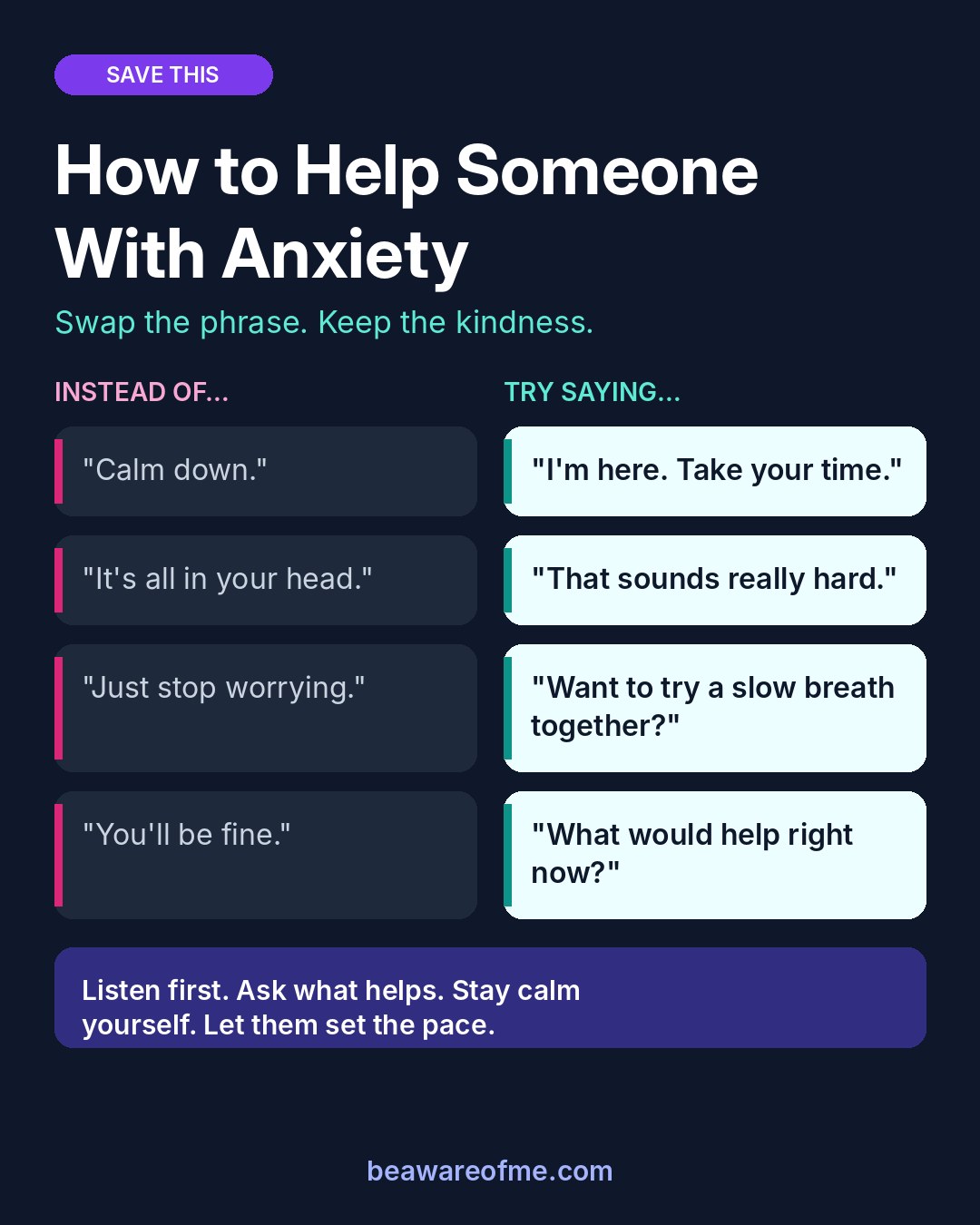
This section lists the phrases that tend to backfire and gives you a better swap for each one. These phrases usually come from love, but they can land as “your feeling is a problem for me.” Swapping just one or two of them changes the tone of a whole conversation.
| Instead of… | Try saying… | Why it works better |
|---|---|---|
| “Just relax.” | “Let’s slow down together for a minute.” | It gives them something to do with you, not an order. |
| “You’re overreacting.” | “This feels really big right now.” | It names the feeling without judging its size. |
| “Don’t worry about it.” | “What part is worrying you most?” | It invites them to talk instead of closing the door. |
| “Everything will be fine, I promise.” | “Whatever happens, you won’t face it alone.” | You cannot promise outcomes, but you can promise support. |
| “Everyone gets stressed.” | “That sounds harder than ordinary stress.” | It takes their experience seriously. |
| “Why can’t you just think positive?” | “Want to look at what’s actually in your control?” | It moves to small action without blame. |
| “I know exactly how you feel.” | “I can’t fully know, but I want to understand.” | It keeps the focus on them. |
One more habit to drop: rapid-fire solutions. If they have not asked for ideas, five suggestions in a row can feel like pressure or criticism. Ask first: “Would ideas help, or not yet?” If the answer is “not yet”, trust it and come back later.
How to help someone with anxiety in a hard moment: a 5-minute plan
This section is a short plan for when the worry is high but the person is not in a full panic attack. The goal is to lower the pace, not to make the feeling vanish.
A weekly support plan that keeps things steady
This section turns support into small, predictable habits, so you are not only there for the next bad day. Many people find anxiety feels a little lighter when life has a few steady anchors. Use this plan as a starting point and adjust it to your relationship.
| When | What you do | Example |
|---|---|---|
| Once a week | A 10-minute check-in on a calm day | “How’s this week looking? Anything coming up that feels heavy?” |
| Before known hard days | Plan one small support | A text the morning of a big meeting, or a lift to the appointment. |
| Two or three times a week | Shared low-pressure time | A walk after dinner, cooking together, a short phone call. |
| Daily, if you live together | Protect a calm wind-down | Screens off a little earlier, lights lower, an easy routine. |
| Once a week | Notice one win out loud | “You made that call you were dreading. That took guts.” |
Be careful with the reassurance loop
Many anxious people ask the same question again and again: “Are you sure it’s fine?” “Do you think they’re angry?” Answering every time feels kind, but the relief often lasts only minutes before the question comes back. Many families find a gentler pattern works better:
- Answer once, clearly and kindly.
- The second time, say: “I’ve answered that one. I think the worry is talking. What would help you sit with it for a bit?”
- Offer something different: a walk, writing the worry down, or setting a “worry time” later in the day when you will talk it through together.
Agree on this together on a calm day, so it does not feel like you are pulling away in the middle of a hard moment. When this is not enough: if the questions keep coming many times a day, or the person cannot function without your answer, that is a sign to suggest outside support.
Help “with” them, not “for” them
It is tempting to make every phone call, skip every party and handle every hard task yourself. In the short term it helps. Over time, it can make their world feel smaller, because the worry learns that the hard thing is always avoided. Try “with you” instead of “for you”: sit beside them while they make the call, go to the first part of the party together, or draft the email side by side and let them press send.
How to look after yourself while you support someone
This section is about you, because a tired, resentful helper cannot stay calm, and calm is the whole job. Supporting an anxious person can be heavy, and many supporters quietly run themselves down without noticing.
- Name your limits kindly. “I want to help, and I can’t talk at midnight on work nights. Let’s set a time tomorrow.”
- Keep one thing that is only yours. A walk, a hobby, a weekly coffee with your own friend. Put it in the calendar.
- Share the load. If you are the only support, gently encourage them to build a wider circle: another friend, a family member, a group or a professional.
- Watch your own signs. Dreading their calls, feeling numb, snapping at small things or sleeping badly can mean you are running on empty. Our guide on emotional exhaustion walks you through what to do next, and this checklist helps you recognise burnout early.
- Drop the guilt. Their anxiety is not your fault, and you cannot make it disappear. Being there, steadily, is enough.
When and how to suggest professional help
This section explains when to bring up outside support and how to say it without sounding like you are giving up on them. A good time to suggest it is when the anxiety lasts for weeks, gets worse, or stops them doing normal parts of life like work, sleep, eating or seeing people.
Signs it may be time to bring it up:
- They avoid more and more places, people or tasks.
- Sleep, appetite or work are clearly suffering.
- They lean on alcohol, pills or other substances to cope.
- The worry fills most of their day, most days.
- They talk about feeling hopeless or not wanting to be here.
How to bring it up
- Choose a calm moment, not the middle of a hard one.
- Start with care: “I love you, and I’ve noticed how hard the last few weeks have been.”
- Be specific: “You’ve missed work a few times and you’re barely sleeping.”
- Offer a step, not a demand: “Would you be open to talking to your doctor? I can help you book it or come with you.”
- Respect their pace. If they say no, leave the door open: “OK. The offer stands any time.”
If you want something to share first, the NHS Every Mind Matters page on anxiety explains common feelings, self-care ideas and where to find support in plain, non-scary language.
Common mistakes when supporting someone with anxiety
This section covers the slips that well-meaning supporters make most often, why they backfire, and what to do instead. Everyone makes some of these. Noticing them is the first step.
1. Trying to fix it in the first minute
Why it is a mistake: jumping straight to solutions can make the person feel unheard, as if their feeling is a problem to be cleared away. What to do instead: listen first, reflect back what you heard, and ask whether they want ideas before offering any.
2. Matching their energy
Why it is a mistake: if you speed up, raise your voice or start worrying too, the room gets louder and the anxiety has more fuel. What to do instead: slow your breathing and your speech on purpose. Let your calm set the pace.
3. Endless reassurance
Why it is a mistake: answering the same worried question over and over brings short relief, and then the worry returns, often stronger. What to do instead: answer once, kindly, and then gently offer a different step, such as a walk or writing the worry down.
4. Taking over every hard task
Why it is a mistake: doing everything for them can quietly shrink their world and their confidence. What to do instead: help “with” them. Sit beside them for the phone call, or go to the first part of the event together.
5. Ignoring your own limits
Why it is a mistake: a worn-out helper becomes short-tempered or withdraws, which can hurt more than setting a clear limit. What to do instead: name your limits kindly, keep one thing that is yours, and help them widen their circle of support.
How to help someone with anxiety: frequently asked questions
How do I help someone with anxiety over text?
Keep texts short, warm and free of pressure. Try “Thinking of you, no need to reply” or “Want a call or a voice note tonight?” Avoid long advice messages, which can feel like a lecture on a small screen. Offer one clear way to connect and let them choose the pace. A quick check-in the next day shows your care was not a one-off.
What do I do if they push me away?
Give them space without disappearing. Say something like “I’ll give you some room. I’m here when you want me,” and then check in lightly in a day or two. Pushing away is often about the anxiety, not about you. Steady, low-pressure contact usually works better than chasing them or taking it personally, and it keeps the door open.
Should I keep reassuring them when they ask the same question?
Answer kindly once, then gently step out of the loop. Repeated reassurance often brings only short relief before the worry returns. Try “I’ve answered that one, I think the worry is talking,” and offer a walk, a slow breath or writing it down. Agree on this approach together on a calm day first, so it never feels like rejection.
How do I help a coworker with anxiety without overstepping?
Keep it practical and private. A quiet “That looked stressful, want to go over it together?” is often enough. Offer specific help, like reviewing notes before a meeting, and respect their answer if they say no. Do not share what they tell you with others, and do not try to diagnose them or manage their health. Being kind and reliable is plenty.
Can I make someone’s anxiety worse by trying to help?
Sometimes, usually by rushing them, dismissing the feeling or taking over every hard task. The fix is simple: slow down, ask what they need, and help “with” them rather than “for” them. Small slips are normal in any relationship. Saying “Sorry, I rushed you there, let’s try again” repairs most of them quickly and builds trust.
What if I’m exhausted from supporting them?
That is a real signal to look after yourself, and many supporters reach it. Set kinder limits, protect one thing that is only yours, and encourage them to widen their support circle. Talk to someone you trust about how you feel, or to a professional. You can only stay calm and helpful if you are not running on empty.
The bottom line
Learning how to help someone with anxiety comes down to three things: stay calm, listen before you fix, and keep showing up on ordinary days as well as hard ones. Today, save one script from this guide and book a 10-minute calm-day check-in this week. For the hardest moments, keep our guide on how to stop a panic attack close, explore more practical anxiety guides, and try our free everyday stress tools.