

If you want to know how to decompress after work, start with the fact that switching off isn’t a mood. It’s a transition, and transitions need a few deliberate steps. Most people walk through the door still running the day: replaying a meeting, half-reading messages, snapping at whoever asks what’s for dinner. This guide gives you a 20-minute routine in four stages, a version for every kind of workday, a 5-minute emergency version for awful days, and the exact words to use with the people you live with.
- Decompression is a short routine, not free time: the same four steps, about 20 minutes, every workday.
- Closing the day on paper stops your brain from holding unfinished tasks open all evening.
- Moving before you sit down helps your body let go of the tension a long day builds up.
- A change of clothes, a shower or a set song works as a clear signal that work time is over.
- On a really bad day, use the 5-minute version and tell the people at home you need it.
Not sure how drained you are today? The free How Empty Is Your Battery? check takes a minute and helps you pick between the full routine and the emergency version below.
Why you still feel at work two hours after you get home
This section explains what is actually going on when the workday follows you home. Your body clocks out at 5:30. Your attention doesn’t. Unfinished tasks stay active in your mind; it’s the same reason a song you stopped halfway keeps playing in your head. Add a commute on autopilot, a phone that buzzes with work messages, and a home that needs things from you the minute you arrive, and there is simply no gap where “work you” turns into “home you”.
We think most advice on this gets the order backwards. It starts with relaxing: a bath, a podcast, a glass of something. But you can’t relax while your brain still has the day open. First you close it, then you discharge the physical tension, and only then does rest actually feel like rest. The American Psychological Association lists both setting boundaries on work after hours and taking time to recharge as core ways to cope with work stress, and the routine below is simply a daily, practical shape for both.
Signs the workday is still running in your head
Two or three ticks is very common and is exactly what the routine below is built for. If you tick most of them most evenings, the routine still helps, but it is also worth looking at workload and support during the day.
How to decompress after work: the 20-minute routine
This is the full routine at a glance. Four stages, about 20 minutes in total, done in the same order every workday. You can split it across your commute and your first minutes at home, which is how most people end up doing it.
| Stage | Time | What you do | Why it works |
|---|---|---|---|
| 1. Close | 3 min | Write three lines, shut the laptop or locker, say one closing sentence | Gives unfinished tasks a place to live outside your head |
| 2. Move | 5 min | Walk, stretch, climb stairs, or do standing chores | Lets your body burn off the tension the day built up |
| 3. Change | 7 min | Shower, change clothes, wash your face, one set drink or song | Creates a clear physical signal: work time is over |
| 4. Land | 5 min | One easy, familiar task, then sit down on purpose | Eases you into the evening instead of crashing into it |
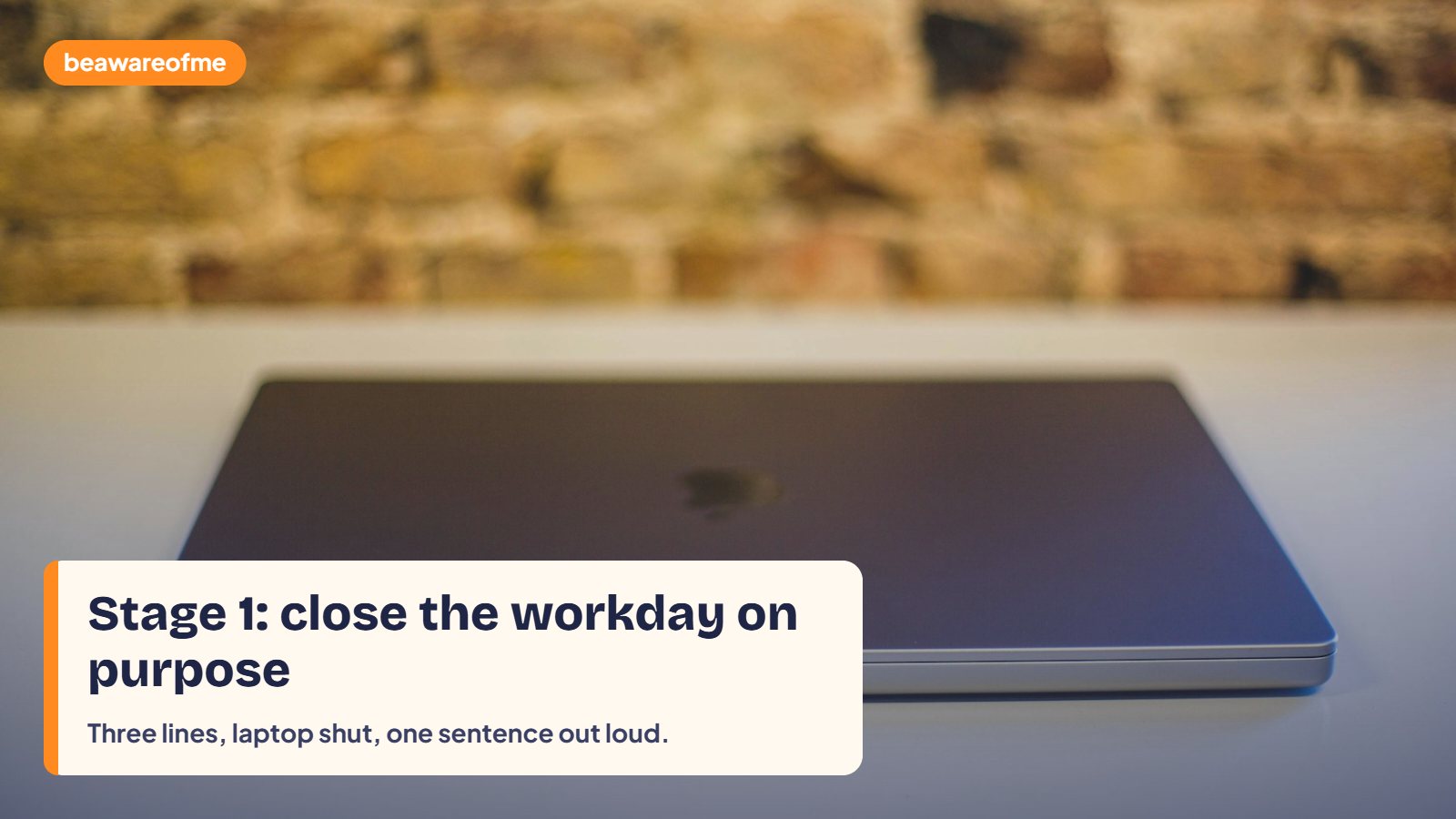
Stage 1: close the workday (3 minutes)
Before you leave work, or before you shut the laptop at home, write three short lines on paper or in a note you won’t open again tonight.
It sounds too simple. It isn’t. Writing the open task and the first step tomorrow tells your brain the loop is held somewhere safe, which is why it stops bringing it up at 9pm. If the replaying keeps going anyway, our guide on how to stop overthinking has a short exercise for that exact moment.
Stages 2 and 3: move first, then change your state
This section covers the physical part of decompressing, which is the part most people skip. A long day leaves real tension in the body: tight shoulders, a clenched jaw, shallow breathing. Sitting down straight away keeps all of that in place.
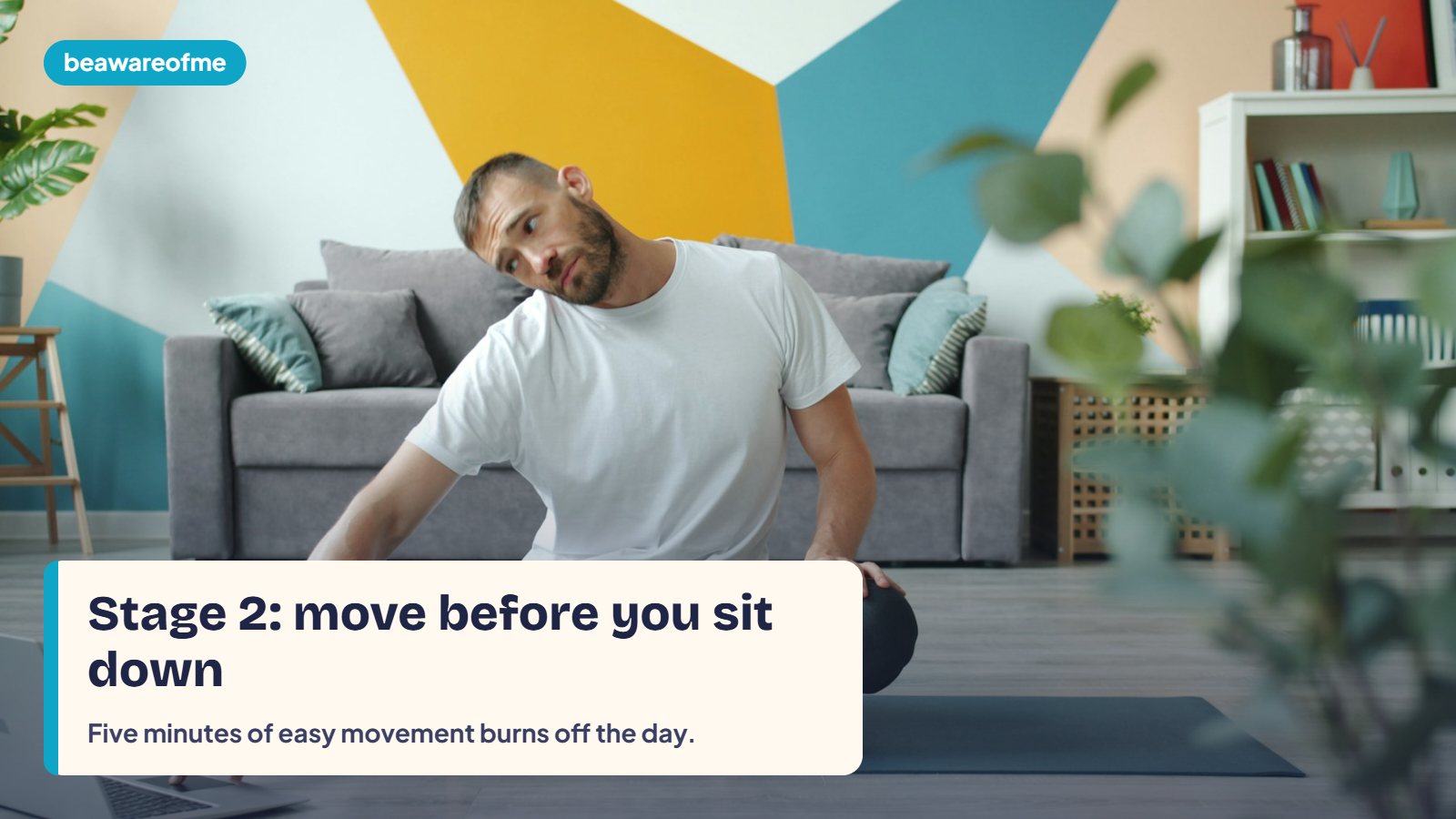
Stage 2: move for five minutes
- Get off the bus or train one stop early and walk the rest.
- Walk around the block before you go inside.
- At home: five minutes of easy stretching (neck rolls, shoulder circles, a slow forward fold).
- No space or time? Do your standing chores now: unpack your bag, empty the dishwasher, take the bins out.
The point is not exercise. It’s discharge. If you have more energy, a longer walk or a workout is great, but five minutes is enough to change how the evening starts.
Stage 3: change your state in seven minutes
Your brain links places, clothes and rituals with modes. Use that. Pick one or two of these and do them every day in the same order:
That last one comes straight from the NHS breathing exercise for stress: breathe in through your nose for a count of five, out through your mouth for five, and keep going. One minute is a good start; the NHS suggests building up to five.
How to decompress after work for your kind of workday
This section matters because the same routine looks very different for a nurse finishing a night shift and someone closing a laptop at the kitchen table. Find your row, then adapt the four stages.
| Your workday | Biggest problem | What to change |
|---|---|---|
| Office + commute | Work thoughts ride home with you | Do Stage 1 at your desk, Stage 2 as the walk to the station, Stage 3 as a fixed playlist on the way |
| Working from home | No border at all between work and home | Create a “fake commute”: shut the laptop, walk round the block, come back in through the front door |
| Shift work | You finish when everyone else is asleep or waking up | Keep the routine identical at any hour; for night shifts, dim lights and skip screens on the way home |
| Customer-facing or caring job | Emotional tiredness from looking after others all day | Add 5 quiet minutes alone in Stage 4 before talking to anyone at home |
| Coming home to kids | No time: the second shift starts at the door | Do Stages 1 to 3 before you walk in, even in the car or on the doorstep, and use the script below |
Your first week with the routine
Building it up step by step matters. People who try all four stages on day one often drop the whole thing by Thursday. One new stage every couple of days feels almost too easy, and that is exactly why it sticks.
If you work from home, the missing border is the whole problem, and our guide to how remote work affects mental health goes deeper into why. Shift workers will find the timing advice in our shift-work articles more useful than any 5:30pm routine.
Stage 4: land softly in your evening
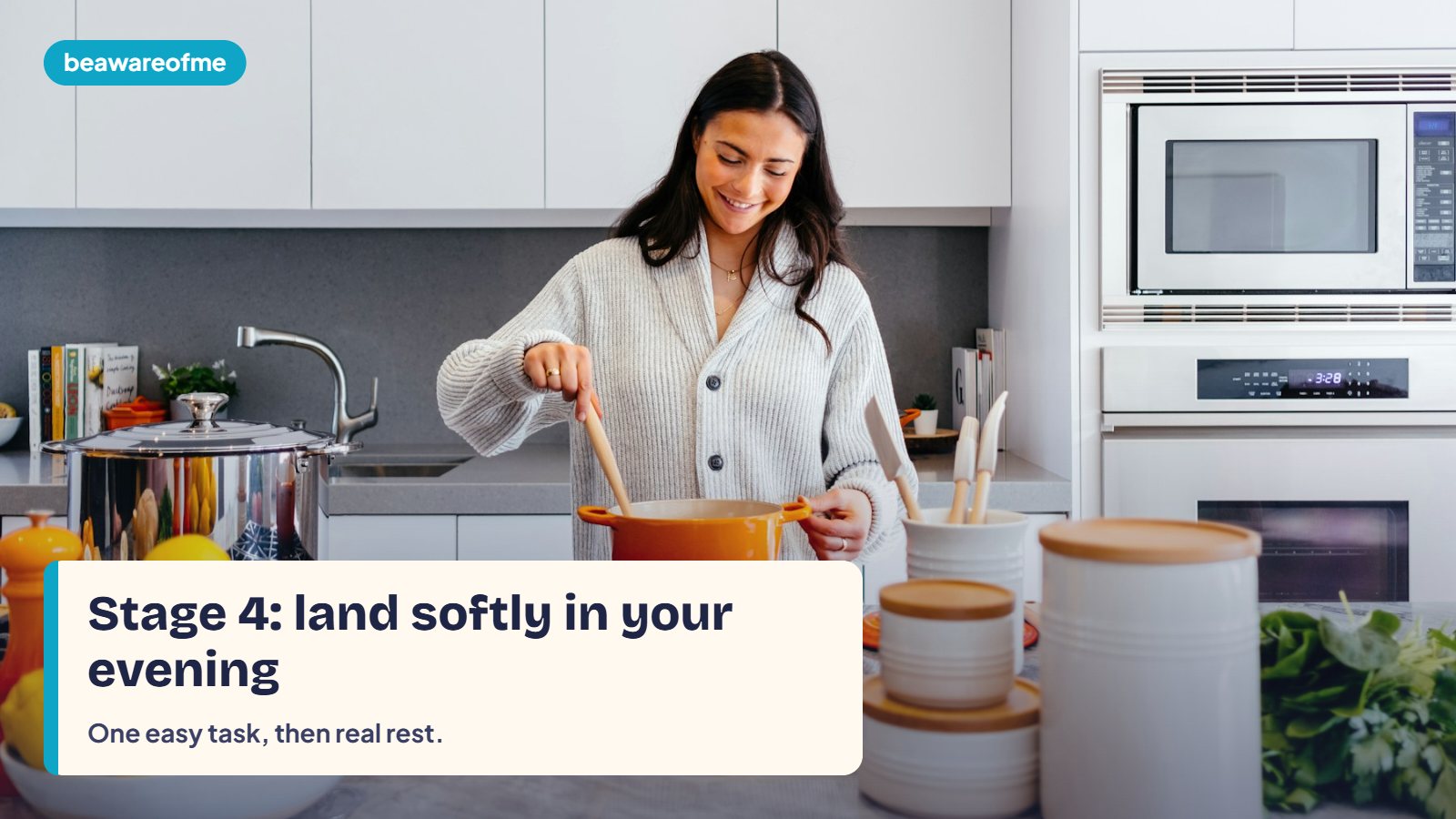
This last stage is about how you enter the evening. Many people finish Stage 3 and immediately collapse on the sofa with their phone, which feels like rest but often keeps the mind buzzing. Landing is a softer step in between.
The 5-minute emergency version for a really bad day
This is for the days when something went wrong: a hard conversation, a mistake, a shift that broke you. On those days 20 minutes feels impossible and the full routine can feel like another task. Use this instead.

If a hard day is still loud at bedtime, the wind-down timeline in how to calm anxiety at night picks up from here. And if bad days have become most days, read our piece on reducing work stress without quitting for changes you can make at work itself.
How to decompress after work when you live with other people
This section is for everyone who walks through the door and is instantly needed. Decompressing is much easier when the people you live with know what you’re doing and why. Say it once, calmly, at a good moment, not at 6pm on a bad day.
Offering the same buffer to the other person makes it far easier to keep. Two people who both get 15 minutes are much kinder to each other at 7pm than two people who both got none.
If you live alone, the risk is different: nobody interrupts, but nobody marks the end of the day either, so work can quietly spread across the whole evening. Use a physical marker instead of a person. Close the laptop and put it in a bag, switch the main light off and a lamp on, or put the kettle on at the same time every day. And if you are a single parent with no one to swap with, shrink the routine to the parts you can do before you walk in: the three-line note on the way, two minutes of breathing in the car or on the doorstep, and one change signal you can do with the children around, like a set song you all know means “evening now”.
Common mistakes when trying to switch off after work
These are the traps that catch people who already know they should switch off and have tried a few things.
1. Going straight to the phone
Scrolling feels like rest, but it keeps your attention jumping and often pulls you back into work apps. Put the phone away for the 20 minutes of the routine, then use it on purpose if you want to.
2. Skipping the close
Most people jump to relaxing without closing the day. Without the three-line shutdown, the open task keeps resurfacing all evening. It takes three minutes; it’s the stage to protect if you only keep one.
3. Relying on a drink to switch off
A glass of wine can become the only signal that work is over, and then it’s needed every night. Keep the ritual (a special drink, a set glass) but make it something you would be happy to have every evening.
4. Making the routine too long
An hour-long wind-down sounds lovely and rarely happens on a Tuesday. A 20-minute routine you actually do beats a perfect one you skip. Shrink it until it fits your worst normal day.
5. Not telling anyone
If the people at home don’t know what you’re doing, they’ll interrupt it, and you’ll feel guilty for wanting it. Use one of the scripts above once, and the routine becomes something the household protects with you.
How to decompress after work: FAQ
How long does it take to decompress after work?
For most people, a deliberate routine of about 20 minutes is enough to feel noticeably more switched off, as long as it includes closing the workday, some movement and a clear change of state. On very stressful days it can take longer, and a walk or an early night may help more than any routine. The key is doing the same steps consistently.
Why can’t I relax after work?
Usually because the workday is still open in your head. Unfinished tasks, work messages on your phone and no clear border between work and home keep your mind on alert. Writing down what is still open, moving your body and changing your clothes or setting help signal that work is over, which makes relaxing far easier.
What is the best thing to do after work to relax?
There is no single best activity, but the order matters more than the activity: close the day first, move for a few minutes, change your state, then rest. After that, choose something that asks little of you and feels good, such as reading, cooking, a call with a friend, or one episode of a show you enjoy.
How do I decompress after work when working from home?
Create the border that a commute would normally give you. Shut the laptop and write your three-line shutdown note, then leave the house for a short walk and come back in through the front door. Change out of your work clothes and, if you can, keep work equipment out of sight for the evening.
Is it normal to feel exhausted after work every day?
Feeling tired after a full working day is common. Feeling completely drained, irritable and empty every single evening for weeks can be a sign that workload, sleep or stress need attention. If it continues, it’s worth talking to your manager about workload and to a doctor or mental-health professional about how you feel.
How do I decompress after a stressful shift?
Use the same four stages at whatever hour your shift ends. After night shifts, keep lights low, avoid screens on the way home and go to bed soon after the routine. On especially hard shifts, use the 5-minute emergency version: a short walk, one sentence about the day, a minute of slow breathing, and tell someone what you need.
Bottom line
Knowing how to decompress after work comes down to one habit: give the day a clear ending before you try to rest. Close it in three lines, move, change your state and land softly, every workday, in about 20 minutes. Start with tonight’s shutdown note, then browse our workplace stress articles and our core guide to workplace stress management for the changes that help during the day too.