You open an app for a minute and close it twenty minutes later, feeling behind on your body, your career, your savings and your whole life. Nobody said anything unkind. You just watched a hundred people reach goals that seem impossible for you. That low, heavy feeling is what many people call social media depression, and unrealistic goals from the feed sit right at the centre of it. This guide shows you how the feed reshapes what “enough” looks like, and how to take your goals back.
🌟 Key takeaways
Social media depression is a plain-language term, not a diagnosis, for low mood tied to heavy scrolling and comparison.
Feeds show a filtered, edited slice of life, so goals copied from them are often unrealistic by design.
In one University of Pennsylvania experiment, limiting three apps to 10 minutes each a day reduced depression and loneliness.
Mute or unfollow accounts that leave you feeling behind, and keep the ones that teach or connect.
Write goals from your own values first, then check whether a goal came from the feed.
If low mood lasts for weeks or affects daily life, talk to a doctor or a qualified professional.
🤝 Support is here
If scrolling leaves you feeling hopeless or you’re having thoughts of harming yourself, please put the phone down and reach out now. Contact local emergency services or a crisis line: US 988 (call or text), UK and Ireland Samaritans 116 123, or findahelpline.com.
What People Mean by Social Media Depression
Social media depression is an everyday phrase for the low mood, emptiness or hopelessness some people feel after heavy social media use. It isn’t a clinical term, and it doesn’t mean the apps alone cause depression. But it names something real: the drop in mood that often follows a long scroll.
Here’s the guide on one screen. Find the feed habit that sounds most like you and start with that fix.
Social media depression and unrealistic goals at a glance
| Feed pattern | How it shapes your goals | First calm step |
|---|---|---|
| Fitness and body content | Makes edited bodies look normal | Mute accounts that trigger body checking |
| Hustle and productivity posts | Sets a 5 a.m., always-on standard | Write your own definition of a good day |
| Money and lifestyle reels | Makes big spending look average | Remember: you see the purchase, not the debt |
| Career milestones | Turns others’ wins into your deadline | Compare with your own past, not their present |
| Relationship highlights | Hides conflict and ordinary days | Notice what’s missing from the post |
| Endless scrolling at night | Fuels rumination and poor sleep | Phone out of the bedroom at night |
What the research actually found
A University of Pennsylvania experiment gives one of the clearest pictures. Researchers split 143 undergraduates into two groups: one kept their usual habits, the other limited Facebook, Instagram and Snapchat to 10 minutes per platform per day for three weeks. The limited group showed significant drops in depression and loneliness. The effect was strongest for people who felt most depressed at the start.
10 min
per platform per day was the limit for the experimental group.
Penn Today
3 weeks
was all it took to see significant drops in depression and loneliness.
Penn Today
📝 Note
The researchers studied only three platforms and one age group, and they didn’t recommend quitting entirely. Their suggestion was to cut chances for comparison and spend more time with people offline.
Why low mood and scrolling feed each other
When you feel low, scrolling can feel like a soft escape. It takes no effort and promises distraction. But a long scroll often adds comparison, bad news and lost sleep, which can deepen the low mood. Then you scroll again. Breaking that loop is a big part of easing social media depression.
Why goals are the hidden link
Most talk about social media depression focuses on screen time. Time matters, but what you see matters too, and much of it is other people’s goals. Each post quietly asks a question: why haven’t you done this yet? Answer that question a hundred times a day, and your own reasonable goals can start to feel like failures. So easing social media depression isn’t only about using your phone less. It’s also about noticing which goals you’ve absorbed from the feed, and deciding whether they deserve a place in your life.
How the Feed Quietly Rewrites Your Goals
The feed rewrites your goals by changing what looks normal. Goals don’t only come from inside you; they come from what you see every day. When you see dozens of people running marathons, buying homes and launching businesses, those wins start to feel like the baseline.
The highlight reel effect
Most people post their best moment, with the best light and the best angle. Nobody films the three years of setbacks behind a career win, or the morning they cried before the gym. So you compare your full, messy life to a stream of other people’s edited peaks. Of course yours looks smaller.
The algorithm amplifies extremes
Feeds tend to reward content that grabs attention. Dramatic transformations, huge incomes and perfect routines catch the eye more than ordinary progress does. Over time, the extreme starts to look typical. That’s how unrealistic goals sneak in: you didn’t choose them, the feed kept showing them until they felt like yours.
Five unrealistic goals the feed often sells
- The 5 a.m. routine: a perfect morning of workouts, journaling and green juice before work.
- The 30-day body: dramatic physical change in weeks, often with edits or filters.
- The side-hustle fortune: big incomes from “passive” projects, rarely with the full costs shown.
- The milestone timeline: married, homeowner and promoted by a certain age.
- The always-calm mind: constant peace and gratitude, with no bad days on camera.
⚠️ Watch out
A goal that makes you feel worse every time you think about it may not be your goal at all. Ask: would I want this if nobody could ever see it?
You’re comparing your whole story to someone else’s best minute. That’s not a fair contest, and you don’t have to enter it.
beawareofme
7 Signs Your Feed Is Weighing on Your Mood
These signs suggest your feed may be affecting how you feel about yourself and your goals. They aren’t a diagnosis; they’re patterns worth noticing. If several feel familiar, it’s a good moment to change how you use social media.
Signs to notice
You feel worse after scrolling
Mood drops after most sessions, even when nothing bad happened.
Your goals keep getting bigger
New targets appear after watching someone else’s success.
You feel behind for your age
Milestones seen online become deadlines you’ve missed.
You can’t enjoy small wins
Your progress feels pointless next to the feed.
You scroll when low
The app is your first move when you feel sad or bored.
Sleep suffers
Late-night scrolling pushes bedtime back most nights.
You hide your real life
You avoid posting or sharing because it doesn’t look “enough”.
When it’s more than a bad scroll
Everyone has low days. But if sadness, emptiness or loss of interest lasts most of the day, nearly every day, for two weeks or more, please talk to a doctor or a qualified professional. The National Institute of Mental Health describes depression as symptoms that affect how you feel, think and handle daily activities. Our guide to the early signs of depression can help you notice patterns, though only a professional can assess what’s going on.
You might also find our deeper look at the role of social media in anxiety and depression helpful for the bigger picture.
The 15-Minute Feed Audit That Eases Social Media Depression
A feed audit means sorting the accounts you follow by how they make you feel. It’s one of the fastest, most practical ways to ease social media depression, because it changes what you see every day without asking for big willpower.
Sort every account into three groups
Your feed audit
| Group | How you feel after | What to do |
|---|---|---|
| Lifts you | Calmer, curious, connected | Keep and engage |
| Neutral | No real change | Keep, but limit time |
| Drains you | Behind, ashamed, anxious | Mute or unfollow today |
How to run the audit
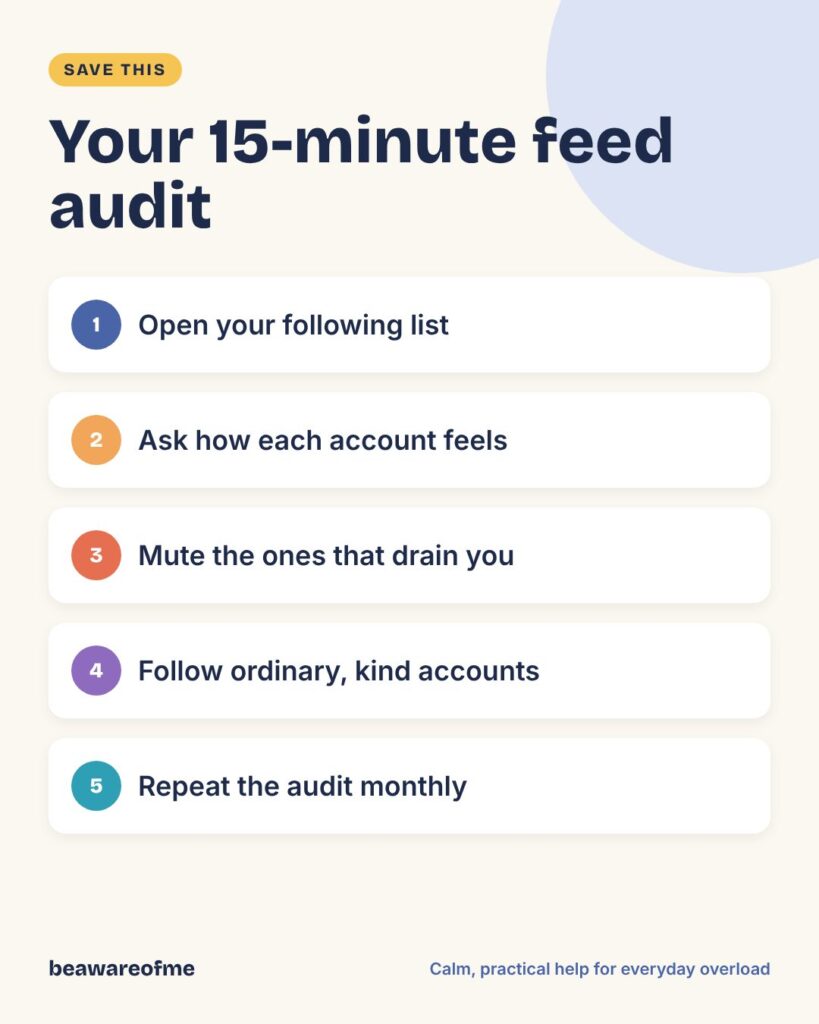
- Open your following list and scroll slowly, account by account.
- For each one, ask: “How do I usually feel after seeing this?”
- Mute anyone in the “drains you” group. Muting is quiet; nobody gets a notice.
- Follow two or three accounts that show ordinary life, practical skills or kind humour.
- Repeat the audit every month, because feeds drift back.
✨ Quick win
Start with the five accounts that most often make you feel behind. Mute them now. That alone can change the tone of tomorrow’s feed.
For a fuller plan, see our guide on how to stop comparing yourself on social media. And if your score on comparison runs high, the free inner critic volume check can show how loud that voice has become.
Rebuild Your Goals From Values, Not the Feed
Rebuilding goals from your values means starting with how you want to live, then choosing small actions that fit. It’s the most lasting answer to unrealistic goals, because values don’t change every time the feed refreshes.
The three-question goal filter
Before you keep any goal, run it through three questions. First, would I still want this if nobody ever saw it? Second, does it fit my real energy and time right now? Third, does working toward it make my days feel better or worse? If a goal fails two of the three, shrink it or let it go.
Swap comparison goals for values goals
Feed goal vs values goal
| Feed goal | The value underneath | A realistic values goal |
|---|---|---|
| Six-pack in 30 days | Feeling strong and well | Walk or stretch for 10 minutes most days |
| Six-figure side hustle | Security and freedom | Save a small fixed amount each payday |
| Perfect 5 a.m. routine | Calm mornings | Phone off the bed, five quiet minutes with coffee |
| Married by 30 | Love and belonging | One honest conversation with someone close each week |
| Constant positivity | Peace of mind | Name one feeling each evening without judging it |
For a step-by-step method, our guide to realistic goal setting for mental wellness shows how to size goals to your real energy. And if perfectionism keeps pushing your targets higher, read about perfectionism and depression.
Keep the parts of the feed that help
Social media isn’t all bad. Many people find support groups, learn practical skills or stay close to friends far away. Fighting social media depression doesn’t mean losing those benefits. It means keeping the accounts that teach, connect and make you laugh, and losing the ones that make you feel small. Our article on the positive effects of social media on mental health shows what a healthier feed can offer.
💡 Tip
Write your values goals somewhere you’ll see them before you open an app, such as your lock screen. It reminds you what you’re actually working toward.
Healthier Scrolling Habits You Can Start Tonight
Healthier scrolling habits reduce social media depression by limiting the time and the moments when comparison hits hardest. You don’t need to delete everything. Small limits, kept steadily, often help more than a dramatic detox you can’t sustain.
Set limits that match the research
The Penn study used 10 minutes per platform per day. You don’t need to copy it exactly, but it’s a useful guide. Use your phone’s built-in screen time tools to set daily limits on the apps that leave you feeling worst. When the limit hits, close the app rather than tapping “ignore”.
Protect the most vulnerable moments
- First thing in the morning: wait until after breakfast before you open any app.
- Last thing at night: charge your phone outside the bedroom.
- When you feel low: text a person or step outside before you scroll.
- After bad news or a setback: skip the feed for the rest of the day.
Open apps with a purpose, not a habit
Mindless opening is where social media depression gets most of its fuel. Before you tap an app, name one reason: check a message, post a photo, look up a recipe. When that task is done, close the app. If you can’t name a reason, you’re probably bored, tired or low, and the feed is unlikely to help.
Try it for three days and notice the difference. Many people find they open apps far more often than they realised. Each mindful pause is a small vote for your own attention, and over time those pauses can soften social media depression in a way no single detox can.
🧭 Try this today
☐Mute five accounts that leave you feeling behind.
☐Set a daily limit on your most draining app.
☐Move social apps off your home screen.
☐Write one values goal for this week.
☐Charge your phone outside the bedroom tonight.
Our guides to healthy social media habits and taking a social media detox offer more ideas if you want to go further.
A Reset Plan for the 10 Minutes After a Bad Scroll
The 10 minutes after a bad scroll are when social media depression often digs in, so a short reset plan helps. Having the steps ready means you don’t have to think clearly while you feel low. You just follow them.
Four steps to reset your mood
- Close the app and put the phone face down. Distance breaks the pull to keep checking.
- Name the feeling. Say “I feel behind” or “I feel ashamed” quietly to yourself. Naming it can take a little of its heat away.
- Move your body for two minutes. Stand up, stretch, refill your water or step outside.
- Do one small real-world action. Wash a mug, reply to a friend or write one line in a notebook.
A script for the comparison voice
When the inner voice says “Everyone is ahead of you,” try answering it like a friend would. “I just saw a few highlights from a few people. I don’t know their full story. My pace is allowed to be mine.” It may feel awkward at first. Most new habits do. With practice, the answer comes faster, and the sting fades sooner.
💡 Tip
Save your reset script as a note on your phone with a clear title, such as “After a bad scroll”. Open it the moment you notice your mood dropping.
Over a few weeks, this simple plan can turn a spiral into a short dip. That’s real progress with social media depression, even when it doesn’t look dramatic.
5 Common Mistakes That Keep Social Media Depression Going
These mistakes are common because they feel like solutions. Each one can keep social media depression going, but each has a simple fix.
1. Quitting cold turkey, then bingeing
Deleting every app in one burst of frustration often ends in a binge a week later. The Penn researchers didn’t recommend quitting entirely. Set limits you can keep instead, and cut the most draining apps first.
2. Following “motivation” accounts that shame you
Many motivation accounts sell intensity: wake earlier, work harder, no excuses. If you feel worse after seeing them, they’re not motivating you; they’re draining you. Mute them, even if the content looks positive.
3. Comparing timelines instead of starting points
You see where someone is now, not where they started, what help they had or how long it took. Compare yourself with your own past instead: what’s one thing you can do now that you couldn’t do a year ago?
4. Scrolling to fix a low mood
Reaching for the phone when you feel low often adds comparison to sadness. Try a two-minute swap first: a glass of water, a short walk, a message to a friend. Then decide whether you still want to scroll.
5. Keeping goals that you set while scrolling
Goals set right after a burst of envy often aren’t yours. Wait 48 hours before you commit to any goal you picked up from the feed. If it still matters after two days, run it through the three-question filter.
📚 Keep reading
Social Media Depression: Your Questions, Answered
Is social media depression a real diagnosis?
No, social media depression is not a clinical diagnosis. It’s an everyday phrase for low mood that seems linked to heavy social media use, often through comparison, poor sleep or loneliness. Depression itself is a real health condition that a professional can assess. If low mood lasts for weeks or affects daily life, talk to a doctor or a qualified professional.
Can social media really cause depression?
Research shows a link, but it’s complex. In a University of Pennsylvania experiment, students who limited three apps to 10 minutes each per day saw significant drops in depression and loneliness after three weeks. That suggests heavy use can affect mood. However, many factors shape depression, and social media is usually one piece of a bigger picture rather than a single cause.
How does social media create unrealistic goals?
Social media shows edited highlights rather than everyday life, and algorithms tend to promote extreme or dramatic content. Over time, rare achievements like fast body changes, big incomes or perfect routines start to look normal. You then set goals based on that distorted picture. Because the goals don’t fit real life, missing them can feed self-criticism and low mood.
How much social media is healthy per day?
There’s no single safe number, and the Penn study didn’t name an ideal amount. Its experimental group used 10 minutes per platform per day, about 30 minutes in total, and felt better. A practical approach is to notice how you feel after use, set daily limits on the apps that drain you and keep phones away at bedtime.
Should I delete social media to feel better?
You don’t have to delete everything. The Penn researchers didn’t recommend quitting entirely; they suggested reducing chances for comparison and spending more time with people. Muting draining accounts, setting time limits and protecting mornings and bedtime often help more than a sudden detox you can’t keep. A short break can still be useful if you feel overwhelmed.
How do I stop comparing my goals to other people’s?
Start by muting accounts that leave you feeling behind. Then write goals from your values: ask what you want to feel, not what you want others to see. Compare yourself only with your own past progress. When a new goal pops up after scrolling, wait 48 hours before committing to it, and check whether it fits your real energy.
Your feed shows a tiny, polished slice of other people’s lives, and your goals deserve a better source than that. Mute what drains you, set limits you can keep and rebuild your goals around your own values. Small steps like these can ease social media depression and give your real, ordinary progress the credit it has earned.
🛟 Please read
Educational content, not a substitute for professional care. If you are struggling, talk to a doctor or a qualified professional. If you are thinking about harming yourself, contact local emergency services or a crisis line now (US 988, UK and Ireland Samaritans 116 123, or findahelpline.com).