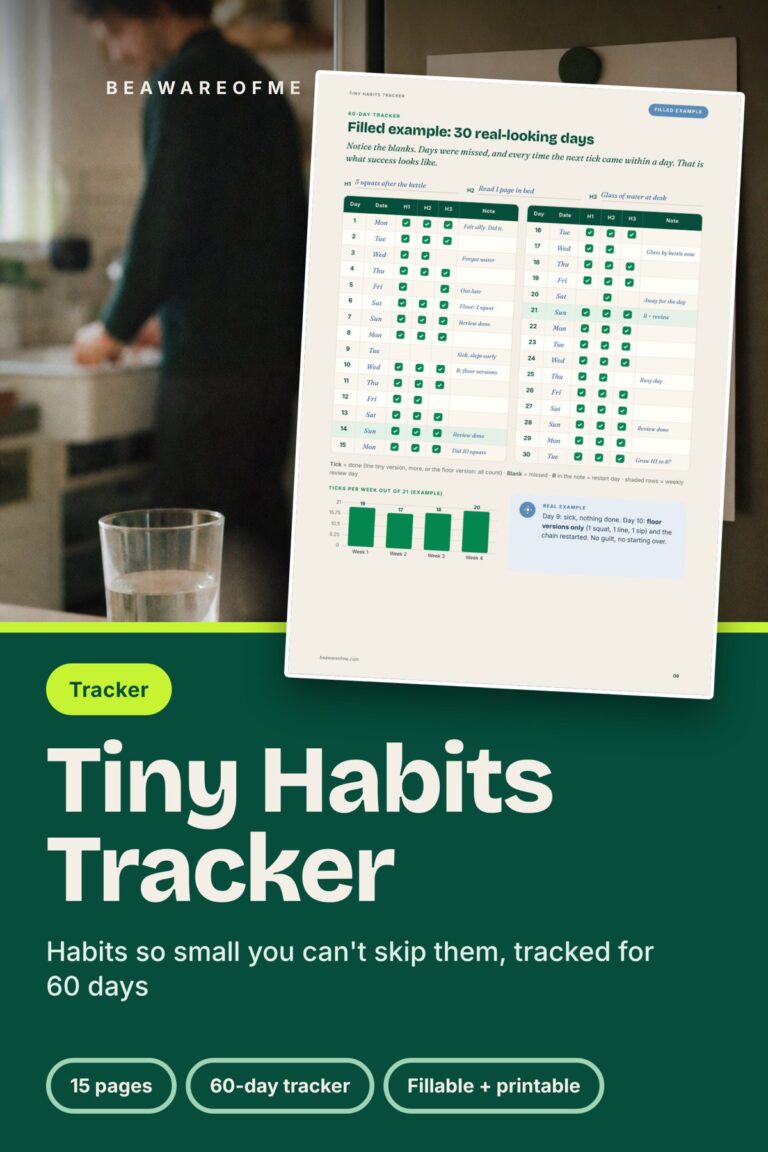




You sat down to fix one small thing, and suddenly it’s dark outside, your coffee is cold and you haven’t eaten since breakfast. Hours vanished, and part of you feels proud while another part feels wrecked. That pull is ADHD hyperfocus, and it can be both your best tool and your fastest route to exhaustion. This guide shows you how to keep the good parts and protect your mood, body and relationships from the rest.
The short answer
To manage ADHD hyperfocus, plan your exit before you start. Set a loud external alarm, decide your stopping point and keep water and a snack within reach. Notice your personal triggers, such as new projects or games late at night, and save them for times you can afford to lose track. After a long session, take a slow transition break before switching tasks. Aim the focus at work that matters, and talk to your doctor if it seriously affects daily life.
Key takeaways
Set an external alarm and a written stopping point before any task that tends to swallow your time.
Keep water, a snack and your phone charger nearby so long sessions don’t drain your body.
Avoid starting high-pull activities, like games or new projects, within two hours of bedtime.
Take a 5-minute transition break after deep focus instead of jumping straight into the next task.
Tell the people around you how to interrupt you kindly, and agree on a signal in advance.
Schedule your most engaging tasks in 90-minute blocks so hyperfocus works for you, not against you.
What ADHD Hyperfocus Is, and Why It Feels So Good
ADHD hyperfocus is a state of intense, absorbed concentration where everything outside the task fades away. Time seems to disappear. Hunger, messages and even the need for the bathroom can go unnoticed for hours.

It can seem strange, since ADHD (attention deficit hyperactivity disorder) is known for distraction. But ADHD isn’t really a lack of attention. It’s trouble steering attention, so focus can swing from scattered to locked-in depending on how interesting the task feels.
Not an official symptom, but very common
Understood notes that hyperfocus isn’t an official ADHD symptom, yet it’s an incredibly common experience. You won’t find it in the diagnostic checklist. You will hear about it from almost anyone who lives with ADHD.
Why your brain grabs on so tightly
Tasks that feel new, urgent, creative or rewarding tend to trigger ADHD hyperfocus most. Once you’re in, stopping feels physically uncomfortable, a bit like waking from a deep dream. That’s why “just stop when the timer goes” rarely works on its own.
15.5M
U.S. adults reported a current ADHD diagnosis, about 6.0% of adults.
Source: CDC MMWR
Up to 70%
of adults with ADHD have sleep problems, which late-night focus can worsen.
Source: NIMH
Not listed
Hyperfocus isn’t an official ADHD symptom, though it’s very common.
Source: Understood
You’re far from alone in this. A CDC report estimated that about 1 in 16 U.S. adults has a current ADHD diagnosis, and many of them know the hours-vanishing feeling well.
📝 Note
Hyperfocus also shows up in other people, including autistic adults and people without any diagnosis. This guide focuses on ADHD hyperfocus and offers practical self-help, not a diagnosis.
Superpower or Trap? The Real Mental Health Trade-Off
Hyperfocus is neither good nor bad; its effect depends on where it points and what it costs. Pointed at a deadline, ADHD hyperfocus can feel like a superpower. Pointed at an endless scroll at 1 am, it can wreck the next day.
The upside many people love
Deep focus can deliver bursts of creative work, finished projects and a real sense of accomplishment. For many adults with ADHD, it’s where their best ideas live. Feeling capable is good for mood, especially after years of hearing you can’t concentrate.
The hidden costs
The costs of ADHD hyperfocus often arrive later. Skipped meals, lost sleep and missed messages can stack up into stress, guilt and conflict with loved ones. Being pulled out suddenly can also trigger strong frustration or tears.
| Area | When it helps | When it hurts |
|---|---|---|
| Work | Finishes a big task in one sitting | Other urgent tasks get ignored |
| Mood | Pride and a sense of flow | Crash, guilt or irritability afterwards |
| Body | Feels energising at first | Skipped meals, dehydration, stiff back |
| Sleep | Daytime sessions cause no harm | Late-night sessions steal rest |
| Relationships | Shared projects feel exciting | Loved ones feel ignored or shut out |
A 4-question check: helpful or costly?
After any long session, ask yourself four quick questions. Your answers tell you whether that bout of ADHD hyperfocus helped you or cost you.
- Did I choose this task, or did it choose me?
- Did I eat, drink and move at least once?
- Did I miss anything important, like a call, a meal or a deadline?
- Will I still feel okay tomorrow morning?
Three or four yes answers to the helpful side means the session worked. If most answers point to costs, that’s useful data, not a failure. Adjust one guardrail next time and check again.
“The goal isn’t to switch hyperfocus off. It’s to give it a doorway in and a doorway out.”
If deep focus often leads to a crash later in the week, read our guide on how to avoid ADHD burnout. The two patterns often feed each other.
Map Your Triggers So Hyperfocus Stops Ambushing You
You can’t manage something you don’t see coming, so the first job is learning your personal triggers. Most people have three to five reliable ADHD hyperfocus triggers. Once you know them, you can decide when to let them in.
A one-week trigger log
For seven days, jot down every time you lose track of time. Note what you were doing, when it started, how long it lasted and how you felt after. Keep it rough, a note on your phone is fine.
- What: the activity, such as coding, research, a game or reorganising a cupboard.
- When: the time of day you started.
- How long: your best guess at the length.
- After: one word for how you felt, like proud, drained, guilty or calm.
Common triggers worth watching
Every brain differs, but some activities spark ADHD hyperfocus for a lot of people. See which of these sound familiar.
- Starting a brand-new project or hobby.
- Video games, especially ones with levels or streaks.
- Research rabbit holes, like reading reviews before a purchase.
- Creative work such as writing, drawing, music or coding.
- A deadline that suddenly feels close and real.
Read the pattern
At the end of the week, look for repeats. Many people notice that evening sessions leave them drained, while morning ones feel good. Others find that new projects pull hardest, while familiar tasks rarely do.
Now sort your triggers into two groups. Helpful triggers are worth scheduling on purpose. Risky triggers need guardrails, such as a time limit or a rule about when you start them.
✨ Quick win
Pick your single riskiest trigger from the log. Write one rule for it today, such as “No new video game levels after 9 pm.” One rule beats ten intentions.
Build an Exit Ramp for ADHD Hyperfocus Before You Start
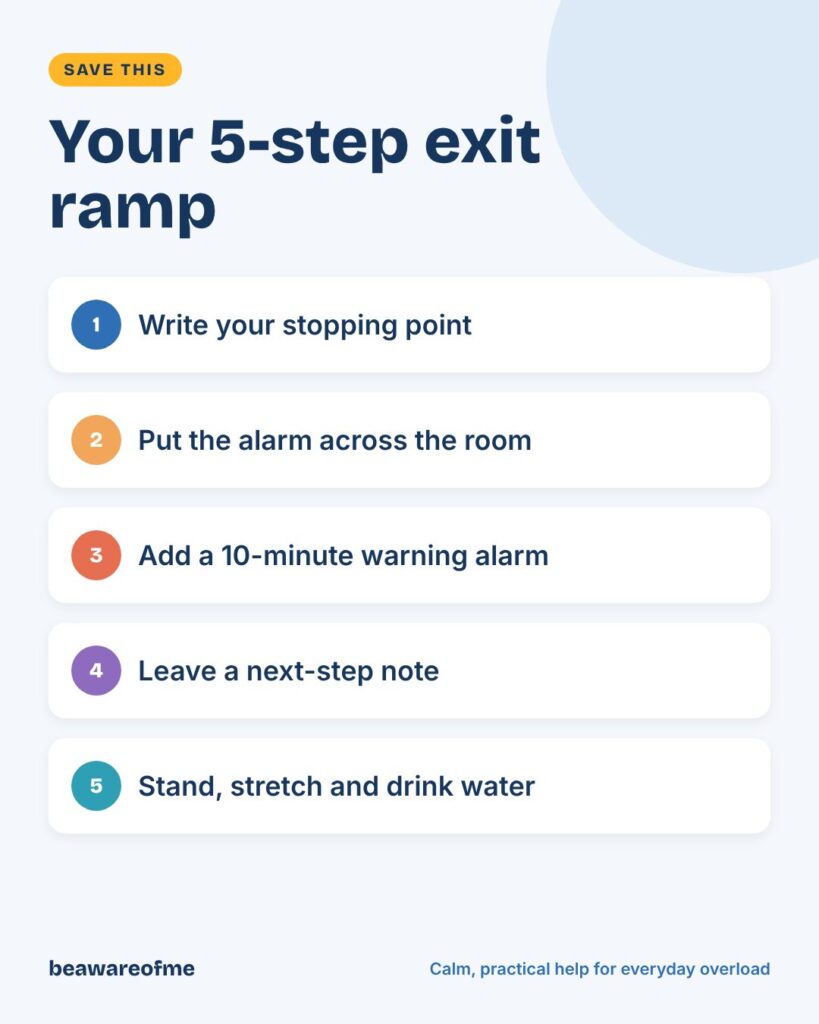
The easiest moment to manage ADHD hyperfocus is before it begins, because once you’re deep in, your brain resists every interruption. An exit ramp is a set of decisions you make in advance. It does the stopping for you.
Write your stopping point
Decide what “done for now” means: a time, a page number or a finished section. Write it on a sticky note and put it where you can see it.
Set an alarm across the room
Phone alarms in your hand are easy to swipe away. Put the alarm where you must stand up to turn it off.
Add a warning alarm
Set a second alarm 10 minutes earlier. It gives your brain time to wind down instead of being yanked out.
Leave a breadcrumb
Before you stop, write one line about your next step. It makes stopping easier because you know you can pick up quickly.
Stand and reset
Once the alarm goes, stand up, stretch and drink water before deciding anything else.
Use external cues, not willpower
Visual timers, smart speakers and a friend’s check-in all work better than promising yourself to stop. Understood suggests asking someone to remind you when it’s time to stop. Our roundup of apps that cut screen time and boost focus includes tools with gentle cut-off features.
💡 Tip
If you keep ignoring alarms, change the sound every week. ADHD brains tune out familiar noises fast, and a new tone often cuts through again.
Protect Your Body During Long Focus Sessions
Your body pays for long ADHD hyperfocus sessions first, so give it a simple support kit before you start. Skipped meals and dehydration can leave you shaky, irritable and foggy. That crash is easy to mistake for a mood problem.
The focus station kit
Try this today
Set up before any long session
A full water bottle on your desk, not in the kitchen.
A simple snack, like nuts, fruit or crackers.
Your phone charger plugged in, so a dead phone isn’t the alarm.
A cushion or footrest so your back doesn’t seize up.
One bathroom break scheduled at the halfway point.
The 50-minute body check
Every 50 minutes or so, do a 60-second scan. Unclench your jaw, roll your shoulders and drink a few sips of water. Ask yourself three questions: Am I hungry? Do I need the bathroom? Am I cold or stiff?
If the answer to any question is yes, deal with it now. It takes two minutes. Ignoring it usually costs much more later, when the headache or irritability arrives.
Guard your sleep
Late-night sessions are where ADHD hyperfocus hurts most. NIMH notes that up to 70% of adults with ADHD have sleep problems. Try a firm rule: no high-pull activities within two hours of bed. If staying up late feels like the only time that’s yours, our guide on revenge bedtime procrastination may help.
Soften the Crash After a Deep Focus Session
Coming out of ADHD hyperfocus can feel like jet lag: foggy, flat and oddly emotional. That dip is normal. A short transition routine helps your brain shift gears without a spiral.
The 5-minute landing routine
- Stand up and move for one minute, such as a walk to the window.
- Drink a glass of water and eat something small.
- Breathe in for four counts and out for six, five times.
- Check the clock and say the time out loud, to reset your sense of the day.
- Look at your list and pick one next step, not five.
If slow breathing helps, the free Box Breathing Coach guides you through a calm two-minute rhythm.
When someone interrupts you
Being pulled out of ADHD hyperfocus suddenly can spark real frustration. It isn’t rudeness; it’s a jolt. Agree on a gentle interruption signal in advance with the people you live or work with, like a tap on the desk or a written note.
💬 Scripts for calm transitions
To yourself: “I’m not losing this. My breadcrumb note will bring me back.”
To a partner: “Give me two minutes to save my place, then I’m all yours.”
To a colleague: “I’m deep in something. Can I come to you in 15 minutes?”
After a snap: “Sorry, that was the switch, not you. Let’s try again.”
Watch the guilt loop
Many people feel guilty after hours of focus on the “wrong” thing. Guilt rarely fixes anything. Instead, note what happened in your trigger log and adjust one guardrail. Our mental health tips for people with ADHD include ways to quiet that harsh inner voice.
Point Your Focus at What Actually Matters
The smartest way to handle ADHD hyperfocus is to aim it, not fight it. When you plan your most absorbing work for the right time, deep focus becomes a tool you can use on purpose.
Schedule focus blocks of 90 minutes or less
Plan your most demanding or creative tasks in blocks of up to 90 minutes, then take a 15-minute break. Put these blocks at the time of day your log shows you focus best. For many people, that’s late morning.
Make dull tasks more hyperfocus-friendly
Boring tasks rarely trigger ADHD hyperfocus, but you can borrow some of the pull. Add novelty, such as a new location or music. Add urgency with a short timer. Add reward by pairing the task with something you like, such as a favourite drink.
| Ingredient | How to add it | Example |
|---|---|---|
| Novelty | Change place or tools | Do admin at a cafe with a new pen |
| Urgency | Race a short timer | Clear the inbox in 20 minutes |
| Interest | Turn it into a game | Score each finished task with a point |
| Reward | Pair with a treat | Favourite playlist only during filing |
For more systems that make dull tasks easier, see our guide on staying organized with ADHD.
Give yourself a weekly free-focus window
Plan one or two longer windows each week where ADHD hyperfocus can run freely, such as a Saturday morning. Clear the calendar, prepare your focus station and let yourself go deep. Knowing this window exists makes it easier to stop on busy weekdays, because the project isn’t gone, just waiting.
💡 Tip
Avoid starting a high-pull task when you don’t have time to finish a sensible chunk. If you have 20 minutes before a meeting, choose a short, low-pull task instead.
Hyperfocus, Relationships and Getting the Right Support
ADHD hyperfocus affects the people around you, so a little communication goes a long way. Loved ones may feel ignored when you vanish into a project. Explaining what’s happening, and how to reach you, lowers tension on both sides.
Talk about it before it happens
Pick a calm moment to explain hyperfocus to a partner, friend or housemate. Share your signal for interruptions and your promise in return, such as checking in every two hours. Make it a team plan, not a confession.
At work, a simple “focus time” status in your calendar helps colleagues know when to message and when to wait. Our guide on managing ADHD in high-stress jobs has more ideas for busy workplaces.
Explain it in one simple sentence
If you’re not sure how to start the conversation, try this: “When I’m in ADHD hyperfocus, I genuinely don’t notice time, so a tap on the shoulder helps more than a shout from the other room.” It’s honest, specific and gives the other person something to do.
When to ask a professional
If ADHD hyperfocus regularly costs you sleep, meals, work or relationships, talk to your doctor. An ADHD coach or therapist can help you build stronger exit habits. If you take ADHD medication and notice changes in how focus feels, talk to your doctor or pharmacist. Our guide on how ADHD medication can affect mental health covers what to track.
For a wider set of tools, explore our mental health strategies for adults with ADHD or browse more mental health guides.
5 Hyperfocus Mistakes That Leave You Drained
These ADHD hyperfocus mistakes feel sensible, which is why they’re so common. Each one turns a useful state into a costly one. Here’s what to do instead.
1. Trying to ban hyperfocus completely
Strict rules like “no more deep dives” usually fail and add shame. ADHD hyperfocus is part of how your brain works. Instead, decide where it’s allowed, such as weekend mornings or focus blocks, and enjoy it there.
2. Relying on a phone alarm in your hand
A silent swipe takes half a second, and you won’t remember doing it. Put the alarm across the room, use a smart speaker or ask someone to check in. Physical distance makes the stop real.
3. Jumping straight into the next task
Switching from deep focus to email in one move often causes irritability and mistakes. Your brain needs a short landing. Take five minutes to move, drink and breathe before you begin anything new.
4. Starting tempting tasks late at night
A quick look at a new project at 11 pm can run until 3 am. That lost sleep hits mood, patience and focus the next day. Keep a two-hour buffer before bed for low-pull activities only.
5. Judging the session by output alone
You might finish a huge task and still feel awful, because you skipped food and sleep. Judge a session by how you feel the next day too. A good session leaves you proud and still functioning.
Hyperfocus Questions People Often Ask
Is hyperfocus a sign of ADHD?
Hyperfocus is very common in ADHD, but it isn’t an official symptom and doesn’t prove that someone has ADHD. Many people without ADHD experience deep focus too, and autistic adults often describe it as well. If you’re wondering about ADHD, look at the wider pattern of attention and daily challenges, and talk to your doctor about a proper assessment.
What triggers ADHD hyperfocus?
Common triggers include new projects, creative work, video games, research rabbit holes and tasks with urgent deadlines. Anything that feels rewarding, novel or high-stakes tends to pull hardest. Triggers vary from person to person, so a one-week log of when you lose track of time is the best way to find yours and plan guardrails around them.
How do you break out of hyperfocus?
Plan the exit before you start. Write a stopping point, set a warning alarm 10 minutes early and place the main alarm across the room. When it rings, stand up, stretch and drink water before deciding anything. Leaving a one-line note about your next step makes stopping easier, because you know you can pick up again quickly.
Can hyperfocus cause burnout?
It can contribute. Long sessions often come with skipped meals, lost sleep and ignored tasks, and those costs can build into exhaustion over time. Many people with ADHD notice a cycle of intense focus followed by a crash. Ending sessions at a set time, protecting sleep and planning recovery help keep deep focus from turning into burnout.
Is hyperfocus the same as hyperfixation?
The terms often get used interchangeably, but some writers draw a line between them. Hyperfocus usually means short, task-driven deep concentration. Hyperfixation often describes a longer, recurring intense interest in a topic or hobby, sometimes used to avoid other tasks. Both can be helpful or costly depending on timing, and similar guardrails work for each.
Why do I feel irritable when interrupted?
Being pulled out of deep focus can feel like a sudden jolt, and your brain needs a moment to shift gears. That jolt can come out as frustration, even toward people you love. Agreeing on a gentle interruption signal, asking for two minutes to save your place and using a short landing routine can make transitions much calmer.
ADHD hyperfocus doesn’t need to be fought; it needs a doorway in and a doorway out. Start with one trigger, one exit ramp and one landing routine this week. With a few guardrails, ADHD hyperfocus can become a tool you reach for on purpose rather than a tide that pulls you under.
A gentle note
Educational content, not a substitute for professional care. If you are struggling, talk to a doctor or a qualified professional. If you are thinking about harming yourself, contact local emergency services or a crisis line now (US 988, UK and Ireland Samaritans 116 123, or findahelpline.com).