
A lunch break reset is the simplest daily habit for anyone whose afternoons feel heavier than their mornings: 20 minutes, four moves, and a clear line between the work you did and the work that is left. If you usually eat at your keyboard, scroll through your break, or skip it to “catch up”, this guide gives you a plan you can use today, a version for 10-minute breaks, exact words for protecting the time, and a five-day experiment to find what actually works for you.
- Leaving your desk matters more than what you eat, because the goal is mental distance from work.
- A 15-minute walk outside or a short relaxation routine at lunch was linked to better afternoon focus in a two-week workplace trial.
- Scrolling feels like rest but usually keeps your brain in input mode, so keep the phone in your pocket for at least half the break.
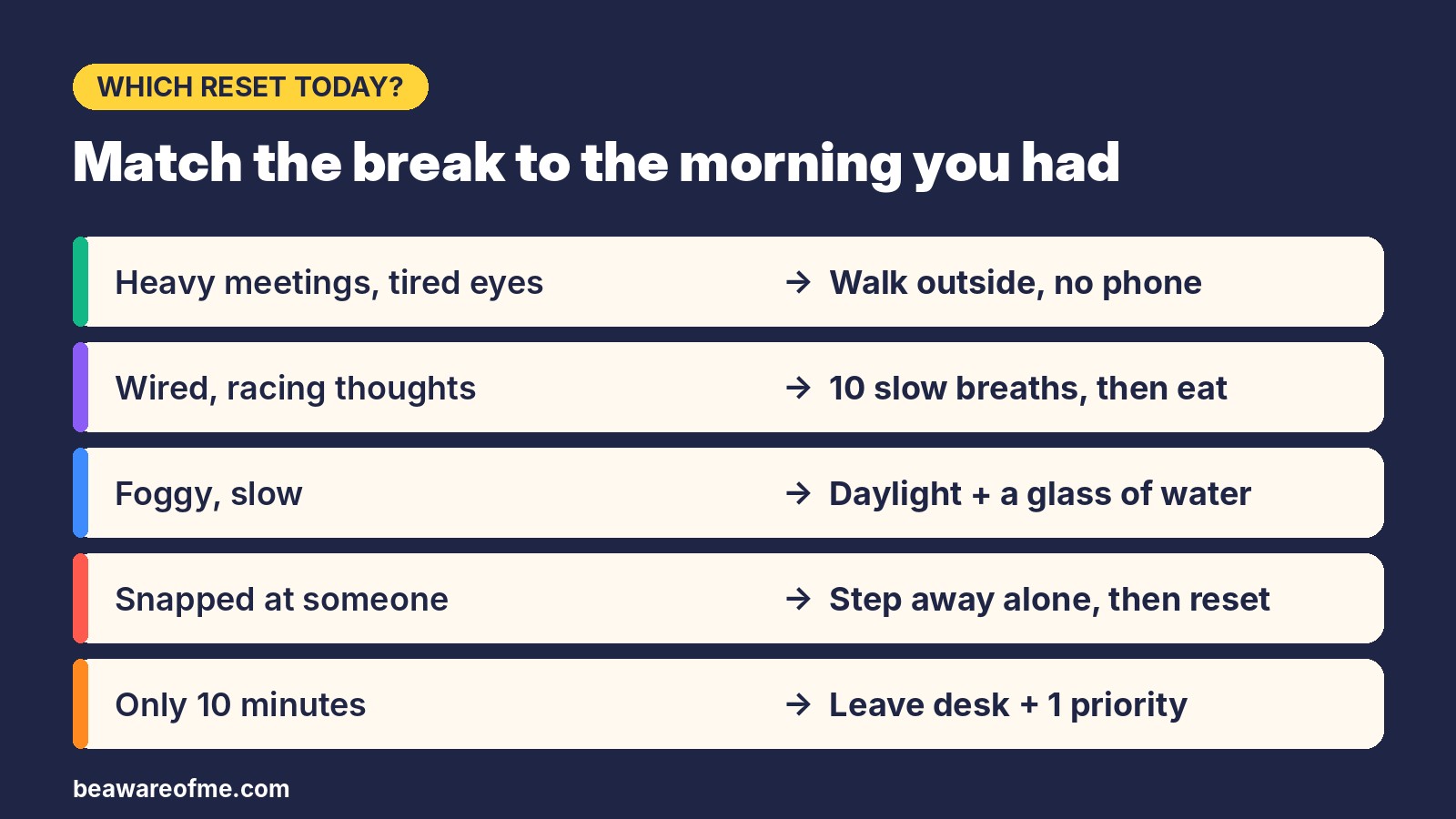
- Match the reset to your morning: walk after screen-heavy mornings, breathe slowly after tense ones.
- End every break by writing one afternoon priority, so you walk back in with a plan instead of a pile.
Why a Lunch Break Reset Beats Powering Through
This section covers what research says about lunch breaks and why the usual “I’ll just eat while I answer emails” habit backfires. The short version: your brain does not recover from work while it is still doing work, even light work.
Researchers at the University of Tampere ran two randomized trials with 153 knowledge workers who spent 15 minutes of every lunch break, for ten working days, either walking in a nearby park or doing guided relaxation exercises. Compared with their normal breaks, both activities were linked to better concentration in the afternoon and less fatigue at the end of the day. The park walkers seemed to benefit mostly because they enjoyed the break more; the relaxation group benefited because they detached from work more. You can read a plain-language summary of the trial from the Greater Good Science Center at UC Berkeley.
A separate 2022 meta-analysis in PLOS ONE pooled studies on micro-breaks (breaks of 10 minutes or less). Short breaks gave a small but real lift in vigor and a small drop in fatigue. Their effect on performance was smaller and mostly showed up on less demanding tasks, and longer breaks helped performance more. The authors suggested that recovering from very draining work probably needs more than 10 minutes. That is exactly what lunch is for.
Here is the part most advice skips: a break only counts if your mind leaves the work too. Reading work messages on your phone at the café is still work. So is replaying the morning’s meeting while you eat. If you already notice that you keep thinking about work on weekends, the lunch break is the smallest daily place to practise switching off, and it gets easier with repetition.

The 20-Minute Lunch Break Reset, Step by Step
This section gives you the full routine with timings. Set a phone timer for 20 minutes when you stand up, then follow the four moves in order. You don’t need a park, an app or a perfect day.
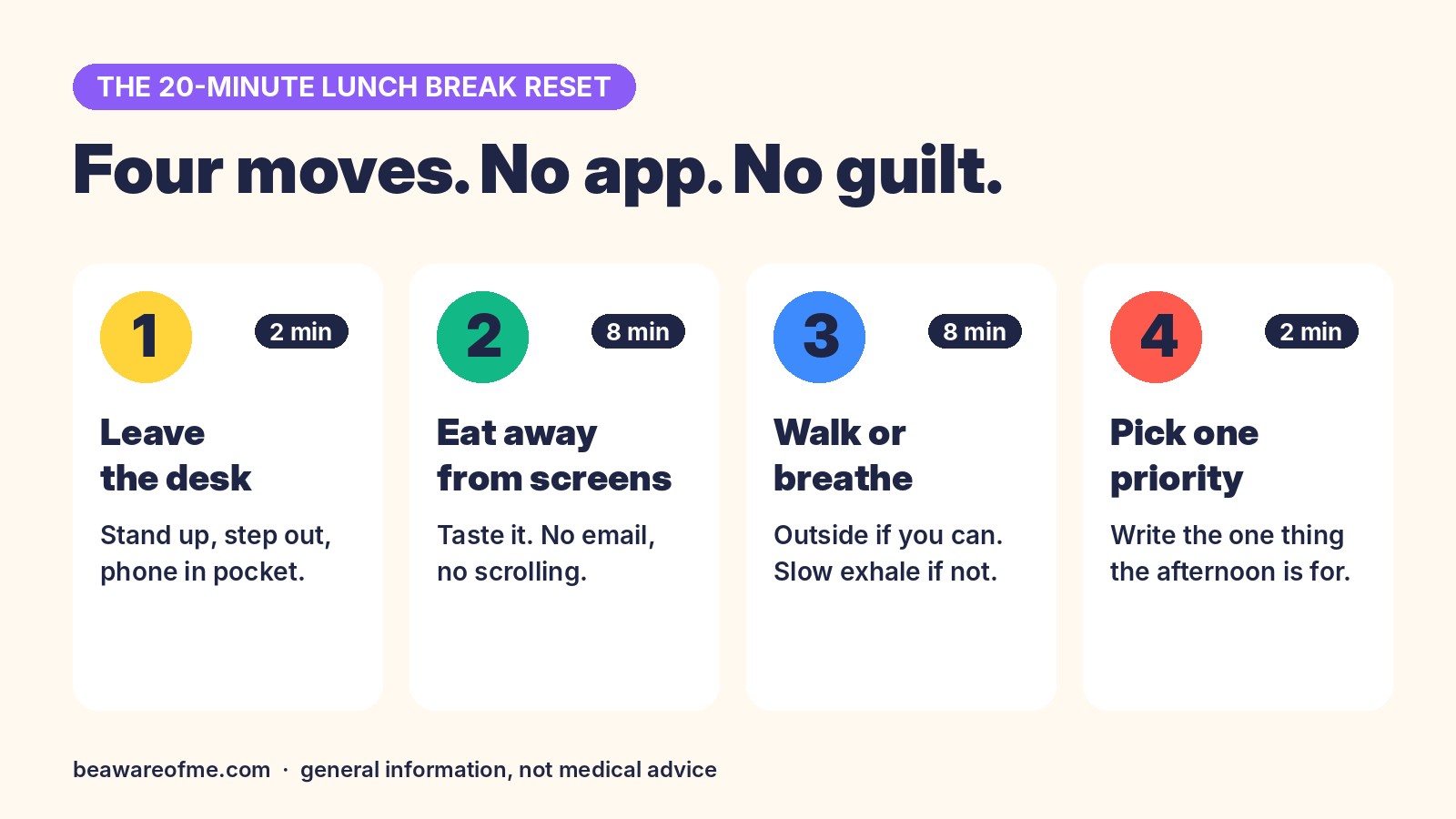
Why this order? Leaving first creates distance. Eating second deals with the most basic need, because low blood sugar makes everything feel harder. Moving or breathing third gives your nervous system a chance to settle. The priority comes last so the break ends with a decision, not a drift. Most people do these in reverse: they plan, then eat at the desk, then never move.
What if you hate walking, or the weather is awful? Swap the outdoor walk for anything that moves your body gently and changes what your eyes are doing: climbing two flights of stairs slowly, stretching by a window, refilling your water at the far end of the building. The point is a change of pace and view, not exercise. Likewise, if slow breathing makes you feel more anxious rather than calmer, drop it and just sit somewhere quiet with your eyes resting on something far away. A lunch break reset should feel like relief, not another task you are failing at.
Which Lunch Break Reset Fits Today?
This section helps you choose, because not every morning needs the same break. A screen-heavy morning and a conflict-heavy morning tire you out in different ways, so the most useful reset is different too.
If you aren’t sure how you feel, use the energy question instead: what drained you this morning, people, screens or pressure? Our free “How empty is your battery?” check takes about two minutes and shows which part of life drains you most, which makes this choice much easier.
How to Reset on a 10-Minute or Desk-Bound Lunch Break
This section is for the days when 20 minutes is a fantasy: shift work, back-to-back calls, a desk you can’t leave, or caring duties at lunch. A shorter break still helps if it is a real break.
☐ Phone face-down or in a drawer
☐ Eat with both hands free, no screen in sight
☐ 6 slow breaths, out-breath longer than in-breath
☐ Stand, roll shoulders, look out of a window for 30 seconds
☐ Write one afternoon priority on a sticky note
At your desk, the biggest enemy is the glowing rectangle. Covering or closing it matters because a visible inbox keeps pulling your attention, even when you aren’t reading it. If your job means you can’t leave, turning your chair to face a different direction is a small but surprisingly useful signal. For more ideas you can use any time of day, see our guide to micro-breaks that keep work calm.
For shift workers, “lunch” might be at 2am. The same rules apply: leave the workstation if allowed, eat without a screen, move or breathe, set one priority for the rest of the shift. The time on the clock matters far less than the separation.

How to Protect Your Lunch Break Without Making It Awkward
This section gives you exact words, because the hardest part of a lunch break is often other people: the colleague who drops by, the meeting booked at 12:30, the manager who messages “quick question”. Calm, boring wording works best.
Notice what these scripts don’t do: they don’t apologise, explain your wellbeing, or ask permission. They offer a specific alternative time, which is what makes them easy to accept. The same skill helps you stop checking work emails after hours, and it gets easier each time you use it.
If your workplace makes lunch genuinely impossible most days, that is useful information. Write down how often it happens for two weeks. A pattern on paper is much easier to raise with a manager than a vague feeling of being stretched.
The Afternoon Handover: Coming Back Without the 2pm Crash
This section covers the five minutes after lunch, which decide whether the reset carries into the afternoon. Many people do a good break, then lose it by opening every app at once.
- Start with the sticky note. Open only what you need for your one priority. Email can wait 30 minutes.
- Drink water before more coffee. Many people feel the post-lunch dip and reach for caffeine; water and a short walk to refill it are a gentler first step.
- Use light. Sit near a window or step into daylight for a minute if your afternoon tends to feel foggy.
- Batch the noise. Check messages at set times (for example 2:00 and 4:00) instead of every time they arrive.
- Plan the end of the day too. A good lunch break pairs well with a short evening buffer. Our 20-minute after-work decompression routine uses the same idea at 6pm.
If the afternoon fog is heavy and frequent, it’s worth reading about what brain fog feels like and when to mention it to a doctor. A lunch routine helps everyday tiredness; it isn’t a fix for everything.
One more habit makes a real difference: decide what you will do at lunch before lunch arrives. At 11:30, take ten seconds to choose: walk, breathe, or eat with someone. Deciding in advance removes the moment of hesitation at 12:30, which is exactly when an email arrives and the break quietly disappears. When the choice is already made, there is less room for the inbox to win.

Try It for 5 Days: A Simple Lunch Break Experiment
This section turns the routine into a small experiment, because the best reset is the one you can see working. For five working days, do the lunch break reset and rate your afternoon at 4pm on two numbers from 1 to 5.
| Day | Lunch plan | Afternoon focus | Energy at 4pm |
|---|---|---|---|
| Mon | Full 20-minute reset, walk outside | __ / 5 | __ / 5 |
| Tue | Full reset, breathing instead of walking | __ / 5 | __ / 5 |
| Wed | 10-minute version only | __ / 5 | __ / 5 |
| Thu | Your choice from the table above | __ / 5 | __ / 5 |
| Fri | Lunch with someone, no work talk | __ / 5 | __ / 5 |
On Friday afternoon, look at the numbers. Most people find one or two versions clearly beat the others. Keep those, drop the rest. You aren’t aiming for a perfect lunch every day, just a reliable default for most days.
Common Mistakes With Lunch Breaks (Even When You Know the Basics)
This section covers the traps that catch people who already know breaks matter. Each one has a simple fix.
1. Scrolling and calling it rest
Social feeds, news and short videos keep your brain taking in information, which is a lot like work for an already busy mind. Many people come back more tired than they left. Keep the phone away for at least the walking or breathing part. If scrolling has become automatic, our guide on how to stop doomscrolling has six steps that help during the day too.
2. Eating at the desk “to save time”
You rarely save time: the afternoon slows down instead. Food at the keyboard also means no change of place, which is the cue that helps you switch off. Even five minutes at a different table is better than twenty at your desk.
3. Talking shop all lunch
Lunch with colleagues is great for connection, but an hour of venting about the project keeps you inside it. Agree on a rule: the first ten minutes are about anything except work. You’ll still bond, and you’ll actually rest.
4. Waiting until you “deserve” a break
If the break depends on finishing something, it never comes on the busiest days, which are exactly the days you need it most. Tie the break to a time, not an achievement.
5. Only resting when you’re already exhausted
Running on empty until 3pm and then crashing isn’t a break pattern; it’s a warning light. If this sounds like most of your days, read about emotional exhaustion and consider talking to someone you trust or a professional.
Lunch Break Reset: Frequently Asked Questions
How long should a lunch break reset be?
About 20 minutes works well for most people: 2 minutes to leave your desk, 8 to eat away from screens, 8 to walk or breathe, and 2 to set one afternoon priority. If you only have 10 minutes, keep the two parts that matter most: leaving your work spot and eating without a screen. Research on micro-breaks suggests longer breaks help more after draining work.
Is it better to walk or rest during lunch?
Both can help, in slightly different ways. In a two-week workplace trial, 15-minute park walks were linked to more enjoyment of the break, while relaxation exercises were linked to switching off from work more. A practical rule: walk after screen-heavy or meeting-heavy mornings, and do quiet, slow breathing after tense or stressful ones. Either beats eating at your desk.
Is scrolling on my phone a real break?
Usually not a restful one. Scrolling keeps your mind taking in new information, so many people come back from a scrolling break feeling just as tired, or more distracted. Try keeping your phone in your pocket for at least the second half of your break. You can still check messages, just not for the whole break.
What should I do on my lunch break to feel less tired?
Leave your desk, eat a real meal away from screens, get some daylight and gentle movement, and drink water before reaching for more coffee. Then write down one priority for the afternoon so you return with a plan. If you feel exhausted most days despite rest and sleep, it is worth talking to a doctor.
How do I take a lunch break when I work from home?
Leave the room your laptop is in, close the lid, and eat somewhere else, ideally near a window. Put a recurring 20-minute block in your calendar and set your chat status to offline. Working from home blurs the edges of the day, so the physical change of place matters even more than in an office.
Can I say no to meetings at lunchtime?
Often, yes, especially if you offer a clear alternative. Try: “I keep 12:30 to 1 free most days. Could we do 1:15 or 11:30 instead?” Calm, specific wording is easy to accept. If lunch meetings happen almost every day, keep a two-week record and raise the pattern with your manager.
The Bottom Line
A lunch break reset is not a luxury: it’s twenty minutes that decide how your afternoon feels. Start tomorrow with the four moves and a timer, then run the five-day experiment to find your version. For the bigger picture, read our guide to recognizing burnout early or browse all of our workplace stress guides.
This article is general educational information for everyday life. It is not medical advice and not a substitute for professional care. If things feel heavy or unsafe, please reach out to a doctor, a mental-health professional or your local emergency services.
Sources: Sianoja M, Syrek CJ, de Bloom J, Korpela K, Kinnunen U. Enhancing daily well-being at work through lunchtime park walks and relaxation exercises: recovery experiences as mediators. Journal of Occupational Health Psychology, 2018. · de Bloom J et al. Effects of park walks and relaxation exercises during lunch breaks on recovery from job stress: two randomized controlled trials. Journal of Environmental Psychology, 2017. · Albulescu P et al. “Give me a break!” A systematic review and meta-analysis on the efficacy of micro-breaks for increasing well-being and performance. PLOS ONE, 2022.