



Some days your face sets into a frown before you’ve even had breakfast, and everything feels a little heavier. You’ve probably heard that a simple smile can fix that, and you’ve probably rolled your eyes. The truth sits in between: smiling is a small, real nudge, not a cure. This guide shows what the research actually says, when smiling helps, when it backfires and seven easy habits to try today.
🌱 Key Takeaways
What a Simple Smile Actually Does to Your Brain and Body
A simple smile sends a small signal from your face back to your brain, and that signal can tilt your mood slightly towards the positive. Scientists call this the facial feedback effect. It’s subtle, but it’s measurable, and it costs you nothing.
| What smiling does | What the evidence suggests | How to use it today |
|---|---|---|
| Nudges your mood | Posed smiles gave a modest happiness boost across 19 countries | Smile on purpose for 20 seconds when you feel flat |
| Softens short stress | Smiling during brief stressors linked to faster heart-rate recovery | Smile through a tricky task, then breathe out slowly |
| Warms conversations | Smiles signal friendliness and make people feel welcome | Smile first with neighbours, colleagues and cashiers |
| Can backfire when forced | Hiding real feelings behind a smile tends to drain you | Let your face match your mood with safe people |
| Not a treatment | The effect is too small to overcome conditions like depression | Seek support if low mood lingers |
The facial feedback effect in plain words
The facial feedback effect is the idea that your expressions don’t just show your feelings. They also shape them a little. When your cheeks lift and the corners of your mouth rise, your brain reads that as a hint that things might be okay.
Think of it like posture. Sitting up straight won’t solve a hard week, but slumping tends to make you feel worse. A simple smile works in a similar way: it’s a small input that pushes in a good direction.
Why a real smile feels different
A genuine smile, often called a Duchenne smile, uses the muscles around your eyes as well as your mouth. You can spot it by the little crinkles at the outer corners of the eyes. A polite, mouth-only smile uses fewer muscles and tends to feel flatter.
You don’t need to master the difference. Just let your eyes join in. Thinking of something you genuinely like, a pet, a friend’s laugh, a favourite song, usually brings your eyes along on its own.
📝 Note: A simple smile won’t erase sadness, anxiety or grief, and it isn’t meant to. Think of it as one small tool in your kit, next to sleep, movement, connection and support.
The Honest Science: How Much Can Smiling Really Shift Your Mood?
A simple smile can shift your mood a little, and the best recent evidence supports that, with clear limits. Most articles overstate this. Here’s what the bigger studies actually found.
3,878
people in 19 countries took part in a global study on posed smiles and mood.
Stanford University
169
adults took part in a lab study on smiling during short stressful tasks.
Association for Psychological Science
Modest
is the honest size of the mood boost: real, but not strong enough to overcome depression.
Stanford University
The 19-country smile study
A global collaboration led by a Stanford researcher tested facial feedback with 3,878 people across 19 countries. According to Stanford’s report on the study, people who copied photos of smiling faces, or pulled their lips back and lifted their cheeks, reported feeling happier.
The famous pen-in-mouth trick, though, didn’t work reliably. The lead researcher suggested that holding a pen may involve clenching your teeth, which a real smile doesn’t. He was also clear that the effect isn’t strong enough to overcome something like depression.
What “modest” means for your day
A modest effect is still useful. It means a simple smile can take the edge off a mildly flat moment. It won’t turn a terrible day into a great one. That’s a fair trade for something that takes three seconds and needs no equipment.
If you want more small, evidence-based lifts, our list of natural mood boosters pairs well with smiling.
A simple smile test you can run yourself
You don’t have to take anyone’s word for it. Try a tiny experiment for one week. Each afternoon, rate your mood from 1 to 10. Then hold a simple smile, eyes included, for 20 seconds while you think of something you like. Rate your mood again.
Some days you’ll notice a one-point lift. Other days, nothing. Both results are useful. You’ll learn when a simple smile helps you personally, which matters more than any average from a study. Many people find it works best on mildly flat days and barely at all on very hard ones.
💡 Tip: Combine your smile with something else that helps, like stepping outside, texting a friend or playing a song you love. Small lifts stack.
3 Surprising Ways Smiling Helps When You’re Stressed
A simple smile during a short stressful moment may help your body settle faster afterwards. It won’t remove stress, but it can make the recovery a little smoother.
1. Faster heart-rate recovery after a short stressor
In a study described by the Association for Psychological Science, 169 participants held chopsticks in their mouths to create neutral faces, standard smiles or full Duchenne smiles. They then did two stressful tasks, including tracing a star in a mirror with their non-dominant hand.
Those who smiled, especially with full smiles, had lower heart rates during recovery than the neutral group. Participants who smiled without knowing it also reported a smaller drop in positive mood. The researchers framed it as helpful “during brief stressors”, not as a cure for ongoing stress.
2. A built-in pause button
A simple smile on purpose gives you a tiny pause. That pause interrupts the rush of a stressful moment and gives you a second to choose your next move. It’s similar to taking one slow breath before answering a difficult message.
3. A gentler inner voice
Many people notice that it’s harder to be harsh with yourself while smiling softly. Try saying your inner critic’s line out loud with a gentle smile. It often sounds less convincing. For everyday stress beyond the face, our simple daily ways to manage stress and anxiety offer more options.
✨ Quick win: Next time you’re stuck in a queue or traffic, relax your jaw, let a soft smile form and breathe out slowly for four counts. Repeat three times.
How a Simple Smile Warms Up Your Everyday Connections
A simple smile is one of the quickest ways to signal “you’re welcome here” to another person. It lowers the social temperature, invites small talk and makes everyday encounters feel less lonely.
Small smiles, small connections
You don’t need deep conversations to feel connected. Brief, friendly moments with a neighbour, a bus driver or a shop assistant add up. A smile is usually the opening move. If you’ve been feeling cut off lately, our free loneliness self-check can help you see where you stand.
Smiling at work without performing
At work, a warm smile at the start of a meeting or a video call can make people more relaxed. That doesn’t mean grinning through every frustration. A genuine smile when you greet someone, and a neutral face when you’re focused, is perfectly normal.
Healthy connection also depends on honesty. Our guide to mental health and relationships explores how openness builds closer bonds than constant cheerfulness.
A smile script for awkward moments
When you walk into a room where you know nobody, try this: make eye contact, smile, and say “Hi, I’m new here. How do you know the host?” The smile does half the work. Most people relax and respond in kind.
Why smiles tend to be catching
People often mirror the expressions around them without thinking. When you offer a simple smile, the other person may smile back, and that shared moment can lift both of you a little. It’s one of the easiest ways to make a stranger’s day slightly better, and your own too.
This doesn’t mean you’re responsible for everyone’s mood. It just means a simple smile is a low-cost gift you can give freely when you have the energy. On days when you don’t, a nod or a kind word works fine.
A smile isn’t a mask. At its best, it’s a small, honest hello.
beawareofme
When Smiling Backfires: The Mask Nobody Talks About
Smiling backfires when you use it to hide what you really feel for long stretches. Constantly putting on a happy face, at work or at home, tends to drain energy and leave you feeling more alone.
Surface smiling versus real smiling
Surface smiling means showing a feeling you don’t have, often because a job or a family role expects it. Doing that all day can feel exhausting. Real smiling comes from a moment of genuine warmth, even a tiny one, and usually feels lighter.
Most advice about smiling gets this backwards. It tells you to smile more, full stop. A better rule: smile when there’s even a sliver of something good to smile at, and let yourself look tired or sad when you are.
If-then rules for honest smiling
- If you feel mildly flat, then try a gentle smile and a slow breath.
- If you feel sad, worried or overwhelmed, then let your face be honest and reach out to someone you trust.
- If you’re smiling through pain most days, then that’s a sign to talk to a doctor or a qualified professional.
- If someone tells you to “just smile”, then you’re allowed to say “I’m having a hard day, actually.”
If you notice you’re always running on empty behind a smile, our guide to emotional exhaustion explains the signs and first steps.
⚠️ Watch out: A smile is never a replacement for help. If low mood, anxiety or hopelessness lasts more than two weeks or gets in the way of daily life, please talk to a doctor or a qualified professional.
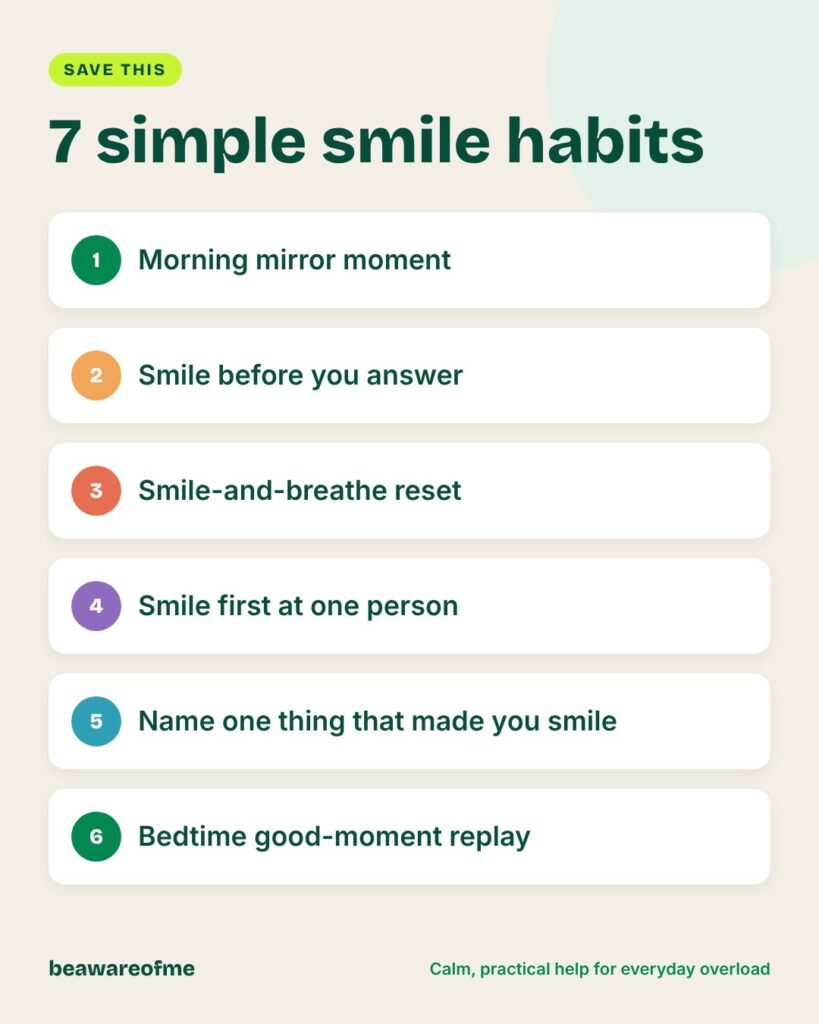
7 Simple Smile Habits for a Lighter Day
These simple smile habits each take under a minute and fit into an ordinary day. Pick two or three that suit you, rather than trying them all at once.
Morning mirror moment
While brushing your teeth, give yourself one soft, real smile and a kind word.
Smile before you answer
Let a small smile form before you pick up a call. People can often hear it in your voice.
Photo prompt
Keep one photo that always makes you smile as your phone lock screen.
Smile-and-breathe reset
Relax your jaw, smile gently, breathe in for 4 and out for 6. Repeat three times.
First-smile rule
Smile first at one person each day: a neighbour, a colleague or a cashier.
Gratitude grin
At dinner, name one thing from the day that made you smile, even a tiny one.
Bedtime replay
Before sleep, replay one good moment and notice whether your face softens.
Why tiny habits beat big promises
Small habits tied to things you already do, like brushing your teeth or eating dinner, are far easier to keep. A simple smile attached to an existing routine needs no willpower. It just happens because the routine reminds you.
The gratitude grin works especially well alongside a written practice. Our step-by-step guide on how to start a gratitude diary shows how to make it stick in five minutes a day.
Make your environment smile-friendly
Your surroundings shape your face more than you think. A funny note on the fridge, a plant on your desk or a playlist of songs you love can all prompt a simple smile without any effort. Change one small thing in the room where you spend the most time.
A simple smile for each part of the day
Morning: a simple smile in the mirror. Midday: a smile and a breath before lunch. Afternoon: a smile at one colleague or neighbour. Evening: a smile as you name one good moment. Four tiny touchpoints, under two minutes in total, spread gently across your day.
🧭 Try this: Set a phone reminder for 3pm that just says “Look up and smile.” Mid-afternoon is when many people’s energy dips, so it’s a good time for a tiny lift.
A 5-Minute Smile Plan for Hard Days
On hard days, a simple smile works best as part of a short, kind routine, not as a demand to cheer up. This plan gives you something gentle to do when everything feels heavy.
Start with your body, not your face
Unclench your jaw. Drop your shoulders. Take three slow breaths, making each out-breath longer than the in-breath. Only then let a simple smile form, even a lopsided one. Your face follows your body more easily than the other way round.
Add one small thing to smile about
Look for one tiny, real thing: warm tea, a soft blanket, a message from a friend. You’re not pretending the day is good. You’re noticing that it contains at least one good thing. That’s a very different, much kinder, request.
If hard days are piling up, our self-care tips for low moods offer more gentle steps for heavier stretches.
🧭 Try this today: your 5-minute smile reset
☐ Unclench your jaw and drop your shoulders.
☐ Take three slow breaths, longer on the way out.
☐ Let a small, soft smile form, eyes included.
☐ Name one tiny good thing in front of you right now.
☐ Send a short, friendly message to one person.
5 Common Smile Mistakes That Quietly Drain Your Mood
A simple smile sounds easy, but a few common habits can turn it from a helpful nudge into extra pressure. Watch for these.
1. Using a smile to hide real distress
Masking pain behind a cheerful face can keep people from noticing you need support. It can also make you feel lonelier. Let at least one trusted person see how you really are.
2. Expecting a smile to fix a bad day
When a smile doesn’t transform your mood, you might decide it “doesn’t work” and feel worse. Expect a small lift, not a rescue. Small lifts still count.
3. Clenching instead of smiling
A tight, teeth-gritted grin isn’t the same as a relaxed smile, and research on the pen-in-mouth method hints that clenching may cancel out the benefit. Soften your jaw first.
4. Telling others to smile
Telling someone to “cheer up” or “smile more” often feels dismissive. If you want to help, smile at them warmly yourself and ask how they’re doing. Then listen.
5. Only smiling at other people
Many of us smile at friends and strangers but never at ourselves. A soft smile during self-talk can make your inner voice kinder. Try it the next time you make a small mistake.
📚 Keep reading
FAQ: 6 Things People Ask About Smiling and Mood
Does smiling really make you happier?
Smiling can make you a little happier. A large study with 3,878 people in 19 countries found that posing a smile gave a modest boost in reported happiness. The effect is real but small, so think of a smile as a gentle nudge rather than a fix. It works best alongside other healthy habits like movement, rest and time with people you like.
Can a fake smile reduce stress?
A posed smile may help a little during short stressful moments. In one lab study, people who smiled while doing brief stressful tasks had lower heart rates during recovery than people with neutral faces. That doesn’t mean forcing a smile all day is healthy. Long-term masking of real feelings tends to be draining rather than calming, so use it lightly.
What is a Duchenne smile?
A Duchenne smile is a genuine smile that uses the muscles around your eyes as well as your mouth. You can usually spot it by the small crinkles at the outer corners of the eyes. It’s linked with real warmth and enjoyment. Thinking of someone or something you genuinely love is the easiest way to bring your eyes into the smile naturally.
Is it bad to smile when you feel sad?
It isn’t bad to smile now and then when you feel sad, especially at something genuinely kind or funny. It becomes unhelpful when you use smiles to hide pain for long periods or to stop people noticing you’re struggling. Let your face be honest with people you trust, and reach out for support if sadness lingers or deepens.
Why does smiling at strangers feel good?
Smiling at strangers signals friendliness and openness, and people often smile back. These small, positive moments can make you feel more connected and less alone in your day. Brief friendly exchanges with neighbours, colleagues or shop staff add up over time. They’re an easy, low-pressure way to feel part of your community without needing long conversations.
Can smiling help with depression?
Smiling isn’t a treatment for depression. The lead researcher behind a large smile study said the effect isn’t strong enough to overcome something like depression. A smile can still be a small comfort on some days. If low mood, loss of interest or hopelessness lasts more than two weeks, please talk to a doctor or a qualified mental health professional.
You don’t have to smile your way through every hard moment, and you shouldn’t. But on ordinary days, a simple smile, shared with yourself or someone nearby, is a small, honest kindness that can make the next hour a little lighter.
📝 Please note: Educational content, not a substitute for professional care. If you are struggling, talk to a doctor or a qualified professional. If you are thinking about harming yourself, contact local emergency services or a crisis line now (US 988, UK and Ireland Samaritans 116 123, or findahelpline.com).