






If your child melts down before school, stalls at bedtime, or asks “what’s happening next?” ten times a day, you already know how tiring worry can be for the whole family. A calming routine gives an anxious child something steady to hold onto when their mind feels busy. This guide shows you how to build one step by step, from mornings to lights out, with scripts, a sample timetable and fixes for the days it falls apart.
A calming routine for kids with anxiety is a short, predictable pattern of daily anchors: the same wake-up, meals, after-school reset, wind-down and bedtime, in the same order. It works because anxious children feel safer when they can predict what comes next. Keep it simple, use a picture or written schedule, add one calming skill such as slow breathing, warn your child before changes, and stay consistent for at least two to three weeks.
- ✓Pick four or five daily anchors, such as wake-up, after-school snack, homework start, bath and lights out, and keep them in the same order every day.
- ✓Show the calming routine on a picture or written chart so your child can check it instead of asking you over and over.
- ✓Build one 10-minute reset into every afternoon, because the hour after school is when many anxious kids feel most overloaded.
- ✓Practise one calming skill, like slow belly breathing, at calm times first so your child can actually use it when worry spikes.
- ✓Give a five-minute warning before every transition and a day’s notice for bigger changes such as a new sitter or a trip.
- ✓Talk to your child’s doctor if worry lasts for weeks or keeps them from school, sleep, food or friends.
Why a Calming Routine Settles an Anxious Brain So Well
A calming routine helps because it removes guesswork, and guesswork is fuel for an anxious mind. When a child doesn’t know what’s coming, their brain fills the gap with “what ifs”. When they do know, that energy has somewhere better to go.

Anxiety, in simple terms, is the body’s alarm system. It’s normal for kids to worry sometimes. It becomes a problem when the alarm goes off often, loudly, or for things that aren’t truly dangerous. You can learn more about that line in our guide on telling normal worry apart from anxiety in kids.
How common is childhood worry?
Those figures come from the CDC’s children’s mental health data and the CDC’s sleep guidance by age. In other words, you’re far from alone. Plenty of families are working through the same evenings you are.
Predictability is the secret ingredient
Most advice about anxious kids focuses on what to say in the hard moment. That matters, but it gets the order backwards. A steady calming routine lowers the number of hard moments in the first place.
Think of it like this. Every surprise costs an anxious child a little energy. A predictable day means fewer surprises, so they have more energy left for school, friends and trying new things. We explore the science of this in how consistency can reduce anxiety in young kids.
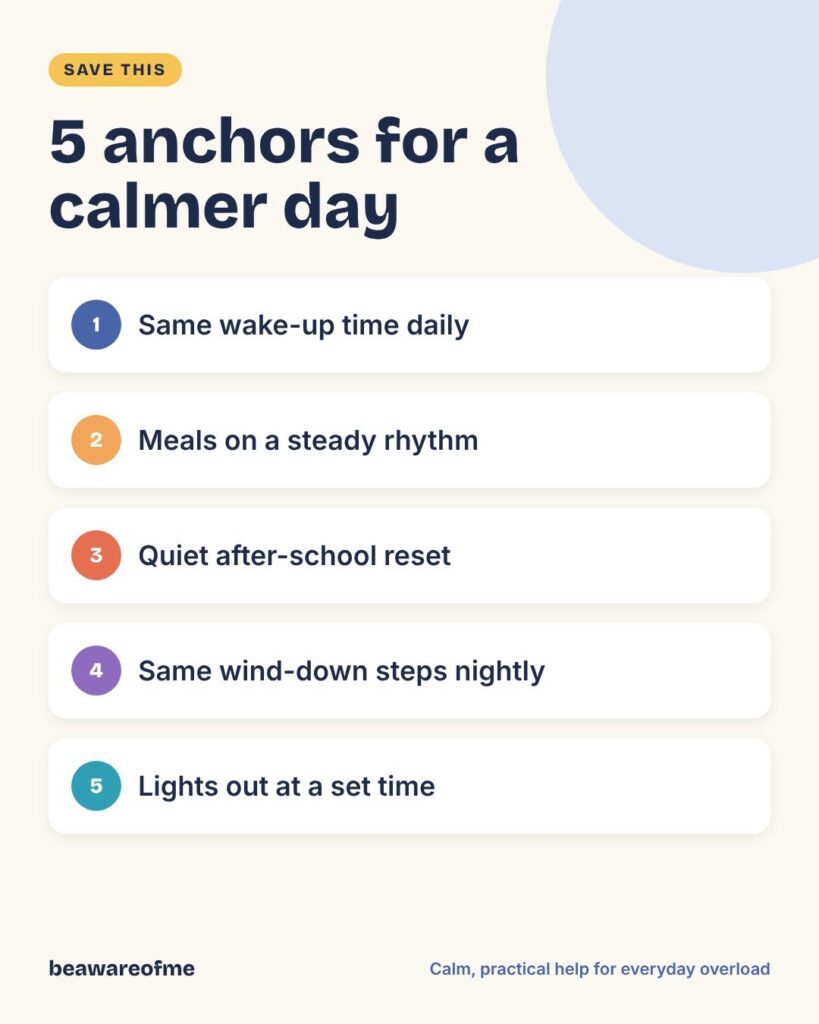
The 5 Daily Anchors Every Anxious Child Needs
A strong calming routine is built on a few fixed anchors, not a minute-by-minute schedule. Anchors are the points of the day that happen at roughly the same time, in the same order, no matter what. Everything else can flex around them.
How many anchors is too many?
Start with five. If your child has a lot of trouble with change, start with three: wake-up, after-school reset and bedtime. Add more once those feel automatic, usually after a couple of weeks.
Keep the gaps flexible
Rigid routines can backfire. If every minute is planned, a late bus or a long phone call feels like a disaster. Leave the space between anchors loose, and your calming routine will survive real life.
How to Build a Calming Routine in 6 Steps This Week
You can set up a calming routine in about a week if you go one step at a time. Rushing it, or announcing ten new rules on Monday, tends to stir up the very worry you’re trying to settle.
Step 1 to 3: watch, choose, involve
- Watch for three days. Note when your child seems most tense. Common hot spots are the morning rush, the hour after school and bedtime.
- Choose one hot spot first. Fix the hardest part of the day before anything else. A calmer evening often makes mornings easier too.
- Involve your child. Ask, “What helps your body feel calm?” Kids follow a plan they helped make far more willingly.
Step 4 to 6: show it, practise it, review it
- Make it visual. Draw or print a simple chart with pictures for younger kids and a short checklist for older ones. Stick it at eye level.
- Practise on a good day. Walk through the new calming routine once when nobody is stressed, like a fire drill for feelings.
- Review on Sunday. Ask what worked and what felt hard. Change one thing at a time.
If you also live with worry yourself, building the plan together can help you both. Our guide to parenting with anxiety while raising confident kids has ideas for keeping your own nerves steady while you do it.
A Sample Calming Routine for Kids, From Breakfast to Bedtime
Here’s a sample calming routine for a school-age child, which you can stretch or shrink to fit your family. Times are a guide only. The order is what matters most.
| Time | Anchor | What it looks like |
|---|---|---|
| 7:00 | Wake-up | Same alarm or light, a hug, curtains open, two minutes to stretch |
| 7:15 | Breakfast | Familiar food, no screens, a quick look at the day’s picture chart |
| 7:45 | Leave home | Bag packed the night before, a goodbye phrase you always use |
| 3:30 | After-school reset | Snack, water and 15 quiet minutes before any questions about the day |
| 4:00 | Homework or play | Same spot, same order, short breaks every 20 minutes |
| 6:00 | Dinner | Family meal where possible, one easy talking question |
| 7:15 | Wind-down | Bath, pyjamas, story, then a short worry chat |
| 8:00 | Lights out | Dim light, the same goodnight words, a calm exit |
Adjusting the plan by age
Preschoolers need shorter steps, more pictures and more of you. School-age kids can tick off a checklist themselves. Tweens and teens often want more say, so offer choices inside the structure, such as which wind-down activity they pick.
Mornings: the make-or-break hour
Mornings are where a calming routine gets tested hardest. Pack bags, lay out clothes and agree breakfast the night before, so the morning has fewer decisions. For more ideas, see our guide on handling morning routines without chaos.
7 Calming Skills to Weave Into Your Child’s Day
A routine sets the stage, but calming skills give your child something to do when worry still shows up. The best time to teach a skill is when your child is already calm. Then it’s ready when they need it.
Body skills that work in under 2 minutes
- Balloon breathing: breathe in through the nose while the tummy fills like a balloon, then let it out slowly through the mouth. Five rounds is plenty.
- Squeeze and release: squeeze fists, shoulders or toes for five seconds, then let go. This is a child-sized version of progressive muscle relaxation.
- Wall push: push hard against a wall for ten seconds. Heavy work like this helps many kids feel grounded.
- Cold water splash: a splash on the face or wrists can help reset a racing body.
Mind skills for busy heads
- 5-4-3-2-1 senses game: name five things you see, four you hear, three you can touch, two you smell and one you taste.
- Worry box: write or draw the worry, post it in a box, and open it together at a set worry time.
- Brave self-talk: pick a short phrase together, such as “I can do hard things slowly.”
If you want a guided rhythm for breathing, try our free box breathing coach together after dinner. For more ideas, see teaching kids stress relief techniques and simple mindfulness and meditation for kids.
The 30-Minute Bedtime Plan That Ends the Stalling
Bedtime is often the hardest part of the day for anxious kids, because the house goes quiet and worries get louder. A clear bedtime calming routine gives those worries a time and place, so they don’t take over lights out.
The 30-minute wind-down
- Screens off at least an hour before lights out, and devices charge outside the bedroom.
- Warm bath or shower, then pyjamas and teeth in the same order every night.
- One or two books in dim light. Choose gentle stories rather than exciting ones.
- A short worry chat: “Anything on your mind before sleep?” Listen, reflect, and keep it to five minutes.
- The same goodnight words, a hug, and a calm exit.
Our guide to a nighttime routine for kids has more bedtime ideas, and ending screen time battles helps if devices are the sticking point.
When your child keeps calling you back
Try a check-in promise. Say, “I’ll come back to check on you in five minutes.” Then do it, every time. As your child learns you always return, stretch the gap to ten minutes, then fifteen. Most kids fall asleep before the visits run out.
If This Happens, Try That: 6 Fixes for Wobbly Days
Every calming routine wobbles sometimes, and a wobble isn’t failure. Illness, holidays, a new sibling or a tough week at school can all knock things off course. Use these quick rules to steer back.
| If this happens | Try this |
|---|---|
| Your child refuses the chart | Let them redesign it with their own drawings or stickers |
| Mornings still feel frantic | Move every possible decision to the night before |
| A big change is coming | Give a day’s notice, explain what will stay the same, and walk through the new step |
| Weekends throw everything off | Keep wake-up, meals and bedtime within an hour of school days |
| Worry spikes after school | Lengthen the reset to 20 minutes and save questions about the day for dinner |
| You’re too tired to keep it up | Drop back to three anchors until you have more energy |
Use a five-minute warning for every transition
Transitions are where routines often crack. A simple warning helps: “Five minutes, then bath.” A visual timer works well for younger kids. Older kids may like a choice: “Bath now, or after this page?”
- Agree one wind-down step order with your child and write it down.
- Practise five rounds of balloon breathing together while things feel calm.
- Set out tomorrow’s clothes and pack the school bag.
- Choose a goodbye phrase for the morning.
- Plan a check-in promise for lights out.
What to Say: 4 Scripts That Make a New Routine Feel Safe
How you introduce a calming routine matters almost as much as the routine itself. Anxious kids can hear “new plan” as “something is wrong”. A few calm, honest words help them see it as support, not punishment.
Script 1: introducing the plan
“I’ve noticed some parts of the day feel bumpy for you, especially after school. Let’s make a plan together so you always know what’s coming. You get to help choose the pictures.” Keep your tone light. Pick a calm moment, like a walk or a car ride, not the middle of a meltdown.
Script 2: when worry shows up anyway
“Your worry is loud right now. That’s okay. Let’s look at the chart. What comes next?” Pointing to the plan gives your child something solid to focus on. It also shows that the calming routine still holds, even on a hard day.
Script 3: warning about a change
“Tomorrow Grandma is picking you up instead of me. Snack, reading and dinner will all stay the same.” Naming what stays the same is the key part. Most kids cope with one change well if everything around it feels familiar.
Script 4: celebrating effort
“You followed the whole evening plan, even when you felt wobbly. That took real courage.” Praise the effort, not just the calm result. Over time, your child starts to see the calming routine as something they’re good at, rather than something done to them.
5 Common Mistakes That Quietly Undo Your Hard Work
These are the slip-ups that trip up even caring, organised parents. Each one is easy to fix once you spot it.
1. Making the routine too rigid
A schedule planned to the minute turns every delay into a crisis. Why it hurts: your child learns that change is dangerous. Instead, fix the anchors and keep the gaps flexible.
2. Removing every hard thing
It’s tempting to cancel anything that makes your child worry. Why it hurts: avoidance can make fears grow. Instead, keep gentle challenges in the week, with support, and praise effort rather than outcome.
3. Teaching calming skills mid-meltdown
A child in full panic can’t learn something new. Why it hurts: the skill becomes linked with distress. Instead, practise breathing and grounding during calm times, so the calming routine has tools ready.
4. Asking about the day too soon
“How was school?” at the gate can flood a tired child. Why it hurts: they shut down or snap. Instead, offer snack and quiet first, then ask a specific question later, like “Who did you sit with at lunch?”
5. Forgetting your own calm
Kids borrow our nervous systems. Why it hurts: a rushed, tense parent makes even a good plan feel stressful. Instead, build a two-minute pause for yourself into the calming routine before the hardest transition.
Questions Parents Ask Most (FAQ)
How long does it take for a calming routine to work?
What should a calming bedtime routine for an anxious child include?
Can too much routine make a child’s anxiety worse?
How do I make a visual schedule for my child?
What age can kids start using calming strategies?
When should I get professional help for my child’s anxiety?
A calming routine won’t erase every worry, and it doesn’t need to. What it does is give your child a steady rhythm to come back to, day after day, so worry has less room to grow. Start with one hot spot this week, keep your anchors simple, and browse more support in our anxiety guides or our checklist of early signs of anxiety in children.