Your child melts down before school, freezes before a test, or lies awake worrying about tomorrow, and “just calm down” isn’t working. Here’s the good news: calm is a skill, and kids can learn it the same way they learn to ride a bike. This guide gives you kids stress relief techniques sorted by age, with the exact words to teach them, games that make practice fun, and a family calm plan you can set up this week.
✨ Key takeaways
Practise stress relief skills when your child is calm, so they’re ready to use when stress hits.
Choose techniques by age: bubbles and teddy breathing for little ones, the 5-4-3-2-1 game for school-age kids, and box breathing for teens.
Keep kids stress relief practice short and playful, around three to five minutes a day.
Stay calm yourself first, because kids borrow their calm from the adults nearby.
Give your child a calm-down corner and a short list of tools they choose themselves.
Talk to your child’s doctor if worry or stress starts getting in the way of school, sleep or friendships.
Why Kids Stress Relief Has to Be Taught, Not Told
Kids stress relief works best when children learn calming skills ahead of time, because a stressed brain can’t take in new instructions. Telling a crying child to “relax” rarely helps. Teaching them a few concrete tools, then practising together, does.
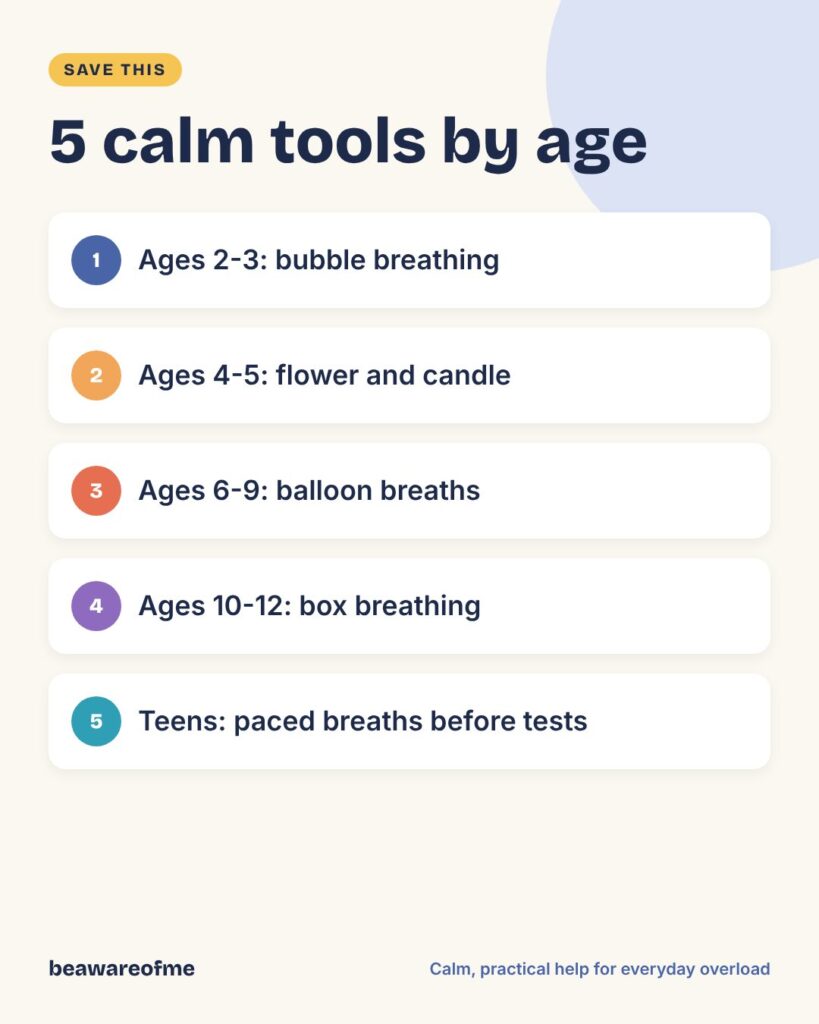
Here’s every technique in this guide on one screen. Find your child’s age and start with the first one.
Kids stress relief at a glance
| Age | Best first technique | How to teach it |
|---|---|---|
| 2-3 years | Bubble breathing | Blow slow bubbles together and copy their breath |
| 4-5 years | Smell the flower, blow the candle | Use your hands as a flower and a candle |
| 6-9 years | Balloon belly breaths | Breathe in for 4, out for 5, hand on belly |
| 6-9 years | 5-4-3-2-1 senses game | Name things they see, hear and feel |
| 10-12 years | Box breathing | Trace a square: in, hold, out, hold for 4 |
| 13+ years | Paced breathing before big moments | Explain why it works, then let them own it |
What stress looks like in children
Children often can’t say “I’m stressed.” Instead, it shows up as tummy aches, headaches, clinginess, tears, anger, trouble sleeping or sudden changes in appetite. Older kids may go quiet, snap or spend more time alone.
Some stress is a normal part of growing up, like a first sleepover or a school play. Kids stress relief skills don’t remove those moments. They help your child move through them with a bit more confidence.
Stress and anxiety aren’t the same thing
Stress is a reaction to a pressure, such as a test, and it usually eases when the pressure passes. Anxiety tends to stick around even without a clear cause. According to the CDC’s children’s mental health data, 11% of US children aged 3-17 had current, diagnosed anxiety, so it’s worth knowing the difference.
4 in, 5 out
A simple breathing count for elementary-age kids
Child Mind Institute
10 breaths
One round of belly breathing for children takes about a minute
Raising Children Network
11%
US children aged 3-17 with current, diagnosed anxiety
CDC
The Golden Rule: Practise When Calm, Use When Stressed
The single most important rule in teaching kids stress relief is to practise when everyone is calm, not in the middle of a meltdown. That’s when the brain can learn. Later, the skill is already there to reach for.
Why timing matters so much
When a child is very upset, the thinking part of the brain goes quiet and the alarm system takes over. That’s why lectures bounce off. Practice in calm moments builds a groove the brain can find again under pressure.
The Child Mind Institute’s relaxation skills guide suggests practising before bed, after school or in the car. Those everyday moments are perfect for kids stress relief. They’re short, they repeat and they don’t feel like lessons.
Teach any calming technique in five steps
Show it
Do the technique yourself first, slowly, while your child watches.
Name it
Give it a fun, short name like “balloon breath” or “turtle squeeze”.
Do it together
Practise side by side for one to three minutes, once a day.
Link it
Connect it to a feeling: “This is what we do when our tummy feels tight.”
Cue it later
When stress shows up, use the name: “Want to do a balloon breath with me?”
Where kids stress relief fits in a busy day
You don’t need extra time, just existing moments. Kids stress relief practice slots neatly into routines you already have. Try these anchors:
- In the car: one round of the 5-4-3-2-1 game on the way to school.
- After school: three balloon breaths before snack time.
- Before homework: a quick turtle squeeze to shake off the day.
- At bedtime: spaghetti toes or teddy breathing as part of lights-out.
Pick one anchor and stick with it for two weeks before adding another. Small and steady wins here.
💡 Tip
Post the steps for your child’s favourite technique where they’ll see them, like the fridge or their bedroom door. Pictures work well for kids who can’t read yet.
Little Kids (Ages 2-5): Bubbles, Bears and Turtle Squeezes
For toddlers and preschoolers, the best kids stress relief tools use toys, pictures and movement, because young children learn through play. Keep it very short. One minute of fun beats ten minutes of instructions.
Bubble breathing
Blow bubbles together and say, “Let’s make the biggest, slowest bubble.” A slow, steady breath out is exactly what calms the body. No bubbles handy? Pretend to blow one.
Smell the flower, blow out the candle
Hold up one finger as a flower and say, “Smell the flower,” with a slow breath in through the nose. Then hold up another finger as a candle: “Now blow out the candle,” with a long breath out. Repeat three times.
Teddy bear belly breathing
Have your child lie down with a teddy or small toy on their tummy. Ask them to breathe in slowly so the teddy rises, then breathe out so it sinks. The Raising Children Network’s belly breathing guide describes 10 slow breaths as one round, which takes about a minute.
The turtle squeeze
Ask your child to pull into their “shell”: squeeze shoulders up, fists tight, face scrunched, for a count of three. Then pop out of the shell and go floppy. This is a playful version of muscle relaxation, which means tensing then releasing muscles to let go of tightness.
Name it to tame it
Little kids calm faster when they have a word for the feeling. Try, “You look really frustrated. Your tower fell down.” Picture books about feelings and a simple feelings chart help build those words.
✨ Quick win
Turn bath time into breathing practice. Blow slow ripples across the water or blow a toy boat across the bath with long, gentle breaths.
School-Age Kids (6-9): Balloon Breaths and the 5-4-3-2-1 Game
Children aged six to nine can handle simple counting and short games, so kids stress relief at this age can be a bit more structured. They also love having a job. Let them teach the technique back to you or a younger sibling, which is one of the best ways to make kids stress relief stick.
Balloon belly breaths
Ask your child to put a hand on their belly and imagine a balloon inside. Breathe in through the nose for four counts to fill the balloon, then out for five counts to let it go. The longer breath out helps the body settle.
The 5-4-3-2-1 senses game
This grounding game pulls attention away from worries and into the present. Ask your child to name five things they can see, four they can touch, three they can hear, two they can smell and one they can taste. It works well in the car, at the doctor’s or before a test.
Spaghetti toes relaxation
At bedtime, guide your child from toes to head. “Make your toes stiff like uncooked spaghetti. Now let them go soft like cooked spaghetti.” Move up through legs, tummy, hands, shoulders and face. Our guide to a nighttime routine for kids shows where this fits in the evening.
The worry box and glitter jar
Give your child a shoebox and some paper. They write or draw a worry, post it in the box, and you look at it together later. A glitter jar works too: shake it, then watch the glitter settle while breathing slowly, just like their busy thoughts.
📝 Note
Kids stress relief games work better when your child picks their favourite. Offer two or three, then let them choose the one they’ll use. Choice builds buy-in.
Tweens and Teens: Let Them Own the Tools
For tweens and teens, kids stress relief techniques work best when you explain why they work and let them decide how to use them. Older kids don’t want to be managed. They do want tools that help them feel in control.
Tweens (10-12): box breathing and worry time
Box breathing is easy to remember. Trace a square in the air: breathe in for four, hold for four, out for four, hold for four. Tweens like that it’s quick, private and something they can do at a desk without anyone noticing.
Worry time is another good fit. Your child writes worries down during the day, then spends 10 minutes looking at them at a set time, choosing one small action for any they can change. Outside that window, worries go “on the list” to wait.
Teens (13+): frame it as a performance skill
Teens respond well to the idea that slow, controlled breathing helps people under pressure, from athletes to pilots. Present it as a way to turn down the intensity before a test, game or hard conversation, not as a way to make stress vanish.
Movement, music, time outdoors and sleep are big stress relievers for teens too. Phones can work against calm, especially at night. Our article on digital curfews has ideas for protecting sleep without a fight.
Apps, videos and music: helpful or not?
Guided breathing videos and calming music can be useful kids stress relief tools, especially for teens who like doing things on their own. The catch is that phones also bring notifications and scrolling. Suggest downloading a track or two, then using it with the screen face down.
🧭 Try this
Ask your teen, “What actually helps you when you’re stressed?” Then really listen. Building on what already works for them beats introducing something brand new.
Build a Calm-Down Corner and a Family Calm Plan
A calm-down corner gives your child a safe, cosy spot to use their skills, and a family calm plan makes those skills part of everyday life. Neither costs much. Both make kids stress relief feel normal rather than like a punishment.
What to put in a calm-down corner
Choose a quiet spot with a cushion or beanbag. Add a few comforting items: a soft toy, a stress ball, a glitter jar, crayons and paper, and a card showing their favourite breathing technique. Keep it inviting, never a time-out zone.
A simple family calm plan
Kids stress relief sticks best when it’s a family habit, not a child’s assignment. Pick one calming technique the whole family practises daily, such as three balloon breaths before dinner. Add a family word, like “pause”, that anyone can say when things get heated. Even adults can use it.
🧭 Try this today: the 5-minute calm kit
☐Pick one technique from this guide that fits your child’s age.
☐Give it a fun name together and practise it once while everyone is relaxed.
☐Choose a calm-down spot and add two comforting items.
☐Draw or write the steps on a card and stick it nearby.
☐Agree on a family “pause” word for heated moments.
☐Practise again at bedtime and praise any effort.
Predictable routines also lower everyday stress. Our guide on creating a calming routine for kids with anxiety shows how to build one step by step.
Your Calm Is Their Best Teacher
Children learn calm mainly by watching and feeling it in the adults around them, so your own stress relief is part of theirs. This is sometimes called co-regulation, which means a calm adult helps a child’s body settle. You don’t need to be perfect. You just need to model the repair.
Say what you’re doing out loud
Kids stress relief starts with what they see you do. When you feel stressed, narrate it: “I’m feeling grumpy because we’re late. I’m going to take two big breaths.” Your child sees that big feelings are normal and that there’s something you can do about them.
What to say in the moment
- “I’m right here. You’re safe. Let’s breathe together.”
- “Your body feels really upset. Want to do our balloon breath?”
- “It’s okay to feel this. We’ll figure it out when you’re calmer.”
- “Do you want a hug, some space, or your calm corner?”
Older kids also benefit from understanding emotions more deeply. Our article on emotional intelligence in kids during household stress explains how to grow that skill at home.
Calm isn’t something kids are born with or without. It’s something they learn, one small breath at a time.
beawareofme
When Stress Needs More Than Breathing
Kids stress relief techniques help with everyday stress, but some children need extra support, and noticing that early is a loving move. Keep an eye on how long the signs last and how much they affect daily life.
Signs to talk to your child’s doctor
- Worry, fear or sadness that lasts for weeks rather than days.
- Avoiding school, friends or activities they used to enjoy.
- Ongoing sleep trouble, nightmares or big appetite changes.
- Frequent tummy aches or headaches with no clear medical cause.
- Meltdowns that are much bigger or more frequent than before.
A pediatrician or family doctor can check for physical causes and point you to support. For more background, see our guides to recognising early signs of anxiety in children and telling normal worry from anxiety in kids.
Bring school into the loop
Teachers often spot stress that doesn’t show at home. Share the kids stress relief technique your child uses, so staff can cue it with the same words. Our guide to school support for anxious children explains how to start that conversation.
⚠️ Watch out
If your child talks about wanting to hurt themselves, take it seriously and get help straight away. Contact your doctor, local emergency services or a crisis line such as 988 in the US.
5 Common Mistakes When Teaching Calm (and What Works Instead)
Most of these mistakes come from love and urgency. A small shift in approach usually makes a big difference.
Mistake 1: Teaching a new skill mid-meltdown
In the heat of the moment, a child can’t learn anything new. Instead, stay close and keep your voice low. Teach and practise the skill later, when everyone feels settled.
Mistake 2: Making it a chore
When breathing practice feels like homework, kids resist. Use games, silly names and toys instead. Three playful minutes of kids stress relief beat a 20-minute lesson every time.
Mistake 3: Using calm-down tools as punishment
Sending a child to the calm corner as a consequence turns a safe space into a shameful one. Offer it as a choice: “Would the calm corner help right now?” Keep discipline separate.
Mistake 4: Expecting instant results
Calming skills take weeks of practice before kids use them on their own. Notice small wins, like one deep breath before a tantrum, and praise the effort rather than the outcome.
Mistake 5: Forgetting your own stress
If you’re running on empty, it’s very hard to model calm. Look after yourself too, even with 10 minutes a day. Our guide on overcoming parental guilt with self-care can help.
📚 Keep reading
Questions Parents Ask About Kids Stress Relief
What are good stress relief techniques for kids?
Good techniques are simple, physical and playful. Belly breathing with bubbles or a teddy, the “smell the flower, blow the candle” breath, turtle squeezes, the 5-4-3-2-1 senses game and box breathing all work well. Movement, drawing and naming feelings help too. Choose one that suits your child’s age and practise it daily when they’re calm.
At what age can kids learn breathing exercises?
Children as young as two or three can learn breathing through play, such as blowing bubbles or a pinwheel slowly. Around four or five, they can follow simple pretend games like smelling a flower and blowing a candle. From about six, most kids can count breaths, and tweens can use box breathing on their own.
How do I help my child calm down during a meltdown?
Stay calm and close, lower your voice and keep words few. Make sure they’re safe, then offer comfort, such as a hug or space, depending on what they prefer. Once they start to settle, gently cue a skill you’ve practised, like “balloon breath with me?” Save the talking and problem-solving for later.
How long should kids practise relaxation each day?
Three to five minutes a day is plenty for most children. Short, regular practice builds the habit better than long sessions. Fit it into routines you already have, like after school, in the car or at bedtime. Over a few weeks, your child will start to use the skill more easily on their own.
What is a calm-down corner?
A calm-down corner is a cosy, quiet spot where a child can go to feel better. It usually has a cushion, a soft toy, a stress ball, a glitter jar and a card showing their favourite breathing technique. It works best as a safe choice your child can pick, never as a punishment or time-out.
When should I worry about my child’s stress?
Talk to your child’s doctor if stress or worry lasts for weeks, affects school, sleep or friendships, or comes with frequent physical complaints. Big changes in mood or behaviour are also worth checking. If your child talks about hurting themselves, seek help straight away through your doctor, emergency services or a crisis line.
Calm is a skill, and every short practice session is a deposit your child can draw on later. Start with one playful technique, practise it when things are easy, and model it yourself on hard days. With steady practice, kids stress relief becomes something your child reaches for on their own.
🛟 Please read
Educational content, not a substitute for professional care. If you are struggling, talk to a doctor or a qualified professional. If you are thinking about harming yourself, contact local emergency services or a crisis line now (US 988, UK and Ireland Samaritans 116 123, or findahelpline.com).