You want your child to feel safe, and you want them to grow up capable. Some days those goals pull in opposite directions. One parent hovers at the playground while another lets a nine-year-old bike to the shop, and both look a little worried. This guide compares helicopter and free-range parenting honestly, then hands you an age-by-age independence ladder, a quick risk check and scripts that help you let go one small step at a time.
🧭 Key takeaways
Think of independence as a ladder with small rungs, not a single leap into freedom.
Teach, practise together, then step back: that three-stage pattern works for crossing roads, cooking and online life.
Judge readiness by your child’s skills and your local setting, never by age alone.
Notice when your own worry, not real danger, is making the decision, and name it out loud.
Agree on a short safety plan with your child before each new freedom, so both of you feel calmer.
Helicopter vs Free-Range Parenting: What Each Really Means
Both labels describe how much freedom and oversight a parent gives, and most families sit somewhere between them. Understanding each style clearly makes it easier to pick the parts that fit your child.
Here’s the full guide at a glance. Use it to spot where you lean today and where you’d like to land.
Helicopter vs free-range parenting at a glance
| Area | Helicopter style | Free-range style | Balanced middle |
|---|---|---|---|
| Play | Adult nearby at all times | Kids roam with friends | Free play within agreed limits |
| Homework | Parent checks every page | Child fully in charge | Parent available, child owns it |
| Getting around | Always driven | Walks or bikes alone early | Practised routes, then solo |
| Conflict | Parent steps in fast | Kids sort it out | Coach first, step in if unsafe |
| Screens | Tight monitoring | Few rules | Clear rules plus open talk |
| Mistakes | Prevented | Allowed | Allowed when the cost is small |
Helicopter parenting in plain words
Helicopter parenting is a style where a parent watches closely and steps in quickly, often before a child has tried. It usually grows from love and worry. The catch is that kids get fewer chances to practise handling things on their own. Over time, that can leave a capable child feeling less capable than they are.
The free-range approach in plain words
Free-range parenting gives children freedom to do things alone that match their age, such as walking to a friend’s house or playing outside without an adult hovering. It doesn’t mean neglect. Done well, free-range parenting comes with teaching, rules and a plan.
📝 Note
You’ll also hear “overparenting” and “overcontrolling parenting.” Both describe the same pattern as helicopter parenting: more control and protection than a child’s age requires.
What Research Says About Too Much Control
Research suggests that very controlling parenting in the early years can make self-control harder later. That doesn’t mean watching your child is harmful; it means kids need room to practise.
The study parents talk about most
A study described by the American Psychological Association followed 422 children over eight years, checking in at ages 2, 5 and 10. Overcontrolling parenting at age 2 linked to poorer emotional and behavioural regulation at age 5. Better regulation at 5, in turn, linked to stronger social skills and school engagement at 10.
Why the worry is so understandable
Parents today carry a lot of fear. In a Pew Research Center survey, four in ten U.S. parents said they’re extremely or very worried their children might struggle with anxiety or depression. Free-range parenting can feel risky when that worry is loud. Yet the same worry is a good reason to build skills step by step, because confident kids tend to feel less anxious, not more.
422
children followed for eight years in research on overcontrolling parenting and self-regulation.
American Psychological Association
4 in 10
U.S. parents are extremely or very worried their kids might struggle with anxiety or depression.
Pew Research Center
2, 5, 10
the ages at which researchers checked children’s emotional and behavioural regulation.
American Psychological Association
What kids practise when adults step back
Unstructured time with less adult direction gives children daily reps in skills that are hard to teach with words. Think of the small decisions in a game of tag or a den built in the garden.
- Problem solving: working out what to do when the ball goes over the fence.
- Negotiation: agreeing on rules with friends who want different things.
- Risk judgement: deciding how high is too high on a tree or wall.
- Recovering from setbacks: losing a game, feeling cross, then joining in again.
- Self-direction: filling a boring afternoon without a screen or a schedule.
None of this requires extreme free-range parenting. A quiet adult in the next room or on a nearby bench still leaves plenty of space for these skills to grow.
💡 Tip
Research shows links, not guarantees. A single anxious afternoon of hovering won’t define your child. Patterns over years matter more than any one day.
Kids don’t need a parent who removes every bump. They need one who teaches them how to fall well.
beawareofme
The Free-Range Parenting Ladder: Age-by-Age Steps
An independence ladder turns free-range parenting into small, planned rungs instead of one big leap. Each rung builds a skill your child can use for life, and you only climb when the last rung feels easy.
Ages 3 to 5: tiny jobs, big pride
For little ones, free-range parenting is mostly about doing things for themselves while you stay close.
- Pour their own drink and clear their plate.
- Choose between two outfits and dress with little help.
- Play in the next room while you’re nearby.
- Say their full name and your phone number out loud.
Ages 6 to 8: practised freedom
- Order their own food at a café while you sit close.
- Walk to a neighbour’s door while you watch from the gate.
- Make a simple snack with a butter knife.
- Ring a trusted adult if they get separated from you in a shop.
Ages 9 to 12: real responsibility
This is the stage where free-range parenting usually gets real, because kids start moving around without you.
- Walk or bike a practised route to school or a friend’s home.
- Stay home alone for a short time, if local rules and their maturity allow.
- Pay for something small and check the change.
- Handle a disagreement with a friend before asking for help.
Ages 13 to 17: near-adult skills
- Use public transport alone and plan a route with a backup.
- Cook a full family meal once a week.
- Manage a small budget for clothes or outings.
- Book their own appointments with you as backup.
Every child climbs at their own pace. The CDC’s positive parenting tips offer a helpful guide to what children can usually handle at each early stage, and household tasks are a great start. These ideas on kids doing chores to build responsibility fit right into the first rungs.
⚠️ Watch out
Laws about children being home alone or out without an adult differ by country and region. Check what applies where you live before you add a new free-range parenting rung.
The 5-Point Readiness Check Before Any New Freedom
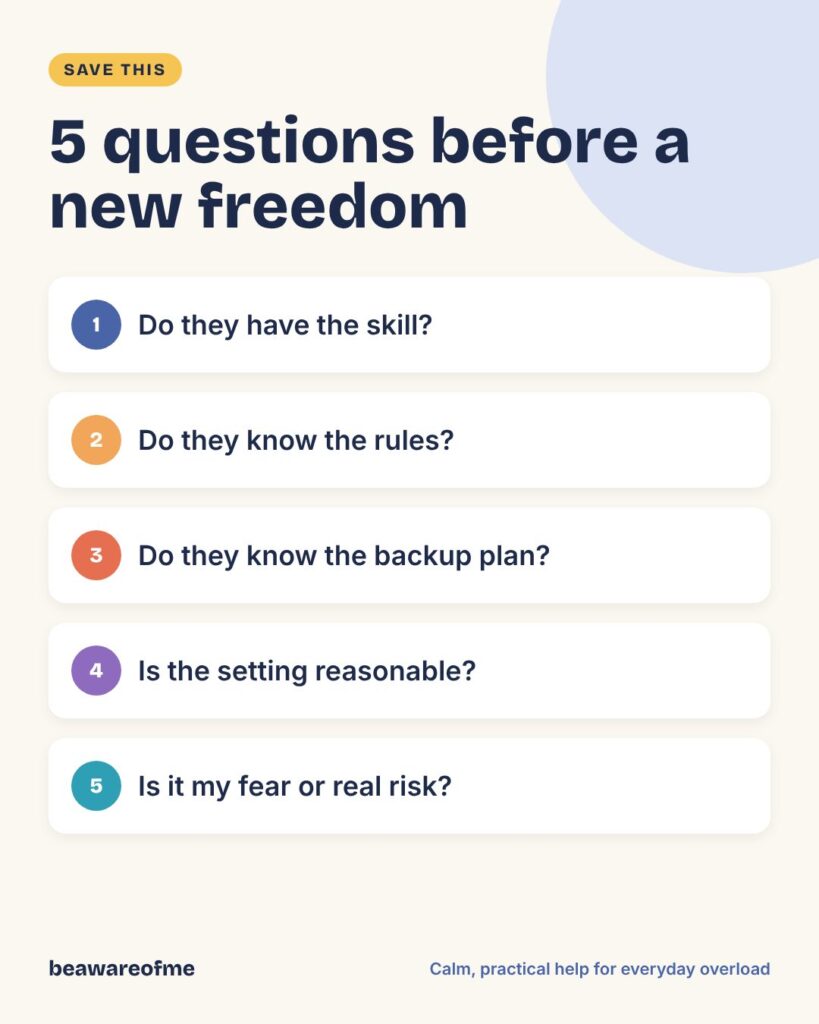
Before saying yes to a new freedom, run a quick five-question check. It replaces gut panic with clear thinking and gives free-range parenting a structure you can trust.
Ask these five questions
Do they have the skill?
Have you practised this together at least three times, with your child leading the last one?
Do they know the rules?
Can your child say the plan back to you, including where to go and when to be home?
Do they know what to do if it goes wrong?
Ask “what if” questions: lost, approached by a stranger, phone dies.
Is the setting reasonable?
Think about traffic, distance, daylight and who’s around, not worst-case headlines.
Is it my fear or a real risk?
Notice if your body is reacting to a story you read rather than the facts in front of you.
If X, then Y rules
- If your child answers four or five questions confidently, try the new freedom with a check-in call.
- If they answer only two or three, practise together for another week and ask again.
- If the setting feels unsafe, choose a smaller step, such as a shorter route or a daytime trip.
- If your fear is the main barrier, take one small step anyway and notice how it goes.
What a check-in plan looks like
Here’s a simple example for a ten-year-old walking to a friend’s house. The route is agreed and practised twice. They text when they arrive. If there’s no message within 15 minutes, you call. That’s free-range parenting with a safety net, and kids usually love the trust it shows.
When Your Own Anxiety Is Steering the Wheel
Many parents lean toward helicopter habits because worry speaks louder than facts. Spotting your own anxiety helps you make choices that serve your child rather than calm your nerves for a minute.
Signs worry is making the call
- You picture rare disasters in vivid detail before saying yes.
- You check location apps many times during a short outing.
- You do tasks for your child because it’s faster and less stressful for you.
- You feel relief when they stay home, even when they wanted to go.
If those feel familiar, you’re not alone. A free self-check like what kind of worrier are you can help you see your worry pattern more clearly. For deeper support, read this guide on parenting with anxiety while raising confident kids.
Calm tools for the letting-go moment
Try slow breathing while your child walks away: in for four counts, out for six. Say a short line to yourself, like “They’ve practised. They’ve got a plan.” Then do something with your hands until the check-in text arrives.
✨ Quick win
Keep a “brave log” on the fridge. Each time your child handles a new freedom, write one line about it. On anxious days, reading that list reminds both of you how much they can do.
Agree with your co-parent first
Couples often split into “the worrier” and “the relaxed one.” One partner may love free-range parenting while the other hates it. Sit down and agree on the next two rungs together, so your child gets one clear message. If you disagree on the bigger picture, this comparison of authoritative vs permissive parenting offers a useful middle frame.
Free-Range Parenting in the Digital World
Online life needs its own ladder, because freedom on a screen works differently from freedom on a street. Free-range parenting online means gradual trust plus open talk, not zero rules.
Start supervised, then widen the circle
Younger kids do best with shared devices in shared rooms. Free-range parenting online starts small, just like it does outdoors. As they show good judgement, give more privacy step by step. A child who tells you about a weird message is showing exactly the skill you want to reward.
Signs your child is ready for more online freedom
- They tell you about odd messages or content without being asked.
- They can explain why they shouldn’t share passwords or location.
- They stick to agreed time limits most days without arguments.
- They can step away from a group chat when it turns unkind.
When you see most of these signs, it’s reasonable to widen the circle a little. That’s the same steady logic as free-range parenting outdoors: proven skill first, more freedom second.
Scripts for online independence
- Ages 6 to 9: “If anything online feels yucky or confusing, come show me. You won’t be in trouble.”
- Ages 10 to 12: “Let’s set up your account together, and we’ll check settings once a month.”
- Ages 13 to 17: “I trust you more each year. What rule do you think is fair for your phone at night?”
For more on setting fair limits, this parent’s guide to social media boundaries offers a clear starting point.
3 Everyday Scenarios and the Balanced Response
Real choices rarely arrive as neat theory, so here are three common moments with a helicopter reaction, a free-range reaction and a balanced middle. Use them as templates for your own week.
Scenario 1: The tall climbing frame
Your five-year-old wants to climb higher than ever. The helicopter reflex is to stand underneath with arms out, saying “careful” every few seconds. A pure free-range parenting response is to keep reading on the bench.
The balanced move sits between them. Stay close enough to see, keep quiet, and offer one useful tip if they freeze: “Where’s your next foot going?” Kids learn to judge height by testing it, and most climb only as high as they feel able.
Scenario 2: The forgotten lunch
Your eleven-year-old texts at 10am: they left lunch on the counter. Helicopter parents drive it over at once. A strict free-range parenting answer is “you’ll survive until dinner.”
A balanced answer depends on the pattern. If it’s the first time this term, bring it and talk about a morning checklist tonight. If it’s the fourth time, let the natural consequence teach the lesson, and help them build a better routine. Either way, skip the lecture.
Scenario 3: The first solo trip to the shop
Your nine-year-old asks to buy bread alone from the corner shop. The worried reflex is a flat no. The free-range reflex is a quick yes and a coin in the hand.
The middle path uses the readiness check. Walk the route together twice, practise paying, and agree on the rule about crossings. Then let them go, with a text on arrival home. That’s free-range parenting with a plan your child helped write.
🧭 Try this today: your first rung
☐Pick one small freedom your child has asked for recently.
☐Teach the skill once, then practise it together twice this week.
☐Agree on one check-in and one backup plan out loud.
☐Step back, and write one line in a “brave log” afterwards.
☐Notice how you felt, and plan the next rung only when this one feels easy.
5 Mistakes Parents Make When Balancing Freedom and Safety
The most common mistakes come from swinging between extremes instead of climbing steadily. Here’s what trips parents up, and what to do instead.
Mistake 1: Using age as the only guide
Two eight-year-olds can have very different skills and settings. Going by age alone leads to too much or too little freedom. Instead, use the readiness check and your child’s track record.
Mistake 2: Skipping the teaching stage
Free-range parenting without practice feels like throwing a child in the deep end. That’s stressful for everyone. Instead, teach, practise together and only then step back.
Mistake 3: Rescuing from small failures
Bringing forgotten homework every time stops kids learning to plan. Small, safe failures teach more than lectures. Instead, let low-cost mistakes happen and talk about them kindly afterwards.
Mistake 4: Granting freedom, then hovering anyway
Saying yes, then calling five times, sends a mixed message about trust. Your child may feel more anxious, not less. Instead, agree on one check-in and stick to it.
Mistake 5: Comparing your choices to other families
Neighbourhoods, children and laws all differ. Copying another family’s rules can push you into risks that don’t suit your setting. Instead, base each rung on your own child and your own street.
📚 Keep reading
Free-Range Parenting FAQ: Straight Answers for Worried Parents
What’s the difference between helicopter and free-range parents?
Helicopter parenting involves close watching and quick rescue, often before a child has tried something alone. The free-range approach gives children age-appropriate freedom to play, travel and solve problems with less supervision. Most families do best somewhere between the two, using small, planned steps that match each child’s skills, their surroundings and the rules where they live.
Is giving kids freedom the same as neglect?
No. Neglect means failing to meet a child’s basic needs or keep them reasonably safe. A free-range approach, done well, includes teaching skills, setting rules and making a plan before each new freedom. Laws about supervision differ by country and region, so check local guidance and your child’s maturity before deciding what they can do alone.
At what age can a child walk to school alone?
There’s no single right age, because routes, traffic and children differ. Many families start with practised walks together, then let a child walk alone when they know the route, follow road rules and can handle a problem calmly. Check local guidance and school rules, and start with a short, familiar route in daylight with a check-in plan.
Is helicopter parenting bad for kids?
Watching out for children is loving and normal. Problems tend to show up when control stays high for years and kids rarely get to practise handling things themselves. Research has linked overcontrolling parenting in early childhood with poorer self-regulation later. Gradually stepping back, while staying available, gives children room to build confidence and coping skills.
How do I stop being an overprotective parent?
Start with one small freedom your child already has the skills for, and agree on a simple safety plan. Notice when worry, not real danger, is driving a decision. Slow breathing and a short reassuring phrase can help in the moment. Celebrate each success together, and add the next step only when the current one feels easy.
How do I give my teen more independence safely?
Involve your teen in setting the rules, because people follow plans they helped make. Widen freedom step by step: solo travel on familiar routes, managing a small budget, booking appointments. Agree on check-ins and what happens if plans change. Keep conversations open and judgement-free, so your teen comes to you when something goes wrong.
Free-range parenting works best as a slow, steady climb, with your child’s skills and your own calm setting the pace. Pick one small rung this week, practise it together and step back with a plan. For more support on everyday family life, explore our life and mental health guides.
🛟 Please read
Educational content, not a substitute for professional care. If you are struggling, talk to a doctor or a qualified professional. If you are thinking about harming yourself, contact local emergency services or a crisis line now (US 988, UK and Ireland Samaritans 116 123, or findahelpline.com).