Your heart is pounding, your mind goes blank, and the words you meant to say come out sharp, or don’t come out at all. Most people were never taught conflict resolution; they copied whatever their family did at the dinner table. This guide gives you a calm, step-by-step way to handle disagreements with a partner, a coworker or a relative. You get the body check, the first sentence, the listening loop and the repair, with scripts you can use tonight.
🧠 Key takeaways
Check your body first: if your heart rate is above about 100 beats per minute, take a break of at least 20 minutes before you keep talking.
Open with a soft start: describe the situation, say how you feel, and name what you need, without the word “always” or “never”.
Reflect back what the other person said before you answer, so they feel heard and calm down faster.
Sort the issue: solvable problems need a plan, while recurring personality differences need understanding and a workable compromise.
Repair after every hard talk with a short check-in, because the repair matters as much as the argument itself.
Conflict Resolution Starts Before You Open Your Mouth
Good conflict resolution begins inside you, a few seconds before the first word. That’s the part almost nobody talks about. If you walk into a hard talk already flooded, defensive or rehearsing your case, no script in the world will save it.

Think of every disagreement as two conversations at once. One happens out loud, about the dishes or the deadline. The other happens in your body, about safety, respect and being understood.
What resolving conflict really means (and what it doesn’t)
Conflict resolution doesn’t mean avoiding every argument or giving in to keep the peace. It means both people leave the conversation feeling heard, with a clear next step. Sometimes that step is a fix; sometimes it’s simply understanding each other better.
Healthy conflict resolution also isn’t the same as compromise every time. Some issues need a firm no, and some need a third person, such as a counsellor or mediator. What matters is that the process feels fair to both of you.
Why your old pattern feels automatic
You probably have a default move. Some people chase, raising the volume until they get a response. Others go quiet, agree to anything, or leave the room.
None of these make you a bad person. They’re learned survival moves, and you can read more about the shutdown side in our guide on why you freeze during conflict. The goal here is to notice your move early, so you get to choose a different one.
📝 Note
Self-awareness is the hidden engine of conflict resolution. If you want to go deeper on how knowing yourself changes the way you relate to others, read how self-awareness builds stronger relationships.
Your Body Calls the Shots First: The 100-Beat Rule
When your heart races past about 100 beats a minute, the thinking part of your brain goes partly offline. Researchers at the Gottman Institute call this state flooding, the body’s response to a threat during an argument. In that state, you hear criticism even in neutral words, and you reach for attack or escape.
100+
Average heart rate during flooding, the point where calm talk gets very hard.
Source: Gottman Institute
20 min
Minimum break the Gottman Institute suggests so stress hormones can settle.
Source: Gottman Institute
69%
Share of couple problems that are perpetual, rooted in lasting differences.
Source: Greater Good, UC Berkeley
The Gottman Institute explains that it takes roughly 20 minutes away from the stressor for stress hormones to leave the bloodstream. That’s why “let’s just finish this now” so often makes things worse.
How to spot flooding in under 15 seconds
- Your pulse feels fast in your neck or chest.
- Your face is hot, or your hands feel cold and shaky.
- You’re rehearsing comebacks instead of listening.
- You feel a strong urge to leave, shout or shut down.
If two or more are true, you’re flooded. That’s not weakness; it’s biology, and it passes. Real conflict resolution can only start once it does.
The break script that keeps trust intact
A break only works if the other person knows you’re coming back. Walking out with no time attached feels like rejection, and it often escalates the fight.
✅ Try this today
Say this, then actually return
“I want to sort this out with you, and I’m too flooded to do it well right now.”
“Can we take 20 minutes? I’ll come find you at 8:15.”
“I’m not leaving the conversation. I’m leaving the adrenaline.”
💡 Tip
Use the break to calm down, not to build your case. Walk, breathe slowly with a longer out-breath, or try one of these grounding techniques for anxiety. Replaying the argument keeps your heart rate high.
Name It to Tame It: The 10-Second Feeling Check
Putting a precise word to your feeling makes it easier to speak calmly. Anger is often the loudest feeling in the room, but it’s rarely the only one. Underneath it you’ll usually find hurt, fear, embarrassment or exhaustion.
Find the feeling under the feeling
Ask yourself one quiet question: what am I afraid this means? If your partner forgot your plans, the fear might be “I don’t matter.” If your manager rewrote your report, it might be “I’m not good enough here.”
This small step does more for conflict resolution than any clever argument. When you name the deeper feeling, the other person stops defending against your anger. They start responding to you instead.
✨ Quick win
Before your next hard talk, finish this sentence on paper: “Right now I feel ___ because I need ___.” It takes ten seconds and changes your whole tone.
If anger is your usual first feeling, our guide to healthy ways to manage anger has body-first tools that pair well with this step.
The First Three Minutes: How to Start a Hard Talk Softly
How a disagreement starts largely decides how it ends. In an interview with Greater Good at UC Berkeley, John Gottman said the first three minutes of a conflict predict how it will go 96% of the time. That gives you enormous power at the start, and it’s why conflict resolution depends so much on your opening line.
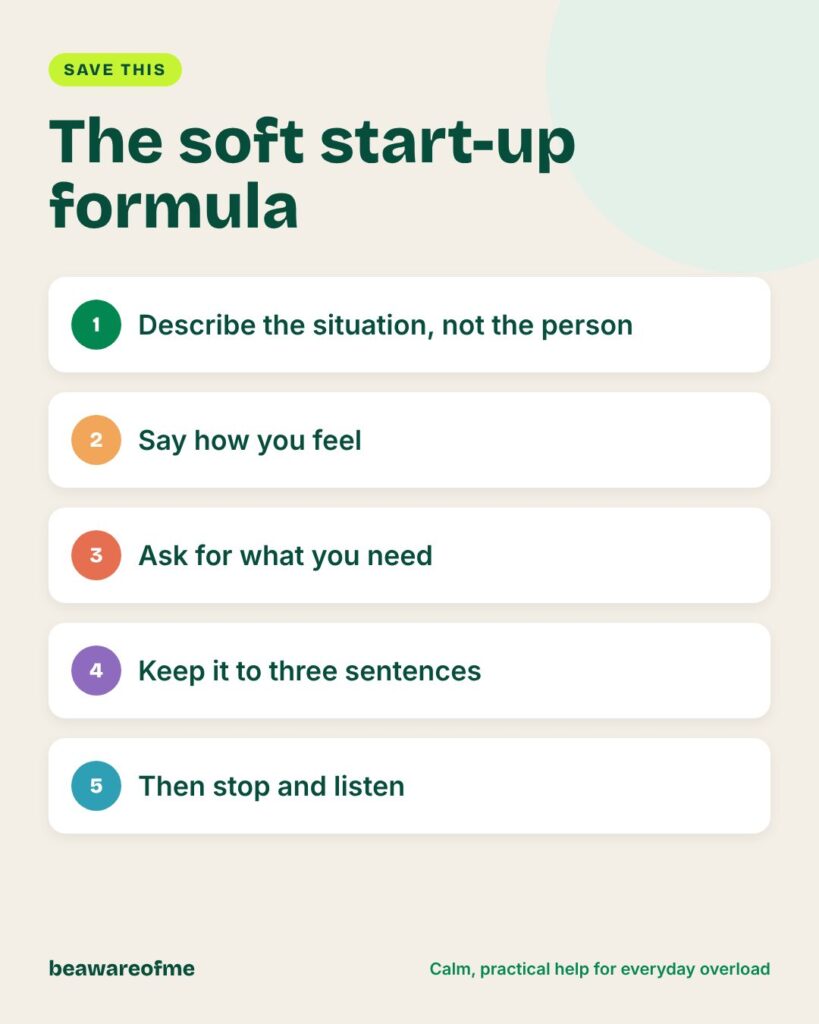
The soft start-up formula
A harsh start-up opens with blame: “You never help.” A soft start-up opens with your own experience and a positive need. Gottman’s advice is to stay with yourself and the specific situation.
Describe the situation, not the person
“The dishes were still in the sink this morning,” not “You’re so lazy.”
Say how you feel
“I felt overwhelmed starting the day like that.”
Ask for what you need, in a positive form
“Could we agree that whoever cooks doesn’t wash up?”
Keep it short
Three sentences, then stop and let them answer.
Harsh versus soft: the same message, two outcomes
⚠️ Watch out
Avoid “always” and “never”. They turn one moment into a verdict on someone’s character, and they invite a debate about the exceptions instead of the real issue.
At work, the same formula sits at the heart of assertive communication. You state facts, feelings and needs clearly, without apologising for having them.
Listen Like You Want to Be Wrong: The Reflect-Back Loop
People calm down when they feel understood, not when they lose the argument. Reflective listening means you repeat the other person’s point in your own words before you respond. It sounds simple, yet it’s surprisingly rare, and it’s the most underused conflict resolution tool there is.
The three-line loop
- Reflect: “So what upset you most was that I made the plan without asking.”
- Check: “Did I get that right, or is there more?”
- Validate: “That makes sense. I’d feel sidelined too.”
Validating doesn’t mean you agree. It means their feelings make sense from where they’re standing. You can still share your side afterwards, and they’ll actually be able to hear it.
If you only remember one listening rule
Listen for the need, not the accusation. “You’re never home” usually means “I miss you.” “This report is a mess” often means “I’m scared we’ll miss the deadline.”
You don’t have to win the argument. You have to understand it well enough to fix one small thing together.
beawareofme
🧭 Try this
In your next disagreement, don’t state your own view until the other person says “yes, that’s it.” Notice how much shorter the conflict gets.
Not Every Conflict Ends in Agreement, and That’s Okay
Some problems have a solution; others are lasting differences you learn to manage. According to the Gottman research reported by Greater Good, 69% of couple problems are perpetual, rooted in personality or lifestyle differences. Trying to “solve” those once and for all only creates gridlock.
Solvable or perpetual? A quick sorting test
How to live with a perpetual difference
Swap “How do I change you?” for “What does this mean to you?” A partner who hates being late may carry a memory of being left behind. A coworker who over-checks everything may have been blamed for mistakes before.
Once you understand the story, you can make a temporary deal. Agree to try it for two weeks, then review, which keeps the conversation open instead of locked. For perpetual issues, that ongoing dialogue is what conflict resolution looks like.
📝 Note
Healthy conflict resolution sometimes ends with a boundary, not a compromise. If a pattern keeps hurting you, learn how to set boundaries without feeling guilty.
Ready-to-Use Scripts for Work, Home and Family
The steps stay the same everywhere; only the words change. Here are simple shapes for the three places most everyday conflict happens. Adapt the words so they sound like you; conflict resolution scripts only work when they feel natural.
With a coworker or manager
Keep it about the work and the outcome you both want. Ask for a short private talk rather than raising it in a meeting.
✅ Try this today
Workplace script
“Do you have ten minutes today? I want to sort out how we split the client follow-ups.”
“When the update went out without my section, I felt left out of the loop. I’d like us to agree on a final check before anything goes to the client.”
“What would work for you?”
If the person keeps undermining you after a fair talk, you’re no longer in a normal disagreement. Our guide on dealing with toxic coworkers covers that harder situation, and how to reset after a high-stress meeting helps you recover afterwards.
With a partner
Choose your timing. Hard talks go badly when either of you is hungry, exhausted or rushing out the door.
- Ask first: “Is now a good time to talk about the weekend plans?”
- Sit side by side, not across a table, if face-to-face feels tense.
- Agree on one topic per conversation.
- End with one concrete step and a time to check in.
With parents, siblings and in-laws
Family conflict carries decades of history, so lower your target. Aim to be clear and kind once, not to change anyone’s mind for good.
A short line works well: “I love you, and I’m not going to discuss my parenting at dinner.” For relatives who push past limits again and again, see our guide to setting boundaries with overbearing relatives.
💡 Tip
If you tend to replay family arguments for days, that loop is a habit, and habits can change. Our guide to breaking negative habits with self-awareness shows you how to catch the pattern early.
After the Argument: The 5-Minute Repair
The repair after a disagreement matters as much as the disagreement itself. A repair is any small move that says “we’re still on the same team”. It can be a joke, a hand on the shoulder, or a direct apology for one specific thing.
Wait until you’re both calm
At least 20 minutes after the heat, or the next morning.
Own one thing
“I raised my voice, and I’m sorry for that.”
Share what you learned
“I realised I was more tired than upset with you.”
Ask what would help
“What would make this feel settled for you?”
Agree on a next time
“Next time I’ll ask for a break sooner.”
Repairs don’t need to be perfect. They need to happen, and they work best when they’re specific. Over time, quick repairs turn conflict resolution from a crisis skill into a normal part of your week.
Build your personal calm-talk plan
Write a short plan while you’re calm, not in the middle of a fight. Keep it on your phone so you can glance at it when tension rises.
- My flooding signs: ___ (for example, hot face, fast talking).
- My break line: “I need 20 minutes, then I’m back.”
- My soft start: “When ___ happened, I felt ___. I need ___.”
- My repair line: “I’m sorry I ___. What would help now?”
A written plan makes conflict resolution less about willpower and more about habit. You simply follow the card.
✨ Quick win
Keep a short note on your phone after each conflict: what set it off, what you felt, what helped. After three or four entries, you’ll see your own pattern clearly. If you want daily practice for that, try these small habits that build self awareness.
Want a quick read on whether your limits are working? Our free self-check, are your boundaries healthy?, takes a few minutes.
5 Conflict Resolution Mistakes That Keep the Same Fight Going
Most repeated fights aren’t about the topic; they’re about the method. These five conflict resolution mistakes are common, and each has a simple fix.
1. Solving while flooded
You push on because stopping feels like losing. In a flooded state, though, you can’t take in new information. Instead, call a timed break and come back calmer, since conflict resolution works best at a normal heart rate.
2. Winning the point and losing the person
You prove you’re right with dates and receipts. The other person feels cornered, so they stop sharing. Instead, ask yourself whether you’d rather be right or close.
3. Stacking old grievances
One topic becomes five, and nobody can fix five things at once. Instead, agree on one issue per talk and write the rest down for another day.
4. Apologising just to end it
A quick “fine, sorry” stops the noise but leaves the issue alive. Resentment then leaks out somewhere else. Instead, apologise only for what you genuinely own, and say what you still need.
5. Treating every disagreement as solvable
Some differences never fully go away, and that’s normal. Fighting the same perpetual issue again and again creates gridlock. Instead, get curious about what the difference means to each of you, because good conflict resolution sometimes means learning to live with a difference kindly.
📚 Keep reading
Conflict Resolution Questions People Ask Most
What are the 5 steps of conflict resolution?
A practical five-step version is: calm your body, name your feeling, start softly with the situation and your need, reflect back what the other person says, then agree on one small next step. Different models use different labels, but they share the same core. Regulate first, understand second, solve last. Skipping straight to solutions is the most common reason conflicts restart.
How do you stay calm during an argument?
Watch for flooding signs such as a racing heart, a hot face or an urge to shout or leave. If you notice two or more, ask for a timed break of at least 20 minutes and say when you’ll return. During the break, walk or breathe slowly with longer out-breaths. Avoid replaying the argument, because that keeps your stress response switched on.
What should you never say during a conflict?
Avoid “always” and “never”, name-calling, threats to leave, and comments about someone’s character instead of their behaviour. Sarcasm and eye-rolling also land as contempt, which makes people defensive fast. Instead, describe the specific situation, say how you felt and ask for what you need. Short, specific sentences keep the talk focused on something fixable.
Is it okay to walk away from an argument?
Yes, as long as you say you’re coming back and give a time. A break helps when you’re flooded, because it lets your body settle. Walking out in silence, though, can feel like rejection and escalate the conflict. Try: “I want to sort this out, and I need 20 minutes first. I’ll find you at eight.”
How do you resolve conflict with someone who won’t talk?
Lower the pressure. Pick a calm moment, keep your opening short and gentle, and offer a choice of time: “Could we talk about this tonight or tomorrow?” Some people shut down because they feel overwhelmed, not because they don’t care. If silence becomes a long-term pattern, a counsellor or mediator can help both of you.
Why do we keep having the same argument?
Repeated arguments usually point to a perpetual difference, such as how you each handle money, time or closeness, rather than a one-off problem. Gottman’s research suggests most couple problems fall into this group. Instead of trying to win, ask what the issue means to each of you. Understanding the story behind it often turns a stuck fight into a workable compromise.
Conflict resolution isn’t about never fighting; it’s about fighting in a way that leaves you both a little closer. Start with your body, open softly, listen until they feel heard, and finish with a repair. Each calm conversation makes the next one easier, and that’s how real change in your relationships begins.
🤍 A gentle note
Educational content, not a substitute for professional care. If you are struggling, talk to a doctor or a qualified professional. If you are thinking about harming yourself, contact local emergency services or a crisis line now (US 988, UK and Ireland Samaritans 116 123, or findahelpline.com).