



If you’ve been searching for how to stop thinking about work on weekends, you probably know the pattern: Friday ends, but your head keeps the laptop open. You replay a meeting on Saturday morning, draft an email in your head at the supermarket, and by Sunday afternoon the week has already started. This guide gives you a Friday shutdown that takes 15 minutes, a way to sort the thoughts that still show up, and a weekend plan that works even when your workload is heavy.
• Studies link low detachment with more exhaustion and lower well-being, and high workload is one of the strongest reasons people can’t detach.
• Not every work thought is a problem: thinking about a win or a good idea tends to lift mood rather than drain it.
• An unfinished task stays “open” in your head; writing it down with a next step and a time is what lets it close.
• If you can’t switch off most weekends for weeks on end, that’s information about your workload, not a personal failing.
Why your brain keeps working when you don’t
This section explains why work follows you home, because the fix depends on the cause. Most people assume they can’t switch off because they care too much or lack discipline. In practice it’s usually one of three things: an open loop, an overloaded week or a phone that keeps reopening the office.
Work and organisational psychologists have studied this for two decades under the name psychological detachment: mentally stepping away from your job during non-work time, not just physically leaving it. A review of that research found that job stressors, especially workload, predict low detachment, and that low detachment in turn predicts higher strain and poorer well-being, including burnout (Sonnentag & Fritz, stressor-detachment model). The uncomfortable part is what one researcher called the recovery paradox: the weeks when you most need to switch off are exactly the weeks when it’s hardest.
The three engines behind weekend work thoughts
- Open loops. A task you left half-done, a reply you haven’t sent, a decision with no date. Your mind keeps returning to anything that has no next step.
- Volume. When there is simply more work than hours, your brain keeps rehearsing it because it’s trying to find time that doesn’t exist.
- Easy re-entry. One notification on Saturday morning drops you straight back into the inbox. Every check restarts the loop.
That’s why the plan below starts on Friday, not Saturday. If you only try to block thoughts once they arrive, you’re fighting the symptom. If you close the loops before you log off, there’s far less to block. It also links closely to evenings: the same habits that help you decompress after work on a weekday work at the bigger scale of a weekend.
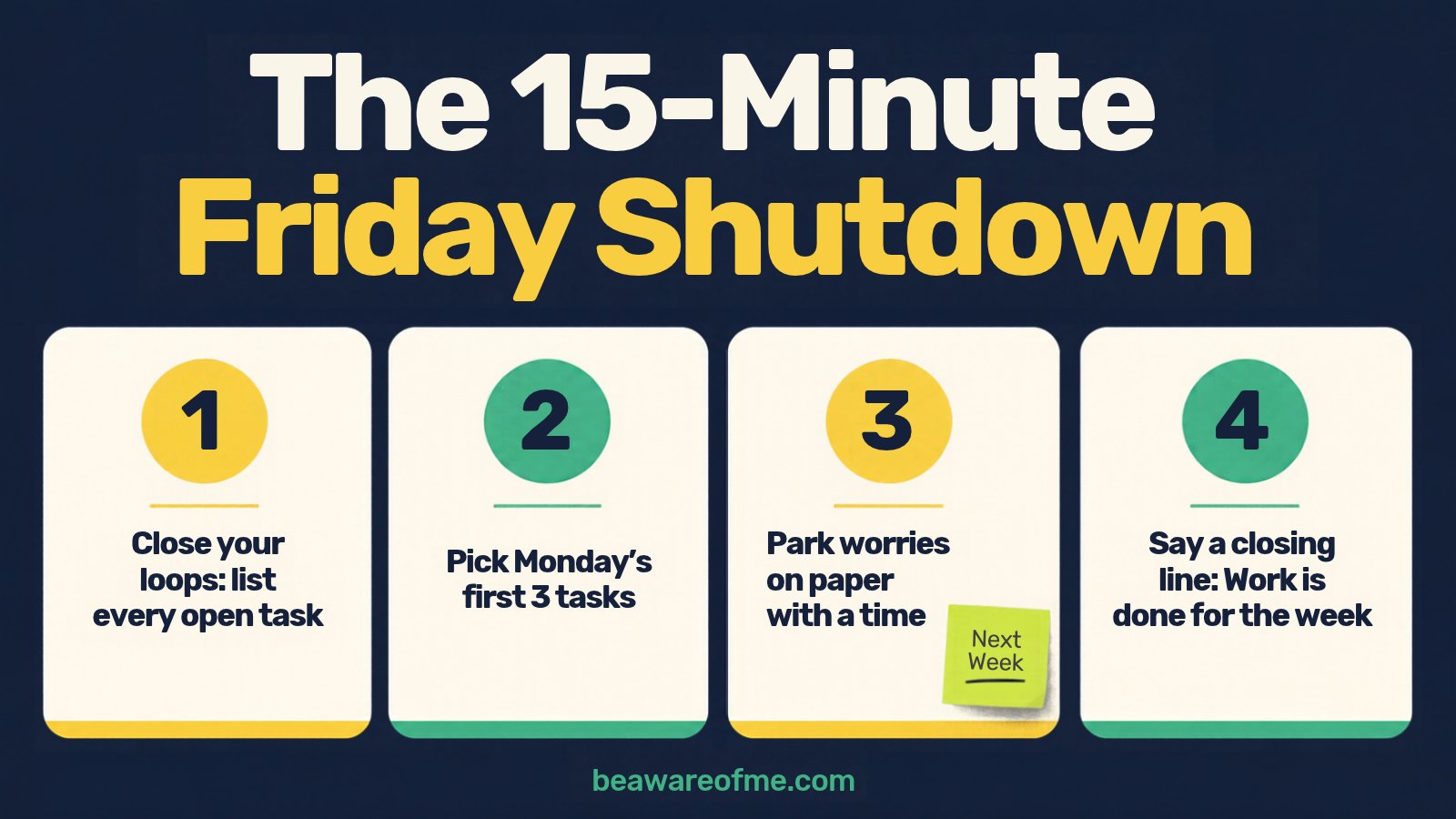
How to stop thinking about work on weekends: the 15-minute Friday shutdown
This is the core habit, and it takes about a quarter of an hour at the end of your last working day. Do it at your desk, before you close the laptop, not on the train home when you’ve already left.
Keep the page where you’ll see it on Monday, not by your bed. You’re not trying to remember any of it over the weekend; that’s the whole point of writing it down.
Many people find the same loop restarts on Sunday afternoon. If that’s you, pair this shutdown with the evening plan in how to stop dreading Monday on Sunday night.
Sort the thought before you fight it
This section shows you how to respond when a work thought shows up anyway, because it will. The key is to notice what kind of thought it is, since each type needs a different response.
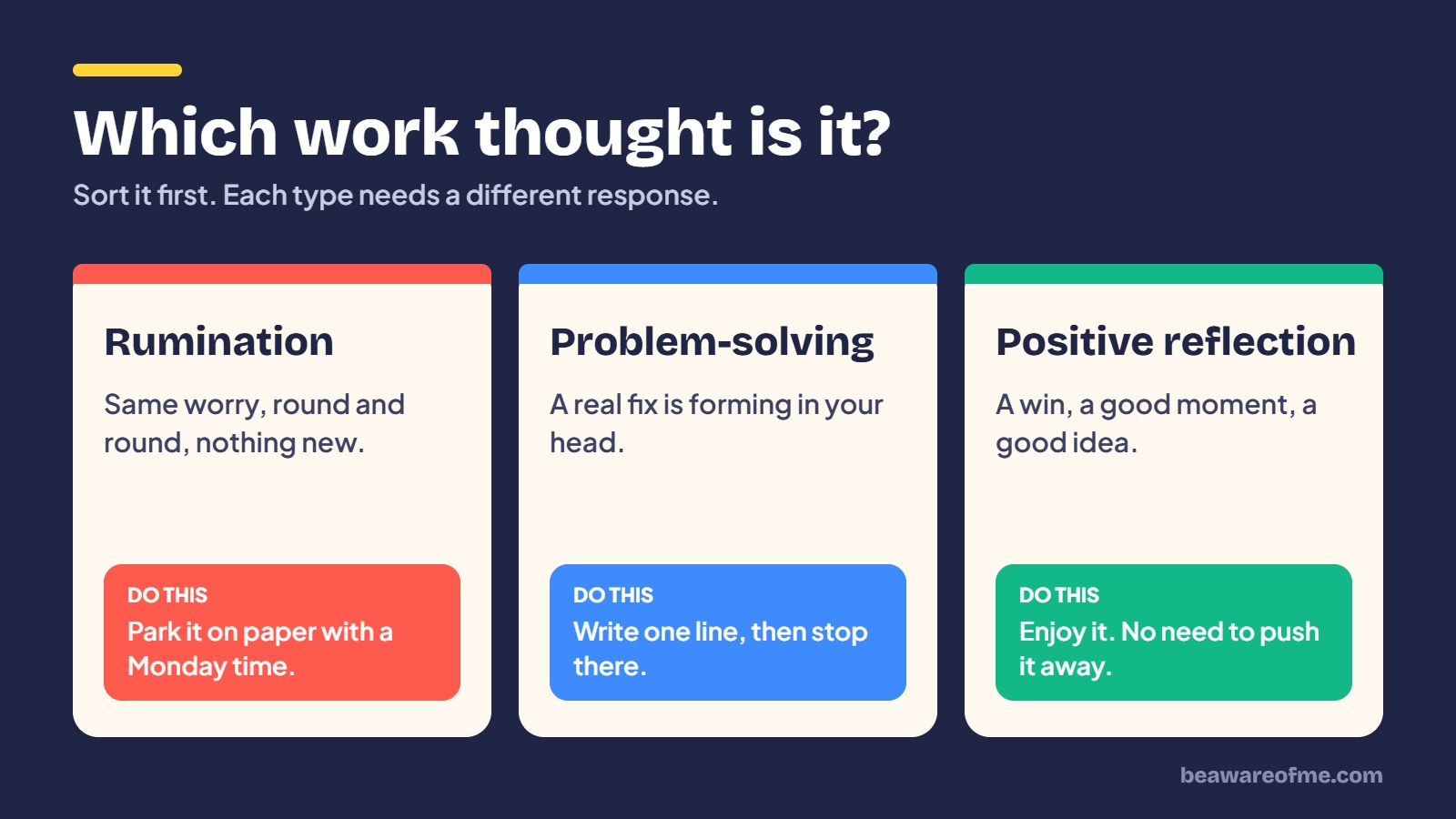
The test is simple: is this thought giving you something new? If it is, capture it in one line and let it go. If it’s the same thought for the fourth time, it belongs on paper with a time, not in your weekend.
A 60-second reset when you catch yourself
- Name it: “That’s a work thought.” Naming it creates a small gap between you and it.
- Check the type using the table above.
- Capture or park it: one line in your notes, or onto Monday’s list.
- Do something with your hands for two minutes: wash a cup, water a plant, stretch, step outside.
If you notice your thoughts often loop like this at night as well, the techniques in calming anxiety at night use the same “park it with a time” idea.
Build a weekend that pulls your attention somewhere else
This section is about what you put into the weekend, because an empty Saturday is where work thoughts grow fastest. Trying not to think about something rarely works on its own. Giving your mind something better to hold onto works much better.

Activities that are absorbing, physical or social tend to crowd work out naturally. Passive ones, like scrolling or half-watching TV with your phone in hand, leave plenty of space for the replay to start.
| Pulls attention away | Leaves room for work thoughts |
|---|---|
| Cooking a new recipe, gardening, DIY, a craft | Scrolling news or social feeds |
| A walk, run, swim or class with other people | Lying in with your phone |
| Seeing a friend face to face | Background TV while half-checking messages |
| Learning something unrelated to your job | “Just a quick look” at the inbox |
Plan one anchor for Saturday and one for Sunday
You don’t need a packed schedule. One fixed, absorbing thing per day is enough to give the weekend a shape: a Saturday morning swim, a Sunday lunch with your sister, a two-hour bike ride. The rest can stay loose.
If your Sunday tends to fill up with chores and worry, the 90-minute plan in our Sunday reset routine checklist gives you a contained slot for both, so they stop leaking into the rest of the day.
Keep the office out of your pocket
This section covers your phone, which is the most common way work gets back into a weekend. Every notification is a small door back into the office, and each time you open it the loop restarts.
- Sign out of work apps on Friday or use your phone’s Focus or Digital Wellbeing mode to hide them until Monday morning.
- Move work email off your home screen. A second tap is often enough to break the habit.
- Set an out-of-hours line in your email signature so people know when you’ll reply.
- Agree what counts as urgent with your manager or team, and how they’ll reach you if it really is.
If checking email at night is the bigger problem for you, the 7-day plan in how to stop checking work emails after hours covers notifications, expectations and the conversation with your boss step by step.
Give leftover thoughts one short Sunday slot
This section offers a safety valve. Some weeks are just heavy, and pretending otherwise makes the thoughts louder. Rather than worrying in small bursts all weekend, give it one container.

Pick a 15-minute slot on Sunday afternoon or early evening. Sit down with Friday’s page and do three things: add anything new, check that Monday’s first three tasks still make sense, and decide whether anything really needs action before 9am Monday. When the timer ends, close the notebook. If a work thought shows up outside that slot, you can tell yourself, truthfully, “That’s for Sunday at 5.”
Many people find this does more than reduce worry. It makes Monday morning easier, because the first hour is already decided.
A sample weekend that actually switches off
This section puts all of the steps together, so you can see what a normal weekend looks like with the plan in place. It isn’t a timetable to follow to the minute; it’s an example of where each piece sits.
| When | What you do | Why it helps |
|---|---|---|
| Friday, last 15 minutes | Friday shutdown: loops, Monday’s three, parked worries, notifications off | Closes the week while you’re still at your desk |
| Friday evening | Something physical or social: cook with someone, a walk, a class | Draws a clear line between work and weekend |
| Saturday morning | Your Saturday anchor: a swim, the market, a long breakfast with the phone in another room | Absorbing activity crowds out the replay |
| Saturday, any time | 60-second reset whenever a work thought loops | Sorts the thought instead of fighting it |
| Sunday afternoon | Your Sunday anchor, then the 15-minute Sunday slot at a table | Contains the leftovers in one short window |
| Sunday evening | A calm, screen-light evening and a normal bedtime | Monday’s first hour is already decided |
Notice what isn’t there: no inbox checks, no “quick look” at the project tool and no hours of trying not to think. The weekend has a shape, and work has two small, fixed places in it, on Friday and on Sunday.
Give it three weekends before you judge it. The first one often feels odd, because your brain is used to checking. By the third, most people find the Friday page does a lot of the work on its own.
If you work shifts or weekends
If your “weekend” is a Tuesday and Wednesday, the plan is the same; only the days move. Do the shutdown at the end of your last shift before your days off, and the short review on the evening before you go back. Shift workers often find the switch-off harder because sleep is out of step too, so protect the first sleep after your last shift before anything else.
Our guide on a 20-minute decompression routine after work adapts well to the end of a run of shifts, and the free How Empty Is Your Battery? check can show whether sleep, work or people are draining you most.
When you still can’t switch off: what it’s telling you
This section is for the weeks when nothing above seems to work. If you can’t stop thinking about work on most weekends, for weeks at a time, that’s useful information rather than a personal failure.
- The workload is too big for the hours. Write down everything you’re responsible for and estimate the hours. If the total is bigger than your week, no weekend habit will fix that; it’s a conversation about priorities with your manager.
- You’re running low. Constant work thoughts can be one of the early signs of burnout, alongside tiredness that sleep doesn’t fix and feeling detached from your job.
- Something specific is weighing on you. A conflict, a review or job insecurity tends to grab attention far more than general busyness.
If you’re not sure which applies, our free burnout early signs check takes a minute and shows which part of work is pulling hardest. You can also read how to recognize burnout early or the signs you are burnt out, not lazy.
Common mistakes when trying to switch off
1. Trying to force the thoughts out
Telling yourself “don’t think about work” usually brings work straight back to mind. Instead, give the thought a place (your Friday page) and give your attention something else to do.
2. Leaving the shutdown until you’re home
By the time you’re on the sofa, the loops are already open. Do the 15 minutes at your desk, before you close the laptop, so the week actually ends at work.
3. “Just checking” email on Saturday
A quick look rarely stays quick. Even a calm inbox gives your brain a reason to start planning. If you must check, do it at one agreed time and stop.
4. Leaving the weekend completely empty
Rest doesn’t have to mean nothing. An empty day gives work thoughts all the room they want. One absorbing activity per day protects your attention far better than a blank calendar.
5. Treating every work thought as a failure
Remembering a good moment from your week is fine, and often pleasant. Save your effort for the loops that repeat without going anywhere.
FAQ: how to stop thinking about work on weekends
Why can’t I stop thinking about work on weekends?
Usually because something is still open: an unfinished task, a decision with no date or a worry with no next step. High workload makes this more likely, and so does checking email on your phone. Closing the week on Friday, by writing down every open loop and Monday’s first three tasks, removes most of the fuel.
Is it bad to think about work on my days off?
Not always. Thinking about a win or a good idea can feel energising, and research suggests positive thoughts about work can lift mood. The thoughts to reduce are the repetitive, worried ones that go round without leading anywhere, because those are the ones linked with exhaustion.
How do I mentally switch off from work on Friday night?
Do a short shutdown before you leave: list every open task, pick Monday’s first three jobs, park any worry on paper with a set time and turn off work notifications. Then start something physical or social on Friday evening, so there’s a clear line between the week and the weekend.
Should I check work email on the weekend?
If your role doesn’t require it, no. Even a quick check can restart planning and worry. If you do need to be reachable, agree one or two set check-in times, tell your team, and stay fully off the rest of the weekend.
What should I do if work thoughts keep me up on Sunday night?
Keep a notepad by your bed, write the thought down with the word “Monday” next to it and go back to a slow breathing pattern. Earlier in the evening, a 15-minute Sunday slot to review your Monday list makes this much less likely.
When is not switching off a sign of burnout?
If you can’t stop thinking about work on most weekends for weeks, and it comes with tiredness that sleep doesn’t fix, irritability or feeling detached from your job, it may be an early sign of burnout. A simple self-check can help, and talking to your manager or a professional is a sensible next step.
The bottom line
The most useful change for how to stop thinking about work on weekends is to close the week before you leave it: one page, three Monday tasks and a time for every worry. Start this Friday with just the 15-minute shutdown, then add one absorbing plan for Saturday. For more on looking after yourself at work, browse our mental health in the workplace guides or start with how to recognize burnout early.
Sources: Sonnentag, S. & Fritz, C. (2015). Recovery from job stress: the stressor-detachment model as an integrative framework. Journal of Organizational Behavior (CDC Stacks: stacks.cdc.gov/view/cdc/203151) · Sonnentag, S. (2018). The recovery paradox. Research in Organizational Behavior, 38 · Sonnentag, S. & Niessen, C. (2020). To detach or not to detach? Two experimental studies on the affective consequences of detaching from work during non-work time · American Psychological Association, Monitor on Psychology (2005): Taking work home can depress mood, energy