Work takes up most of your waking hours, so it shapes your mood more than almost anything else. If you leave most days drained, tense or quietly dreading tomorrow, you’re not weak, and you’re definitely not alone. This guide shows you how to foster mental health at work with small daily habits, honest scripts for hard conversations, and a simple plan for team leaders. Everything here works in an ordinary job, starting this week.
The short answer
To foster mental health at work, protect three things every day: focus, recovery and connection. Plan a few clear priorities, check messages at set times, and take short breaks away from screens. Close each day with a shutdown ritual so work stays at work. Then tackle your biggest pressure point, like unclear roles or heavy workload, with one calm, specific conversation. Leaders can help by giving people more control and regular check-ins.
Key takeaways
Find your main pressure point first, because a workload problem needs a different fix than a support problem.
Plan three priorities each morning so the day has a clear shape before the inbox takes over.
Take short, screen-free breaks every 90 minutes or so to let your nervous system reset.
Bring your manager a specific request with two options, not a general complaint about stress.
Use the support you already have, such as an employee assistance program, before things feel urgent.
Talk to a doctor or qualified professional if stress lasts for weeks or rest stops helping.
Why Work Shapes Your Mind More Than You Think
Work affects your mental health through the hours, pressure, people and sense of purpose it brings into your life. A good job can steady you. A badly set up one can wear you down, even if you love what you do.

The numbers make this hard to ignore. The World Health Organization’s fact sheet on mental health at work estimates that depression and anxiety cost the world 12 billion working days every year. The American Psychological Association’s Work in America survey found that 77% of workers felt work-related stress in the past month.
12 billion
working days lost each year to depression and anxiety (WHO)
US$1 trillion
in lost productivity every year (WHO)
77%
of US workers felt work-related stress in the past month (APA)
19%
of workers called their workplace somewhat or very toxic (APA)
The good news hidden in those numbers
Most of the strain comes from how work is set up, not from who you are. That matters, because setups can change. When you foster mental health at work, you’re adjusting the conditions around you, not fixing a personal flaw.
If you want the bigger picture on recognising strain early, our guide to stress in the workplace covers the quiet warning signs.
📝 Note
Stress is a normal response to pressure, not a diagnosis. This article covers everyday work strain. If you’re living with a mental health condition, your doctor can help you plan support that fits.
What It Really Means to Foster Mental Health at Work
To foster mental health at work means building steady conditions that help your mind stay well, rather than waiting for a crisis and reacting. Think of it like tending a garden, not calling a firefighter. Small, regular care beats one dramatic rescue.
Most advice gets this backwards. It hands you a meditation app and calls the job done. Real change comes from three everyday pillars, and you can work on each one without permission from anyone.
Pillar 1: Focus
Focus means knowing what matters today and getting to do it without constant interruption. When focus breaks down, everything feels urgent and nothing feels finished. That stuck feeling drains people faster than hard work itself.
Pillar 2: Recovery
Recovery means real pauses during the day and a clear ending after it. Your stress system needs time to switch off, the same way muscles need rest after exercise. Without recovery, small pressures stack up quietly.
Pillar 3: Connection
Connection means having people at work who notice you and help you. You don’t need a big social circle. One or two supportive colleagues can make a hard job feel survivable, and sometimes even good.
💡 Tip
Ask yourself which pillar feels weakest right now. Start there. When you foster mental health one pillar at a time, the changes feel lighter and they tend to stick.
The 6 Pressure Points Behind Most Hard Workdays
Most work strain traces back to one of six pressure points, and spotting yours makes every fix easier. These come from the risks WHO highlights. Read the table, then circle the row that feels most familiar.
Control matters more than people expect. In the APA survey, 79% of workers happy with their control over how, when and where they work rated their mental health good or excellent. Only 44% of dissatisfied workers said the same.
⚠️ Watch out
Bullying, harassment or discrimination isn’t a stress-management problem. Don’t try to breathe your way through it. Keep dated notes, and report it through HR or a trusted manager.
9 Simple Ways to Foster Mental Health at Work: Your Daily Five
The first five habits shape your day so it stays manageable from morning to log-off. Each takes under ten minutes. Pick two to start, not all five. That’s the easiest way to foster mental health without overwhelm.
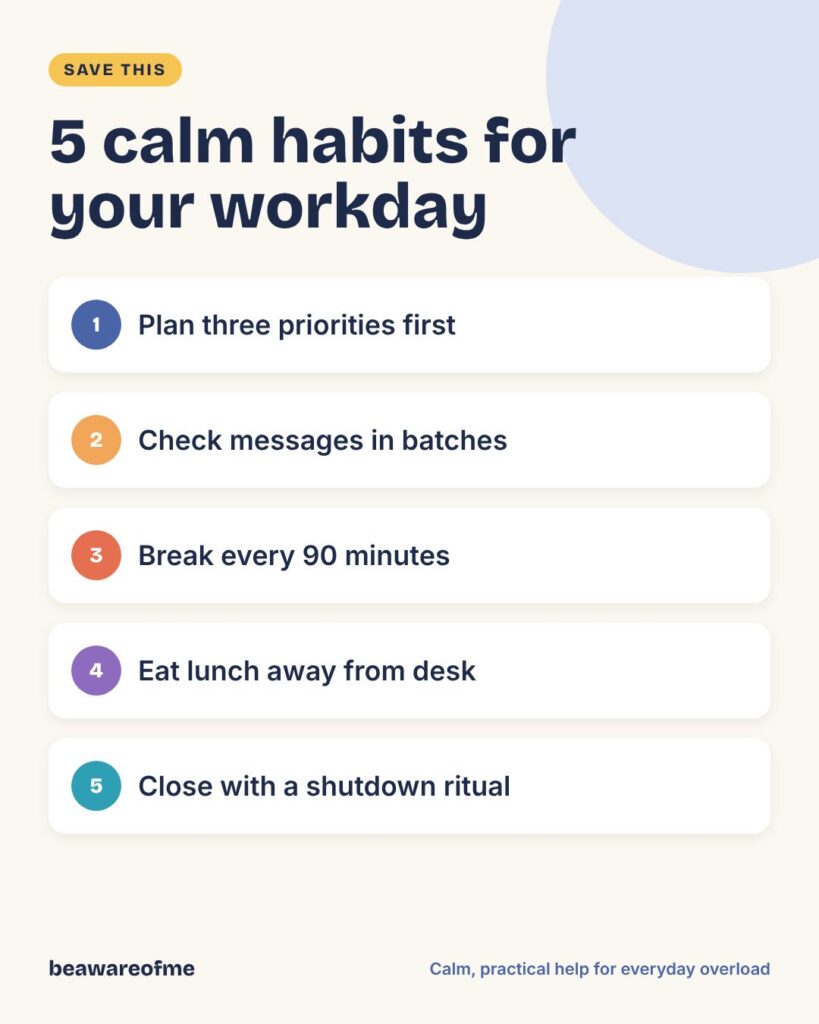
1. Plan three priorities before you open email
Your inbox is a list of other people’s priorities. Before you open it, write down the three things that would make today a win. If something new arrives, ask whether it beats one of the three. Usually, it doesn’t. This one habit can foster mental health quietly, because it gives you back a sense of control.
2. Check messages in batches, not all day
Constant pings keep your stress system on low alert. Try checking messages at set times, such as on the hour. Turn off pop-up alerts for everything except truly urgent channels. Most messages can wait 45 minutes without harm.
3. Take a screen-free microbreak every 90 minutes
A break only helps if it’s actually a break. Stand up, look out a window, refill your water, or walk to the end of the corridor. Scrolling your phone doesn’t count, because your brain keeps processing. Short, real breaks foster mental health better than one long lunch.
✨ Quick win
Set a gentle 90-minute timer. When it goes off, stand and take five slow breaths, out longer than in. It takes one minute and resets your focus.
4. Eat lunch away from your desk
Desk lunches feel efficient, but they rob you of the one real pause in the day. Even 15 minutes somewhere else helps. If you can, eat with a colleague. A short, easy chat lifts mood more than you’d guess. Shared meals foster mental health through connection, not just rest.
5. Close the day with a two-minute shutdown ritual
Without an ending, work follows you home. Before you log off, write tomorrow’s first task, close every tab, and say a simple phrase like “done for today.” It sounds small, yet it gives your brain permission to stop. Our guide on recovering from work stress has more evening ideas.
The Weekly Four: Habits That Protect You Long-Term
The last four habits work on a weekly rhythm and protect you from slow build-up. Daily habits get you through Tuesday. These get you through the year. They foster mental health slowly, the way savings build up.
6. Name your boundary hours out loud
Boundaries work best when people know them. Tell your team when you’re reachable and when you’re not. Then stick to it most of the time. If you struggle with this, our piece on setting healthy boundaries offers gentle wording.
7. Build one work ally
You don’t need a work best friend. You need one person you can message with “Is it just me?” Swap small favours, share a coffee, cover for each other. Support from colleagues buffers stress in a way solo coping can’t. Few things foster mental health at work as reliably as one kind colleague.
8. Use the support you already have
Many workplaces offer help that nobody uses. Check for an employee assistance program, mental health days, flexible hours or wellbeing leave. The APA found only 29% of workers said their employer offers an EAP, so ask HR what’s available where you are.
9. Do a 10-minute Friday review
Every Friday, ask yourself three questions. What drained me most this week? What gave me energy? What’s one thing I’ll change next week? Over a month, you’ll see patterns that daily stress hides. Those patterns show you exactly where to foster mental health next.
Try this today: your Friday review card
Copy these four lines into your notes app and fill them in before you log off.
The task or moment that drained me most was…
The thing that gave me energy was…
Next week I’ll change one thing:…
One person I’ll thank or check in with:…
How to Ask Your Manager for Help Without Oversharing
The best way to raise stress at work is to talk about the work, not your inner life. Managers respond well to specific problems and clear options. You don’t owe anyone a diagnosis or your full story. A clear request can foster mental health for you and your team at the same time.
A three-part script that works
- Name the situation: “I’ve got the report, two client projects and the audit due this month.”
- Name the impact: “I can’t do all of them well at this pace.”
- Offer two options: “Could we move the audit back a week, or share the second project?”
Ask for a short meeting ahead of time rather than catching your manager in a corridor. Afterwards, send a two-line email confirming what you agreed. That small habit protects you and keeps everyone clear.
💡 Tip
If talking feels too hard, write it first. Many people find it easier to send a short message, then discuss it in person once the words are out.
If your manager is the problem
Sometimes the person you’d ask is the source of the stress. In that case, go to their manager, HR, or a trusted senior colleague. Keep notes with dates and facts, and stay calm and specific.
If You Lead a Team: 5 Ways to Foster Mental Health for Everyone
Leaders foster mental health at work mainly through everyday behaviour, not big programs. The way you plan, respond and switch off sets the tone for the whole team. These five steps cost almost nothing, and they foster mental health far better than a one-off wellbeing day.
Hold short, regular check-ins
Ten minutes every week or two. Ask “What’s getting in your way?” and then listen more than you talk.
Make priorities painfully clear
Tell people what matters most and what can slip. Unclear roles are a major stressor on WHO’s list.
Give people real choices
Offer some control over when, where or how work happens. The APA data links control with better mental health.
Model rest out loud
Take your leave, log off on time, and say so. People copy what you do, not what you say.
Learn to spot distress
WHO recommends manager training for mental health. Learn to notice changes, ask kindly and point people to support.
“People don’t need a perfect manager. They need a predictable, kind one.”
For more depth, read our guides on supporting employees with anxiety and stress and building resilience in the workplace. You’ll find more in our workplace mental health library.
Remote, Hybrid or On-Site: Adjust the Plan to Where You Work
Where you work changes which habits matter most, so tweak the plan to fit your setup. The goal stays the same: focus, recovery and connection. Only the tactics shift. You can foster mental health in any setup once you know which lever to pull.
Working from home
Remote work brings flexibility but blurs edges. Create a fake commute, like a ten-minute walk before and after work. Keep your laptop out of the bedroom. Schedule one call a week that’s purely social. Our guide to the hidden struggles of working from home goes further.
Hybrid weeks
Use office days for collaboration and home days for deep work. Plan which tasks go where on Sunday or Monday morning. That way, neither day feels wasted.
On-site and shift work
If you can’t control your hours, protect what’s around them. Keep a steady wind-down routine after shifts. Use breaks to step outside, even briefly. Daylight and movement help reset a tired system.
When Work Stress Needs More Than Habits
Habits help with everyday strain, but they can’t fix ongoing overload, mistreatment or a health problem. Knowing the difference keeps you from blaming yourself when tips stop working. Sometimes the kindest move is asking for more help. Habits foster mental health, but they don’t replace care.
Signs it’s time to reach out
- Rest and weekends no longer refresh you.
- You dread work most days, for weeks.
- Sleep, appetite or mood have clearly changed.
- You feel numb, cynical or detached from your job.
- Physical symptoms, like headaches or stomach trouble, keep returning.
If several of these fit, try our free burnout early signs check. You can also learn the difference between stress and burnout. Then book a chat with your doctor or a qualified professional.
Your 4-Week Plan to Foster Mental Health, One Step at a Time
A four-week plan lets you foster mental health at work gradually, so new habits stick instead of fading by Friday. Each week adds one layer. Keep what works, drop what doesn’t, and don’t chase perfection.
At the end of each week, run your Friday review. If a habit feels forced after two weeks, swap it for a different one. The aim is a steady routine that helps you foster mental health without adding more pressure to your plate.
📝 Note
Progress rarely looks like a straight line. A rough week doesn’t erase what you’ve built. Pick up where you left off on Monday.
5 Common Mistakes That Quietly Undo Your Efforts
Even good intentions can backfire. These mistakes come up again and again when people try to foster mental health at work.
Mistake 1: Trying every habit at once
A sudden ten-habit overhaul usually collapses by Thursday. Instead, pick two habits and run them for two weeks. Add one more only when those feel automatic.
Mistake 2: Treating breaks as phone time
Scrolling feels like rest but keeps your brain busy. Swap at least one break a day for movement, daylight or a real conversation.
Mistake 3: Complaining instead of asking
“I’m so stressed” gives your manager nothing to act on. A specific request with two options gets results far more often.
Mistake 4: Waiting for the company to fix everything
Good employers help, but you can’t wait for them. You can foster mental health in your own corner of the job today. Small personal habits protect you now, while bigger changes take shape.
Mistake 5: Calling it resilience when it’s mistreatment
Resilience means bouncing back from normal pressure. It doesn’t mean tolerating bullying or endless overload. If something is wrong, name it and report it.
Frequently Asked Questions: Mental Health and Work
How can I foster mental health at work if my job is stressful?
Start with what you control. Plan three priorities each morning, check messages at set times, and take short breaks away from your screen. Close the day with a two-minute shutdown ritual. Then pick one pressure point, such as unclear priorities, and raise it calmly with your manager. Small, steady changes protect your mind even when the job stays busy.
What are the biggest risks to mental health at work?
The World Health Organization lists heavy workloads, little control over your work, long or inflexible hours, unclear roles, poor support, job insecurity, and bullying or harassment among the main risks. Most people face one or two of these more than the rest. Naming your main one helps you choose a fix that actually matches the problem.
Should I tell my employer about my mental health?
That’s your choice, and you don’t have to share a diagnosis. Many people simply describe what would help, such as clearer priorities or a quieter workspace. If you need formal adjustments, sharing more may help you access them. Check your workplace policy, and consider talking to HR, an employee assistance program, or a doctor before you decide.
What is an employee assistance program?
An employee assistance program, or EAP, is a confidential service some employers offer. It often includes short-term counselling, plus advice on stress, money, legal or family issues. Your employer usually doesn’t learn who uses it. The APA’s Work in America survey found only 29% of workers said their employer offers one, so check your staff handbook or ask HR.
How do I know if work stress has become burnout?
Burnout usually shows up as deep exhaustion, growing cynicism about your job, and feeling less effective, even after time off. Ordinary stress tends to ease when the pressure drops. If rest no longer helps, and you dread work most days, take it seriously. Try a burnout self-check, then talk to a doctor or qualified professional about what you notice.
What can managers do to support mental health at work?
Managers can hold regular one-to-one check-ins, set clear priorities, respect off-hours, and give people more say in how and when they work. They can also model taking breaks and leave. The World Health Organization recommends manager training so leaders can spot distress, listen well and respond calmly. Small, consistent actions build trust faster than big programs.
You can foster mental health at work one small habit at a time, even in a busy job. Start with three priorities, one real break and a shutdown ritual this week. As those settle in, your days will feel steadier and your evenings will feel like yours again.
Please read
Educational content, not a substitute for professional care. If you are struggling, talk to a doctor or a qualified professional. If you are thinking about harming yourself, contact local emergency services or a crisis line now (US 988, UK and Ireland Samaritans 116 123, or findahelpline.com).