You open one app to check a message, and forty minutes later you feel flat, tense or oddly behind in life. That drained feeling isn’t in your head. The impact of social media on mental health is real, but it’s also uneven: some scrolling lifts you, and some quietly wears you down. This guide shows you how to tell the difference and gives you calm, specific ways to reset your habits, whether you unplug for a week or simply scroll smarter.
The impact of social media on mental health depends less on the app and more on how you use it. Endless passive scrolling, constant comparison, late-night checking and frequent posting for approval are linked with more anxiety, low mood, loneliness and poorer sleep. Using it on purpose, for real connection, with time limits and screen-free evenings, tends to feel much better. You rarely need to quit completely. Most people feel lighter by cutting back and changing what they see.
- ✓Notice how you feel after scrolling, not during it, because that after-feeling is the clearest sign of how an app affects you.
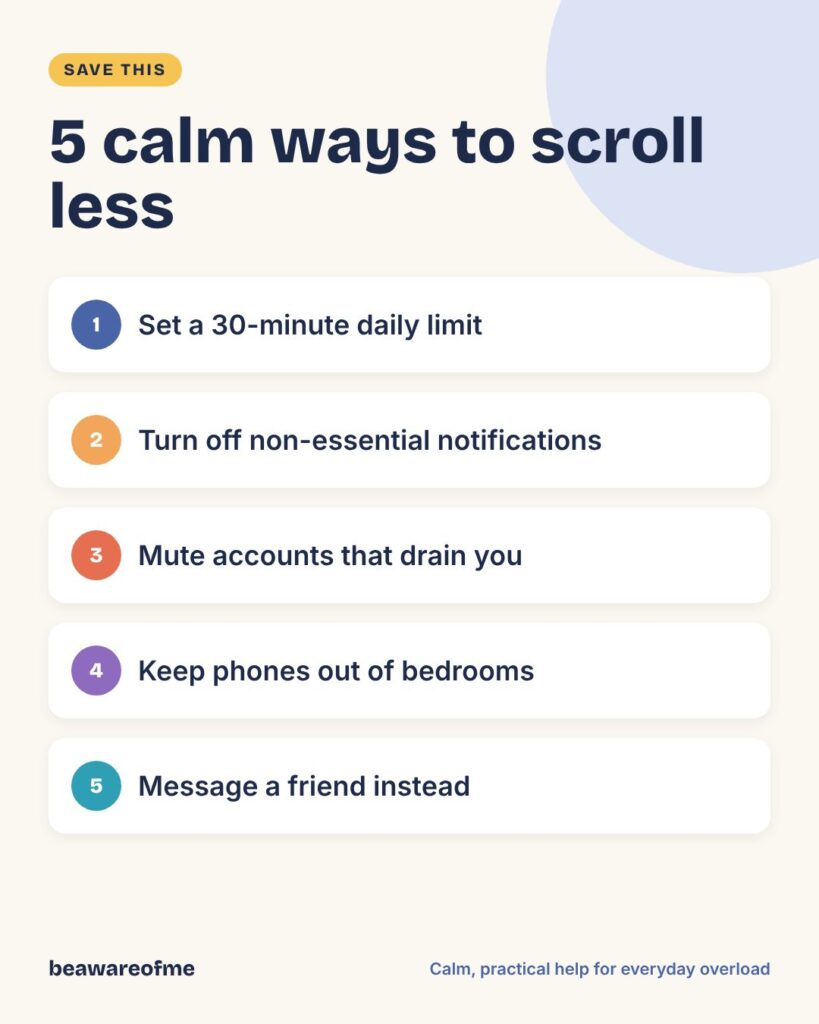
- ✓Set a daily limit of around 30 minutes for your most draining apps and track it for two weeks before judging the result.
- ✓Unfollow or mute any account that leaves you comparing, worrying or feeling behind, even if you like the person.
- ✓Keep phones out of the bedroom and stop scrolling at least an hour before sleep to protect your rest.
- ✓Swap some passive scrolling for active connection, like messaging one friend or making a plan to meet.
- ✓Talk to a doctor if low mood, worry or poor sleep lasts most days for two weeks or more, whatever the cause.
What the Impact of Social Media Really Feels Like in Your Mind and Body
The impact of social media shows up first as small shifts in mood, focus and sleep, long before it feels like a problem. You might not notice it while you scroll. You notice it afterwards.
Think about the last time you put your phone down after a long scroll. Did you feel rested? Most people describe something closer to a fog: a little restless, a little low, and strangely tired for someone who has been sitting still.
That fog has a few clear sources. Your attention jumps from post to post every few seconds. Your brain keeps comparing your real life with other people’s highlight reels. And notifications train you to expect something new at any moment, so it gets harder to settle.
The three channels where scrolling affects you
- Mood: comparison, bad news and arguments in the comments can leave you anxious, irritable or flat.
- Attention: fast switching between short clips makes slow tasks, like reading or deep work, feel harder.
- Body: late-night scrolling pushes back sleep, and tired brains handle stress less well the next day.
None of this means social media is bad for everyone. It means the impact of social media builds quietly, through habits you rarely stop to examine. Once you can see those habits, you can change them.
Why the effect feels stronger on hard days
When you’re already stressed, lonely or low, you’re more likely to reach for your phone for relief. Unfortunately, that’s also when a feed can hit hardest. A friend’s holiday photos land differently when you’re struggling to pay bills or feeling stuck at work.
Why adults feel it too, not just teens
Most headlines focus on teenagers, but the impact of social media reaches adults as well. Work stress, money worries, parenting pressure and loneliness all shape what you look for online, and what hurts when you find it.
Adults also tend to scroll in the gaps: late at night, during breaks or while the kids watch TV. Those are exactly the moments when you’re tired and least able to brush off a stressful post. So if you’ve wondered why the impact of social media feels heavier than it used to, your season of life may be part of the answer.
7 Quiet Signs Your Feed Is Costing You More Than It Gives
The clearest signs that the impact of social media is hurting you are changes in how you feel and behave, not the number of hours on your screen. Time matters, but the pattern matters more.
Read through these and count how many sound familiar. One or two is common. Four or more suggests it’s time to change something.
What your score is telling you
If several of these fit, you’re not weak or broken. These apps use features like endless feeds, autoplay and unpredictable rewards that make stopping genuinely hard. Seeing the pattern is the first real step in easing the impact of social media.
If FOMO is the big one for you, our guide to managing social media anxiety and FOMO goes deeper. And if checking feels close to compulsive, these signs of social media addiction can help you see where you stand.
Why Some Scrolling Drains You and Some Actually Helps
Not all use is equal, and the impact of social media depends on how you use it: posting for approval and passive comparison tend to feel worse, while purposeful connection often feels better. That’s why blanket advice to just quit misses the point for most people.
Posting versus viewing: what a large UK study found
A longitudinal study of 15,836 UK adults looked at how different kinds of use related to later mental health. Adults who posted daily, or several times a week, reported slightly worse mental health a year or so later than those who never posted. Simply viewing social media, at any frequency, showed no significant link once other factors were taken into account.
The effects were small, and the study shows a link rather than proof of cause. Still, it’s a useful nudge. Sharing your life for an audience, then waiting for reactions, may affect you more than quietly reading.
Active connection versus passive scrolling
| Use that tends to drain you | Use that tends to help you |
|---|---|
| Scrolling a feed with no goal | Opening the app to message one person |
| Comparing your life to curated photos | Following people who share real, ordinary days |
| Refreshing for likes after posting | Joining a supportive group for a hobby or challenge |
| Reading arguments in comments | Sharing a useful resource with a friend |
| Checking in bed at night | Planning a real meet-up in a group chat |
The difference is purpose and connection. When you use an app as a tool, it often adds something. When it uses you, filling every quiet moment, the impact of social media usually turns negative.
The 30-Minute Experiment: What Happened When People Cut Back
When researchers asked people to limit their social media use, depression and loneliness dropped, especially among those who felt worst at the start. It’s one of the clearest experiments on the topic.
Inside the University of Pennsylvania study
In a University of Pennsylvania experiment, 143 students were split into two groups. One group kept their usual habits. The other limited Facebook, Instagram and Snapchat to 10 minutes each per day, about 30 minutes in total, for three weeks. Their phones tracked actual use, so the results didn’t rely on memory.
The group that cut back reported significantly less depression and loneliness. The effect was strongest for people who were more depressed at the start. Both groups also showed less anxiety and FOMO, which the researchers linked to simply paying more attention to their habits.
What this means for you
The study involved young adults and three platforms, so it doesn’t prove the same will happen for everyone. It does suggest a practical starting point. You don’t need to delete everything to feel a difference. A firm daily limit, kept for a few weeks, may be enough to soften the impact of social media on how you feel.
You don’t have to quit social media to feel better. You have to stop letting it decide how your day feels.
9 Proven Ways to Ease the Impact of Social Media Without Quitting
The most effective ways to reduce the impact of social media are small, specific and built into your environment, so you don’t rely on willpower alone. Pick two or three to start, not all nine.
How to make these changes stick
Start with the changes that remove friction for good habits and add friction to bad ones. For example, moving apps off your home screen works every day without effort. Ideas for creating screen-free zones at home can help the whole household join in, which makes it far easier.
If comparison is your main trigger, these realistic ways to stop comparing yourself on social media pair well with a feed audit. Give any change two weeks before you judge it. The first few days often feel restless, and that’s normal.
Is It Time to Unplug? A Simple Way to Decide
Whether you need a full break or a smaller reset depends on how strongly the impact of social media shows up in your mood, sleep and relationships. Use this guide to match your response to your situation.
| If this sounds like you | Then try this | For how long |
|---|---|---|
| You feel a bit drained after scrolling | Set app limits and audit your feed | Two weeks, then review |
| Comparison sticks with you for hours | Mute triggering accounts and cut to 30 minutes a day | Three weeks |
| Your sleep is slipping | Phone out of the bedroom, no scrolling an hour before bed | Start tonight and keep going |
| You check compulsively and feel anxious without your phone | Take a full break from one or two apps | One week to start |
| Low mood or worry most days for two weeks or more | Cut back and talk to a doctor | Book this week |
How to take a short break without feeling cut off
A break works best with a plan. Tell close friends how to reach you, delete the app rather than just logging out, and decide in advance what you’ll do in those spare moments. A book, a walk or a podcast in your pocket helps.
Our guide on how a social media detox can boost your mental health covers a full break step by step. If feeling cut off is what scares you, a quick check like How lonely am I really? can show whether your online contact is meeting your need for connection.
The Bedtime Scroll: Protecting Sleep From the Impact of Social Media
Late-night scrolling is one of the most direct routes for the impact of social media to reach your mental health, because it steals sleep and keeps your mind busy right when it should wind down.
What the sleep research says
According to the Sleep Foundation, 21% of adults say they wake during the night to check their phone. In one poll of hospital employees and university students, 70% said they used social media after getting into bed, and almost 15% spent an hour or more doing so.
People with higher fear of missing out were also more likely to check social media close to sleep. That makes sense. A feed full of news, drama and other people’s lives is the opposite of calming.
A calmer evening routine
Set a phone curfew of about an hour before bed. Charge your phone outside the bedroom and use a basic alarm clock. Then fill that last hour with something slow, like a shower, a book or a few minutes of stretching.
For more ideas, see why setting a digital curfew for your phone helps so many people. If your mind races once the phone is gone, these tips on how to stop overthinking can help it settle.
- Set an alarm for one hour before bed labelled “Phone goes to bed.”
- Plug your phone in to charge outside the bedroom.
- Write tomorrow’s top three tasks on paper so your mind can let go.
- Read, stretch or listen to something calm until you feel sleepy.
5 Common Mistakes That Keep You Stuck in the Scroll
Most attempts to reduce the impact of social media fail for predictable reasons, and each one has a simple fix. Watch out for these.
1. Going cold turkey with no plan
Deleting every app at once can leave a big empty space, and the urge to scroll rushes back to fill it. Instead, cut back gradually and decide in advance what you’ll do in those spare minutes.
2. Blaming yourself for a lack of willpower
These apps are built to hold attention, so relying on willpower alone is a losing game. Change your environment instead: limits, fewer notifications and apps moved out of easy reach.
3. Only counting hours, not feelings
Two hours chatting with family is not the same as two hours of comparison. Track how you feel after each app, then cut the ones that leave you worse, not just the ones you use most.
4. Swapping one feed for another
Leaving one platform and spending the same time on another changes little. If you cut back, replace that time with something offline, like a walk, a call or a hobby that uses your hands.
5. Treating a detox as a cure for deeper struggles
A break can ease the impact of social media, but it won’t fix grief, burnout or ongoing low mood on its own. If you still feel low after a few weeks, talk to a doctor or a qualified professional.
FAQ: Real Questions About the Impact of Social Media
How does social media affect mental health?
How much social media is too much per day?
Can quitting social media improve your mood?
Why do I feel worse after scrolling social media?
Is a social media detox good for you?
How do I stop checking my phone before bed?
The impact of social media on your mental health isn’t something that just happens to you. It’s shaped by small, daily choices about when you scroll, what you see and how you feel afterwards. Start with one change this week, maybe a 30-minute limit or a phone-free bedroom, and notice how much lighter your days can feel. Explore more calm, practical guides in our mental health library.