
You keep hearing that personal development is the key to success, and part of you agrees. The other part feels tired, behind on laundry and allergic to anyone who says “rise and grind”. This guide gives you a calmer version of personal development: a one-page plan, tiny habits that survive bad weeks and a simple way to see your progress. No 5 a.m. routine required.
The short answer
Personal development is the steady work of building skills, habits and self-knowledge that make your life work better. It’s the key to success because almost every result you want, from a calmer career to closer relationships, depends on how you think, act and recover. The practical version is small: pick one life area, choose one tiny habit, repeat it for about two months, and review it weekly. Consistency beats intensity every time.
Key takeaways
Pick one life area to grow this season instead of trying to fix everything at once.
Shrink every new habit until it takes two minutes on your worst day, then let it grow.
Expect a habit to take around two months to feel automatic, and don’t panic when you miss a day.
Use a 15-minute weekly review to adjust the plan rather than judging yourself.
Treat rest, relationships and self-awareness as part of personal development, not a break from it.
Why Personal Development Is the Real Key to Success
Personal development matters because you bring the same brain, habits and energy into every part of your life. Change how you plan a day, handle a setback or ask for help, and you change your results everywhere at once. That’s the whole case in two sentences.
Most advice about success gets this backwards. It obsesses over the goal (the promotion, the savings number, the perfect body) and treats the person chasing it as fixed. In reality, the goal is just the scoreboard. The skills and habits underneath are what move it.
What growing on purpose actually means
Personal development is any deliberate effort to grow your skills, habits, health, relationships or self-understanding. It can look like learning to cook, finally sorting your money, getting better at saying no or reading one chapter a night. It doesn’t need a coach, a course or a vision board. Even the NHS five steps to mental wellbeing include learning new skills, which can boost confidence and a sense of purpose.
A useful test: does this make next month’s version of you a little more capable or a little calmer? If yes, it counts. If it mostly makes you feel guilty for not doing more, it’s not growth. It’s noise.
Success, redefined for a stretched adult
For a lot of readers here, success isn’t a corner office. It’s getting through Thursday without snapping, having some money left at the end of the month, and feeling like yourself again by Sunday. That’s a perfectly good definition, and personal development serves it well.
There’s also solid evidence that the softer stuff matters. The Harvard Study of Adult Development has followed its participants since 1938. Its director said the people most satisfied in their relationships at 50 were the healthiest at 80. Growth that ignores your people isn’t really success.
66 days
average time for a new daily habit to feel automatic in a UCL study.
Source: UCL
268
Harvard sophomores started the long-running study of adult life and health.
Source: Harvard Gazette
5 steps
to mental wellbeing from the NHS, including learning new skills.
Source: NHS
The 4 Life Areas to Grow (and Which One Goes First)
You’ll make faster progress by picking one of four life areas than by chasing all of them. The four are energy, work and skills, money, and relationships. Each one feeds the others, so improving one usually lifts the rest a little.
Use the table below to spot the area that’s causing the most friction right now. Then look at the starter column, because the first step should be almost embarrassingly small.
| Life area | Sign it needs attention | 10-minute starter |
|---|---|---|
| Energy (sleep, food, movement) | You wake up tired and run on caffeine by 3 p.m. | Set a fixed wind-down alarm 45 minutes before bed. |
| Work and skills | You feel stuck or bored, or you dread Monday. | List three skills that would make your job easier, then circle one. |
| Money | You avoid checking your balance. | Open your banking app and write down one number. Just look. |
| Relationships | You feel lonely in a full house, or you argue about the same thing. | Send one honest message to someone you miss. |
If you can’t decide, start with energy
Here’s a simple rule. If you’re torn between areas, choose energy first. Sleep, food and movement are the battery that powers every other kind of growth. Trying to learn a new skill on five hours of sleep is like charging your phone with the cable unplugged.
If your tiredness doesn’t lift with rest, don’t push through it with willpower. Our guide on why you feel tired after doing nothing covers common everyday causes and when to check in with a doctor.
💡 Tip
Not sure where you’re stuck? The free Why Am I Stuck? self-check takes a few minutes and points you toward the area that needs a gentle push first.
Build Your Personal Development Plan on One Page
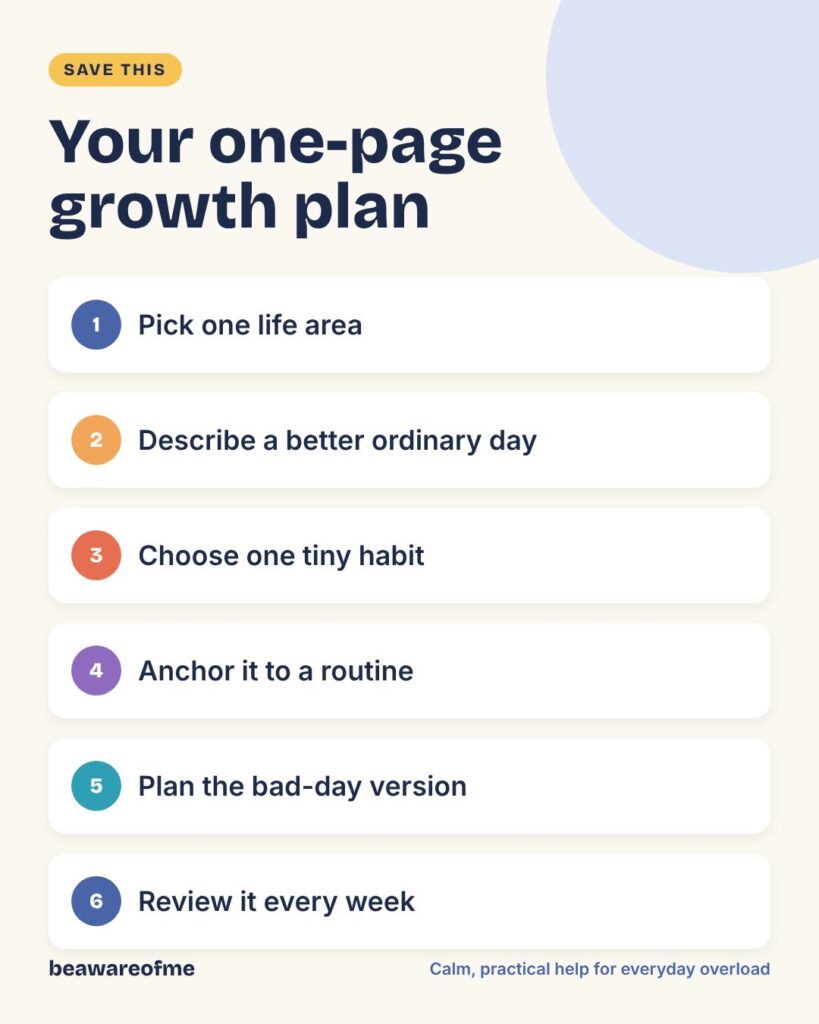
A personal development plan works best when it fits on one page and takes about 20 minutes to write. Long plans feel productive to create and then sit untouched in a notes app. One page, one area, one habit is enough to start.
Grab a sheet of paper or a blank note and work through these five steps in order. Don’t polish anything. A messy plan you use beats a beautiful plan you avoid.
Name the area
Write the one life area you picked. Example: “Energy.” Only one, for now.
Describe a better ordinary day
In two sentences, describe a normal day that feels a bit better. Example: “I fall asleep before 11 and don’t need a second coffee.”
Choose one tiny habit
Pick a habit so small it feels silly. Example: “Phone on the charger in the kitchen at 10:15 p.m.”
Anchor it
Attach it to something you already do. Example: “After I brush my teeth, I plug my phone in downstairs.”
Plan the bad day
Write a two-minute fallback for rough days. Example: “If I’m late, I still leave the phone outside the bedroom.”
Why the “bad day” line matters most
Most plans fail on the first bad day, not the first good one. You get sick, a kid wakes up at 3 a.m., work explodes, and the habit vanishes. Deciding the fallback ahead of time means you don’t have to make a choice when you’re running on empty.
Think of it as an if-then rule. If the day goes sideways, then you do the smallest version. You keep the chain alive, and your brain keeps learning that this is just what you do.
Make your goals realistic before you start
Big goals aren’t the problem. Unrealistic timelines are. If you’d like a deeper walk-through, our guide to realistic goal setting for mental wellness shows how to size a goal so it motivates you instead of crushing you.
Tiny Habits Beat Big Resolutions: The 66-Day Truth
Small daily habits drive personal development far more than big bursts of motivation. Motivation is a weather system. It shows up, it leaves, and you can’t schedule it. Habits are more like the plumbing.
A study from University College London found that it took participants an average of 66 days for a new daily habit to feel automatic. That’s a lot longer than the popular “21 days” claim. It’s also oddly good news, because it means struggling in week three is normal, not a sign you’re failing.
The two-minute version rule
Shrink every habit until it takes two minutes or less. Want to read more? Read one page. Want to exercise? Put on your trainers and step outside. Want to journal? Write one sentence about today.
The point isn’t the two minutes. It’s teaching your brain that you show up. Once the habit feels automatic, you can let it grow naturally, and it usually does.
Stack it on something you already do
Your day already runs on dozens of automatic routines: making coffee, starting the car, brushing your teeth. Attach your new habit to one of them using a simple sentence: “After I [current habit], I will [new habit].”
- After I pour my morning coffee, I write tomorrow’s top task on a sticky note.
- After I close my laptop, I take a three-minute walk around the block.
- After I get into bed, I write one line about what went okay today.
- After I pay for groceries, I check my budget app for one minute.
✨ Quick win
Pick one of the four lines above, swap in your own habit, and write it on a sticky note where the current habit happens. That’s your whole personal development step for today.
What the first 90 days usually feel like
Knowing the rough shape of the journey stops you quitting at the wrong moment. Here’s a common pattern, though your own timing will vary.
- Weeks 1 to 2: It feels fresh and a little exciting. You remember the habit easily because it’s new.
- Weeks 3 to 6: The novelty fades. You forget some days, and it starts to feel like a chore. This is the danger zone.
- Weeks 7 to 10: The habit begins to run on autopilot more often. You notice small wins, like better sleep or less dread.
- Weeks 11 to 13: It feels like part of who you are. Now you can let it grow or add the next small habit.
If you’re in the middle stretch and feeling flat, that’s normal. Keep the two-minute version going and trust the slow build. Personal development rarely feels dramatic while it’s happening, but it adds up.
How to Keep Growing When You’re Already Exhausted
You can keep growing on low energy if you lower the bar on purpose. Exhausted growth looks quieter than motivated growth. It’s still real.
When you’re stretched thin, the most useful skills are often recovery skills: switching off after work, noticing stress early, asking for help. Those count as personal development too, and they’re usually the ones that change your life the most.
If-then rules for low-energy weeks
- If you slept under six hours, then do only the two-minute version of your habit.
- If you feel overwhelmed by your list, then pick one task and let the rest wait until tomorrow.
- If you missed two days in a row, then restart today with no catch-up and no guilt.
- If you dread the habit every single day, then change the habit, not your character.
- If everything feels heavy for weeks, then talk to a doctor or a qualified professional.
⚠️ Watch out
If you feel low most days, can’t enjoy things you used to like, or feel exhausted no matter how much you rest, that isn’t a discipline problem. Please talk to a doctor. Personal development works alongside proper care, never instead of it.
Be kind to yourself on purpose
Self-criticism feels like it should motivate you. Usually it just makes you avoid the thing you feel bad about. Speaking to yourself the way you’d speak to a struggling friend is a skill, and our page on self-compassion techniques for tough days gives you simple phrases to practise.
Perfectionism is the other trap. If you can’t start until conditions are ideal, you’ll rarely start. This piece on perfectionism and high expectations explains why “good enough today” often wins.
Self-Awareness: The Skill Underneath Every Other Skill
Self-awareness is the foundation of personal development, because you can’t change a pattern you can’t see. It means noticing your own thoughts, feelings, reactions and habits, and how they affect other people. Without it, you end up fixing the wrong problem.
For example, you might think you need a better productivity app. But a week of honest notes shows you only lose focus after skipped lunches and late-night scrolling. The fix is food and a phone curfew, not software.
“You can’t change a pattern you can’t see. Personal development starts with noticing.”
Three quick ways to see yourself more clearly
- Write a 3-line evening note. What drained me? What helped? What will I try tomorrow?
- Ask one trusted person. “What’s one thing I do that makes things harder for me?” Then just listen.
- Notice your body first. Tight jaw, shallow breathing or a racing heart often show up before you name a feeling.
If you want to go deeper, our complete self-awareness guide for personal growth covers the full skill. For a habit-based approach, see these daily habits that build self-awareness.
Where self-awareness pays off fastest
It shows up first in your relationships. Knowing your triggers changes how you talk, listen and apologise, which is why we wrote a separate guide on using self-awareness for stronger relationships. It also changes how you argue. Our guide to calm conflict resolution shows how to handle disagreements without losing yourself.
Track Progress Without Turning Growth Into a Second Job
A 15-minute weekly review is enough to keep your personal development on track. Daily tracking can turn into another thing to fail at. A weekly glance shows the trend, and the trend is what matters.
Pick a regular slot, like Sunday afternoon or Friday lunch. Make a cup of tea. Then answer the questions in the card below, honestly and briefly.
Try this today
Your 15-minute weekly review
How many days did I do my habit, even the two-minute version?
What made it easier on the good days?
What got in the way on the hard days?
Is the habit still the right size, or should it shrink or grow?
What’s one thing I’m quietly proud of this week?
What’s my one focus for next week?
Use a simple tally, not a perfect streak
Streaks feel great until you break one. Then many people quit entirely. Try a tally instead: “I did my habit 5 out of 7 days.” Five out of seven is a win, and next week you aim for the same or one more.
Writing things down helps here. If you like pen and paper, our guide to journaling prompts and techniques has formats that take under five minutes.
When to add a second habit
Add a new habit only when the first one feels boring, in the good way. If you do it without thinking most days, you’ve got room for one more. If you still have to argue with yourself, give it another few weeks.
What to say to yourself after a missed week
Instead of
“I always do this. I have no discipline.”
Try
“That week was hard. My plan was too big for it. What’s the two-minute version for this week?”
Then
“I’ll do the small version tomorrow after coffee. That’s enough.”
5 Personal Development Mistakes That Keep Good People Stuck
Most people don’t fail at growth because they’re lazy. They fail because of a few predictable mistakes. Here’s what to watch for, and what to do instead.
1. Starting five habits on the same Monday
It feels efficient to fix sleep, food, money and fitness at once. But every new habit draws on the same limited energy, so they all wobble together and collapse together. Instead, run one habit at a time until it feels automatic, then add the next.
2. Consuming instead of practising
Reading books, saving posts and listening to podcasts can feel like growth. Mostly it’s just information. For every hour of input, do one small action. Read a chapter on money, then actually check your balance that evening.
3. Measuring outcomes you can’t control
“Get promoted” depends on your boss, your budget and luck. “Practise one presentation skill each week” depends on you. Track the actions you control, and let outcomes follow. You’ll feel steadier, and you’ll still move toward the result.
4. Treating rest as a reward you have to earn
Rest isn’t the gap between productive moments. It’s part of the system. When you skip it, your focus, mood and patience all drop. Schedule recovery the same way you schedule work. If it helps, these daily routines for a more balanced life show how to build rest into ordinary days.
5. Comparing your chapter 2 to someone’s chapter 20
Other people’s progress is usually a highlight reel with the hard years cut out. Comparing your start to their middle only drains you. Compare yourself to last month’s version of you instead. If comparison is a constant weight, this guide on how to stop feeling behind can help.
Your Questions About Growing On Purpose, Answered
What is personal development in simple words?
Personal development is the ongoing work of growing your skills, habits, health, relationships and self-understanding. In simple words, it means becoming a little more capable and a little calmer over time. It can be as small as reading one page a night or practising saying no. You don’t need a coach or course, just one habit you repeat and review regularly.
Why is personal development the key to success?
Personal development is the key to success because your habits, mindset and energy shape every result you get. Better sleep improves focus at work. Clear communication improves relationships. Money habits reduce stress. When you grow the person, the outcomes follow more easily, and the progress tends to last longer than any single lucky break or burst of motivation.
How do I start growing when I have no motivation?
Start smaller than feels useful. Choose one life area, then pick a habit that takes two minutes or less, such as writing one line in a notebook after brushing your teeth. Motivation usually follows action rather than leading it. If you have no motivation for weeks and feel low, talk to a doctor, because that can be a sign of something more.
How long does it take to see results from new habits?
Many people notice small changes within a few weeks, but habits usually take longer to feel automatic. A University College London study found an average of 66 days for a daily habit to feel automatic. Expect some missed days along the way. Missing occasionally doesn’t erase your progress, as long as you return to the habit soon.
What are the five main areas of personal growth?
Common frameworks list five areas: mental, physical, emotional, social and spiritual or values-based growth. A simpler working version uses four everyday areas: energy, work and skills, money, and relationships. The exact list matters less than choosing one area to focus on first. Improving one area usually makes the others a little easier too.
Is self-awareness part of personal growth?
Yes. Self-awareness sits underneath almost every kind of personal growth, because you can’t change a habit or reaction you don’t notice. It means understanding your thoughts, feelings, triggers and how you affect others. Simple practices like a three-line evening note, asking a trusted friend for honest feedback and noticing body signals all build it steadily over time.
You don’t need a new personality or a perfect morning to grow. Pick one area, shrink one habit, protect it on bad days and look back once a week. Done gently and steadily, personal development becomes the quiet key to success that keeps working long after motivation fades.
A gentle note
Educational content, not a substitute for professional care. If you are struggling, talk to a doctor or a qualified professional. If you are thinking about harming yourself, contact local emergency services or a crisis line now (US 988, UK and Ireland Samaritans 116 123, or findahelpline.com).