


You bought the candle, the journal and the fancy bath salts, yet you still feel wiped out by Wednesday. That gap is the difference between performative vs practical self-care, and once you see it, you can’t unsee it. This guide shows you how to tell the two apart, why the glossy version often leaves you more tired, and how to build a simple routine that actually refills your tank.
🧭 Key Takeaways
Performative vs Practical Self-Care: What Each One Really Means
Performative vs practical self-care is a distinction between looking after your image and looking after your life. Both can involve the same activity, such as a bath, but the motive and the result differ. One is staged for an audience, even an imaginary one; the other quietly solves a problem.
Here’s the whole guide at a glance, so you can see what to keep, what to swap and where to start.
| Area | Performative version | Practical version |
|---|---|---|
| Rest | A curated “reset day” you film or plan for weeks | A fixed bedtime most nights of the week |
| Money | Retail therapy and wellness hauls | A small buffer fund and one bill on autopay |
| Food | Aesthetic smoothie bowls once a week | Three easy meals you can make while tired |
| Boundaries | Posting about boundaries | Saying no to one request this week |
| Movement | Expensive kit you rarely use | A daily walk that fits your real schedule |
| Work wellness | A wellness week with free snacks | Clear priorities and workable deadlines |
Self-care: a definition worth keeping
The National Institute of Mental Health describes self-care as taking the time to do things that help you live well and improve both physical and mental health. Notice what’s missing from that definition: products, aesthetics and an audience.
That’s why the performative vs practical question matters so much. If an activity helps you live well, it counts. If it mainly helps you look like you live well, it’s decoration.
Why performative self-care took over
Wellness turned into a huge market, and social feeds reward pretty routines. A twelve-step skincare ritual photographs better than a phone call to sort out a bill. So the most visible self-care became the most marketable, not the most helpful.
There’s nothing wrong with enjoying nice things. The problem starts when buying or showing replaces doing, and you’re left with a full basket and an empty tank.
📝 Note: Performative vs practical isn’t about good and bad people. Everyone slips into performance sometimes. The goal is noticing, then nudging your routine towards what really helps.
7 Signs Your Self-Care Is More Performative Than Practical
A few clear signs reveal when self-care has drifted into performance. Run through these honestly; most people tick at least two.
Quick self-check
- You feel worse afterwards. The face mask is done, but your to-do list still looms and the guilt is louder.
- It costs money every time. Your routine depends on buying something new to feel cared for.
- You plan it for the photo. You think about lighting or captions before you think about rest.
- It feels like another task. You “have to” do the ten-step evening routine, even when you’re exhausted.
- The same problems keep returning. Sunday dread, money stress or late nights never really change.
- It’s all treats, no maintenance. You reward yourself constantly but never deal with the root of the stress.
- You compare your routine to others. Someone else’s morning ritual makes yours feel inadequate.
If three or more fit, don’t panic. That simply shows where a small practical swap could make the biggest difference. Comparison in particular drains energy, so our guide on how to stop comparing yourself on social media is a useful next read.
💡 Tip: Try the next-morning test. Before any self-care activity, ask: “Will tomorrow-me be glad I did this?” It’s the simplest performative vs practical filter there is.
7+ hrs
of sleep a night is the CDC recommendation for adults aged 18 to 60.
Source: CDC
150 min
of moderate activity a week is the WHO guideline for adults.
Source: World Health Organization
30 min
of daily walking can help boost mood and improve health.
Source: National Institute of Mental Health
The Performative vs Practical Test: 4 Checks for Any Habit
Four simple checks sort any habit into performative vs practical in under a minute. Use them on things you already do, and on anything you feel tempted to buy.
Would I do this if nobody saw it?
If posting or telling someone is half the appeal, it may lean performative.
Does it solve a real, recurring problem?
Practical self-care removes friction, such as a late bill or a chaotic morning.
Can I afford it in time and money?
If it adds stress to your budget or schedule, it’s working against you.
How do I feel tomorrow?
Real care leaves a trace: better sleep, more energy, fewer worries.
Run the test on three common habits
| Habit | Verdict | Why |
|---|---|---|
| A Sunday bath with your phone off | Practical | Cheap, restful and you sleep better afterwards |
| A new planner every few weeks | Performative | Buying the planner replaces using the plan |
| A 20-minute weekly money check | Practical | It cuts the background worry about bills |
| A morning routine copied from a feed | Depends | Practical only if it fits your real life and energy |
Notice the same activity can land on either side. A bath can be pure performance or genuine rest. The performative vs practical line runs through your intention and the outcome, not the activity itself.
✨ Quick win: Pick one habit you do every week and run it through the four questions tonight. Keep it, tweak it or drop it. One honest audit beats ten new routines.
If it would still be worth doing with nobody watching and nothing to buy, it’s real self-care.
beawareofme
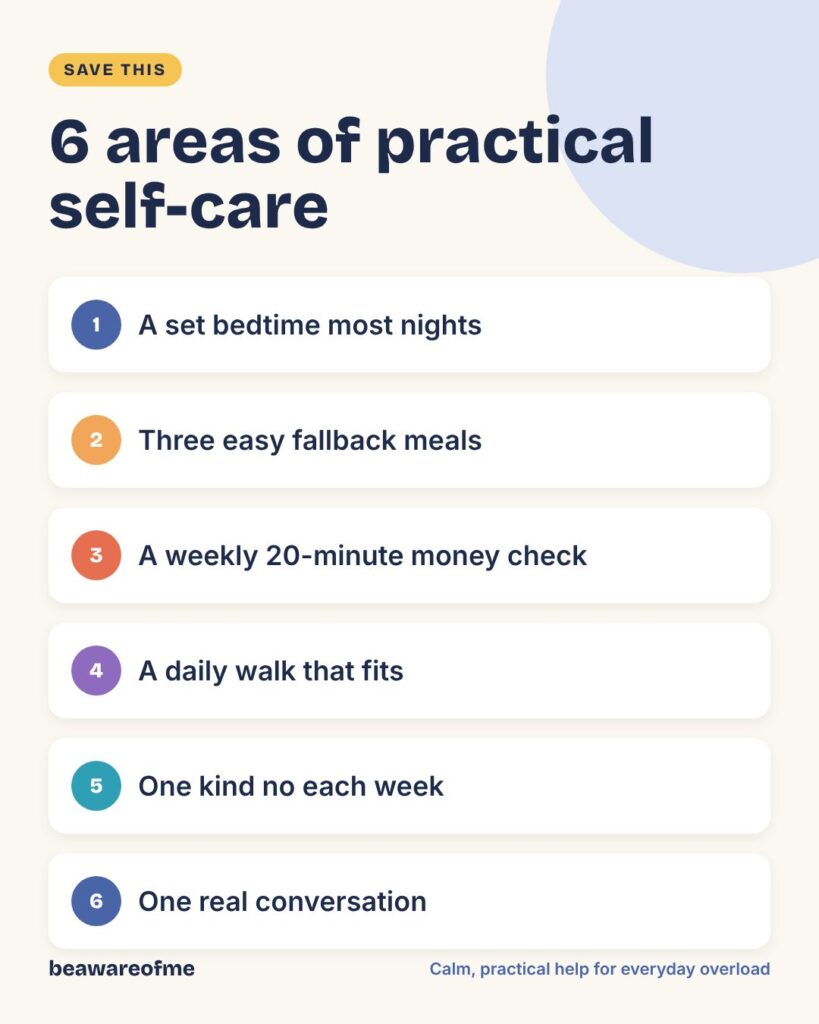
Practical Self-Care in 6 Areas That Actually Lower Stress
Practical self-care works best when it targets the areas that cause most of your stress: sleep, food, money, movement, boundaries and connection. Pick one area, not all six, and start there.
Sleep and rest
Rest is the base layer of everything else. The CDC recommends seven or more hours of sleep a night for adults aged 18 to 60. A practical move here is boring on purpose: a set bedtime, a phone charging outside the bedroom and a ten-minute wind-down.
Our guide on sleep as self-care has more simple ideas you can try tonight.
Food and energy
Practical food care means having three or four fallback meals you can make on your worst day. Think eggs on toast, a tin of soup with bread or a tray of roasted vegetables. Keep the ingredients stocked, and tiredness stops leading straight to skipped meals.
Money and admin
Few things weigh on the mind like an unopened letter. A 20-minute weekly money check, one bill on autopay and a small emergency buffer can calm more anxiety than any bath bomb. That’s performative vs practical in its plainest form.
Keep a short list of what you spend on self-care each month. Seeing the total next to how much it actually helped is often the clearest lesson of all, and it frees money for things that genuinely ease pressure, like a small savings buffer.
Movement that fits your real life
The World Health Organization advises adults to aim for at least 150 minutes of moderate activity a week. That’s about 20 minutes a day, which a brisk walk to the shop or a dance in the kitchen can cover. Skip the expensive kit until a habit sticks.
Boundaries and connection
Saying no protects your time far better than a scented candle does. Practise one small boundary each week, using our guide to setting boundaries as self-care. Then use some of that reclaimed time for a real conversation with someone who leaves you feeling lighter.
☑️ Try this today
☐ Set tonight’s bedtime and put a reminder 30 minutes before it.
☐ Write down three easy meals and check you have the ingredients.
☐ Open one piece of admin you’ve been avoiding.
☐ Take a 15-minute walk without headphones.
☐ Decline one request that drains you, kindly and briefly.
Swap This for That: 8 Easy Performative vs Practical Upgrades
The easiest way to change your routine is a straight swap: keep the time slot, change what goes in it. These eight upgrades take the performative vs practical idea and make it concrete.
| Swap this | For this | What you gain |
|---|---|---|
| Browsing wellness shops at night | Laying out tomorrow’s clothes and bag | A calmer morning |
| A detox tea | A glass of water next to your bed | Hydration without the hype |
| Buying a new journal | Writing three lines in any notebook | Clearer thoughts tonight |
| A weekend “reset” marathon | Ten minutes of tidying each evening | No Sunday overwhelm |
| Scrolling #selfcare posts | Texting one friend to check in | Real connection |
| An expensive retreat you dread paying off | One phone-free afternoon a week | Rest without debt |
| A complicated morning routine | One glass of water and one stretch | A routine you’ll keep |
| Posting about burnout | Asking your manager to drop one task | A lighter workload |
Each swap keeps the pleasant feeling you were chasing but points it at a real result. That’s the heart of performative vs practical thinking: the same time and effort, aimed at something that lasts beyond the evening.
You don’t need all eight. Choose the one that matches your biggest stressor right now. If evenings are the problem, try the clothes-and-bag swap first; if money nags at you, start with the admin.
A short script for saying no without guilt
💬 Copy-ready scripts
“Thanks for thinking of me. I can’t take this on right now.”
“I’d love to, but I’m keeping this weekend quiet. Can we look at next month?”
“I can do one of these this week. Which matters most to you?”
🧭 Try this: If writing helps you sort your thoughts, try a nightly two-line check: “What drained me today?” and “What one small thing would help tomorrow?”. Our journaling for anxiety guide offers more prompts.
Performative vs Practical Wellness at Work: How to Spot the Difference
Workplaces face the same performative vs practical split, only on a bigger scale. A meditation app subscription or a themed wellness week can help a little, but it can’t fix unmanageable workloads, unclear roles or a culture that punishes rest.
Signs of real support at work
- Workloads and deadlines get adjusted when priorities change.
- People can take leave and switch off after hours without penalty.
- Managers check in regularly and act on feedback, not just collect it.
- Mental health support, such as an assistance programme, is easy to find and confidential.
- Reasonable adjustments are possible when someone is struggling.
If your workplace leans performative, focus on what you can influence. Ask to clarify priorities, protect your breaks and use any confidential support on offer. Our guide to building a supportive workplace has practical ideas for teams and managers.
Remember that you are one person, not the whole culture. You can’t fix company policy alone, but you can model practical habits: taking your lunch break, logging off on time and being honest about capacity. Quiet examples often spread further than any poster.
A quick script for a workload conversation
Try: “I want to do this well. With my current load, I can deliver A and B by Friday. Which should come first, or can C move to next week?” Clear options make it easier for a manager to say yes.
⚠️ Watch out: If work stress is affecting your sleep, appetite or mood for weeks, self-care alone may not be enough. Talk to a doctor or a qualified professional, and read our guide on recognising and overcoming burnout.
A 7-Day Plan to Shift Your Routine From Show to Substance
A one-week plan turns the performative vs practical idea into habits you can feel by the weekend. Each day takes ten to twenty minutes, and each step builds on the one before, so nothing feels like a dramatic overhaul.
Your week, one small step at a time
Day 1: Audit
List five things you do for self-care and run each through the four checks.
Day 2: Pick one stressor
Choose the problem that nags at you most, such as sleep, money or mornings.
Day 3: Make one swap
Replace one performative habit with a practical action aimed at that stressor.
Day 4: Remove friction
Set up the swap so it’s easy: alarms, a stocked shelf, a bill reminder.
Day 5: Protect the time
Say no to one request so the new habit has room to breathe.
Day 6: Add connection
Message or meet someone who leaves you feeling lighter, without a screen in between.
Day 7: Review
Ask how this week felt compared with last week, and keep what helped.
How to tell if it’s working
Look for small, real changes rather than dramatic ones. Maybe you fell asleep a little faster, felt less dread on Sunday or stopped avoiding that email. Those quiet shifts are the clearest sign that performative vs practical thinking has started to change your days.
If nothing seems different, that’s useful information too. Try a different stressor next week, or make the swap even smaller. The point is steady experiments, not a perfect result, and the performative vs practical lens works best when you stay curious rather than critical.
📝 Note: Keep a tiny log on your phone: one line a day about energy, sleep or mood. After two weeks, patterns appear that you’d never notice day to day, and they show which habits deserve a permanent spot.
5 Common Mistakes When Switching to Practical Self-Care
Moving from performance to practice sounds simple, yet a few traps catch almost everyone. Here’s what to watch for.
1. Making practical self-care a new performance
Swapping aesthetic routines for a perfectly optimised productivity system misses the point. If you’re tracking twelve habits and feeling guilty about missed ones, scale back to one or two that clearly help.
2. Banning all treats
Joy matters too. A favourite coffee or a lazy afternoon can be practical if it genuinely restores you. The aim isn’t austerity; it’s making sure treats sit on top of the basics, not in place of them.
3. Starting with the hardest area
Tackling money, sleep and boundaries all at once usually ends in burnout. Begin with the area that would bring the quickest relief, build a small win and then move on.
4. Ignoring the signals that you need more help
Self-care supports mental health, but it isn’t treatment. If low mood, anxiety or exhaustion lasts for weeks, talk to a doctor or a qualified professional rather than adding more routines.
5. Copying someone else’s routine
A routine that works for a person with no kids and a flexible job may not fit your life at all. Build yours around your real energy, budget and schedule, and expect it to change over time.
📚 Keep reading
Want a quick sense of how drained you feel right now? Try our free How Empty Is Your Battery? self-check. It’s a gentle reflection, not a diagnosis, and it can point you to the area that needs care first.
Your Questions About Performative vs Practical Self-Care, Answered
What is performative self-care?
Performative self-care is self-care done mainly for appearance, whether for social media, for others or for your own image of a well person. It often relies on products, aesthetics and elaborate rituals. It can feel nice briefly, but it rarely changes the stressors behind your exhaustion, and it can add cost, pressure and comparison to an already full week.
What are examples of practical self-care?
Practical self-care includes keeping a regular bedtime, stocking easy meals, paying a bill on time, saying no to an extra commitment, taking a daily walk and calling a friend. These actions are often unglamorous, yet they reduce recurring stress. The common thread is function: each one makes tomorrow a little easier, whether or not anyone sees it.
Is a bubble bath performative or practical?
It depends on why you do it and how you feel afterwards. A bath that helps you unwind and sleep better is practical. A bath staged for a photo, or used to avoid a pressing problem that then grows, leans performative. Ask yourself whether tomorrow-you will feel more rested because of it. That answer settles the question.
Why does self-care sometimes make me feel worse?
Self-care can backfire when it becomes another chore, costs money you’re worried about or distracts from the real source of stress. Comparing your routine to polished posts can also add guilt. Try shrinking your routine to one or two actions that solve a real problem, like an earlier bedtime or a quick money check, and notice how you feel.
How do I start practical self-care with no time?
Start tiny and attach it to something you already do. Drink a glass of water when you make coffee, lay out tomorrow’s clothes while brushing your teeth or take a ten-minute walk at lunch. Small, repeated actions beat occasional big efforts. Once one habit feels automatic, add another that targets your next biggest stressor.
What does practical wellness at work look like?
Practical workplace wellness shows up in daily conditions: manageable workloads, clear priorities, real breaks, flexible leave, managers who act on feedback and confidential mental health support. Perks like apps or wellness weeks can help a little, but they can’t replace fair workloads. If those basics are missing, focus on clarifying priorities and protecting your own breaks.
Performative vs practical self-care isn’t about doing more; it’s about doing what genuinely helps, even when it’s dull and nobody sees it. Choose one small practical swap this week, notice how tomorrow feels, and let that quiet difference guide your next step.
📝 Please note: Educational content, not a substitute for professional care. If you are struggling, talk to a doctor or a qualified professional. If you are thinking about harming yourself, contact local emergency services or a crisis line now (US 988, UK and Ireland Samaritans 116 123, or findahelpline.com).