When your mind feels heavy, the people you love can start to feel like one more thing you’re failing at. You cancel plans, snap over small stuff, or go quiet for days and then feel guilty about it. You can still maintain healthy relationships while you look after your mental health, and you don’t need perfect energy to do it. This guide gives you scripts, a weekly check-in, low-battery options and repair steps you can use this week.
The short answer
To maintain healthy relationships while managing your mental health, tell the key people what’s going on in plain words, agree on what helps and what doesn’t, and keep a small weekly check-in. Protect your energy with clear boundaries instead of silent withdrawal. On low days, send tiny signals of connection. After conflict, repair quickly with a calm apology and one concrete change. Get outside support early when things keep slipping.
Key takeaways
Tell one or two close people what a hard day looks like for you, so they don’t read your silence as rejection.
Give the people around you a short list of what helps and what doesn’t, because guessing wears everyone out.
Hold a 15-minute weekly check-in to clear small irritations before they build into big arguments.
On low-energy days, send a one-line message instead of disappearing, since a tiny signal keeps the bond warm.
Repair after a bad moment within 24 hours with a specific apology and one small change.
Bring in a doctor, counsellor or support group when the same problems repeat for more than a few weeks.
Why It’s Harder to Maintain Healthy Relationships When Your Mind Is Overloaded
Stress, anxiety and low mood drain the exact skills that relationships run on: patience, listening and showing up. That’s not a character flaw. It’s a capacity problem, and capacity problems have practical fixes.

You’re far from the only one juggling this
According to the National Institute of Mental Health, about 23.1% of US adults live with a mental illness in a given year. That’s more than one in five people. Plenty more deal with everyday stress and overwhelm that never gets a label.
Loneliness sits right beside this. The CDC reports that about 1 in 3 US adults say they feel lonely, and about 1 in 4 say they lack social and emotional support. Relationships matter, and lots of people are quietly struggling to keep them going.
23.1%
of US adults live with a mental illness in a given year
Source: NIMH
1 in 3
US adults report feeling lonely
Source: CDC
1 in 4
US adults say they lack social and emotional support
Source: CDC
What actually changes when you’re struggling
When your stress runs high, your brain leans toward threat. A neutral text can read as cold. A partner’s question can feel like criticism. You may also pull away to save energy, which the other person can easily misread as “I don’t care.”
Here’s the thing most advice gets backwards: the goal isn’t to hide your struggles so the relationship stays smooth. The goal is to make your struggles readable. People cope far better with “I’m having a rough week” than with unexplained distance. For a wider view, our guide to how mental health and relationships affect each other covers the two-way link in more depth.
The 9 ways at a glance
Here’s the full toolkit in one place. You don’t need all nine at once. Pick the one that matches the problem you feel most this week.
- Explain what’s happening with a short, three-part script.
- Choose how much to share with each person.
- Hold a 15-minute weekly check-in.
- Swap silent withdrawal for clear, kind boundaries.
- Use tiny signals of connection on low-battery days.
- Ask for specific help instead of waiting to be rescued.
- Repair within 24 hours after a rough moment.
- Match your approach to each type of relationship.
- Bring in outside support before problems harden.
Each one is a small, repeatable habit. Together they help you maintain healthy relationships without pretending you feel fine.
📝 Note
Irritability, withdrawal and forgetfulness often show up as symptoms of stress or low mood, not as proof that you’ve stopped caring. Naming that difference out loud helps both of you.
Say It Out Loud: A 3-Part Script That Takes Two Minutes
The fastest way to maintain healthy relationships through a hard patch is to explain what’s happening before it causes damage. You don’t need a big, tearful talk. A short, calm script does most of the work.
The script: what, how it shows, what helps
Use three parts, in this order. First, say what’s going on in one sentence. Second, describe how it tends to show up. Third, name one thing that helps and one thing that doesn’t.
What’s going on
“I’ve been dealing with a lot of anxiety lately, and my energy is lower than usual.”
How it shows up
“When it’s bad, I go quiet, cancel things last minute, or get short with people I love.”
What helps, what doesn’t
“It helps if you check in with a simple text. It doesn’t help if I’m pushed to explain everything right away.”
That’s it. You’ve given the other person a map, and maps are how you maintain healthy relationships when energy is scarce. They no longer have to guess, and you no longer have to perform being fine.
Choose how much to share
You decide the depth. A close partner might hear the full picture. A friend might only need “I’m going through a stressful stretch, so I may be slow to reply.” A manager might need even less. Sharing is not all or nothing. You can maintain healthy relationships with very different levels of openness.
If you’re not sure where to start, try the free emotional weather check first. It gives you simple words for how you feel, which makes the script much easier to say.
💡 Tip
Send the script in writing if speaking feels too hard. A text that starts with “This is easier for me to write than say” is a completely fair way to open the conversation.
When the other person reacts badly
Some people respond with advice, worry or awkward jokes. Usually that’s discomfort, not dismissal. Give them a second chance: “I don’t need you to fix it, I just wanted you to know.” If someone keeps belittling you, that tells you something important about the relationship.
The 15-Minute Weekly Check-In That Keeps Small Things Small
A short, regular check-in is one of the most reliable habits to maintain healthy relationships, because it catches friction early. Most big arguments start as small things nobody mentioned.
How to run it
Pick a calm, regular slot, such as Sunday after dinner. Set a 15-minute timer so it never turns into a marathon. Sit side by side or walk together if face-to-face feels intense.
Try this today
Your 15-minute check-in, word for word
- Minutes 1-3: “One thing you did this week that I appreciated was…”
- Minutes 4-7: “My energy this week was about a 4 out of 10, mostly because…”
- Minutes 8-11: “One small thing that bugged me was… Can we try…?”
- Minutes 12-15: “Next week, the thing that would help me most is…”
Rules that keep it safe
- One issue each, maximum. Save the rest for next week.
- Talk about behaviour, not character: “You were on your phone at dinner” rather than “You never care.”
- No decisions about big life topics in a check-in. Flag them and book a separate time.
- If either of you hits overwhelm, pause and come back tomorrow.
Couples aren’t the only ones who benefit. You can run a lighter version with a housemate, a parent or a close friend. Swap the energy score for a quick “How are you really doing?” Small, regular contact is how most people maintain healthy relationships over years.
✨ Quick win
Put the check-in in your calendar right now as a recurring 15-minute event. A fixed time removes the awkward job of asking for it.
Boundaries That Protect Your Energy Without Pushing People Away
A boundary tells people what you can do, not just what you can’t. Clear boundaries help you maintain healthy relationships because they replace silent withdrawal with honest limits.
Withdrawal versus a boundary
Withdrawal sounds like nothing at all. You ignore messages, skip plans and hope nobody notices. A boundary sounds like this: “I can’t do the party tonight, but I’d love a short walk on Saturday morning.”
The second option protects your energy and keeps the door open. If boundaries trigger guilt, our guide on how to set boundaries without feeling guilty walks through that feeling step by step.
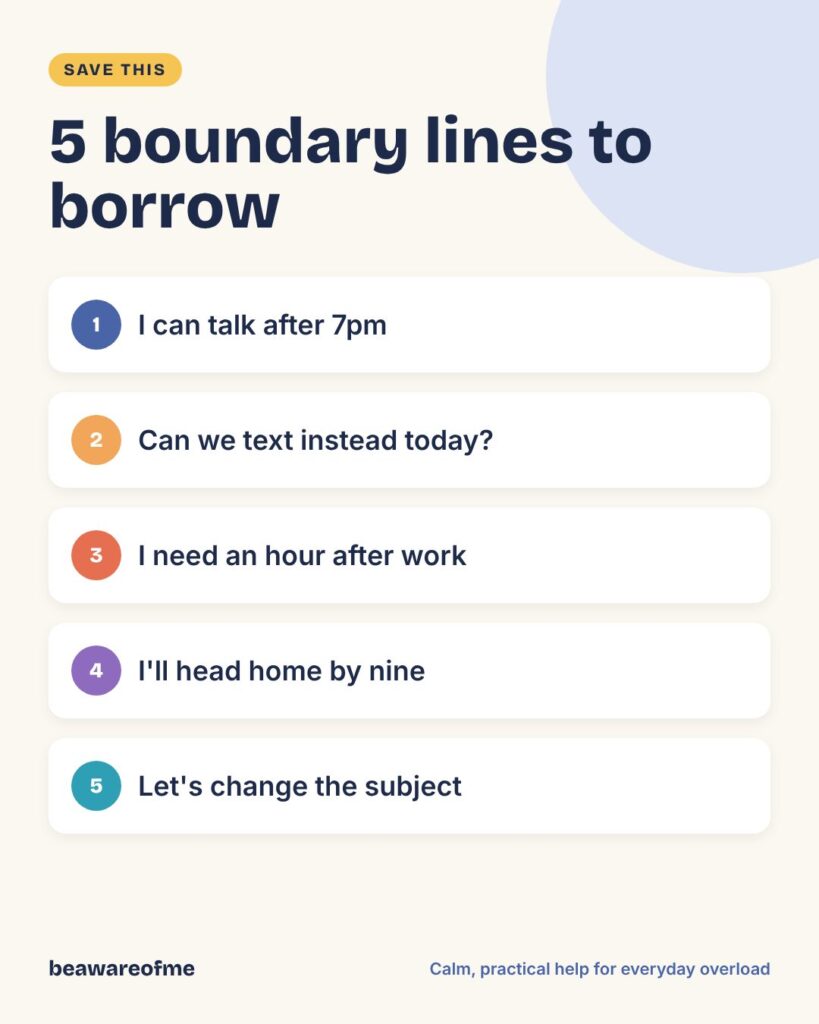
Five boundary scripts you can borrow
- “I want to hear about this, and I can give it my full attention after 7pm.”
- “I’m not up for a phone call today. Can we text instead?”
- “I need an hour to myself after work, then I’m all yours.”
- “I’m happy to come for dinner, but I’ll head home by nine.”
- “I’d rather not talk about my weight or diet. Can we change the subject?”
Want to see where your limits stand right now? The free boundaries self-check takes a few minutes and points out where you might be over-giving.
⚠️ Watch out
A boundary only works if you follow through. If you say you’ll leave at nine, leave at nine. Otherwise people learn that your limits are flexible, and you end up resentful.
Low-Battery Days: How to Stay Connected With Almost Nothing Left
On your hardest days, the aim shifts from quality time to tiny signals. A small signal of connection protects the bond far better than a long silence followed by a guilty apology.
The tiny-signal menu
Agree on a few low-effort signals in advance, while you feel okay. Then, on a bad day, you just pick one. No planning, no performance. It’s the lowest-effort way to maintain healthy relationships when you’re running on empty.
| Energy level | What you can offer | Example |
|---|---|---|
| Very low (1-2/10) | A pre-agreed emoji or code word | Send a 🔋 to say “low battery, still love you” |
| Low (3-4/10) | One short message | “Rough day. Thinking of you. Talk tomorrow?” |
| Medium (5-6/10) | Quiet company | Sit together and watch something, no deep talk needed |
| Okay (7+/10) | Active time together | Cook a meal, take a walk, make a plan for the weekend |
Let people help in specific ways
“Let me know if you need anything” rarely leads anywhere. Instead, keep a short list of concrete asks ready. Can they bring food, take the kids for an hour, or just sit with you?
Specific requests feel easier to give and easier to receive. They help you maintain healthy relationships because nobody has to read your mind. They also let loved ones feel useful, which eases their worry. If someone close to you lives with high anxiety, these ideas for supporting a loved one with high-functioning anxiety work well from the other side too.
💡 Tip
Write your tiny-signal menu on a note in your phone and share it with the people who matter. It turns a bad day into a plan instead of a mystery.
How to Maintain Healthy Relationships After a Bad Day or an Argument
Every relationship has rough moments, and stress makes them more likely. What keeps a bond strong is how fast and how kindly you repair. Repair, in plain terms, means reconnecting after a rupture so the hurt doesn’t harden.
The 4-step repair
Calm your body first
Take 10 slow breaths or step outside for five minutes. Repair attempts made while you’re still flooded usually fail.
Name your part
“I snapped at you about the dishes. That wasn’t fair.” Keep it specific and skip the long justification.
Explain without excusing
“I’d had a really anxious day, and I took it out on you.” Context helps, as long as it doesn’t replace the apology.
Offer one change
“Next time I feel that wound up, I’ll tell you I need ten minutes first.”
Aim for repair within 24 hours
You don’t have to fix things the same minute. But leaving a rupture for days lets both people build stories about what happened. A rough rule: repair before the next sleep if you can, and within 24 hours at most. Quick repair is one of the simplest ways to maintain healthy relationships under stress.
If arguments feel extra loaded because you fear the other person will leave, this guide on relationship anxiety signs and solutions explains why that fear shows up and how to calm it.
“You don’t need a relationship without hard days. You need one where hard days get repaired.”
When the other person is the one struggling
Flip the steps. Give them space to calm down, then invite repair gently: “That got heated earlier. Can we try again?” You can care about their stress and still name behaviour that hurt you. Both things can be true. Partners who maintain healthy relationships long term tend to take turns doing the repairing.
Partners, Friends, Family, Work: One Plan Doesn’t Fit Every Relationship
Different relationships need different amounts of sharing and different kinds of support. Matching your approach to each one stops you from overexplaining to a coworker or underexplaining to a partner.
| Relationship | How much to share | Best support to ask for |
|---|---|---|
| Partner | The fullest picture you feel safe giving | Weekly check-in, tiny signals, help with chores on low days |
| Close friend | The main theme and what helps | Patience with slow replies, low-key plans |
| Family | Depends on trust, start small | Practical help, fewer heavy topics at gatherings |
| Work | Only what affects your work | Clear priorities, flexible deadlines where possible |
Keeping friendships alive when you have less to give
Friendships often fade quietly when you’re struggling, because nobody schedules them. Pick two or three friends and set a gentle rhythm, such as a voice note every Sunday. Low effort, steady contact beats rare, intense catch-ups. That rhythm helps you maintain healthy relationships even in a busy, stressful month.
Family patterns can hit harder
Family time can stir up old roles and old arguments. Plan ahead: decide how long you’ll stay, which topics you’ll avoid, and who you can text if things get tense. If a relationship keeps leaving you drained or scared, our piece on how toxic relationships affect your mental health can help you see the pattern more clearly.
📝 Note
You’re allowed to have different levels of closeness with different people. Healthy doesn’t mean equal. You can maintain healthy relationships with someone you see twice a year.
When Outside Support Helps You Maintain Healthy Relationships
Getting help from a professional or a group is a smart move, not a sign the relationship has failed. Outside support often gives both people new tools and a neutral space.
Signs it’s time to bring someone in
- The same argument repeats every week with no progress.
- You’ve stopped sharing anything real because it always goes wrong.
- Low mood or anxiety has lasted more than two weeks and affects daily life.
- Either of you feels unsafe, controlled or constantly on edge.
Options to consider
Start with your doctor if your mental health has changed. They can talk through options and refer you on. A counsellor can help you on your own, while couples or family counselling helps you both build skills together.
Peer support groups help too. Hearing how others maintain healthy relationships through similar struggles makes your situation feel less strange. To understand how your own patterns show up with people, read about self-awareness for stronger relationships.
⚠️ Watch out
If you or someone close to you is in danger or thinking about self-harm, contact local emergency services or a crisis line now: 988 in the US, Samaritans on 116 123 in the UK and Ireland, or findahelpline.com elsewhere.
5 Common Mistakes That Quietly Strain Your Closest Relationships
These mistakes feel protective in the moment but tend to backfire. Spotting them early makes it much easier to maintain healthy relationships through a hard season.
1. Waiting until you feel better to explain
It seems kinder to wait until you can talk calmly about it. But in the meantime, people fill the silence with their own worries. Share a short version now and the fuller version later.
2. Turning one person into your whole support system
Leaning only on a partner puts heavy pressure on one relationship. They can burn out, and you lose other perspectives. Spread support across a friend, a professional and maybe a group. It’s far easier to maintain healthy relationships when no single person carries everything.
3. Apologising for existing instead of for specific actions
“Sorry I’m such a mess” invites reassurance but doesn’t repair anything. A specific apology, like “Sorry I cancelled without telling you,” is shorter and actually works.
4. Treating every bad mood as a relationship problem
Low mood can make a good relationship look bad. Before deciding something is wrong between you, ask yourself: “Would I feel this way about them on a good week?” If not, it may be your stress talking. Wait a day or two before you make any big decisions.
5. Dropping all your own self-care to keep others happy
Skipping sleep, movement or alone time to please people makes you more irritable, not less. Your basic care is part of how you maintain healthy relationships, not a selfish extra.
Frequently Asked Questions About Relationships and Mental Health
Can you maintain healthy relationships with anxiety or depression?
Yes. Many people with anxiety or depression keep loving, stable relationships. The key is honest communication about how your symptoms show up, a few agreed ways to stay connected on hard days, and support from outside the relationship. It won’t feel smooth all the time, but readable struggles do far less damage than hidden ones. Talking to a doctor or counsellor adds useful tools.
Should I tell my partner about my mental health struggles?
In most cases, sharing at least a short version helps. Your partner sees the changes anyway, and without context they may take them personally. You choose the depth and timing. A simple script works: what’s going on, how it shows up, and what helps. If you don’t feel safe sharing with a partner, that is important information to discuss with a professional.
How do I stop pushing people away when I feel low?
Replace silence with a tiny signal. Agree on an emoji, code word or one-line message that means “I’m struggling but still here.” Then use it on bad days instead of disappearing. Also, tell close people ahead of time that withdrawal is a symptom for you. That way they can check in gently instead of feeling rejected.
Is it selfish to set boundaries when someone needs me?
No. Boundaries let you keep showing up without burning out. Saying “I can talk after seven” is more reliable than agreeing to everything and then shutting down. A good boundary offers what you can give, not just a refusal. That honesty helps you maintain healthy relationships over time. People who care about you generally prefer an honest limit to resentful, half-present help.
How can I support a partner who is struggling with their mental health?
Ask what helps instead of guessing, and accept small answers. Offer specific help, such as cooking dinner or handling one errand. Listen without rushing to fix. Keep your own support network and self-care going so you don’t burn out. Encourage professional help kindly, and if you’re worried about their safety, contact emergency services or a crisis line.
When should a couple consider counselling?
Consider counselling when the same conflict repeats for weeks, when you’ve stopped talking about real things, or when one person’s mental health keeps straining daily life. You don’t need to wait for a crisis. Counselling can teach communication and repair skills early. If either person feels unsafe or controlled, seek individual support first and contact local services.
Hard days don’t have to cost you the people you love. When you explain what’s happening, protect your energy with kind limits and repair quickly after rough moments, you can maintain healthy relationships through almost any season. Pick one tool from this guide, like the weekly check-in or a tiny-signal code, and start using it this week. Browse more practical guides in our everyday mental health section.
Please note: Educational content, not a substitute for professional care. If you are struggling, talk to a doctor or a qualified professional. If you are thinking about harming yourself, contact local emergency services or a crisis line now (US 988, UK and Ireland Samaritans 116 123, or findahelpline.com).