
You did the laundry, answered the emails, picked everyone up on time, and still ended the day with that same low hum in your chest: I’m behind. Somewhere. On something. That feeling isn’t a discipline problem, and it isn’t really about your workload either — it’s a visibility problem, and it has a fix you can build in about ten minutes tonight. Here’s exactly why it shows up even on good days, and the one-page system that finally makes it quiet down.

There's a version of this that asks you questions back.
An article can tell you what burnout is. A workbook makes you locate where you actually are in it, on paper, in your own handwriting. That's The Burnout Fix — ninety-odd pages of it.
Look at the workbook →
Feeling behind on everything usually isn’t caused by how much you’re actually doing — it’s caused by your brain having no reliable way to register that something is finished. Tasks that aren’t visibly marked “done” stay mentally open, and open tasks read as pressure no matter how much progress you’ve made. The fix isn’t a bigger planner or more willpower. It’s a simple, visible system that gives your brain the “closed” signal it’s missing, built once and checked daily.
Key Takeaways
- ✓Feeling behind is usually a tracking problem, not a workload problem — most days, you’re further along than it feels.
- ✓Your brain holds onto unfinished tasks far more strongly than finished ones, so an untracked day will always feel incomplete.
- ✓A visible, one-page system gives your brain a real “done” signal that a mental to-do list never can.
- ✓The feeling can come back after a genuinely good week — that’s not the system failing, it’s a missing last step.
- ✓A same-day, ten-minute version of this works even before you build the full system.
- ✓More apps and more willpower usually make this worse, not better.
Why “I’m Behind” Almost Never Means What It Sounds Like
“Behind” is a schedule word. It implies there’s a fixed timeline somewhere and you’ve fallen off it. But for most adults, there’s no such external timeline for the bulk of what’s nagging at them — no boss, no deadline, no grade attached to “finally organize the hall closet” or “reply to that message from three days ago.” The schedule is one you invented, silently, and you’re the only one keeping score. That’s worth sitting with for a second, because it changes what you’re actually solving.
Here’s the part that actually explains the feeling, though: your brain is built to hang onto unfinished business. A century-old finding in psychology, now known as the Zeigarnik effect, showed that people recalled interrupted or unfinished tasks roughly twice as often as ones they’d completed. The original observation came from a psychologist watching waiters — they could reel off a complicated, unpaid order from memory, then draw a total blank on it the second the bill was settled. Once a task closes, your brain seems to file it away and stop spending energy on it. Until then, it keeps nudging.
Which means the twelve things you finished today aren’t sitting in your mental inventory demanding attention. The three you haven’t are. Your felt sense of “behind” is built almost entirely from the open loop pile, so of course it feels disproportionate to how much you actually got through — it’s not measuring your day, it’s measuring your leftovers.
Get the first 7 days by email
Before the full system below, try the short version. One email a day for a week — a single small shift, nothing to install, nothing to buy. Most people feel the difference in their evenings by day four.
[EMBED OPT-IN FORM — “The First 7 Days”]
The Real Reason the Feeling Won’t Quit
Here’s the mechanism nobody explains: closing one loop doesn’t reduce the pile — it just makes room for the next one to become visible. Answer the email that’s been bothering you, and within an hour your attention has already latched onto the next unclosed thing, because that’s how this system works. It isn’t designed to ever show you “done.” It’s designed to keep pointing at whatever’s still open, one item at a time, forever.

Your phone makes this dramatically worse, and not in the way people usually mean. It’s not that the phone distracts you — it’s that every badge, every unread count, every red dot is a tiny, externally generated open loop that your brain now has to track alongside your own. You didn’t create most of them. You’re still carrying them.

None of this means you need to become a monk about notifications or delete your apps. It means the pile you’re tracking is bigger than the pile you actually own, and no amount of hustle fixes a tracking problem. Only a visible record does — which is the part almost nobody builds, because it sounds too simple to bother with.
The 2-Minute Check: Actually Behind, or Just Untracked?
Before you build anything, run this check. It takes less time than reading this paragraph, and for most people it’s genuinely surprising.
| Signs you’re actually behind | Signs you’re just untracked |
|---|---|
| A specific date has already passed — a bill, a form, a reply someone is waiting on | The “behind” feeling is vague — you can’t name the one thing that’s actually late |
| Someone else is currently blocked, waiting on you to move | Nobody’s waiting; you’re the only one who knows the list exists |
| You can name it in one sentence right now, no searching required | You have to think for more than a few seconds to name what’s “behind” |
| It’s been open for weeks with no movement at all | You made real progress on it today, but it still doesn’t feel like enough |
If most of what you circled sits in the right column, you’re not behind. You’re just running a full week without a single place that shows you what’s actually closed. That’s a fixable, boring, mechanical problem — which is good news, because boring mechanical problems are the easy ones.

The One-Page System That Makes “Caught Up” Visible
Checklists have a strange reputation — people treat them as beneath the size of their problems. That instinct is wrong, and it’s wrong at a scale worth mentioning. Surgeon Atul Gawande’s research into surgical checklists found that a ninety-second checklist, used before and after operations, cut the rate of major complications by more than a third across the hospitals that tried it. Not a new drug. Not more training. A page with boxes on it, checked in order, every single time. If a page of checkboxes moves a number that large in an operating room, it will move your Tuesday.
Here’s the version built for a normal week, not a hospital:
There's a version of this that asks you questions back.
An article can tell you what burnout is. A workbook makes you locate where you actually are in it, on paper, in your own handwriting. That's The Burnout Fix — ninety-odd pages of it.
Look at the workbook →Take one sheet of paper. Not an app yet — paper forces you to keep the list short, which is the entire point.
List 5 to 7 “must happen” items for the week — not everything, just what would make you say “caught up” if it were done.
Put a physical box next to each one. Not a mental tally — a real box you cross out with a pen.
Look at the sheet once a day. Not to add to it — to see the boxes that are already crossed out. That’s the “done” signal your brain’s been missing.
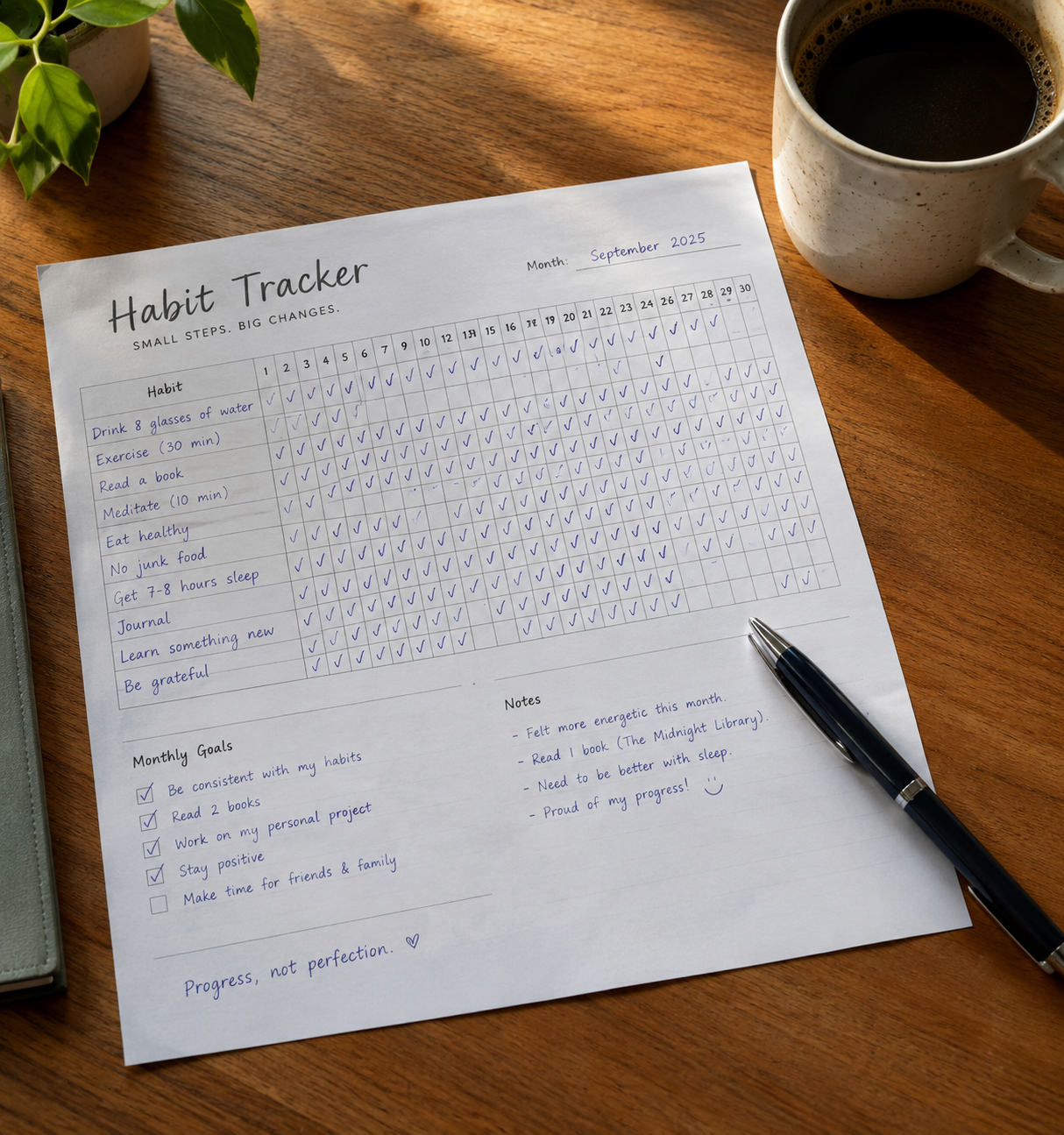
That’s genuinely the whole system. The temptation is always to make it bigger — more categories, more colors, a habit tracker bolted onto a mood tracker bolted onto a meal plan. Resist that. The entire value of this page is that it takes ten seconds to read. A one-page system you actually check beats a beautiful one you abandon in eight days, every time.
The 60-Day Reset · $27
This page, already built for the next 60 days
The one-page idea above is the whole mechanism. The 60-Day Reset is that mechanism already laid out day by day, so you’re not designing a system from scratch on a Tuesday night — you’re just filling in boxes that are already there. No app, no login, no streak to protect. Just a structure that holds the week together while you’re busy living it.
See The 60-Day Reset →Pairs with The Digital Life Planner. Want to go further after the 60 days? That’s The Standard.
What to Do in the Next Ten Minutes
If the feeling is hitting right now and you don’t want to wait until tonight to build the full page, here’s the version that takes ten minutes and still works.
- Set a timer for 10 minutes. A real one — phone or kitchen timer, doesn’t matter.
- Write down the 3 things making the “behind” feeling loudest right now. Not 10. Three.
- Pick the smallest one and do the first physical step only — send the text, open the drawer, start the load of laundry. Not finish it. Start it.
- Cross it off your 3-item list the moment it’s started, not finished. Starting is what breaks the freeze.
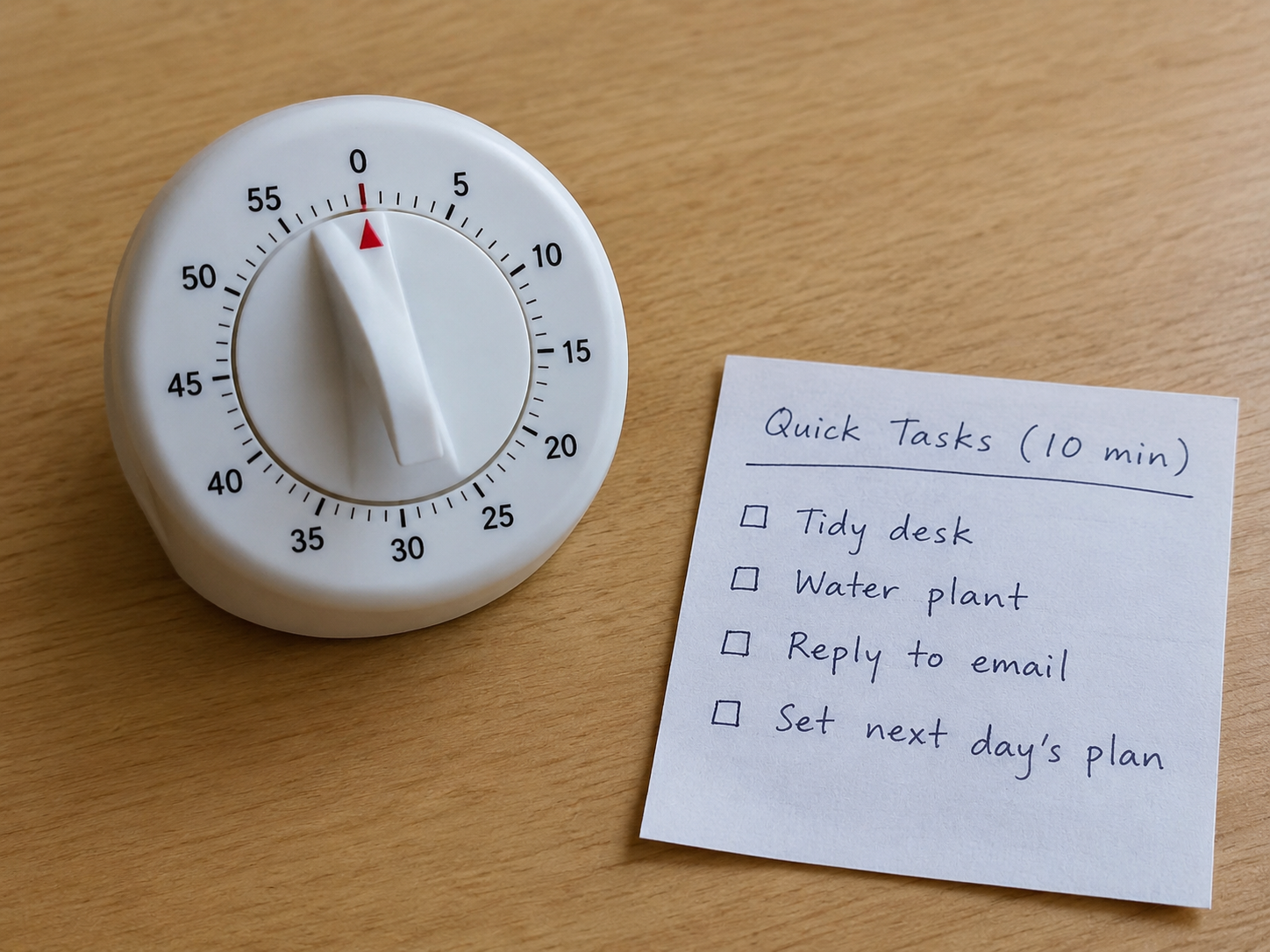
This isn’t a productivity hack — it’s a scale trick. Three items you can actually see are less overwhelming than an infinite mental list you can’t. You’re not trying to get caught up in ten minutes. You’re trying to prove to yourself, quickly, that the pile has an edge.
Why the Feeling Comes Back Even After a Good Week
This is the part that convinces most people the system doesn’t work, when actually it’s the most predictable part of the whole thing. Harvard Business School research led by Teresa Amabile, built from nearly 12,000 daily diary entries from people at work, found something specific: a single setback has a far larger effect on how someone feels than an equivalent day of progress has in the other direction. One missed day doesn’t cancel out six good ones on paper — but it can absolutely feel like it does.
So a good week followed by one chaotic Tuesday isn’t a sign your one-page system failed. It’s a sign you hit the single most reliable trigger for the feeling to resurface — a missed check-in — and your brain, doing exactly what it’s built to do, gave that one miss more weight than the six hits around it deserved.
The fix isn’t a better system. It’s a lower bar for restarting. A missed day means you look at the page again tomorrow — that’s it. Not a review of what went wrong, not a new system, not starting over on a Monday because that feels more “official.” Just the next box.

Common Mistakes People Make Trying to Fix This
Switching systems every few weeks. A new app, a new planner, a new method — each one resets you to zero and gives you a fresh excuse to feel behind again. Boring and continuous beats exciting and abandoned.
Making the page too detailed to maintain. Five categories, color codes, a mood log bolted on — by week two it takes longer to update than the tasks themselves take to do, and it gets dropped. One page, one glance, one pen.
Treating a missed day as proof it doesn’t work. One skipped check-in isn’t data about the system. It’s just a skipped check-in. Pick it back up the next time you think of it — not next Monday.
Trying to track everything. The goal isn’t a complete inventory of your life. It’s the 5 to 7 things creating the loudest “behind” feeling. Everything else can stay untracked without consequence.
Reading “behind” as a verdict on your worth. It’s a scheduling signal, not a character reference. The page fixes the signal. It was never measuring the rest.
FAQ
This is a structure and scheduling fix, not medical guidance. If this feeling stays this heavy no matter what you try, it’s worth talking to a professional about it directly — that’s the right next step, not a failure of anything here.
Feeling behind was never really about how much you did today. It’s about whether anything you did left a mark you could see afterward. Give it one page and ten minutes tonight, and check it tomorrow — that’s the whole fix, and it starts working before you’ve finished building it.
Sources: Psychology Today — Zeigarnik Effect · Atul Gawande, The Checklist Manifesto · Harvard Business School — Teresa Amabile

Quiet the noise — without burning your phone in a field.
Get Beat Information Overload free, plus the occasional calm, no-hype note from me.