When your mood is low, your mind rarely stays in the room with you. It drifts back to what went wrong or forward to what might, and today starts to feel grey and far away. Living in the present is a simple, trainable skill that can ease that pull and help you feel a little more steady. This guide shows you what it really means, what the evidence says about mindfulness and low mood, and gentle practices you can start today, even on heavy days.
Living in the present means placing your attention on what’s happening right now, such as your breath, your senses or the task in front of you, and gently coming back each time your mind drifts. For low mood, it helps by loosening the grip of dwelling on the past and worrying about the future. Mindfulness-based therapy is recommended in the UK for less severe depression, and short daily practice is where most people start.
- ✓Start with three minutes of mindful breathing a day rather than long sessions you’ll skip.
- ✓Attach a present-moment pause to something you already do, such as making coffee or brushing your teeth.
- ✓When your mind wanders, simply notice where it went and come back, without scolding yourself.
- ✓On low-energy days, choose one sense to focus on for one minute; that still counts.
- ✓Make room for difficult feelings by naming them and breathing with them rather than pushing them away.
- ✓Use mindfulness alongside, not instead of, support from a doctor or therapist if low mood lasts.
What Living in the Present Really Means (and What It Doesn’t)
Living in the present means paying attention to this moment on purpose, with curiosity rather than judgment. It’s the core idea behind mindfulness.

The NHS describes mindfulness as paying more attention to the present moment, including your thoughts, feelings, body and the world around you. It also helps you see thoughts as passing mental events rather than facts you must act on. That shift is where much of the relief comes from.
Common myths, cleared up
| Myth | Reality |
|---|---|
| You have to empty your mind | You notice thoughts and let them pass |
| It means ignoring the past and future | You still learn and plan, then come back |
| You need an hour of meditation | A few minutes a day is a real start |
| It means always feeling calm | It means meeting whatever you feel with kindness |
| It’s only for spiritual people | It’s a practical attention skill anyone can learn |
So living in the present isn’t about forcing happiness. It’s about being where your life is actually happening, which is the only place you can do anything about it.
Being present is not the same as avoiding
Some people worry that living in the present means burying problems. It’s closer to the opposite. Avoidance turns away from what’s hard, while presence turns toward it with steady attention.
Say a bill arrives and your stomach drops. Avoidance shoves it in a drawer. Presence notices the drop, takes a breath, then opens the envelope and decides on one next step. Living in the present makes hard things more manageable, not invisible.
Why a Wandering Mind Weighs So Heavily on Your Mood
A wandering mind tends to drift toward problems, and when mood is low, those problems feel bigger and stickier. That’s why living in the present can feel like setting down a heavy bag.
In the large study behind the first figure, people tended to feel less happy when their minds wandered than when they focused on what they were doing. A wandering mind is normal. The problem comes when it wanders down the same painful paths every day.
How low mood pulls you out of the moment
Low mood tends to bring two habits: replaying the past (rumination) and dreading the future (worry). Both keep you thinking in circles instead of noticing what’s around you. Our guide to how past and future thinking fuel low mood explains that loop in more depth.
Living in the present gently interrupts those circles. Each time you bring attention back to your breath or your feet on the floor, you’re practising leaving the loop. Over time, that return gets quicker and easier.
A small example from an ordinary evening
Picture yourself washing up while replaying an awkward comment you made at work. You notice the replay, then turn toward the warm water, the smell of soap and the clink of plates. Thirty seconds later the memory drifts back, and you return again. That’s the whole practice, and it’s enough.
What the Evidence Says About Mindfulness and Depression
Mindfulness has some of its strongest evidence in helping people who have had depression stay well. It’s not a cure, but it’s a well-studied support.
Mindfulness-based cognitive therapy in brief
Mindfulness-based cognitive therapy, or MBCT, is a structured group course that blends mindfulness practice with ideas from cognitive therapy. It usually runs over several weeks, with home practice in between. The aim is to help people notice early warning signs and step out of spiralling thoughts.
According to the American Psychological Association’s Monitor, a large trial found MBCT helped prevent depression from coming back about as well as maintenance antidepressant medication. A review it describes found relapse risk fell by 43% for people with three or more past episodes.
The NHS also notes that mindfulness-based therapies are recommended by the National Institute for Health and Care Excellence (NICE) for less severe depression. That’s a meaningful vote of confidence from a national body. The NHS adds that NICE also recommends employers make mindfulness available to staff.
What does this mean for you? It suggests that living in the present is more than a pleasant idea. It’s a skill with real research behind it, especially for staying well once mood has lifted. Self-guided practice is a gentler, lighter version of the same idea.
Who it may not suit right now
Mindfulness isn’t right for everyone. The NHS points out that some people find it unhelpful or even feel worse. If inward focus brings up overwhelming feelings or memories, try outward practices such as mindful walking, or talk to a therapist who can guide you safely.
6 Simple Practices for Living in the Present Every Day
The best practices for living in the present are short enough to do on a busy or heavy day. Start with one, repeat it daily for a week, then add another. None of them needs an app, a cushion or any special skill.
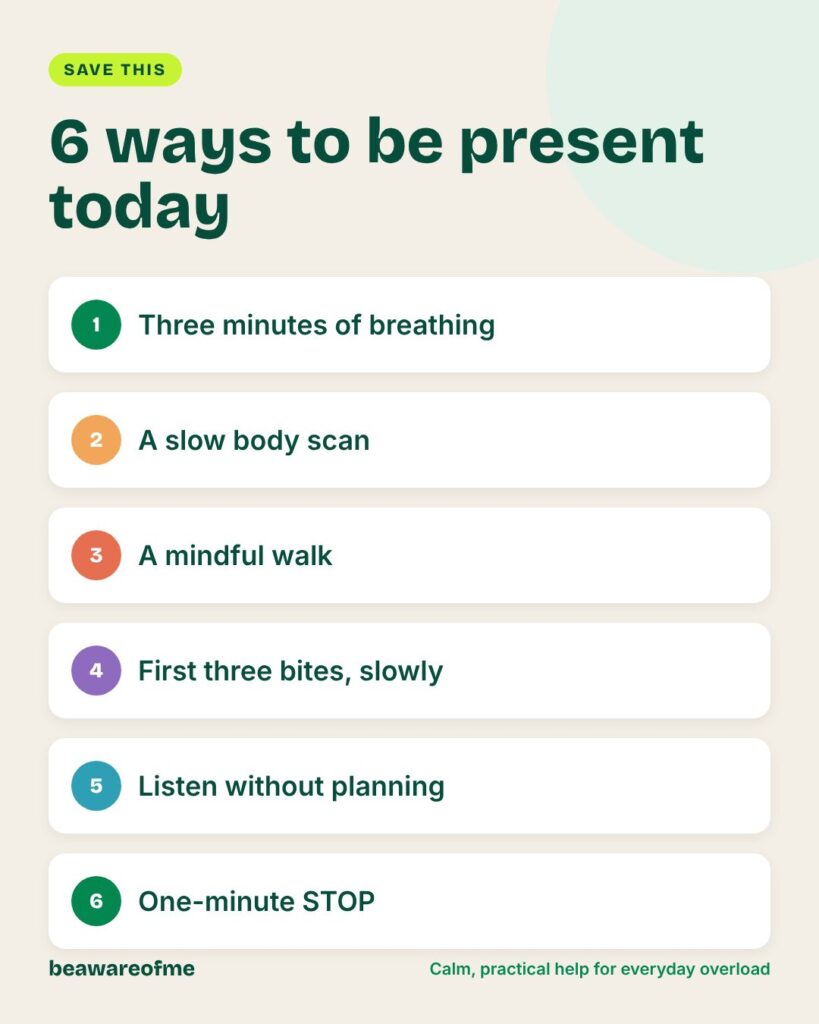
For more ideas, our list of daily mindfulness habits and our guide to mindful living practices build on these basics.
Living in the Present on a Heavy Day: A Low-Energy Plan
On heavy days, living in the present can shrink to one minute and one sense, and that still counts. The goal is a small moment of contact, not a perfect session.
If this is how today feels, try this
| If you feel… | Then try… | Time |
|---|---|---|
| Too tired to sit and meditate | Lie down and feel the weight of your body on the bed | 1 minute |
| Numb or flat | Hold something warm or cold and notice the temperature | 1 minute |
| Restless and agitated | Slow walk around your home, feeling each step | 3 minutes |
| Stuck replaying something | Name five things you can see, out loud | 1 minute |
| Dreading tomorrow | Breathe in for 4 and out for 6, ten times | 2 minutes |
| Disconnected from people | Message one person and notice how it feels to reach out | 2 minutes |
Not sure how you feel? Our free emotional weather check can help you put a name to it, which is a mindful act in itself.
Gentle movement helps on these days too. Our article on exercise for depression and anxiety explains why even short walks can support mood. If mornings are hardest, see our tips on coping with morning depression.
How to Sit With Painful Feelings Instead of Fighting Them
Living in the present doesn’t mean only noticing pleasant things. It also means making room for sadness, emptiness or frustration without letting them take over.
A four-step practice for hard moments
Many mindfulness teachers use a four-step approach, often remembered as RAIN. It takes two to five minutes.
- Recognise what you’re feeling and name it: “This is sadness” or “This is dread.”
- Allow it to be here for a moment, without trying to fix or push it away.
- Investigate gently where you feel it in your body, such as a heavy chest or tight throat.
- Nurture yourself with a kind gesture, such as a hand on your heart or a soft word.
“This is a hard moment. Hard moments pass.”
“I don’t have to solve this feeling right now. I can just breathe with it.”
“I’m doing the best I can today, and that’s enough.”
Self-kindness is a big part of living in the present. Our guide to self-compassion for low mood shows how to build it day by day.
When a feeling seems too big to sit with
Sometimes a feeling is simply too strong to explore. That’s okay. Shift your attention outward instead: feel your feet on the floor, press your palms together or look slowly around the room and name what you see.
This is still present-moment practice, just with a wider lens. Once the wave eases, you can return to gentler noticing. If big feelings arrive often or stay for long stretches, that’s a good reason to talk to a doctor or therapist.
You don’t have to feel better to be present. You just have to be here, with whatever is here.
Bringing Present-Moment Habits Into Work, Home and Bedtime
The practices stick best when they live inside your normal day rather than in a separate meditation slot. Here’s how to weave them into the three places most days happen.
At work: one-minute resets between tasks
Before you open a new email or join a call, take one slow breath and feel your feet on the floor. That tiny pause stops the last task from spilling into the next one. It also gives you a moment to notice if you’re tense, hungry or need a short break.
If your mind keeps jumping ahead to the rest of the to-do list, write the next three tasks on paper and turn it over. Then give the current task your full attention. Single-tasking is living in the present with a deadline attached.
At home: present with the people you love
Low mood can make you feel far away from the people right next to you. Try putting your phone in another room for the first twenty minutes after you get home. Ask one real question and listen to the whole answer.
Shared routines help too. Washing up together, walking the dog or cooking a simple meal can all become present-moment practice. You don’t need to call it mindfulness for it to count.
At bedtime: let the day end
Night is when the mind loves to replay the day and rehearse tomorrow. A short body scan in bed gives your attention somewhere neutral to rest. If a worry won’t settle, jot it on a bedside notepad and tell yourself you’ll look at it in the morning.
Sleep and mood are closely linked, so a calmer bedtime can ripple into the next day. Living in the present at night simply means letting this moment, lying in bed, be enough.
A 7-Day Starter Plan for Living in the Present
A simple week-long plan takes the guesswork out of starting. Each day adds one small practice, and none takes more than ten minutes.
| Day | Practice | Minutes |
|---|---|---|
| 1 | Three-minute breathing after breakfast | 3 |
| 2 | Breathing, plus the first three bites of lunch | 5 |
| 3 | Breathing, plus a mindful walk | 10 |
| 4 | Body scan in bed | 10 |
| 5 | STOP practice three times during the day | 3 |
| 6 | Mindful listening in one conversation | 5 |
| 7 | Choose your two favourites and keep them | 5 to 10 |
After the week, keep the two practices that felt most natural. Living in the present grows from repetition, not intensity. If you’d like guidance, our piece on how meditation supports mental health explains what to expect.
What to do when you miss a day
You will miss days. Everyone does. Missing a day isn’t a reason to start over or to decide mindfulness isn’t for you.
Simply pick up where you left off at the next natural moment, perhaps with three breaths before lunch. Treat the restart itself as practice: noticing you drifted and coming back is exactly what living in the present asks of you.
- Three slow breaths before you check your phone.
- One meal or drink enjoyed without a screen.
- One short walk noticing sights and sounds.
- One hard feeling named and allowed for a minute.
- One kind sentence said to yourself before bed.
5 Mistakes That Make Living in the Present Harder
These common traps can make mindfulness feel like another thing you’re failing at. Here’s how to sidestep them.
1. Judging every wandering thought
Scolding yourself each time your mind drifts adds a layer of criticism to low mood. Instead, treat each return as a small win. Noticing that you wandered is the practice.
2. Expecting instant relief
Mindfulness is a skill that builds over weeks. If you judge it after two sessions, you’ll likely give up. Commit to a short daily practice for a few weeks before deciding.
3. Using it to push feelings away
Trying to breathe sadness out of existence usually backfires. Living in the present means letting feelings be here while you stay kind to yourself. They tend to soften when they aren’t fought.
4. Going too long, too soon
Starting with 30-minute sessions often leads to frustration and skipped days. Three minutes done daily beats a long session done once a week.
5. Replacing professional care with mindfulness
Mindfulness can support recovery, but it isn’t a substitute for treatment when depression is moderate or severe. Keep talking to your doctor, and see our guide to self-care for low moods for other everyday supports.
Questions About Mindfulness and Low Mood, Answered
Can mindfulness help with depression?
Mindfulness can help many people manage low mood and lower the chance of depression returning. The NHS notes that mindfulness-based therapies are recommended by NICE for less severe depression. A large trial found mindfulness-based cognitive therapy prevented relapse about as well as maintenance medication. It works best as one part of care, alongside support from a doctor or therapist.
What does it mean to live in the present moment?
Living in the present moment means placing your attention on what’s happening right now, such as your breath, your body, your senses or the task in front of you. You still learn from the past and plan for the future, but you don’t stay stuck there. When your mind drifts, you notice and gently come back without judging yourself.
How do I start practising mindfulness when I feel low?
Start very small. Try three minutes of mindful breathing once a day, or simply notice the warmth of a drink in your hands. Link the practice to something you already do so it’s easy to remember. On heavy days, one minute with one sense still counts. Build slowly, and be kind to yourself when you miss a day.
What is mindfulness-based cognitive therapy?
Mindfulness-based cognitive therapy, often called MBCT, is a structured course that combines mindfulness practice with ideas from cognitive therapy. It usually runs in groups over several weeks, with daily home practice. It’s designed to help people who have had depression notice early warning signs and step out of spiralling thoughts. Ask your doctor whether a course is available locally.
Can mindfulness make depression worse?
For some people, yes. The NHS points out that mindfulness isn’t right for everyone, and some people find it unhelpful or feel worse. Focusing inward can sometimes bring up difficult memories or feelings. If that happens, stop, open your eyes and try an outward practice like mindful walking. A therapist can help you practise in a safer, guided way.
How long does mindfulness take to improve mood?
There’s no exact timeline, and it varies from person to person. Structured programmes such as MBCT usually run for several weeks with daily home practice. Many people notice small changes first, such as catching spirals sooner or feeling a little calmer. If your mood hasn’t improved after a few weeks, or gets worse, talk to a doctor.
Your mind will keep wandering, and that’s perfectly human. What matters is the gentle return, again and again, to the breath, the body and the life right in front of you. Start small today, be patient with yourself, and let living in the present become a quiet source of steadiness on both light and heavy days. Explore more support in our depression and low mood guides.