You’ve read the lists. Meditate for an hour, journal three pages, cut out sugar, wake at 5am. Then real life happens, and none of it sticks. This guide is different: 10 small daily habits that boost mental health in minutes, not hours, plus a simple way to stack them so they last past the first busy week.
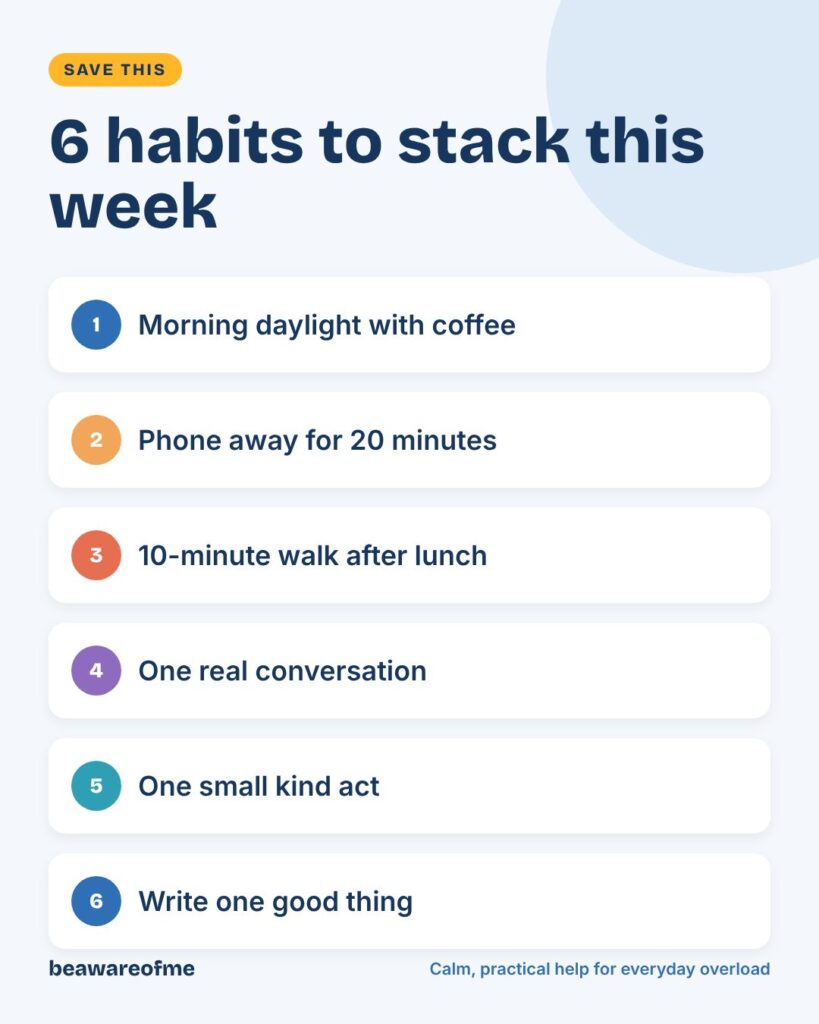
The daily habits that boost mental health most are small and repeatable: getting morning daylight, moving your body for 10 to 30 minutes, eating regular meals, connecting with someone, helping others, limiting doom-scrolling, learning something small, noticing what went well, pausing to breathe and protecting a steady sleep routine. You don’t need all ten. Start with two, attach them to things you already do, and build from there.
- ✓Start with just two habits from this list, because two habits kept for a month will do more than ten dropped in a week.
- ✓Attach each new habit to something you already do, such as stretching while the kettle boils or texting a friend on your commute.
- ✓Get outside within an hour of waking whenever you can, even for five minutes, to help set your body clock.
- ✓Keep your phone out of reach for the first 20 minutes of the day so your mood isn’t set by other people’s news.
- ✓End each day by writing one thing that went well, which trains your attention to notice small wins.
- ✓Talk to a doctor if low mood or worry lasts most days for two weeks or more, even while you build good habits.
Why Small Habits Boost Mental Health More Than Big Resets
Small habits boost mental health because your brain responds to repetition, not intensity. A five-minute walk you take every day beats a two-hour hike you manage once a month.

Big resets feel exciting on a Sunday night. By Wednesday, work, family and tiredness push them aside, and you’re left feeling like you failed. Tiny habits survive bad days. That reliability is exactly what makes them work.
What the experts recommend
The NHS suggests five steps to mental wellbeing: connect with other people, be physically active, learn new skills, give to others and pay attention to the present moment. The National Institute of Mental Health adds regular meals, steady sleep, gratitude and relaxation to the list. Every habit below builds on those foundations.
How to use this list
Read through all ten, then circle the two that feel easiest, not the two that feel most impressive. Easy wins build trust in yourself. Once those two run on autopilot, usually after a few weeks, add a third.
Habits 1 to 3: A Calm Start Before the Day Grabs You
The first hour sets the tone for the rest of your day, so these three morning habits come first. Together they take about 10 minutes.
Habit 1: Get daylight within an hour of waking
Morning light helps set your body clock, which supports energy during the day and sleepiness at night. Step outside with your coffee, walk to the shop, or sit by a bright window if going out isn’t possible. Five to ten minutes is enough to start.
Cloudy days still count, because outdoor light is usually far brighter than indoor lighting. Of all the small ways to boost mental health, this one needs the least effort: you only have to stand outside.
Habit 2: Keep your phone away for 20 minutes
Checking messages in bed means other people’s demands and the world’s bad news reach you before you’ve even stood up. Leave your phone charging in another room, or simply turn it face down. Use those 20 minutes to wash, dress and eat something.
This habit doesn’t ban your phone. It simply lets you decide your first thoughts of the day, which is a quiet way to boost mental health before anyone else’s agenda arrives.
Habit 3: Take three slow breaths and pick one priority
Before you open your laptop or start the school run, pause. Breathe in for four counts and out for six, three times. Then ask yourself: what’s the one thing that would make today feel good enough? Write it down. This tiny pause is one of the quickest ways to boost mental health, because it swaps rushing for choosing.
For more morning ideas, our guide to daily routines for a more aware life has gentle options for every schedule.
Habits 4 and 5: Move Your Body and Feed Your Brain
Your mood runs on your body, so movement and food are two of the most reliable ways to boost mental health. Neither needs to be perfect.
Habit 4: Move for 10 to 30 minutes
Movement eases tension, burns off stress chemicals and often improves sleep. The NHS points out that you don’t need hours in a gym. Pick something you actually enjoy: walking, cycling, dancing, gardening or a short online yoga class.
If you only add one habit from this whole list, make it this one. Movement can boost mental health and physical health at the same time, which is why our guide on the link between body and mind puts it near the top.
| If you have | Try this | Mood bonus |
|---|---|---|
| 5 minutes | Stretch your neck, shoulders and back | Releases desk tension |
| 10 minutes | Brisk walk around the block | Clears a busy head |
| 20 minutes | Bike ride, swim or dance to a playlist | Lifts energy for hours |
| 30 minutes | Walk with a friend or a podcast | Combines movement and connection |
For the science behind it, read our guide on how exercise boosts mood.
Habit 5: Eat regular meals and drink water
Skipping meals and running on coffee can leave you shaky, irritable and foggy, which can feel a lot like anxiety. Aim for three regular meals with some protein, fibre and colour, plus water through the day. If you want a food pattern with good research behind it, our piece on the Mediterranean diet and mood is a calm place to start.
Habits 6 and 7: Connect With People and Give a Little
Relationships protect your mood more than almost anything else, and helping others gives a quiet lift of its own. These two habits take five minutes or less.
Habit 6: Have one real conversation a day
The NHS advises against relying on texts and social media alone. A phone call, a chat with a neighbour or lunch with a colleague counts. If talking feels hard right now, start smaller: a voice note to a friend, or asking the barista how their day is going.
Connection is one of the most reliable ways to boost mental health, yet it’s often the first thing we drop when life gets busy. Put one weekly call in your calendar, just like a meeting.
- “I saw this and thought of you. How’s your week going?”
- “I’ve been a bit quiet lately. Fancy a quick call this week?”
- “What’s the best thing that’s happened to you this week?”
- “No need to reply, just wanted to say I’m thinking of you.”
Habit 7: Do one small kind thing
Giving shifts your focus away from your own worries for a moment. Thank someone properly, hold a door, check on an older neighbour or leave a kind review for a local shop. The NHS suggests really listening when you ask someone how they are. That alone is a gift.
Habits 8 and 9: Guard Your Attention and Learn Something Small
What you feed your attention shapes how you feel. These two habits protect your focus and give your brain a sense of progress.
Habit 8: Set a doom-scrolling limit
Endless feeds can fuel comparison, worry and poor sleep. You don’t have to quit social media. Try two simple rules: no scrolling in bed, and a 20-minute daily limit on the app that drains you most. Most phones have a built-in timer that makes this easy.
Notice how you feel after each app. Keep the ones that leave you calmer or more connected, and mute or unfollow the accounts that leave you tense. Curating your feed is a small edit that can boost mental health every single day.
Our guide on taking breaks from social media offers more ways to step back without missing out.
Habit 9: Learn one small thing
Learning gives you a sense of growth and something to think about besides your worries. It can be tiny: ten minutes of a language app, a new recipe, a chapter of a book or a short video on fixing something at home. The NHS lists learning new skills as one of its five steps for a reason.
Learning works best when it feels like play rather than homework. If it starts to feel like pressure, switch topics. The goal is to boost mental health, not to add another performance target.
Habit 10: The Evening Shutdown That Protects Your Sleep
A steady evening routine protects sleep, and good sleep is the foundation every other habit stands on. This final habit ties the day together.
The CDC recommends seven or more hours of sleep a night for adults aged 18 to 60, and notes that good sleep helps reduce stress and improve mood. A short shutdown routine makes that far easier to reach.
The 15-minute shutdown
If anxiety keeps you awake, our article on sleeping better when you are anxious has more ideas you can try tonight.
The Bare-Minimum Version for Days When Everything Feels Heavy
On hard days, a smaller version of each habit still counts, and it keeps the chain alive. This is the list to use when you’re exhausted, overwhelmed or low.
Think of it as a floor, not a ceiling. Habits that boost mental health only work if they survive your worst weeks, so every habit needs a version you can do in under two minutes.
| Full habit | Bare-minimum version |
|---|---|
| 10 minutes of morning daylight | Open the curtains and stand by the window for one minute |
| 20 minutes phone-free | Keep the phone down until you’ve had a glass of water |
| 10 to 30 minutes of movement | Stretch your arms overhead and roll your shoulders five times |
| Three regular meals | Eat something with protein, even toast and peanut butter |
| One real conversation | Send one emoji or a two-word message to someone you trust |
| One small kind act | Say thank you and mean it |
| Learn one small thing | Read one paragraph of something interesting |
| 15-minute shutdown | Write one word that sums up today |
Why the tiny version matters
Doing a small version tells your brain that you’re still someone who looks after yourself. That identity is what carries you back to the full habit when energy returns. Skipping completely tends to start a slide that’s hard to stop.
When the bare minimum still feels impossible
If even the tiny versions feel out of reach for days at a time, that’s important information, not a personal failure. It may mean your mood needs more support than habits alone can give. Reach out to a doctor, a qualified professional or someone you trust, and let them help carry some of the load.
How to Stack Daily Habits That Boost Mental Health
Habit stacking means linking a new habit to one you already do, so the old habit becomes the reminder. It’s the easiest way to make daily habits that boost mental health stick.
Use this simple formula
After I [current habit], I will [new habit]. For example: after I pour my morning coffee, I’ll step outside for five minutes. After I sit down for lunch, I’ll text one friend. After I brush my teeth at night, I’ll write one good thing.
| You already | Stack this habit | Habit number |
|---|---|---|
| Make coffee or tea | Step outside for daylight | 1 |
| Wake up | Leave your phone face down for 20 minutes | 2 |
| Open your laptop | Take three breaths and pick one priority | 3 |
| Finish lunch | Walk for 10 minutes | 4 |
| Commute or wait in a queue | Send a check-in message | 6 |
| Brush your teeth at night | Write one good thing | 10 |
A 4-week plan to build them
Week one: pick two habits and do them daily. Week two: keep those and add one more. Week three: add a fourth if the first three feel easy. Week four: review, keep what works and drop what doesn’t. This slow build is how you boost mental health without burning out on self-improvement.
Want a quick baseline before you start? Our free 5-minute self check-in gives you a snapshot you can repeat at the end of the month.
5 Common Mistakes That Make Good Habits Fall Apart
Most habits fail for predictable reasons, not because you lack discipline. Avoid these traps and your new routine has a much better chance.
1. Starting with all ten
Trying to change everything at once overloads you. When one habit slips, they all tend to go. Start with two. You can always add more once those feel automatic.
2. Making habits too big
“Exercise every day” is vague and heavy. “Walk for 10 minutes after lunch” is clear and doable. Shrink every habit until it feels almost too easy, then let it grow naturally.
3. Breaking the chain and giving up
Missing one day doesn’t erase your progress. Missing several in a row is what turns a habit off. The rule that helps: never miss twice. If you skip today, do a tiny version tomorrow.
4. Using habits to avoid feelings
Healthy habits support your mood, but they aren’t meant to cover up pain. If you’re running, cleaning or scrolling to avoid a feeling, pause and name it. Sometimes the most helpful habit is a short honest conversation.
5. Expecting habits to replace professional help
Daily habits boost mental health, but they aren’t a treatment for depression, anxiety disorders or other conditions. If low mood or worry lasts most days for two weeks, see a doctor or a qualified professional alongside your habits. Our guide to boundaries as self-care can also help you protect time for both.
Questions About Daily Habits That Boost Mental Health
What daily habits boost mental health the most?
How long does it take for a new habit to stick?
Can daily habits really improve my mood?
What is the best morning routine for mental health?
How much exercise do I need for better mental health?
Do I need to do all 10 habits every day?
Real change rarely comes from a dramatic fresh start. It comes from small daily choices that boost mental health a little at a time, especially on ordinary days. Pick your first two habits tonight, and explore more calm ideas in our everyday mental health guides.