








Maybe your doctor just mentioned mood stabilizers, or someone you love started taking one, and the leaflet raised more questions than it answered. That’s completely normal. This guide explains what these medicines do, the main types, the side effects worth knowing, and simple daily habits that make treatment feel less overwhelming.
Mood stabilizers are prescription medicines that help even out the extreme highs and lows of conditions like bipolar disorder. They don’t erase normal feelings. Instead, they aim to make mood swings less intense and less frequent. The main families are lithium, certain anti-seizure medicines and some antipsychotics. Most need regular check-ins, and some need blood tests. Your prescriber picks the right one for you, so always talk to your doctor or pharmacist.
If you’re having thoughts of harming yourself, please reach out now. In the US call or text 988. In the UK and Ireland call Samaritans on 116 123. Elsewhere, find a line at findahelpline.com, or contact local emergency services.
- ✓Think of mood stabilizers as a steadier floor and ceiling for mood, not a switch that turns feelings off.
- ✓Expect a settling-in period of several weeks, and keep a short daily note so you and your prescriber can spot real change.
- ✓If you take lithium, keep every blood test appointment and carry your alert card, because levels can shift with heat, illness or new medicines.
- ✓Never stop or change a medicine on your own, even on good days; plan any change with your prescriber.
- ✓Protect sleep, routine and hydration, since these three habits support treatment more than almost anything else you can control.
- ✓Bring a written list of questions to every appointment so short visits still cover what matters to you.
What Mood Stabilizers Actually Do (and What They Don’t)
Mood stabilizers help reduce the size and frequency of extreme mood episodes. They work in the background, day after day, rather than giving an instant lift. That makes them very different from a painkiller you take when something hurts.

According to the National Institute of Mental Health, these medicines mainly treat bipolar disorder and mood changes linked to some other conditions. Doctors sometimes add one alongside an antidepressant for depression. They may also use them for schizoaffective disorder and some impulse control problems.
A steadier floor and ceiling, not a flat line
Here’s the picture many people find helpful when they first hear about mood stabilizers. Imagine your mood as a line moving up and down through the week. Without support, the peaks may climb into mania or hypomania, and the dips may drop into deep depression.
A mood stabilizer aims to lower the ceiling and raise the floor. You still feel happy at a wedding and sad at a funeral. What changes is that the swings stop taking over your sleep, spending, work or relationships.
Who might be offered one
Prescribers consider several things before suggesting mood stabilizers. They look at your diagnosis, how severe your symptoms feel, what you’ve tried before and any other health conditions. Pregnancy plans matter too.
- Bipolar disorder: the most common reason. Our plain-language guide to understanding bipolar disorder covers the basics.
- Depression that hasn’t responded well: sometimes as an add-on to an antidepressant.
- Schizoaffective disorder: mood symptoms mixed with other symptoms.
- Some impulse control problems: chosen case by case.
The word “stabilizer” can sound like the goal is to make you flat. A good treatment plan aims for the opposite: more of your real personality, with fewer days lost to extremes. If you feel numb or dull, that’s useful information to share, not something to quietly put up with.
The 3 Main Families of Mood Stabilizers, Side by Side
Most mood stabilizers fall into three broad families: lithium, anti-seizure medicines and certain antipsychotics. Each family has its own strengths, check-ups and side effects. Your prescriber matches the option to your symptoms, health history and life plans.
No single option suits everyone. Two people with the same diagnosis can do well on completely different mood stabilizers, so a first choice that doesn’t fit isn’t a failure. It’s simply information that guides the next step.
| Family | Common examples | What to know |
|---|---|---|
| Lithium | Lithium carbonate, lithium citrate | Long-standing option for bipolar disorder. Needs regular blood tests to check levels, kidney and thyroid health. |
| Anti-seizure medicines (anticonvulsants) | Valproate, lamotrigine, carbamazepine | First developed for epilepsy. Some suit mixed or rapid-cycling symptoms. Some need blood monitoring; some carry pregnancy warnings. |
| Some antipsychotics | Several newer (atypical) antipsychotics | Often used for mania or as part of a combination. Your prescriber tracks weight, blood sugar and other markers over time. |
Lithium: the long-standing option
Lithium has a long track record for bipolar disorder. NIMH describes it as approved for treating mania and bipolar disorder. The trade-off is monitoring. Your care team checks lithium levels plus kidney and thyroid function, because the gap between a helpful level and too much is fairly narrow.
Anti-seizure medicines: borrowed from epilepsy care
Some anticonvulsants work well as mood stabilizers, even though doctors first used them for seizures. NIMH notes they may suit people with “mixed” symptoms or rapid cycling better than lithium does. Each one behaves differently. For example, some need slow, careful increases, while others need blood checks.
Pregnancy matters a lot with this group. Some medicines in this family can harm a developing baby, so tell your prescriber early if you might become pregnant. Don’t stop suddenly if you find out you’re pregnant; call your doctor the same day instead.
Antipsychotics: often part of a combination
Several newer antipsychotics also help steady mood. Prescribers may use them for a manic episode, for bipolar depression or alongside lithium or an anticonvulsant. Regular checks on weight, blood sugar and cholesterol usually come with this option.
Ask your pharmacist for the printed patient information leaflet each time you collect a new medicine. Highlight one line you want to ask about. It turns a dense document into a single, useful question.
Why Lithium Comes With Blood Tests and an Alert Card
Lithium needs regular blood tests because the right amount sits in a fairly narrow range. Too little may not help, and too much can make you unwell. The tests let your care team keep you in that safe, helpful zone.
Those details come from the NHS page on how and when to take lithium. In the UK, people usually get a record booklet too. You or your doctor note your dose, levels, other blood results and weight inside it, and you show it at appointments and when you collect prescriptions.
Everyday things that can shift lithium levels
Your body clears lithium through the kidneys, together with salt and water. So anything that changes your fluid or salt balance can nudge your level up or down. Watch for these situations:
- Hot weather or hard exercise: you sweat more, so drink more.
- Vomiting or diarrhoea: sip fluids and call your doctor or pharmacist for advice.
- Sudden diet changes: don’t cut salt sharply without talking to your doctor first.
- Alcohol: it dehydrates you, especially on hot days.
- New medicines: some common painkillers and other tablets can interact, so always check with your pharmacist.
Signs of too much lithium
The NHS list of lithium side effects describes warning signs that need urgent help. They include stomach pain, sickness and diarrhoea, blurred vision, strong thirst, confusion, drowsiness, muscle twitches or weakness, shaking and difficulty speaking.
If you notice signs like confusion, slurred speech, strong shaking or repeated vomiting while taking lithium, treat it as an emergency. Call emergency services or go to the nearest emergency department, and bring your medicines with you. Don’t drive yourself.
Common Side Effects and a Calm Plan for Each One
With mood stabilizers, many side effects show up in the first weeks and often ease as your body adjusts. Others need a quick call to your prescriber. Knowing which is which takes a lot of fear out of the early days.
The usual early-days nuisances
For lithium, the NHS lists feeling or being sick, diarrhoea, a dry mouth or metallic taste, a slight hand tremor and tiredness as common. Other medicines have their own lists, so check the leaflet for yours. Here’s a calm way to sort what you notice.
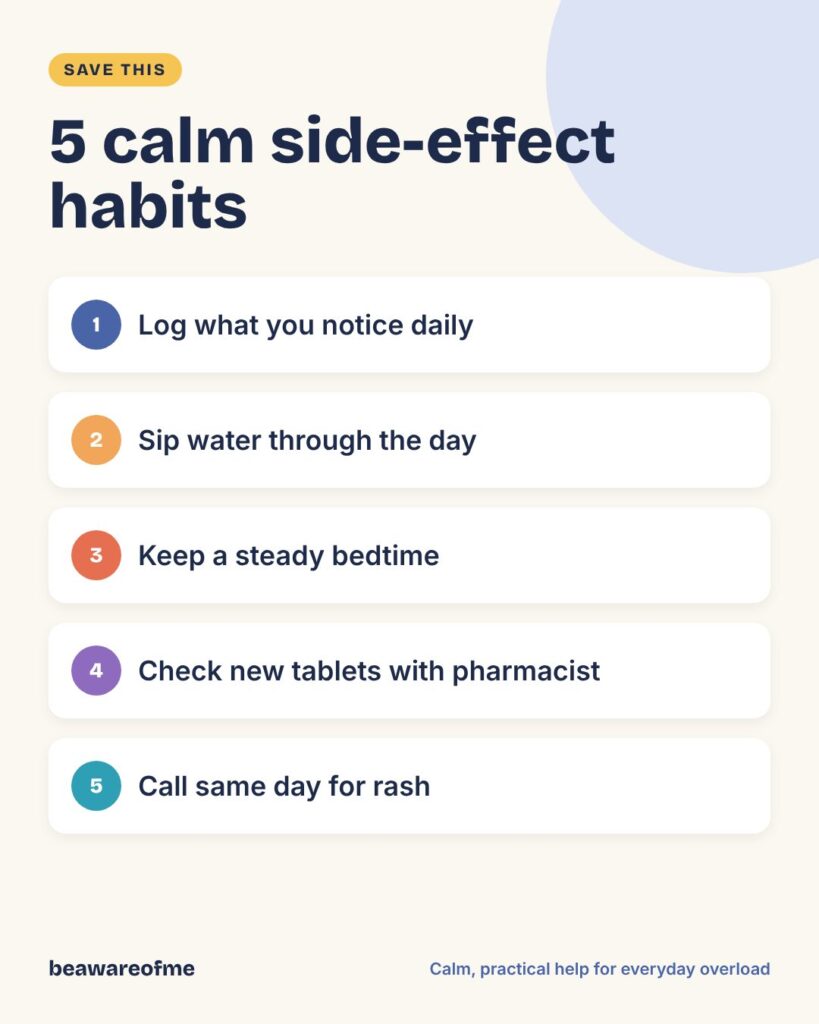
| What you notice | Small things that may help | When to call your prescriber |
|---|---|---|
| Nausea | Take it with food if your leaflet allows; eat smaller meals. | It lasts beyond a few days or you can’t keep fluids down. |
| Dry mouth or odd taste | Sip water through the day; try sugar-free gum. | It stops you eating or drinking normally. |
| Tiredness | Keep a steady bedtime; plan easier tasks for slow hours. | You feel too drowsy to work or drive safely. |
| Slight hand tremor | Cut back on caffeine; note when it’s worst. | It gets stronger, spreads or affects daily tasks. |
| Weight or appetite change | Track meals and movement for two weeks. | You notice steady change over a month. |
| Rash | Don’t guess; photograph it. | Any new rash, especially on lamotrigine: call the same day. |
Side effects that deserve a same-day call
Some reactions need prompt attention whatever the medicine. A new rash, fever with a sore throat, unusual bruising, yellowing skin or eyes, severe stomach pain or sudden confusion all count. If in doubt, call your doctor, pharmacist or an out-of-hours line. Asking never wastes anyone’s time.
Start a two-column note on your phone today: “what I noticed” and “when”. Two weeks of short entries gives your prescriber far better information than “I’ve felt a bit off”.
Your First 8 Weeks: A Realistic Timeline
Most people need patience in the first two months, because mood stabilizers usually work gradually. Your prescriber may adjust the dose a few times, and early side effects often ease along the way. Here’s a gentle way to think about the stages.
How to tell if it’s helping
Improvement on mood stabilizers rarely looks dramatic. Instead, look for quieter signs. Do you sleep more regularly? Are arguments shorter? Have you had fewer days where you couldn’t get out of bed or couldn’t slow down?
A free tool like our emotional weather check gives you a quick daily snapshot to bring to appointments. Patterns over weeks matter far more than any single day.
7 Daily Habits That Support Steady Moods
Mood stabilizers work best inside a steady daily rhythm. Small habits around sleep, routine and stress can protect you from triggers and help treatment do its job. None of these replace medical care, but they add up.
The big three: sleep, rhythm and fluids
- Keep a regular sleep window. Lost sleep can trigger mood episodes for many people. Our guide to how poor sleep affects mood explains why.
- Anchor your day. Wake, eat and take medicines at similar times, even at weekends.
- Drink steadily. Carry a water bottle, especially if you take lithium or live somewhere hot.
Four more habits that quietly help
- Go easy on alcohol and caffeine. Both can disrupt sleep and mood, and alcohol can interact with many medicines.
- Move most days. A brisk 20-minute walk counts. See how exercise supports low mood and anxiety.
- Name your early warning signs. Less sleep, racing ideas or pulling away from people can come before an episode.
- Write it down. A few lines in a journal each evening builds a record you can share. Try these journaling prompts for mental health.
- Did I take today’s medicine at my usual time?
- Roughly how many hours did I sleep last night?
- Mood today from 1 to 10, in one word.
- Anything new: side effect, stress, missed meal?
- One small thing I’ll do tomorrow to keep my rhythm.
How to Talk to Your Prescriber Without Feeling Rushed
A short appointment about mood stabilizers goes much further with a written plan. Bring your questions, your notes and one clear priority. You deserve to understand your treatment, and prescribers generally welcome prepared patients.
Questions worth bringing to your first visit
“Why do you think this medicine suits me, and what are the alternatives?”
“Which side effects are common, and which mean I should call you straight away?”
“Will I need blood tests? How often, and for how long?”
“Does it interact with anything I take, including the pill, painkillers or supplements?”
“What should I do if I miss a dose?”
“I might want to get pregnant one day. Does that change anything?”
If you struggle to speak up in appointments, our guide on how to talk to your doctor when you’re anxious has extra scripts that work for any health visit.
If you want to stop or switch
Feeling better on mood stabilizers is a sign the plan is working, not proof you no longer need them. NIMH advises against stopping a prescribed medicine without your provider’s help. Stopping suddenly can bring symptoms back or cause unpleasant effects, so a prescriber plans any change slowly and safely.
Feeling steady is a reason to keep going with your plan, not a reason to quit it.
If side effects are the problem, say so plainly: “This side effect is hard for me to live with. What are my options?” There’s usually more than one route, and an honest conversation is the fastest way to find yours.
Natural Mood Support: Helpful Extras, Not Replacements
Lifestyle steps and talking therapies can support mood stabilizers and other prescribed treatment, but they can’t safely replace them for a condition like bipolar disorder. Think of them as the team around the medicine. Always check supplements with a pharmacist first.
What fits alongside treatment
Talking therapies help many people spot triggers and build coping plans. They also give you a space to talk through how life on mood stabilizers feels, including the frustrating parts. Our overview of different types of therapy explains the main options. Peer support groups, steady routines and kind family support also make a real difference.
Be careful with supplements
Supplements can also change how mood stabilizers behave in your body. A product labelled “natural” still contains active ingredients, and the label rarely mentions interactions with prescription medicines.
Herbal remedies sound gentle, yet some interact with prescription medicines. St John’s wort, for example, interacts with many drugs. If you’re curious about options like these, read our balanced look at natural antidepressants, then bring your questions to your pharmacist before trying anything.
Keep one up-to-date list of everything you take: prescriptions, over-the-counter tablets, vitamins and herbal products. Show it at every appointment and pharmacy visit.
5 Quiet Mistakes That Undermine Your Treatment
These mistakes with mood stabilizers are common because they feel reasonable at the time. None of them make you a “bad patient”. Each one has a simple swap that protects you and keeps your plan on track.
1. Judging the medicine in week one
Early side effects can arrive before any benefit does, which makes the first days feel worse. Instead, agree a review point with your prescriber and keep notes until then.
2. Skipping doses on good days
Steady levels matter for many of these medicines. Missing doses of mood stabilizers can make your mood less stable and blood results harder to read. Use a phone alarm or a weekly pill box.
3. Forgetting to mention over-the-counter tablets
Some everyday painkillers and remedies interact with mood stabilizers, especially lithium. Ask your pharmacist before taking anything new, even something you’ve used for years.
4. Hiding side effects to seem “fine”
Many people downplay problems so they don’t look ungrateful or difficult. Your prescriber can’t fix what they don’t know about, so describe side effects plainly and early.
5. Going it alone
Taking mood stabilizers feels lighter with one trusted person in the loop. Share your early warning signs with a partner, friend or relative, and agree what they should do if they notice them.
6 Questions People Ask Before Starting Treatment
Do mood stabilizers change your personality?
Mood stabilizers aim to reduce extreme highs and lows, not to change who you are. Many people say they feel more like themselves once severe swings ease. Some notice feeling flat or slowed at first, especially during dose changes. If that happens, tell your prescriber. Adjusting the dose or trying a different medicine often helps, so you don’t have to accept it.
How long do mood stabilizers take to work?
Mood stabilizers usually work gradually rather than overnight. Many people need several weeks of regular doses before they notice steadier sleep or fewer intense swings, and the change can feel small at first. Your prescriber may adjust the dose during this time. Keep short daily notes and agree a review date, so you can judge progress over weeks, not single days.
Can you drink alcohol on a mood stabilizer?
Alcohol can disrupt sleep and mood, and it can interact with many medicines, adding to drowsiness or other side effects. With lithium, it can also dehydrate you, which may affect your levels. The safest step is to ask your doctor or pharmacist what applies to your specific medicine. Many people choose to cut back or avoid alcohol during treatment.
Are mood stabilizers addictive?
Mood stabilizers aren’t considered addictive in the usual sense, and people don’t typically crave them. However, stopping suddenly can bring symptoms back or cause unpleasant effects. That’s why prescribers recommend planning any change together and lowering doses gradually when needed. If you want to stop or switch, talk to your doctor first rather than deciding alone on a good week.
What happens if I miss a dose?
Advice depends on the exact medicine and form you take, so check your leaflet or ask your pharmacist. For lithium tablets, NHS guidance says to take a missed dose if you remember soon, otherwise skip it. Never take two doses together to catch up. A phone alarm, weekly pill box or pairing doses with a meal can help you remember.
Can I take a mood stabilizer during pregnancy?
Some medicines used to steady mood carry real risks during pregnancy, while others may be safer. Planning matters most. Tell your prescriber early if you hope to become pregnant, so you can make a plan together. If you find out you’re pregnant, don’t stop suddenly. Call your doctor promptly, because stopping abruptly can also cause problems for you.
Mood stabilizers work best as part of a bigger, kinder plan: steady routines, honest notes, good questions and people who know how to support you. Take things one week at a time, keep your prescriber in the loop, and remember that finding the right fit is a process. With patience and support, mood stabilizers can help many people spend more of their days feeling like themselves. You can find more gentle guides in our mental health library.