






You snapped at someone you love, sent the email you shouldn’t have, or swallowed your anger until it leaked out sideways. Afterwards comes the guilt, and the worry that it’ll happen again. Good anger management isn’t about never feeling angry; it’s about cooling the spike, then saying what matters in a way people can actually hear. This guide gives you a three-phase plan: before, during and after.
🌊 Key takeaways
Why Anger Isn’t the Enemy (But Your Reaction Might Be)
Anger is a normal emotion that signals something feels unfair, blocked or threatening; problems start with how we act on it. It ranges from mild irritation to intense fury. Handled well, it helps you protect your boundaries and fix what’s wrong.

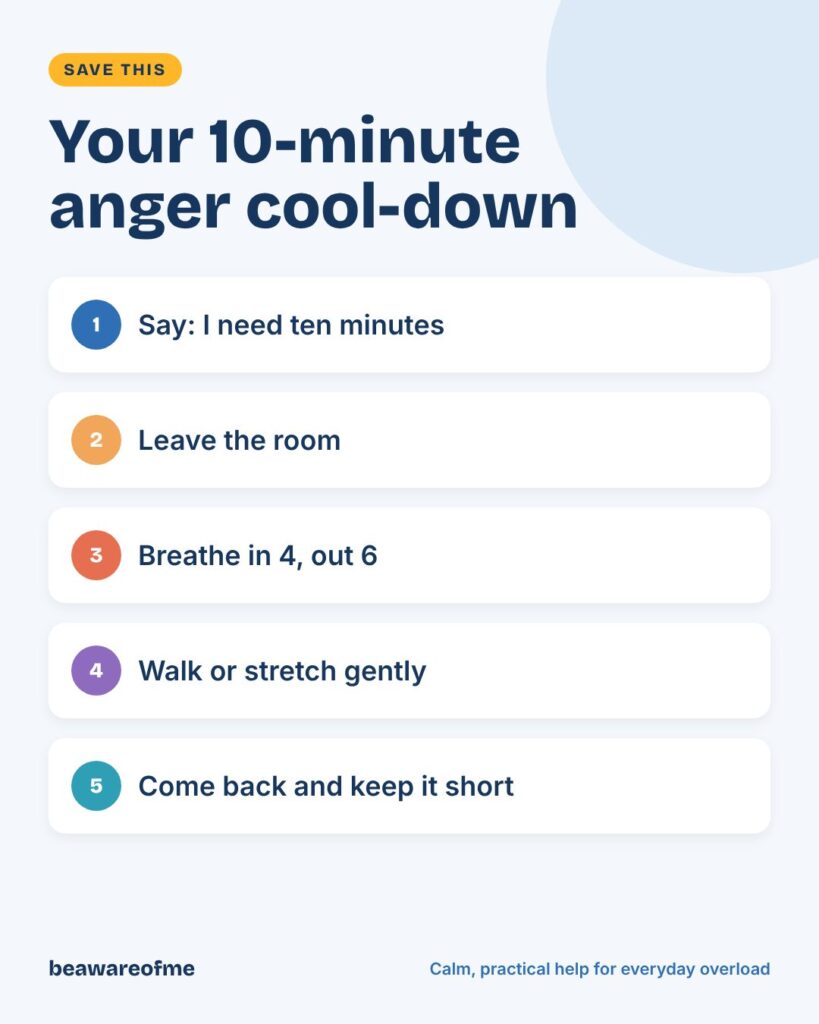
Here’s the full plan on one page. Use it as a quick reference whenever you feel the heat rising.
What happens in your body when you get angry
According to the American Psychological Association’s guide to controlling anger, anger raises your heart rate and blood pressure and boosts stress hormones like adrenaline. Your body gets ready to fight. That’s why reasoning feels nearly impossible at the peak, and why calming the body comes first.
The iceberg under the anger
Anger is often the visible tip of something softer: hurt, fear, embarrassment, exhaustion or feeling ignored. When you ask “what’s under this?”, you usually find the real need. Shouting about the dishes may really be about feeling unsupported.
Healthy anger vs harmful anger
Healthy anger is proportionate, passes within a reasonable time and leads to a fair request or a fix. Harmful anger is frequent, lingers for hours or days, frightens people or ends in actions you regret. If yours often lands in the second group, that’s not a character flaw. It’s a sign your anger management skills need practice and, possibly, support.
A simple test helps: after the anger passes, did you protect something important, or did you damage something important? Keep that question in mind as you read the phases below.
Phase 1: Spot Your Anger Before It Spots You
The easiest anger to manage is anger you catch early. Most outbursts have a build-up, and the first few signals are your best chance to change course. Spend a week noticing yours.
Your early warning signals
- Body: hot face, tight chest, clenched jaw or fists, fast heartbeat, shallow breathing.
- Thoughts: “they always do this,” “this is ridiculous,” replaying what someone said.
- Behaviour: raised voice, sarcasm, slamming doors, typing faster and harder.
- Urges: wanting to interrupt, have the last word or leave abruptly.
Common triggers worth tracking
Triggers are situations that reliably set you off: being interrupted, feeling disrespected, running late, money talk, noise or certain people. Write down what happened, how angry you felt from 1 to 10 and what was going on underneath. Patterns usually appear within days.
For a deeper look at why certain moments hit so hard, read our guide on the science of emotional triggers.
Build a simple anger log
An anger log is the most underrated anger management tool there is. Keep a note on your phone with four columns: what happened, your anger from 1 to 10, the feeling underneath and what you did. Fill it in once a day, even when nothing big happened.
After a week, look for repeats. Maybe your worst moments cluster around 6 p.m., or after certain calls, or on nights with little sleep. Those patterns tell you where to put your energy first, so you can prevent spikes rather than only react to them.
The HALT check
Before blaming the situation, ask: am I Hungry, Angry about something else, Lonely or Tired? Low fuel shortens everyone’s fuse. Often, the most effective anger management tool is a snack, a glass of water or an early night.
Phase 2: Cool the Spike in the First 10 Minutes
When anger flares, your only job is to lower the heat before you speak or act. Big decisions, hard conversations and messages can wait. This is where most anger management plans succeed or fail.
Why venting backfires
Many people believe letting it all out helps. Research says otherwise. A review of 154 studies with 10,189 participants, published in Clinical Psychology Review, found that calming activities reduced anger, while venting showed little benefit and could make it worse, as ScienceAlert’s report on the anger meta-analysis explains.
154
studies were reviewed in a large analysis of what actually reduces anger.
Source: Clinical Psychology Review, via ScienceAlert
10,189
participants were included; calming activities beat venting.
Source: Clinical Psychology Review, via ScienceAlert
8 to 10
weeks of counselling may help a very angry person move toward a middle range, depending on the person.
Source: American Psychological Association
Your 10-minute cool-down
Say the pause line
“I’m getting too heated. I need ten minutes, and then I’ll come back.”
Leave the room
Physical distance stops the argument from escalating further.
Breathe slowly
In for 4, out for 6, for at least two minutes.
Move gently
Walk, stretch or do slow yoga to let the adrenaline settle.
Come back
Return when you’re calmer, as you promised, and keep it short.
If you can’t leave the room
Sometimes walking out isn’t possible, like in a meeting or with small children. Stay seated, plant your feet, and breathe out slowly through your nose. Lower your voice on purpose and slow your speech. Say less, and buy time with “Let me think about that.” These quiet moves are anger management you can use anywhere.
Calm-down tools that work in real life
Slow belly breathing, progressive muscle relaxation (tensing and releasing muscle groups), counting to ten and a timeout all lower physical arousal. Cold water on your wrists helps too. Our guide to fast calming techniques shares more body-first tools you can borrow for anger.
Phase 3: Reframe the Angry Thoughts
Once your body is calmer, your thoughts become the next lever. Angry thinking tends to exaggerate, generalise and assume the worst about other people’s intentions. Small changes in wording can lower the temperature a lot.
Swap absolute words for accurate ones
The APA calls this cognitive restructuring: replacing exaggerated thoughts with more balanced ones, and turning demands into preferences. It doesn’t excuse bad behaviour. It simply keeps you from pouring fuel on the fire.
Look for the need underneath
Ask yourself: “What do I actually need here?” Respect, rest, help, fairness or reassurance are common answers. Once you know the need, you can ask for it directly instead of hoping your anger will make the point for you.
When old anger keeps coming back
Sometimes today’s anger carries years of resentment. If the same grudge keeps resurfacing, our guide on letting go of old grievances offers ways to work through it.
Phase 4: Express Anger Constructively With Words That Work
Healthy anger management ends with expression, not silence. The APA describes assertive expression as the healthiest option: respecting yourself and the other person at the same time. Assertive doesn’t mean pushy; it means clear.
The 4-part assertive script
🧭 Try this today: say it without a fight
When (the specific event): “When the plans changed at the last minute…”
I felt (one feeling word): “…I felt frustrated and a bit dismissed.”
Because (your need): “…because I’d arranged my evening around it.”
Could we (one clear request): “Could you give me a heads-up earlier next time?”
Keep it to one issue. Bringing up three old complaints turns a request into an attack. Mayo Clinic’s anger management tips also recommend sticking with “I” statements and focusing on solutions rather than what upset you.
Timing makes or breaks it
Choose a calm moment, not the minute someone walks through the door. The APA suggests scheduling hard conversations for times when you’re not already tired or distracted. A simple “Can we talk about something tonight after dinner?” sets everyone up better.
Listen as hard as you speak
After you’ve made your point, ask for theirs and listen without planning your comeback. Repeat back what you heard: “So you felt rushed too?” Feeling understood lowers defensiveness on both sides. If conflict tends to spiral in your relationships, read our conflict resolution basics.
Repair after you’ve lost your temper
Everyone gets it wrong sometimes, and the repair matters as much as the slip. Wait until you’re calm, then own your part without excuses: “I raised my voice, and that wasn’t okay.” Name the effect on the other person, and say what you’ll do next time.
Skip the “but you” that undoes the apology. If the original issue still needs discussing, raise it later, separately. Repair builds trust, and trust makes every future conversation easier. Over time, this habit is one of the clearest signs your anger management is working.
Anger Management at Work, at Home and Online
Different places call for different anger management moves. The core stays the same: pause, cool down, then speak clearly. These quick rules help you apply it wherever the heat rises.
At work
Keep replies short and factual when you’re annoyed. Say “Let me look into this and come back to you,” then take a walk. Raise ongoing issues privately with your manager, using specifics, not labels. If workplace pressure keeps you on edge, explore our mental health guides for stress support.
At home
Home is where anger often spills over, because we feel safe enough to drop the filter. Agree on a timeout signal, avoid big conversations when someone is hungry or exhausted, and protect 15 minutes of quiet decompression after work, an idea the APA suggests.
With children around
Kids learn anger management mostly by watching you. When you notice the heat rising, narrate your own pause: “I’m feeling frustrated, so I’m going to take three slow breaths.” It calms you and teaches them a skill at the same time. If you do shout, repair with them too; it shows that mistakes can be mended.
Online and in traffic
Screens and steering wheels strip away the human face, which makes anger easier. Before replying online, ask: “Will this matter in a week?” On the road, breathe out slowly, put on calming audio and leave earlier so delays sting less.
Anger tells you something matters. Calm lets you say what it is.
beawareofme
When Anger Needs Professional Support
Self-help works for everyday irritation, but some anger needs a professional. Getting support is a strong, responsible choice, especially when other people are affected.
Signs it’s time to get help
- Your anger feels out of control, or you often regret what you say or do.
- Arguments regularly turn into shouting, threats or breaking things.
- People around you seem afraid of you, or walk on eggshells.
- Anger is causing problems at work, with the law or in your relationships.
- You’ve hurt someone, or you fear you might.
Mayo Clinic advises seeking help if anger feels out of control, leads you to do things you regret or hurts people around you. A doctor can refer you to anger management programmes, counselling or therapy. The APA notes that counselling may help many people move toward calmer responses within about 8 to 10 weeks.
What professional programmes usually involve
Professional anger management often uses cognitive behavioural approaches: noticing triggers, challenging hot thoughts, practising relaxation and rehearsing assertive communication. Sessions may be one-to-one or in a group. Some people also work on stress, sleep or alcohol use, since these often feed anger.
There’s no shame in joining a programme. Calmer reactions can make work, family life and your own health feel easier, and asking for help is how that change starts.
Anger and anxiety often travel together, and irritability can be a sign of stress overload. Our piece on the connection between anger and anxiety explains how they feed each other.
5 Common Anger Management Mistakes to Avoid
Even with good intentions, some popular habits keep anger alive. Watch for these.
1. Punching pillows or going for a hard run to “let it out”
High-arousal outlets keep your body revved up. The large review of anger studies found that venting didn’t help, and some high-energy activities could even increase anger. Choose calming tools first, then exercise later for general stress.
2. Trying to resolve it at the peak
Insisting on settling things “right now” usually escalates them. Your thinking brain is offline at the peak. Pause, cool down and agree on a time to return, then keep that promise.
3. Confusing silence with control
Swallowing anger can look calm, yet it often comes out as sarcasm, coldness or a sudden explosion later. Say what bothered you, briefly and kindly, once you’ve cooled down.
4. Apologising vaguely
“Sorry if you were upset” doesn’t repair much. A real repair names what you did, acknowledges its effect and says what you’ll do differently: “I’m sorry I shouted. That wasn’t fair. Next time I’ll take a break first.”
5. Ignoring the basics
Poor sleep, skipped meals, alcohol and constant stress all shorten your fuse. No script works well on empty. Protecting rest and routine is quiet but powerful anger management.
📚 Keep reading
Healthy ways to manage angerThe science behind anger controlWhy you freeze during conflictCalm conflict with kidsAnger Management FAQ: Straight Answers
What is the fastest way to calm down when angry?
Is it healthy to express anger?
Does venting help with anger?
What are the signs that I need help with anger management?
How long does anger management take to work?
How do I stop yelling when I get angry?
Anger will keep showing up, because you care about things. With steady anger management, you can catch it early, cool the spike and speak up in ways that protect both you and the people you love. Start with one pause line today, and let calm do the talking.