

You opened the app to kill four minutes in a checkout line. You closed it eleven minutes later feeling like your apartment is too small, your job is too boring, and everyone else got a memo about how to live that never reached you. Nothing bad happened in those eleven minutes — nobody said anything unkind, nothing went wrong. You just scrolled. And somehow you came out the other side feeling worse. If you’ve ever wondered why does scrolling make you feel worse about yourself, this is the mechanism behind it, and the ten-minute fix that actually works.

Key takeaways
Why Does Scrolling Make You Feel Worse About Yourself? The Mechanism Nobody Names
Most explanations stop at “comparison is the thief of joy” and leave it there, which is true and also not remotely useful. Here’s the actual mechanism, in the order it runs.
Scrolling is a one-directional flow of information. You see. You don’t interact, most of the time — a University of Florida study on social comparison and social media notes this is exactly why passive scrolling behaves differently from an actual conversation. There’s no back-and-forth to correct the picture, no chance for the other person to mention the argument they had that morning or the rejection email they got last week. You’re handed a single, polished frame and asked, silently, to compare your entire messy, ongoing life against it.
That comparison happens automatically. Humans evaluate their own standing by measuring against other people — it’s one of the oldest, least optional habits the mind has, and social media didn’t invent it. What social media changed is the sample size and the selection. Instead of comparing yourself to the dozen or so people you actually see in a week, you’re comparing yourself to a curated cross-section of everyone you’ve ever followed, each one showing you their best five seconds.

The Child Mind Institute has reported on internal research — conducted by Meta itself and later made public — showing the company’s own data found Instagram made body image issues worse for one in three teen girls who already struggled with them. That finding was specific to teenage girls, but the mechanism it reveals isn’t age-locked: the platform’s own research found its format actively worsens the exact kind of comparison this article is about. If the company that built the feed found this effect in its own data, it’s not a personal failing that you feel it too.
📝 Note on the term
Researchers call this upward social comparison — measuring yourself against someone who appears to be doing better. Its counterpart, downward social comparison, is measuring yourself against someone who appears worse off. Both happen constantly online, but they don’t affect mood the same way, which is the whole subject of the next section.
The Study That Proves It Isn’t Just You
In 2013, researchers at the University of Michigan ran an experiment that’s aged into one of the most-cited pieces of evidence on this exact question, and it’s worth knowing the actual numbers rather than the folklore version.

Psychologist Ethan Kross and his team recruited 82 young adults and texted each of them five times a day for two weeks. Every text linked to a short survey: how do you feel right now, how worried, how lonely, how much Facebook have you used since we last asked, and how much have you interacted with people directly. The design mattered — the University of Michigan’s own summary of the findings explains that experience-sampling in the moment avoids the fuzziness of asking people to remember how they felt hours later.
The result: the more someone used Facebook in one period, the worse they felt the next time researchers checked in. Over the full two weeks, the more a person used Facebook overall, the more their life satisfaction declined. Crucially, direct interaction with other people — a phone call, a real conversation — didn’t produce this effect. It did the opposite. And the researchers ruled out the obvious alternative explanation: people weren’t simply scrolling more because they already felt bad. Loneliness and Facebook use each independently predicted feeling worse, which means the scrolling itself was doing something, not just reflecting a mood that was already there.

Put plainly: this wasn’t a one-off survey asking people to guess how social media makes them feel in general. It was two weeks of real-time evidence, and the pattern held. Feeling worse after scrolling isn’t a personality quirk or a sign you’re “too sensitive.” It’s a documented, repeatable effect.
Upward vs. Downward: The One Variable That Decides Whether Scrolling Helps or Hurts
Here’s the detail most advice on this topic skips entirely, and it’s the most useful thing in this article.
Not all social comparison online produces the same effect. Researchers split it into two directions. Upward comparison is looking at someone who appears to be doing better than you — happier, more successful, further along. Downward comparison is looking at someone who appears to be doing worse. A 2021 study out of the University of Florida surveyed 163 adult social media users and measured exactly this. The finding: more frequent upward comparisons reliably reduced positive feelings and left people with a more deflated sense of themselves. More frequent downward comparisons did the reverse — people came away feeling comparatively better.

Most of what you read this week will be gone by Thursday.
That isn't a discipline problem. It's what happens to information you never write down. Beat Information Overload is a free 35-page workbook that turns reading into something that stays.
Get the free workbook No cost · unsubscribe in one click
This matters because it explains something confusing: why the exact same fifteen minutes of scrolling can leave you fine on some days and hollow on others. It was never really about the fifteen minutes. It was about which fifteen accounts you happened to land on. A feed weighted toward people announcing promotions, engagements, and vacations is doing something different to your mood than a feed with a mix of ordinary, unremarkable posts — even though both are “just scrolling” from the outside.
✨ Quick win
Next time you close the app feeling worse, pause and ask one question: which specific post did that? Not “social media in general” — one post, one person. You’ll usually find it in seconds, and naming it turns a vague, sticky bad mood into one concrete, addressable data point.
The Algorithm Isn’t Neutral — It’s Built to Show You What Stings
This is the part that turns an individual psychology problem into something closer to a design problem, and it changes what “just don’t compare yourself” is actually asking you to override.
Your feed isn’t chronological anymore on most platforms, and it isn’t a random sample of what the people you follow posted. It’s a ranked selection, chosen by a system optimized for one metric: how long you stay and how often you come back. Content that provokes a strong reaction — admiration, envy, awe, outrage — keeps people scrolling longer than content that doesn’t. That’s not a conspiracy theory; it’s the plain mechanical incentive of an attention-based business model, and it means the single most polished, most enviable post in someone’s week is disproportionately likely to be the one your feed surfaces to you, precisely because it’s the one most likely to make you stop and look.
In other words: you’re not imagining that everyone else’s life looks like a highlight reel. The system is specifically tuned to show you the highlights, stripped of the ordinary Tuesday that surrounds them. Nobody’s feed shows the argument before the anniversary photo or the four discarded drafts of the “grateful for this life” caption.

“You’re comparing your unfiltered Tuesday to a system-selected highlight reel of everyone else’s best five seconds. That was never a fair fight — and knowing that changes how the loss feels.”
None of this means the platforms are malicious in some cartoonish sense, and it doesn’t mean you’re powerless against them either. It means the fix isn’t willpower applied to yourself — telling yourself to stop comparing rarely works for long. The fix is changing the raw material the algorithm has to select from, which is exactly what the audit below does.
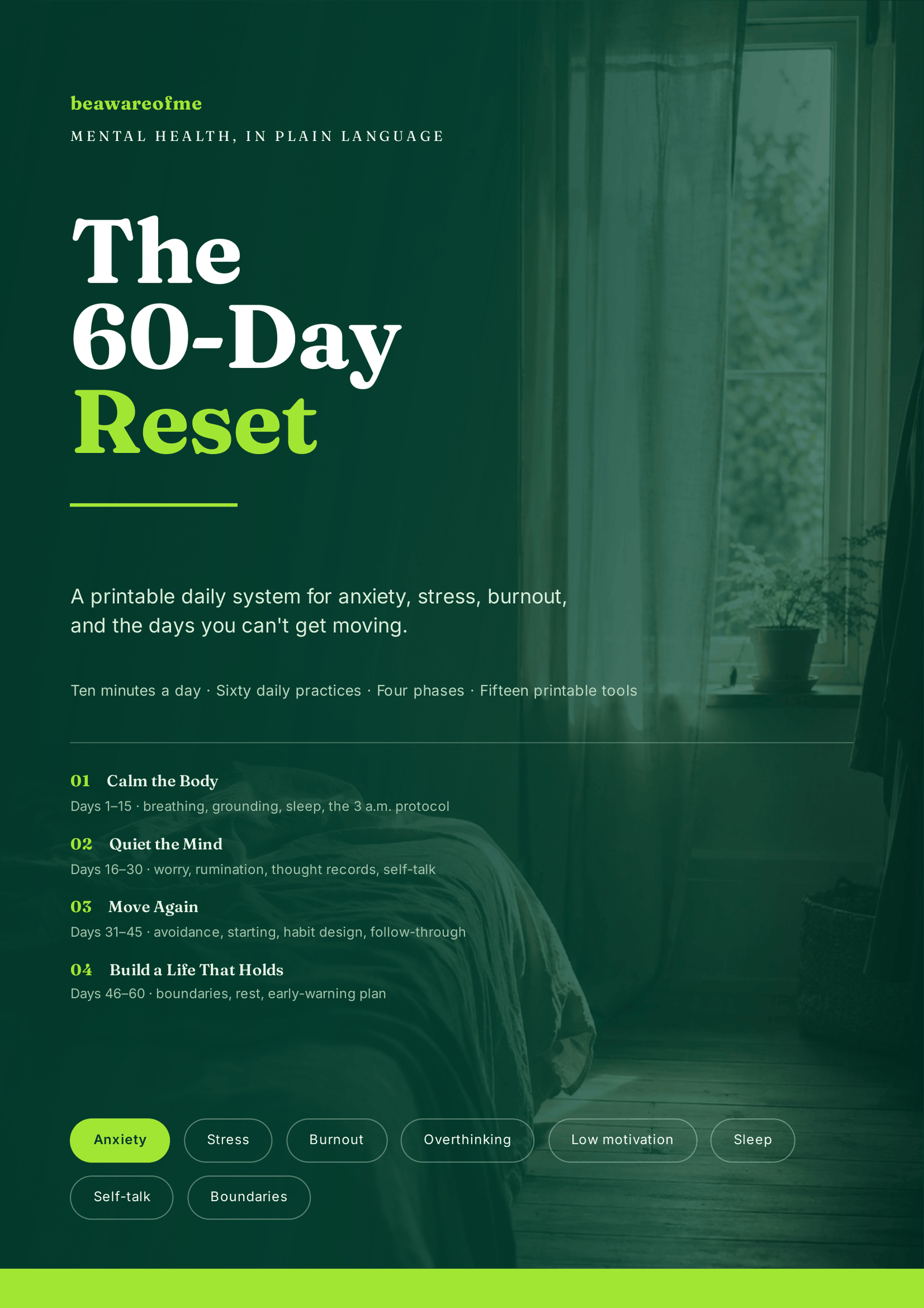
The 60-Day Reset
Everything on this page, sequenced into a printable ten-minute daily practice — 84 pages across anxiety, sleep, overthinking and low motivation, with a two-minute version of every day for the hard ones.
Instant PDF · 60 daily practices · 15 printable tools · Educational, not therapy
The 10-Minute Feed Audit That Actually Changes How Scrolling Feels
This isn’t “take a social media break,” which works for exactly as long as the break lasts and then stops. This changes the underlying comparison diet, so the effect is different even on days you scroll just as much as before.
Open your most-used app and scroll for two minutes, noticing (2 minutes)
Don’t change anything yet. Just notice, for each post: did this make me feel worse, neutral, or genuinely fine? You’re gathering data, not fixing anything.
Name the three accounts that landed in “worse” (2 minutes)
Not a mood — a name. Scroll back through your recent activity if you need to jog your memory. Three is usually enough to spot the pattern.
Mute, don’t unfollow (3 minutes)
Unfollowing someone you actually know creates its own social anxiety — will they notice, will it seem pointed. Muting removes their posts from your feed silently. Do this for all three accounts from step two.
Add one deliberately ordinary account (2 minutes)
Follow one account that posts unremarkable, unpolished, real-life content — a friend who shares mess and boredom along with the good days. This dilutes the highlight-reel ratio of your whole feed, not just removes the worst of it.
Set a re-check reminder for two weeks out
Run steps one and two again in two weeks. Most people notice the “worse” pile shrinking — not because they’re comparing less, but because there’s simply less upward-comparison material left to compare against.

Beat Information Overload
If the audit above helped, this takes it further — a full workbook for quieting the noise, auditing what’s actually draining your attention, and rebuilding a calmer relationship with your phone.
Instant download · No credit card · Unsubscribe any time
Why Does Scrolling Make You Feel Worse About Yourself Around Certain People and Not Others?
This is the detail that makes the whole pattern click for most people, and it’s the fastest route to actually changing it.
You can scroll past a stranger’s vacation photos without a flicker, and then one specific person’s ordinary Tuesday post leaves you flat for an hour. That’s not random, and it’s not proof you’re a bad or petty person for reacting that way. It’s usually one of three things: proximity, timing, or an unresolved comparison you were already primed for.
| If it’s usually | The likely cause | What actually helps |
|---|---|---|
| A close friend or sibling | Proximity — their life feels like a live benchmark for what yours “should” look like | Mute (not unfollow) for a stretch, and get updates from them directly instead |
| Someone your age from school | Timeline comparison — an implicit “we started at the same point” benchmark | Notice the thought “I should be further by now” and question the timeline itself, not just the feeling |
| An influencer or public figure | Manufactured aspiration — their entire account exists to look enviable | Unfollow freely; there’s no relationship cost, and the content is designed to do exactly this |
| A specific topic (career, family, money) | A live insecurity the post happened to touch, regardless of who posted it | Address the underlying insecurity directly rather than treating the post as the actual problem |

That last row matters more than it looks. If money is already a source of quiet anxiety for you, a friend’s new-house post will hit differently than it would on a week you feel financially steady — same post, same friend, different result. Our piece on looking fine while struggling underneath covers why this kind of selective sensitivity so often gets mistaken for oversensitivity, when it’s really just an accurate signal pointing at something worth looking at directly.
5 Mistakes That Keep the Comparison Spiral Going
1. Deleting the app for a weekend and calling it fixed
A break interrupts the feeling. It doesn’t change the feed waiting for you when you reinstall. Most people redownload, scroll for ten minutes, and land right back where they started, because nothing about the comparison diet actually changed. The audit above works precisely because it changes what’s there when you come back, not just whether you’re looking at it this week.
2. Telling yourself “it’s just a highlight reel” mid-scroll
This is true and it doesn’t work in the moment, because the comparison response fires faster than the reminder does. Knowing it intellectually while scrolling is like reminding yourself a horror movie isn’t real while you’re still jumping at it. Save the reframe for after, when you’re reviewing what happened, not as a shield during.
3. Comparing your scrolling to other people’s scrolling
“Everyone else seems fine with social media, so something’s wrong with me for feeling this way” is comparison applied to the comparison problem itself. Most people who look unbothered by their feed simply haven’t examined the effect closely, not that they’re immune to it.
4. Only auditing during a bad week
Doing the feed audit only when you’re already low means you’re making follow/mute decisions from inside the mood you’re trying to fix, which skews toward cutting too much or too little. A calmer baseline day gives you clearer data on which accounts are actually doing the damage.
5. Treating every bad mood after scrolling as proof you need to quit entirely
One rough scroll session is information, not a verdict on the entire medium. The Michigan study didn’t find that all social media use is uniformly harmful — it found a pattern tied to passive use over time. A single account swap often does more than an all-or-nothing decision you won’t actually stick to.
❗ Important
If scrolling regularly leaves you not just deflated but consumed by thoughts of worthlessness, or if it’s tangled up with a broader pattern of low mood most days, that’s worth more than a feed audit can offer. A therapist or counselor can help you work with it properly — this article covers a specific, common mechanism, not every possible cause of feeling bad about yourself.
Frequently Asked Questions
The 2026 + 2027 Digital Life Planner
The real antidote to comparison isn’t looking away from other people’s lives — it’s having a clear, honest view of your own. One spreadsheet tracking your finances, habits, health and goals, so your own progress becomes the benchmark that actually matters.
Instant download · Lifetime access · Educational tool, not a substitute for professional care
Here’s what’s worth carrying with you: why does scrolling make you feel worse about yourself has a specific, researched answer, and it was never a referendum on your life. It’s a one-directional comparison loop, pointed upward by default, running through a system built to keep you watching. Change what it has to show you, and the same ten minutes on your phone stops costing you the rest of your afternoon.
For more on the patterns behind moments like this, browse our Tech & Mind articles, or read about staying up late scrolling instead of sleeping when the day’s comparisons follow you into bed.
A note on what this article is
This is educational content, not a substitute for professional care. It doesn’t diagnose anything and it isn’t therapy. If comparison, low mood, or self-worth concerns are significantly affecting your daily life, a licensed therapist or counsellor can help you work with it properly. If you’re in crisis, contact your local emergency services or a crisis line — findahelpline.com lists free, confidential helplines in over 130 countries.
Sources
Kross E, Verduyn P, Demiralp E, et al. (2013). Facebook use predicts declines in subjective well-being in young adults, PLOS ONE — summarized by University of Michigan News (Aug 2013) · Child Mind Institute, Instagram Is Harmful to Teenage Self-Esteem (2021) · Johnson, B. (2021). Look Up, Look Down: Articulating Inputs and Outputs of Social Media Social Comparison, Journal of Communication Technology — summarized by the University of Florida College of Journalism and Communications.

Quiet the noise — without burning your phone in a field.
Get Beat Information Overload free, plus the occasional calm, no-hype note from me.