



You know someone matters to you, but when you try to say it, the words come out flat: “thanks for everything” or “you’re the best.” This guide shows you how to write words of appreciation that actually reach the other person. You’ll get a simple three-part formula, 40 ready-to-use lines for partners, friends, family and coworkers, and a five-minute daily practice. No grand speeches needed, just a few honest sentences.
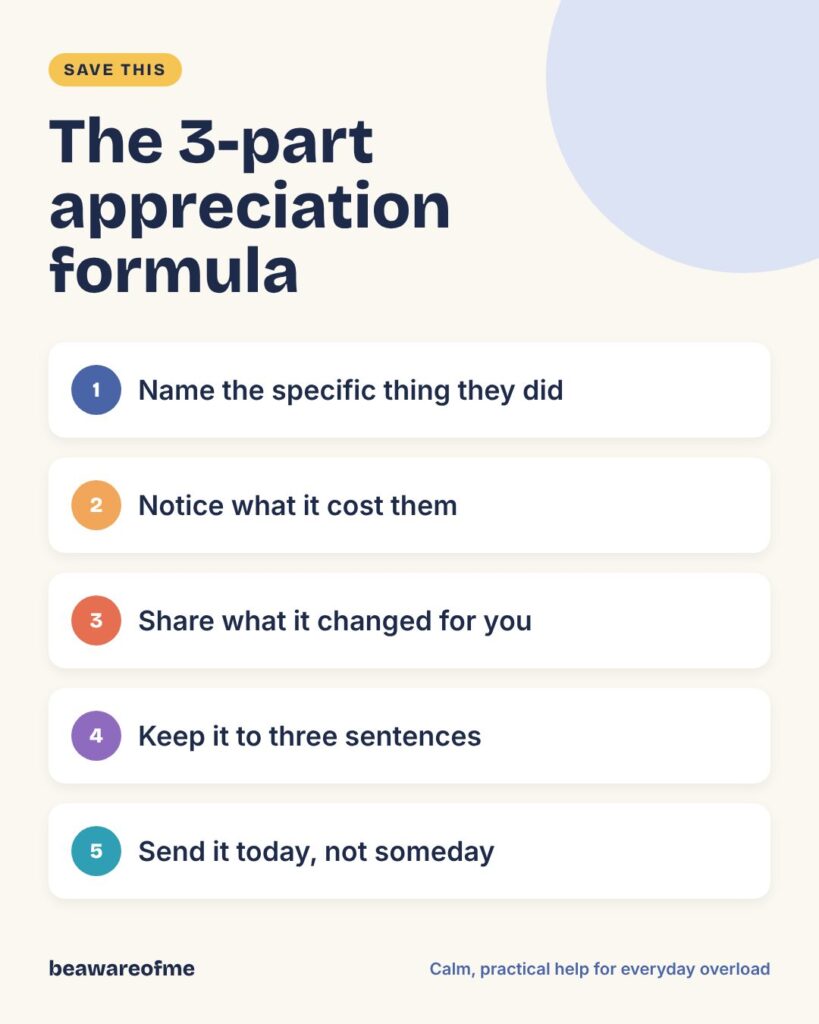
Meaningful words of appreciation name something specific the person did or is, say what it cost them, and say how it changed things for you. For example: “You stayed late to help me finish that report, even though you were exhausted. I walked into the meeting calm instead of panicked.” Specific beats grand. A short, sincere message sent today almost always lands better than a perfect one you never send.
- ✓Use the formula “I saw, it cost you, it changed” to turn vague thanks into appreciation people remember.
- ✓Name the effort or the quality behind an action, not just the result, so the person feels seen as well as thanked.
- ✓Send it today, even if it feels clumsy, because research shows people underestimate how good a thank-you note makes others feel.
- ✓Match the medium to the moment: a quick text for small favours, a written card for deep gratitude.
- ✓Appreciate people for who they are, not only for what they do for you, especially partners and close friends.
- ✓Try one appreciation message a day for seven days and notice how your own mood shifts.
Why Words of Appreciation Land Harder Than You Expect
Words of appreciation tend to mean far more to the person receiving them than you think, and that gap stops most of us from saying them. Researchers at the University of Chicago asked people to write a letter of thanks to someone who had affected their life, then compared the writers’ predictions with how the recipients actually felt.

The results, described in the University of Chicago write-up of the study, were consistent. Writers underestimated how surprised and how positive recipients would feel. They also overestimated how awkward the moment would be.
You’re worried about the wrong thing
Here’s the part that matters most. The letter writers worried about finding the right words. The recipients didn’t care much about polish. They felt happy because of the warmth of the gesture itself.
So if perfectionism has kept your words of appreciation stuck in your head, that’s the signal to relax. Clumsy and sincere beats eloquent and unsent every single time.
Appreciation changes what people do next
Words of appreciation also shape behaviour. Harvard Health describes a Wharton School experiment with university fundraisers. The group that heard their director express gratitude made 50% more fundraising calls the following week than the group that didn’t.
The same article reports that partners who expressed gratitude felt more positive toward each other. They also felt more comfortable raising concerns. Appreciation, in other words, makes hard conversations easier, not softer.
The 3-Part Formula Behind Meaningful Words of Appreciation
The most meaningful words of appreciation follow a simple pattern: what you saw, what it cost them, and what it changed. You don’t need a writer’s talent. You need about three sentences and one concrete detail.
Put together, the words of appreciation sound like this: “You drove across town to drop off soup when I had the flu. You’d worked a ten-hour shift. It made me feel a lot less alone that night.” Three sentences. Nothing fancy. Yet it lands.
Before and after: vague thanks vs real appreciation
| Vague version | Meaningful version |
|---|---|
| Thanks for your help. | Thanks for walking me through the new system twice. I felt confident in Monday’s training instead of lost. |
| You’re a great friend. | You remembered my exam date and texted me good luck at 7 a.m. That small thing carried me through the whole morning. |
| Love you, Mum. | You never once made me feel like a burden when I moved back home. I’m only now realising how much that protected me. |
| Great job, team. | You caught that error before the client saw it. Your careful checking saved us a very hard week. |
Effort, quality or presence: three angles to choose from
Not every message has to focus on a favour. Some of the strongest words of appreciation praise a quality, like patience or honesty. Others simply value someone’s presence: “I like who I am around you.”
If someone did something for you, appreciate the effort. If they’re consistently a certain way, appreciate the quality. If they matter regardless of what they do, appreciate their presence. Rotating between all three keeps your appreciation fresh instead of formulaic.
Thanks vs Appreciation: Why “Thank You” Alone Can Fall Flat
Thanks responds to an action, while appreciation recognises the person behind it, and that difference explains why some thank-yous feel empty. Both matter. They just do different jobs, and words of appreciation do the deeper one.
A thank-you closes a transaction: you held the door, I said thanks. Appreciation opens a relationship: I noticed you, I value you, and I want you to know it. Our piece on thankful vs grateful explores a similar split between a passing response and a lasting attitude.
| A simple thank-you | Words of appreciation | |
|---|---|---|
| Focus | The favour or action | The person, effort or quality |
| Timing | Right after the moment | Any time, even years later |
| Length | One or two words | Two to four sentences |
| What the person hears | “You did a thing.” | “I see you.” |
| Best for | Everyday courtesy | People who shape your life |
When a simple thanks is enough
You don’t need a three-part message for the barista or the colleague who passed the stapler. A warm, prompt thank-you fits those moments perfectly. If you’d like better everyday phrases, our guide to the right words to say thank you covers quick, polite options.
Save the deeper form for people who carry real weight in your life. If you can’t remember the last time you told them why they matter, that’s your cue.
40 Ready-to-Use Words of Appreciation for the People in Your Life
These 40 lines give you a starting point for partners, friends, family, coworkers, your team and people who helped in hard times. Treat these words of appreciation as templates. Swap in one real detail and they’ll sound like you, not like a greeting card.
For your partner (7 lines)
- “I noticed you took the bins out before I asked. Small things like that make me feel looked after.”
- “You listened to my whole rant about work without fixing it. That was exactly what I needed.”
- “I love how you make our home feel calm, even on chaotic weeks.”
- “Thank you for being patient with me while I figured things out. I didn’t make it easy.”
- “You make ordinary evenings feel like the best part of my day.”
- “I appreciate how honest you are with me, even when it’s hard to hear.”
- “I don’t say it enough: I’d choose you again.”
For a friend (7 lines)
- “You always remember the little things I mention. It makes me feel like I matter to you.”
- “Thanks for showing up when I cancelled on everyone else. You didn’t push, you just stayed.”
- “I love that I can be completely myself around you.”
- “Your texts during that awful month kept me going more than you know.”
- “You make me laugh at things I was ready to cry about.”
- “I admire how you handle hard stuff. You’ve taught me a lot without trying.”
- “Our friendship is one of the best things in my life. I wanted you to hear that.”
For family (7 lines)
- “Mum, the way you always made dinner a calm moment is something I copy in my own home now.”
- “Dad, thank you for teaching me to fix things myself. I think of you every time I do.”
- “I know you gave up a lot so I could have options. I see that more clearly now.”
- “Thanks for always picking up the phone, no matter what time I call.”
- “You never made me feel like I had to earn your love. That shaped everything.”
- “I’m proud to be your sister. You’ve grown into someone I really admire.”
- “Grandma, your stories make me feel connected to where I come from.”
For a coworker or manager (7 lines)
- “Thanks for covering my calls on Friday. I came back to a clear desk instead of a pile.”
- “Your feedback on my draft was clear and kind. It made the final version much stronger.”
- “I appreciate how you stay calm when deadlines hit. It keeps the whole room steadier.”
- “You explained that process so simply that I can now teach it to others.”
- “Thank you for backing my idea in the meeting. It gave me the confidence to keep pushing it.”
- “I’ve learned more from watching how you handle clients than from any training.”
- “You make this job easier and a lot more fun. I’m glad we’re on the same team.”
For your team, if you lead people (6 lines)
- “You spotted the problem early and flagged it. That’s exactly the kind of judgement I trust.”
- “I saw how much extra time you put into the launch. It showed in every detail.”
- “Your questions in today’s meeting made everyone think harder. Keep asking them.”
- “You handled that difficult customer with real patience. Thank you for representing us so well.”
- “I know this quarter has been heavy. Your steadiness has held the team together.”
- “You’ve grown a lot this year, and I want you to know I’ve noticed.”
At work, words of appreciation work best when they’re specific and timely. Our guide to building resilience in the workplace explains why small, regular recognition helps people cope with pressure over time.
For someone who helped you through a hard time (6 lines)
- “I don’t think I ever properly thanked you for being there when everything fell apart.”
- “You sat with me when I couldn’t explain how I felt. That quiet company meant everything.”
- “You never made me feel like a burden, even when I needed a lot.”
- “Your one message, ‘I’m here, no pressure to reply’, got me through more than one night.”
- “Looking back, you were a big reason I made it through that year.”
- “I’m in a much better place now, and part of that is because of you.”
Text, Card or Face to Face? Matching the Moment to the Medium
The right channel for your words of appreciation depends on how big the moment is and how the person likes to receive attention. A text can feel perfect for a small kindness and too light for something life-changing.
| Moment | Best medium | Why it works |
|---|---|---|
| Small, everyday favour | Quick text or in person | Prompt and light, matches the size of the gesture |
| Steady support over weeks | Voice note or handwritten card | Shows you took time, not just a second |
| Life-shaping influence | Letter, read aloud if possible | Gives space for detail and lasting emotion |
| Work achievement | Specific message, plus public mention if they’d like it | Recognition with credit, without forcing attention |
| Someone shy or private | Private written note | Avoids the spotlight they dislike |
The case for writing it down
Spoken appreciation disappears once the moment passes. Written words of appreciation can be reread on a hard day, months later. Many people keep cards like these for years.
Harvard Health suggests writing a thank-you letter and, if possible, reading it to the person in person. It also suggests aiming for one such letter a month. That rhythm feels manageable for most people.
Public or private appreciation?
Some people love being thanked in front of a group. Others would rather sink through the floor. If you’re not sure, go private first, then ask: “Would you mind if I mentioned this in the team meeting?” That one question shows respect as well as gratitude.
When Appreciation Feels Awkward, Hard or One-Sided
Expressing appreciation can feel uncomfortable when you’re anxious, low or unsure how it will land, and those feelings are normal rather than a sign you’re doing it wrong. Here’s how to handle the most common sticking points.
If you feel awkward or anxious
Start in writing, where you control the pace. A short text removes the pressure of watching someone’s face. Remember the research too: recipients feel far less awkward than senders expect.
If social situations often make you tense, start with low-stakes people, like a helpful neighbour or a colleague. Confidence grows with repetition, not with waiting until you feel ready.
If you’re struggling yourself
On heavy days, words of appreciation can feel impossible or even fake. You don’t have to force a warm mood. A single honest line, like “Thanks for checking on me,” counts.
Be gentle with yourself on those days. Our ideas for self-compassion on tough days can help you treat yourself with the same kindness you’d show a friend.
If the other person brushes it off
Some people deflect appreciation with “Oh, it was nothing.” That usually says more about their comfort with praise than about your words. Smile and repeat it once: “It wasn’t nothing to me.” Then let it go.
How to receive appreciation gracefully
Receiving matters as much as giving. When someone appreciates you, resist the urge to argue or shrink it. Try: “Thank you, that means a lot to hear.” Accepting kindly makes it easier for others to keep offering it.
A 7-Day Appreciation Practice That Takes Five Minutes a Day
A short daily practice turns words of appreciation from a rare event into a natural habit within a week. Each day has one small focus, and none takes more than five minutes.
Many people find that noticing things to appreciate gets easier when they write them down. If you’d like a place to collect those moments, our guide on how to start a gratitude diary walks you through a simple setup.
- Pick one person who made your week easier
- Write down the exact thing they did
- Add what it cost them in time, energy or courage
- Finish with “Because of you, I…”
- Read it once, then send it without over-editing
5 Common Mistakes That Make Appreciation Sound Hollow
Most failed words of appreciation aren’t insincere, they’re just shaped badly. These five mistakes are easy to miss and easy to fix.
1. Praising the outcome, ignoring the effort
“Great result!” rewards luck as much as work. People feel more seen when you notice the late nights, the careful checking or the courage behind it. Instead, name one specific thing they did along the way.
2. Adding a “but” or a request
“Thanks for the report, but can you also…” turns appreciation into a set-up. The person remembers the request, not the thanks. Instead, send the appreciation on its own and raise the request later, in a separate message.
3. Waiting for the perfect moment
Birthdays and holidays feel like natural times for appreciation, so people save it up. Meanwhile, months pass in silence. Instead, appreciate people on ordinary days, when it clearly isn’t expected.
4. Using the same phrase for everyone
If you tell every colleague “You’re a rock star,” the phrase stops carrying meaning. Generic praise feels automated. Instead, attach one detail that could only apply to that person.
5. Making it about you
“I’m so grateful, I’ve been so stressed, my week was awful…” can bury the other person under your story. Keep the focus on them. Mention your situation only to show the impact of what they did.
Your Questions About Words of Appreciation, Answered
What are some meaningful words of appreciation?
How do you show appreciation without sounding fake?
What is the difference between thanks and appreciation?
How do I appreciate a coworker in writing?
How often should I express appreciation?
Is it too late to thank someone from years ago?
The best words of appreciation are rarely the most polished ones. They’re the specific, slightly imperfect sentences you actually send. Pick one person today, name what they did and what it changed, and let that small message start a habit that strengthens every relationship you care about.